


Last updated:
TL;DR:
- Small business owners often post on social media with good intentions but see little engagement or return on investment. A comprehensive social media strategy involves auditing existing accounts, setting measurable goals, selecting the right platforms, creating targeted content, and tracking meaningful metrics to achieve real results. Focusing on quality content, strategic engagement, and continuous measurement transforms social media into a system that effectively grows your business.
Most small business owners post on social media with good intentions and get very little back. No enquiries, no engagement, no clear sense of whether it’s working. A solid social media strategy guide won’t just tell you to “post consistently” and call it done. This one walks you through the real process: auditing what you already have, setting goals that connect to actual revenue, finding where your audience lives online, building content that earns attention, and measuring what actually matters. Follow this and you’ll stop guessing.
Table of Contents
- Key takeaways
- Building your social media strategy from scratch
- Finding your audience and choosing your platforms
- Content strategy: pillars, the 80/20 rule, and your calendar
- Executing your strategy and engaging your community
- Measuring results and refining your approach
- My honest take on what actually moves the needle
- Ready to grow your digital presence?
- FAQ
Key takeaways
| Point | Details |
|---|---|
| Start with an audit | Review your existing accounts and past performance before building anything new. |
| Set SMART goals | Tie every social media goal directly to a measurable business outcome. |
| Choose fewer platforms | Focus on 2 to 3 platforms where your audience is genuinely active. |
| Use the 80/20 rule | Publish 80% value-driven content and keep promotional posts to 20%. |
| Measure what matters | Track engagement rates, reach, and conversions rather than follower count alone. |
Building your social media strategy from scratch
Before you write a single caption, you need a clear picture of where you stand. A social media audit is the foundation of any effective social media marketing plan. Pull together every account your business has, even the old ones you haven’t touched in two years. Note what content performed well, what flopped, how often you posted, and what your engagement rates looked like.
Then look at your competitors. Not to copy them, but to understand what’s resonating in your space. What content formats are they using? Where are they most active? Are there obvious gaps you can fill?
Once you know your baseline, set your goals. Vague goals like “grow our social media” won’t help you make decisions. SMART goals give you a specific, measurable target to work toward, such as increasing Instagram engagement by 20% over six months. That kind of goal tells you what to measure and when to call it a win.
Here’s a simple way to think about goal categories for small businesses:
- Brand awareness: Reach more people in your local area or niche
- Lead generation: Drive traffic to your website or booking page
- Customer retention: Build loyalty through consistent, helpful content
- Sales: Convert followers into paying customers with offers and promotions
Pro Tip: Keep strategy and plan separate. Your strategy defines the “what” and “why.” Your plan defines the “how” and “when.” Confusing the two leads to activity without direction.
| Goal type | Example SMART goal |
|---|---|
| Brand awareness | Reach 5,000 accounts per month on Instagram within 90 days |
| Lead generation | Drive 200 website clicks per month from Facebook by end of Q3 |
| Engagement | Increase average post engagement rate from 1.5% to 3% in 6 months |
| Sales | Generate 15 direct enquiries per month from social media by December |
Finding your audience and choosing your platforms
Knowing who you’re talking to changes everything. You can’t build effective social media tactics around a vague idea of your customer. You need specifics.
Start with demographics: age, location, income bracket, profession. Then go deeper into psychographics: what problems do they want solved, what motivates their buying decisions, how do they spend their time online? A good audience persona for a Gold Coast physiotherapy clinic, for example, isn’t just “adults aged 30 to 60.” It’s “busy professionals aged 35 to 55 who’ve had a sports injury and are sceptical of quick fixes.”
Niche specificity dramatically speeds up how algorithms categorise and distribute your content to the right people. The more precisely you define your audience, the more precisely platforms can serve your content to them.
Once you know who they are, find out where they spend time online:
- Instagram and Facebook: Strong for local service businesses, retail, food, and lifestyle brands. Facebook still has the broadest demographic reach in Australia.
- LinkedIn: Suited to B2B businesses, professional services, and recruitment.
- TikTok: Rapidly growing for younger audiences and short-form educational content in any niche.
- Google Business Profile: Often overlooked but critical for local search visibility alongside social.
Pick 2 to 3 platforms and commit to them properly. Spreading yourself across five platforms with half-hearted effort produces worse results than owning two platforms well. Your bandwidth is limited. Spend it where your audience actually is.
Pro Tip: Survey your existing customers. Ask them directly which platforms they use most. Ten responses beat hours of guessing.

Content strategy: pillars, the 80/20 rule, and your calendar
Content pillars are the main themes your brand consistently covers. Think of them as the recurring categories your audience can expect from you. A landscaping business might build pillars around: “before and after transformations,” “seasonal garden tips,” and “client Q&A.” Every piece of content fits into one of these buckets.
This structure keeps your content cohesive without forcing you to come up with fresh ideas from scratch every week. It also signals consistency to both your audience and the algorithm.
The 80/20 content rule is the right balance for maintaining engagement without turning your feed into an ad. Eighty per cent of what you publish should genuinely help, entertain, or inform your audience. Twenty per cent can be directly promotional. If you flip that ratio, people stop following. If you never promote, you miss conversions.
Here’s how to put your content plan together:
- Define 3 to 4 content pillars aligned with your brand and audience interests
- Assign a content format to each pillar. Video, carousels, static images, stories, or text posts each serve different purposes
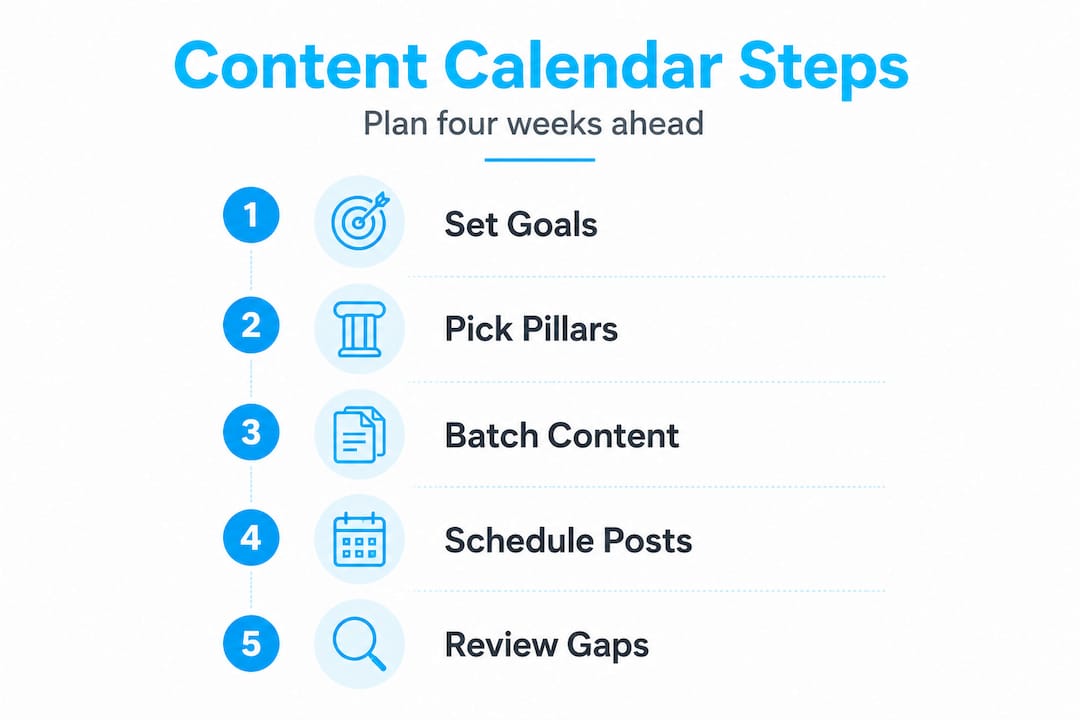
- Map content to a monthly calendar with seasonal hooks, local events, and product launches noted in advance
- Batch your content creation. Spend one focused session per week or fortnight producing multiple pieces at once
- Use scheduling tools to publish at optimal times without being tied to your phone
Video content generates 48% more views than static posts, and short-form video consistently outperforms for audience retention. If you’re not yet using Reels or short videos, that’s where your attention should go first.
| Content format | Best use | Engagement strength |
|---|---|---|
| Short-form video | Education, tips, behind the scenes | Very high |
| Carousel posts | Step-by-step guides, before/after | High |
| Static image | Quotes, announcements, promotions | Medium |
| Stories | Daily updates, polls, quick tips | Medium |
| Long-form video | Deep dives, product demos | Variable |
Building a content system through batching and AI-assisted workflows is far more sustainable than trying to produce content daily on the fly. Treat it like any other production process in your business.
Pro Tip: Map out your content calendar at least four weeks in advance. You’ll spot gaps, avoid repeating the same format back to back, and create space for reactive content when something timely happens.
Executing your strategy and engaging your community
Posting is the easy part. Building a community takes more deliberate effort. Execution is where most small businesses let their social media marketing plan fall apart, not because they stop posting, but because they treat social media as a broadcast channel rather than a two-way conversation.
Brands that actively engage with comments and messages see a 22% increase in customer loyalty. That means replying promptly to questions, thanking people for sharing your content, and joining conversations in your niche, not just waiting for people to come to you.
The 5-5-5 rule is a simple daily habit worth building. Before you post, spend five minutes engaging with content in your niche. After you post, spend five minutes replying to anyone who comments. Then spend a final five minutes proactively commenting on other accounts your ideal audience follows. It takes fifteen minutes and it compounds over time.
When it comes to what content to prioritise, depth of engagement matters far more to algorithms than surface-level likes. Saves, shares, and substantive comments signal to platforms that your content is genuinely valuable. Design posts with that in mind. Ask a real question. Share something surprising. Give people a reason to save your post for later.
A few execution habits that produce results:
- Post at times when your audience is most active. Check your platform analytics for this data.
- Use platform-native features. Instagram Reels, Facebook Stories, and LinkedIn articles each get preferential distribution.
- Keep your profile bios updated with your current offer and a clear call to action.
- Respond to direct messages within 24 hours. Speed of response affects how warmly leads convert.
Check out social media content tips for practical ideas on formats and hooks that actually drive engagement.
Pro Tip: Pin your best-performing post or a key offer to the top of your profile. New visitors often make a decision about following you based on the first three posts they see.
Measuring results and refining your approach
Posting without measuring is guesswork. You need a reporting rhythm that keeps you honest about what’s working and what to change.
Set up a simple weekly or monthly reporting process. You don’t need a complicated spreadsheet. What you need is a clear record of the metrics that connect to your goals.
| Metric | What it tells you |
|---|---|
| Engagement rate | How well your content resonates with your current audience |
| Reach | How many unique accounts saw your content |
| Website clicks | Whether social media is driving traffic to your site |
| Conversions | Whether that traffic is turning into enquiries or sales |
| Follower growth rate | Whether your audience is growing at a meaningful pace |
Avoid obsessing over follower count alone. A business with 800 engaged, local followers will outperform one with 8,000 passive ones nearly every time. What matters is whether your audience is taking action.
Review your analytics at the end of each month. Identify your top three performing posts and ask what they had in common. Do more of that. Identify your three weakest posts and ask why they underperformed. Adjust your approach.
Algorithms change. What worked in 2025 may not perform the same way now. Stay current by following credible marketing publications and scheduling a quarterly audit of your full social media presence. Your social media management approach should evolve as platforms do.
Pro Tip: Set a calendar reminder for a quarterly strategy review. Compare your metrics against your SMART goals, not just against last month. Trend data over three months is far more useful than a single week’s results.
My honest take on what actually moves the needle
I’ve worked with small businesses across the Gold Coast and broader Australia, and the pattern I see most often is this: business owners put enormous effort into posting and almost no effort into thinking. They post daily, try every trend, chase follower counts, and wonder why nothing converts.
What I’ve found actually drives results is almost the opposite of what most people do. Go narrow. Pick a tighter niche than you think you need. Post less often, but with more intention behind each piece. Spend more time engaging with other people’s content than you do creating your own, at least in the early stages. Build an audience that genuinely cares, and they’ll do far more for your business than a large passive one ever will.
I’ve also learned that the businesses that succeed long-term are the ones that treat social media as a system, not a creative outlet. Systems are repeatable. Creative inspiration is not. When you have a content system with clear pillars, a batching process, and a measurement habit, social media stops feeling chaotic and starts producing predictable results.
One more thing. Authenticity is not a strategy. Showing up authentically while also being strategic is. Know your goals, know your numbers, and know your audience. Then show up in a way that feels genuine within that framework. That combination is what I’ve seen work, time and again.
— Richie
Ready to grow your digital presence?
Your social media strategy doesn’t exist in isolation. The traffic you drive from Instagram, Facebook, or LinkedIn needs somewhere to land, and that destination needs to convert. If your website isn’t working as hard as your social content, you’re losing warm leads every day.
At Titan Blue, we help Gold Coast and Australian businesses build a digital presence that performs end to end. From user-friendly website design that converts social visitors into customers, to SEO-driven web design that ranks and generates organic traffic, to digital advertising that amplifies your reach, we build the full picture. Get in touch with Titan Blue today and let’s build something that works.
FAQ
What is a social media strategy guide?
A social media strategy guide is a structured framework that helps businesses define their goals, audience, content approach, and measurement process for social media. It differs from a simple posting schedule by connecting every decision back to a business objective.
How many platforms should a small business focus on?
Focus on 2 to 3 platforms where your audience is most active. Spreading effort across too many platforms reduces quality and consistency, which are the two factors that drive real results.
What is the 80/20 rule for social media content?
The 80/20 rule means 80% of your content should provide genuine value to your audience through education, entertainment, or information, while only 20% should be directly promotional. This balance keeps your audience engaged without tuning out.
How do I know if my social media strategy is working?
Track engagement rate, reach, website clicks, and conversions rather than follower count alone. Review these monthly against your SMART goals to see whether your strategy is producing measurable business outcomes.
How often should small businesses post on social media?
Consistency matters more than frequency. Posting three to five times per week with genuine value and engagement beats posting daily with low-effort content. Use a content calendar and batch creation to maintain a sustainable rhythm.
Recommended
- What is social media management? Essential guide for SMBs
- A Guide to Social Media Marketing Services
- Social Media Marketing Services A Complete Guide
- Digital Marketing Tips for Small Businesses
Make Titan Blue a preferred source in Google
One click tells Google to surface our articles more often in Top Stories, AI Overviews and AI Mode.

Best Dental Website Design Agencies in Australia: 7 Compared
Best dental website design agencies in Australia 2026: seven compared on dental proof, booking, AHPRA…

Childcare Centre Website Design Australia: The 2026 Guide
Childcare centre website design Australia: show hours, ages and enrolment as text so parents and…

Electrician Website Design Australia: The 2026 Guide
Electrician website design Australia: what to build, what we found on eight Gold Coast electrician…