Stay ahead with the latest tips, trends, and insights from the Titan Blue team , straight from the studio in Broadbeach.


Australian internet advertising reached $18.4 billion in 2025, yet many small and medium-sized business owners still aren’t sure what digital advertising actually covers. Is it just Google Ads? Does it include your social media posts? The confusion is real, and it’s costing businesses money. This guide cuts through the noise. You’ll walk away with a clear definition, a breakdown of every major channel, and a practical roadmap to start spending smarter on digital advertising in 2026.
Table of Contents
- Defining digital advertising for Australian businesses
- Types of digital advertising channels explained
- How digital advertising drives growth for SMBs
- Key trends shaping digital advertising in 2026
- Building an effective digital advertising strategy
- How expert support can accelerate your digital advertising
- Frequently asked questions
Key Takeaways
| Point | Details |
|---|---|
| Major revenue driver | Digital advertising generates billions for Australian small businesses and helps drive sustainable growth. |
| Multiple effective channels | Search, social, and video ads each offer unique ways to reach your audience and achieve business goals. |
| AI and tracking matter | Integrating AI tools and tracking real outcomes—not just impressions—leads to much stronger returns. |
| Adoption gap is costly | SMBs lagging in digital ad adoption risk missing out on significant extra revenue opportunities. |
| Success starts with strategy | A clear strategy, well-chosen channels, and expert help are key to digital advertising success. |
Defining digital advertising for Australian businesses
Digital advertising is paid online promotion designed to reach your target customers wherever they spend time online. That’s the simple version. The fuller picture includes a wide range of formats and platforms, all working toward one goal: getting your business in front of the right people at the right moment.
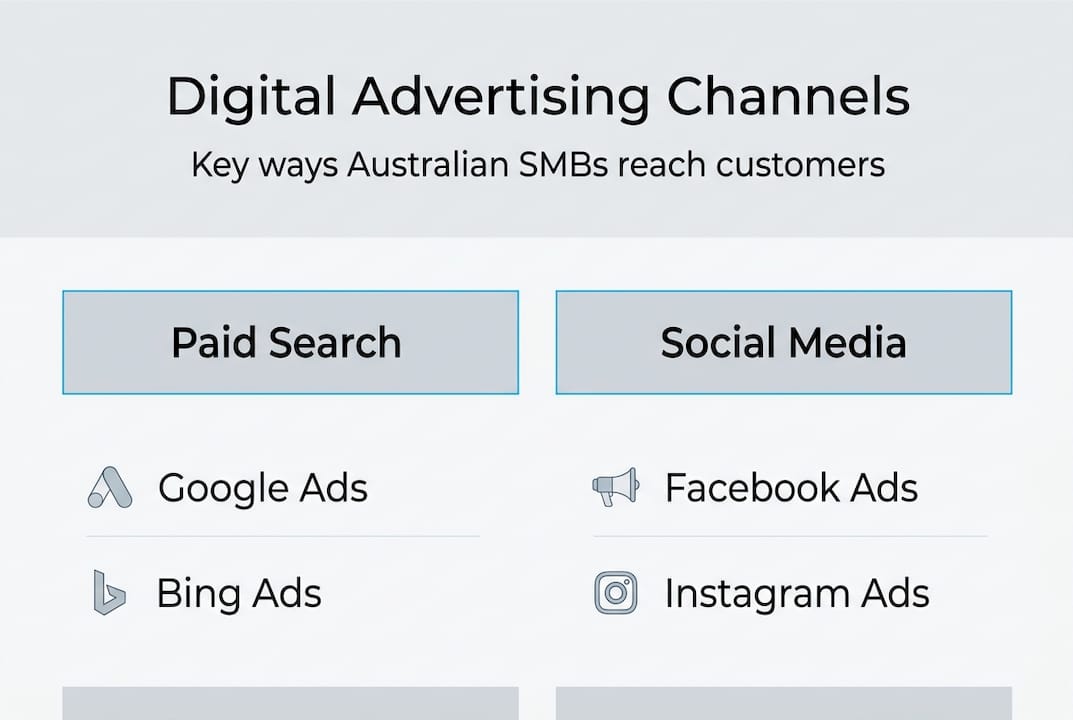
Many SMB owners assume digital advertising means running a Google or Facebook campaign. That’s understandable, but it’s only part of the story. Why digital advertising matters goes well beyond two platforms. The main forms include:
- Search ads: Text-based ads shown when someone searches for a product or service on Google or Bing
- Social media ads: Paid placements on Facebook, Instagram, LinkedIn, and TikTok
- Video ads: Pre-roll or in-feed video on YouTube, TikTok, and streaming platforms
- Display ads: Visual banner ads shown across websites in ad networks
- Remarketing: Ads shown to people who have already visited your website or engaged with your brand
- Native ads: Sponsored content that blends into editorial environments
Digital advertising sits within the broader world of digital marketing, which also includes organic efforts like SEO, email, and content. The key difference is simple: advertising involves paid spend.
The scale of opportunity is significant. Online advertising generates $152 billion in annual revenue for Australian SMEs. That’s not a number to ignore.
Pro Tip: Before you choose a single channel, write down your primary business objective. More leads? More foot traffic? Online sales? Your goal should drive every channel decision you make.
Types of digital advertising channels explained
Now that you know what digital advertising is, let’s unpack the different channels you can use and how they stack up. Not every channel suits every business, and budget matters too.
Search advertising dominated the market in 2025, with search making up $8 billion and video reaching $5.4 billion in total spend. These two formats are growing fastest, and for good reason.

Here’s how the major channels compare:
| Channel | Reach | Targeting | Budget flexibility | Creative needs | Key platforms |
|---|---|---|---|---|---|
| Search ads | High intent | Keyword, location | Low minimum | Minimal (text) | Google, Bing |
| Social media ads | Broad | Demographic, interest | Flexible | Images, video | Meta, LinkedIn, TikTok |
| Video ads | Mass reach | Behavioural, interest | Medium | Video production | YouTube, TikTok |
| Display ads | Wide | Contextual, retargeting | Low minimum | Visual banners | Google Display Network |
| Remarketing | Warm audiences | Past visitors | Very flexible | Varies | Google, Meta |
| Native ads | Editorial audiences | Contextual | Medium | Written content | Outbrain, Taboola |
Key benefits and limitations to keep in mind:
- Search ads deliver high-intent traffic but can be expensive in competitive industries
- Social media ads build awareness quickly but require consistent creative refresh
- Video ads drive strong engagement but need quality production to perform
- Display ads are cost-effective for brand visibility but have lower click-through rates
- Remarketing converts warm leads efficiently but needs sufficient website traffic first
You can explore social media advertising services to see how platforms like Meta and LinkedIn can work for your specific business goals.
“The businesses winning in digital advertising aren’t necessarily spending the most. They’re spending on the right channels for their audience and tracking what actually works.”
How digital advertising drives growth for SMBs
Understanding the available channels is only part of the story. It’s crucial to see how digital advertising actually propels business growth for small businesses like yours.
Australian SMEs currently generate $152 billion through digital advertising, but the potential sits at $231 billion. That gap represents businesses not yet using digital advertising effectively. If you’re a late adopter, you’re leaving real revenue on the table.
Here’s how digital advertising drives practical outcomes for SMBs:
- Increases visibility: Your business appears in front of people actively searching for what you offer
- Generates qualified leads: Targeting tools mean you reach people most likely to buy, not just anyone online
- Builds brand awareness: Consistent ad exposure keeps your business top of mind in your local market
- Drives website traffic: Paid campaigns send immediate, measurable traffic to your site
- Supports increasing online sales: E-commerce businesses can directly attribute revenue to specific campaigns
- Provides measurable ROI: Unlike traditional advertising, every dollar can be tracked to an outcome
Here’s how different channels align with common SMB goals:
| Business goal | Best channel | Why it works |
|---|---|---|
| Generate leads fast | Search ads | Captures high-intent buyers |
| Build local awareness | Social media ads | Precise geographic targeting |
| Re-engage past visitors | Remarketing | Targets warm, familiar audiences |
| Launch a new product | Video ads | High engagement and shareability |
| Grow e-commerce sales | Search + social combo | Covers intent and discovery |
The digital marketing growth in Australia shows that over 76% of SMBs are either actively using digital advertising or planning to adopt it. If you’re not in that group yet, your competitors likely are.
Key trends shaping digital advertising in 2026
The playing field doesn’t stay the same. Here’s what to expect and act on as digital advertising evolves in 2026.
Artificial intelligence is reshaping how ads are created, targeted, and optimised. SMBs using AI in their advertising report 40 to 52% stronger revenue growth compared to those who don’t. That’s a significant performance gap. Learning how AI in digital marketing works is no longer optional for growth-focused businesses.
Privacy changes are also reshaping tracking. Third-party cookies are being phased out, which means businesses relying on old tracking methods will lose visibility into campaign performance. Server-side tracking is becoming the new standard.
Emerging strategies worth acting on in 2026:
- Server-side tracking: Maintain accurate data as browser-based tracking becomes less reliable
- AI-generated ad copy: Use AI tools to test more variations faster and improve click-through rates
- Hyper-local targeting: Reach customers within specific suburbs or postcodes for maximum relevance
- Authentic short-form video: Raw, genuine content outperforms polished production on TikTok and Instagram Reels
- Community-focused content: Ads that reflect local values and community identity perform better with Australian audiences
- First-party data strategies: Build your own email and customer lists to reduce reliance on platform data
Check your digital marketing checklist for 2026 to see how many of these strategies you’ve already implemented.
Pro Tip: Stop measuring success by impressions alone. An impression just means your ad was displayed. Track clicks, leads, and sales instead. Those are the numbers that reflect real business growth.
“Vanity metrics like impressions and reach feel good but don’t pay the bills. Focus on tracked outcomes: form submissions, phone calls, and purchases.”
Building an effective digital advertising strategy
Armed with an understanding of trends, you’re ready to put theory into practice. Here’s a roadmap to getting started.
Australian SMBs typically allocate 7 to 10% of annual revenue to digital marketing, with 30 to 40% of that going toward search and SEO. Use these benchmarks as a starting point, not a rigid rule.
Follow these steps to build your strategy:
- Audit your current presence: Review your website, existing ads, and analytics. Identify what’s working and what isn’t
- Clarify your goals: Define specific, measurable outcomes. “More leads” isn’t a goal. “50 new enquiries per month” is
- Choose your channels: Match channels to your goals using the table in the previous section
- Allocate your budget: Start conservatively. You can scale what works
- Build your offer: A strong ad needs a compelling reason for someone to click. Discounts, free consultations, and guarantees all work well
- Set up tracking: Install conversion tracking before you spend a single dollar. Without it, you’re flying blind
- Test and iterate: Run A/B tests on headlines, images, and audiences. Let data guide your decisions
Common pitfalls to avoid:
- Ignoring creative quality and running generic, uninspiring ads
- Skipping tracking setup and having no way to measure results
- Spreading budget too thin across too many channels at once
- Failing to align your landing page with your ad message
Strong content marketing best practices support your paid campaigns by giving people something valuable to engage with once they click. And if you’re unsure where organic search fits in, SEO for small business works alongside paid advertising to build long-term visibility.
Pro Tip: Start with a test budget of $500 to $1,000 per month on one channel. Run it for 60 days, review the data, then decide whether to scale or shift to a different channel.
How expert support can accelerate your digital advertising
DIY digital advertising is possible, but the learning curve is steep and mistakes are expensive. Working with specialists helps you avoid common errors and reach results faster.
At Titan Blue, we work with Australian SMBs to plan, launch, and manage digital advertising campaigns that deliver real outcomes. Whether you’re starting from scratch or looking to improve existing campaigns, our team brings the strategy, tools, and local knowledge to make your budget work harder. Explore our digital advertising tutorial to see practical examples of what’s possible, learn more about why digital advertising matters for businesses like yours, or discover how our social media management solutions can take the pressure off your team. Get in touch now and let’s build a strategy that fits your goals and your budget.
Frequently asked questions
What is the difference between digital advertising and digital marketing?
Digital advertising refers specifically to paid online promotion, while digital marketing covers all online efforts including SEO, content creation, and email campaigns. Advertising is one component within the broader digital marketing mix.
How much should Australian SMBs spend on digital advertising?
Most Australian SMBs allocate 7 to 10% of annual revenue to digital marketing, with 30 to 40% of that budget typically directed toward search advertising or SEO.
Why should I track sales, not impressions, from my campaigns?
Impressions only confirm your ad was displayed, not that it drove any business outcome. Tracking sales and leads gives you a true picture of campaign performance and return on investment.
Which digital advertising channel is best for start-ups?
Search advertising works well for start-ups because it captures people already looking for your product or service. Social ads on Meta or TikTok can build brand awareness quickly alongside search. Search and social are the two dominant channels for Australian SMBs.
Does using AI really improve advertising results?
Yes. SMBs using AI in their advertising report 40 to 52% stronger revenue growth compared to those not using AI tools. It’s one of the most impactful changes you can make to your campaigns right now.
Recommended

Web Design Gold Coast: Costs, What to Look For, and Why AI Readiness Matters
Gold Coast web design costs, timelines, how to choose a designer, and why AI readiness…

AI SEO Agency Australia: How Do You Choose the Right One?
Learn how to compare AI SEO agencies in Australia using nine practical questions about strategy,…

AI Search Optimisation Services Australia: What’s Included and How They Work
Discover what AI search optimisation services include, how they improve visibility across ChatGPT, Google AI…