


Last updated:
TL;DR:
- Targeted digital advertising directs ads to specific audiences, reducing wasted spend and increasing conversion efficiency.
- Proper measurement, location settings, and compliance are essential for local businesses to maximize campaign success and build trust.
Most local business owners have tried some form of digital advertising and walked away frustrated. The budget disappeared fast, the results were hard to measure, and the clicks came from people who were never going to buy. That frustration is real, and it usually comes down to one problem: broad, untargeted ads. Understanding why choose targeted digital advertising changes the conversation entirely. Instead of paying to reach everyone, you pay to reach the right people. This guide covers exactly how it works, what the benefits are for local businesses, and how to get it right from the start.
Table of Contents
- Key takeaways
- What targeted digital advertising actually is
- Why targeted ads deliver better results for local SMBs
- Measuring performance so you can improve
- Location targeting and staying compliant
- How to start targeted digital advertising locally
- My take on targeted ads for local businesses
- Ready to run ads that actually work?
- FAQ
Key takeaways
| Point | Details |
|---|---|
| Precision beats reach | Targeted ads focus your budget on likely buyers, not random browsers, reducing wasted spend significantly. |
| Measurement drives results | Real-time tracking of clicks, conversions and calls lets you refine campaigns based on actual data. |
| Location settings matter | Switching to presence-only targeting can cut wasted ad spend by 20 to 35 per cent for local campaigns. |
| Compliance is non-negotiable | Using platforms that follow data privacy regulations protects your business from penalties and builds customer trust. |
| Start small, scale on data | Define your audience, set tight location targeting, build dedicated landing pages, then scale what works. |
What targeted digital advertising actually is
There is a big difference between placing an ad online and placing the right ad in front of the right person. Targeted digital advertising uses data and platform technology to deliver your ads specifically to people who match your ideal customer profile. Traditional print or radio ads reach whoever happens to be listening or reading. Targeted digital ads can reach a 35-year-old woman in Broadbeach who searched for a plumber in the last 24 hours.
The targeting methods available to you today include:
- Demographics: Age, gender, income level, and household type
- Interests and behaviours: What people search for, watch, click on, and buy
- Location: Country, city, suburb, or even a radius around your shopfront
- Remarketing: People who already visited your website or engaged with your social media
- Custom audiences: Lists of your existing customers matched to platform profiles
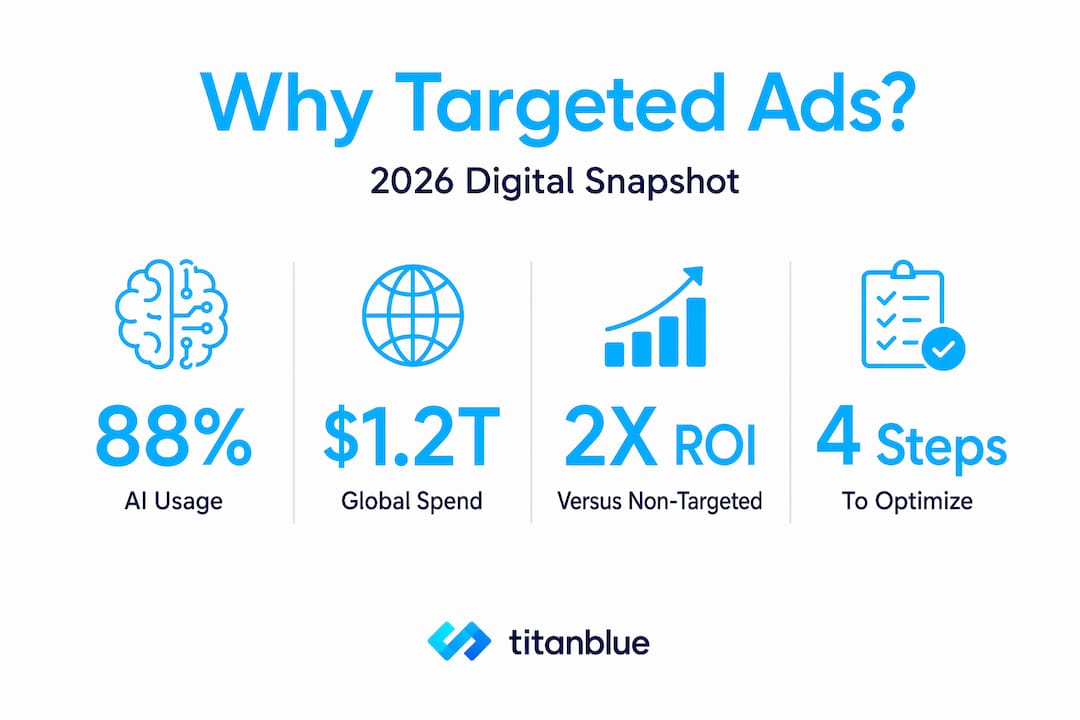
The digital advertising market is projected to surpass $1.2 trillion by 2034, reflecting just how central precise targeting has become to modern marketing. For a local business on a limited budget, this technology levels the playing field considerably. You do not need a million-dollar ad budget to reach the right customers. You need the right settings.
88% of digital marketers now use AI daily to personalise campaigns, which means platforms like Google Ads and Meta Ads are getting better at finding your audience automatically, as long as you give them the right signals to work from.
Why targeted ads deliver better results for local SMBs
The advantages of digital ads over traditional advertising are not subtle. For a small business with a tight budget, every dollar has to count. Targeted advertising is the mechanism that makes that possible.
When acquisition costs rise 31%, the difference between targeted and untargeted advertising stops being a marketing preference and becomes a financial reality for small businesses.
That figure is not hypothetical. Small business acquisition costs jump from $38.16 to $49.93 without tailored ad data. That is a direct hit to your bottom line from running broad, generic campaigns.
The benefits of targeted advertising for local businesses come down to four practical outcomes:
- Less wasted spend: Your budget goes to people most likely to become customers, not an indiscriminate audience.
- Better relevance: 84% of consumers want to be treated like a person, not a number. Relevant ads create a better experience and higher engagement.
- Stronger competitive position: You can target the same audience as a large competitor without needing their budget.
- Improved conversion rates: Ads matched to intent convert at higher rates than generic placements.
Customised digital marketing also means you can tailor your message to where someone is in the buying process. A person who searched for a specific service today gets a different ad than someone who visited your site three weeks ago. That kind of relevance is simply not possible with traditional advertising.
Pro Tip: If you are running Meta Ads, segment your audiences by warm and cold traffic. Show social proof and reviews to cold audiences, and show a direct offer or booking link to warm audiences who already know your brand.
For local businesses in particular, digital advertising strategies for 2026 now include AI-assisted audience expansion, which means platforms can find lookalike customers beyond your defined targeting parameters, often at a lower cost per acquisition.
Measuring performance so you can improve
One of the biggest advantages of digital ads is that everything is measurable. You know exactly how many people saw your ad, how many clicked, and how many completed an action on your site. That is something a billboard or a newspaper ad can never tell you.
The practical steps for setting up proper measurement are:
- Install Google Analytics 4 on your website before launching any campaign. This tracks user behaviour after the click, not just the click itself.
- Set up conversion tracking in Google Ads or Meta Ads Manager. Define what counts as a conversion: a phone call, a form submission, a booking, or a purchase.
- Enable call tracking if phone calls are your primary lead source. Both Google and Meta support call conversion tracking natively.
- Connect your ad platform to Analytics so you can see the full customer path from ad impression to completed action.
- Review performance weekly in the first month. Look at cost per conversion, not just click-through rate.
Tracking every digital marketing touchpoint in real time through platforms like Google Analytics 4 and Meta Business Suite is what separates businesses that improve their campaigns from those that keep spending without progress.
The most common mistake local businesses make is optimising for vanity metrics over conversions. A high click-through rate with no conversions means your ad is interesting but your offer or landing page is not. That is a different problem, and you can only find it through proper tracking.

Pro Tip: Use Google Tag Manager to manage all your tracking codes in one place. It makes adding and updating conversion events much faster, without needing a developer every time.
Harness your analytics data properly and you will know within a few weeks which ads are working, which audiences are converting, and where your budget should go next.
Location targeting and staying compliant
For a local business, location targeting is the single most important setting in your campaign. Getting it wrong means paying for clicks from people who will never walk through your door or use your service.
| Setting | What it does | Best for |
|---|---|---|
| Broad location (interest) | Includes anyone interested in your area, even if they live elsewhere | Tourism businesses, online retailers |
| Presence targeting | Only shows ads to people physically located in your target area | Local service businesses, retail, hospitality |
| Radius targeting | Targets a set distance around a specific address | Businesses with a physical catchment area |
| Bid adjustments by location | Increases or decreases bids based on location performance data | Advanced campaigns with historical data |
Google Ads defaults to the broad setting, which includes people who are merely interested in your location, not physically there. Switching to presence-only targeting reduces wasted ad spend by 20 to 35 per cent for most local campaigns. That is a significant saving that takes about 30 seconds to adjust.
Beyond location settings, data privacy compliance is becoming a real concern for businesses using digital advertising. The importance of precision targeting is matched by the responsibility to use data ethically. Regulatory enforcement around PADFAA restricts the sale of sensitive data, including geolocation data, to certain parties, with civil penalties exceeding $53,000 per violation. While most small businesses are not data brokers, this signals the direction regulation is heading globally.
Using reputable platforms like Google and Meta, which invest heavily in compliance infrastructure, reduces your exposure. Avoid lesser-known ad networks that promise cheap clicks but cannot demonstrate how they source their audience data.
Pro Tip: Check the Australian Privacy Act requirements for any first-party data you collect through lead forms in your ads. You need to disclose how you use that data, and your privacy policy should reflect current collection practices.
How to start targeted digital advertising locally
Getting started does not require a large budget or a dedicated marketing team. It requires a clear process and disciplined execution.
- Define your audience first. Write down who your ideal customer is: their age range, location, what problem they need solved, and what they are likely searching for. This drives every other decision.
- Choose the right platform. Google Ads captures people actively searching for your service. Meta Ads works well for building awareness and remarketing. Start with one platform and do it well.
- Set location targeting to presence only. Do this before your campaign goes live. Radius targeting between 5 and 15 kilometres, combined with bid adjustments, consistently improves local campaign efficiency.
- Build a dedicated landing page for each campaign. Sending all your ad traffic to your homepage wastes the click. A dedicated campaign landing page that matches the ad message converts significantly better.
- Set up conversion tracking before spending a dollar. Without it, you are flying blind. Track calls, form submissions, and bookings as separate conversion events.
- Review and refine every week for the first month. Pause ads with high spend and zero conversions. Increase bids on keywords that are generating leads.
- Scale on proven data. Once you have a campaign converting at a cost you can sustain, increase the budget incrementally. Do not scale what is not yet working.
This process is how targeted advertising effectiveness is built over time. Each cycle of review and refinement compounds your results, making your cost per lead lower and your return higher.
My take on targeted ads for local businesses
I have worked with local business owners who spent thousands on digital ads and got almost nothing back. In most cases, the problem was not the platform. It was the setup. Broad targeting, generic landing pages, and no conversion tracking. The same spend, structured properly, would have produced real leads.
What I have found is that most SMBs underestimate how much control they actually have. You are not at the mercy of the algorithm. You set the location, the audience, the bid strategy, and the message. The algorithm optimises within those parameters. Your job is to make sure the parameters are tight and the tracking is accurate.
The compliance environment is worth paying attention to now, not later. Privacy regulations are tightening in Australia and globally. Businesses that build their ad strategies on compliant, first-party data practices today will have a structural advantage as third-party data becomes more restricted. It is not just about avoiding penalties. It is about building an advertising foundation that holds up long-term.
My advice: start smaller than you think you need to, measure everything, and treat the first 60 days as a learning investment, not a revenue expectation.
— Richie
Ready to run ads that actually work?
If you have been sitting on the fence about digital advertising because previous campaigns underdelivered, the problem is almost always strategy and setup, not the concept itself. Titan Blue works with local businesses across the Gold Coast and Australia to build targeted advertising campaigns that are properly structured from day one.
From Google Ads and Meta Ads campaigns through to the landing pages and websites that convert the traffic you pay for, Titan Blue handles the full picture. Check out the digital advertising campaign guide for Australian SMEs to see what a well-built campaign looks like in practice. If you want a Gold Coast web presence that works hand in hand with your ad campaigns, Titan Blue can help you build it. Get in touch now to talk through your goals.
FAQ
What is targeted digital advertising?
Targeted digital advertising delivers ads to specific audiences based on demographics, location, interests, and behaviour, rather than broadcasting to everyone. This focus reduces wasted spend and improves conversion rates for local businesses.
Why use targeted ads instead of traditional advertising?
Targeted ads let you control exactly who sees your message, track every result in real time, and adjust your spend based on what is working. Traditional advertising offers none of those capabilities.
How does location targeting work for local businesses?
You set a specific area, suburb, or radius around your business address, and your ads only show to people physically present in that zone. Switching from the default broad setting to presence-only targeting can reduce wasted spend by 20 to 35 per cent.
How do I measure whether my targeted ads are working?
Set up conversion tracking in your ad platform to record specific actions: phone calls, form submissions, and bookings. Track these against your ad spend to calculate a real cost per lead, not just a cost per click.
Are there compliance risks with digital advertising in Australia?
Using reputable platforms with strong data privacy practices reduces your risk significantly. Collecting first-party data through lead forms requires disclosure under the Australian Privacy Act, so keep your privacy policy current and accurate.
Recommended
- Digital advertising strategies for Australian SMEs in 2026
- Digital marketing checklist for Australian SMBs in 2026
- Types of digital marketing Australian businesses need in 2026
- Solving Meta Ads Targeting Issues Effectively
Make Titan Blue a preferred source in Google
One click tells Google to surface our articles more often in Top Stories, AI Overviews and AI Mode.

Cleaning Company Website Design Australia: The 2026 Guide
Cleaning company website design Australia: the pages, quote forms and schema that win jobs, plus…

Is AI Search Just Google? What the Numbers Say for Australian Businesses (2026)
Is AI search just Google? Google reports 2.5B+ monthly AI Overviews users. Sourced figures, our…

Choosing a Meta Ads Agency in Queensland: A Small Business Guide (2026)
How to choose a Meta Ads agency in Queensland: what a good agency does, tracking,…