


Last updated:
TL;DR:
- Australian SMEs can significantly grow online advertising revenue by improving targeting and data-driven strategies.
- Preparation and ongoing optimisation, including audience segmentation and clear objectives, are essential for success.
- AI tools are increasingly vital for automating bids, personalising ads, and improving campaign performance.
Australian small and medium-sized enterprises are sitting on a massive opportunity. Online advertising revenue could grow from $152 billion to $231 billion once SMEs close existing performance gaps. Yet most businesses are still struggling to get their campaigns off the ground. Budget pressures, limited expertise, and the sheer number of platforms make it feel overwhelming. This guide cuts through the noise. We’ll walk you through exactly how to prepare, target, deploy, and optimise digital advertising so you can drive real growth for your business in 2026.
Table of Contents
- Preparing for digital advertising success
- Defining audiences and objectives
- Choosing and deploying the right channels
- Optimising performance and tracking results
- Why most digital advertising advice misses the mark for Australian SMEs
- Connect with proven digital advertising solutions
- Frequently asked questions
Key Takeaways
| Point | Details |
|---|---|
| Audit digital presence | Assess your online readiness and resources before launching digital ad campaigns. |
| Focus on high-intent channels | Prioritise paid search and targeted ads for the best return on investment. |
| Leverage AI for growth | Integrating AI tools boosts advertising outcomes for Australian SMEs. |
| Measure and adapt | Track key metrics and adjust your approach for continual improvement. |
Preparing for digital advertising success
Before you spend a single dollar on ads, you need an honest look at where your business stands. Most Australian SMEs jump straight into campaigns without a solid foundation, and that’s where budgets get wasted. The good news is that a quick audit can save you thousands.
The barriers are real. 90% of Australian SMEs cite limited budgets as their key challenge, while 83% say they lack the tools or expertise to run effective online ads. These aren’t minor hurdles. They’re the reason so many campaigns underperform.
Start with a digital marketing checklist to assess your current position. Here’s what to review before you launch anything:
- Website performance: Is your site fast, mobile-friendly, and built to convert visitors?
- Analytics setup: Do you have Google Analytics or a similar tool tracking your traffic?
- Existing channels: Which platforms are already sending you leads or sales?
- Budget clarity: How much can you realistically spend per month without stress?
- Conversion tracking: Can you measure what happens after someone clicks your ad?
Once you’ve answered those questions, you’ll know exactly where the gaps are. Use the table below to match your business stage with the right tools.
| Business stage | Recommended tools | Primary purpose |
|---|---|---|
| Just starting | Google Analytics, Meta Business Suite | Baseline tracking and audience data |
| Growing | Google Ads, Meta Ads Manager | Paid traffic and lead generation |
| Scaling | HubSpot, SEMrush, AI bidding tools | Automation and performance optimisation |
Understanding the types of digital marketing available to your business will also help you prioritise where to focus first.
Pro Tip: Before investing in a new channel, identify which existing platform already sends you the most engaged traffic. Double down there first. It’s far cheaper to scale what’s already working than to start from scratch.
Defining audiences and objectives
Once you’ve prepared your baseline, honing your audience and objectives is the next essential step. Running ads without a clear target is like posting flyers in an empty street. You need to know exactly who you’re speaking to and what you want them to do.
Start by segmenting your ideal customers. Think beyond basic demographics. Consider their behaviour, their pain points, and what stage of the buying journey they’re in. A well-defined customer profile makes every dollar work harder.
Here’s a practical framework for audience segmentation:
- Demographics: Age, location, income level, and occupation
- Psychographics: Values, interests, and lifestyle choices
- Behavioural data: Past purchases, website visits, and engagement history
- Intent signals: Search terms, product comparisons, and review-reading behaviour
Setting clear campaign goals is equally important. Vague goals produce vague results. Instead of “get more customers,” define it as “generate 20 qualified leads per month at a cost under $30 each.” That level of specificity shapes every decision you make.
The five strategies most effective for Australian SMBs right now are: audit your digital presence, target your best customers precisely, leverage AI tools, track key metrics consistently, and monitor regulatory changes. Each one builds on the last.
For budget allocation, expert guidance on SME digital marketing budgets suggests aligning spend with your most measurable outcomes first. Your digital marketing strategy should reflect your business goals, not just industry trends.
Explore the full range of web and digital marketing options available to find the right mix for your objectives.
Pro Tip: If your budget is tight, only run campaigns where you can directly measure the outcome. Brand awareness is valuable, but leads and sales pay the bills. Start with conversion-focused campaigns and expand once you have positive ROI.
Choosing and deploying the right channels
With your target audience and goals defined, you now need to select and activate the most impactful platforms. Not every channel suits every business. The right choice depends on your audience, your offer, and your budget.
The Australian internet advertising market reached $18.4 billion in 2025, up 11.5% year on year. Search advertising led at $8.0 billion, followed by video at $5.4 billion. These numbers tell you where Australian audiences are paying attention.

Here’s a quick comparison of the main channels:
| Channel | Average cost | Best for | Targeting strength |
|---|---|---|---|
| Search (Google Ads) | Medium to high CPC | High-intent buyers | Very high |
| Social (Meta Ads) | Low to medium CPM | Brand awareness and promotions | High |
| Video (YouTube) | Low CPM | Storytelling and product demos | Medium |
| Display | Very low CPM | Retargeting and reach | Medium |
To launch effectively, follow these steps:
- Choose one primary channel aligned with your goal and audience behaviour.
- Set a test budget of at least 30 days to gather meaningful data.
- Build your creative assets including ad copy, images, and landing pages before launch.
- Configure tracking so every click and conversion is recorded from day one.
- Review performance weekly and make small adjustments rather than large overhauls.
“Prioritise channels that align with your objectives, not just trends.”
For social media advertising, Meta platforms offer powerful targeting at accessible price points. Working with a specialist social media ads agency can accelerate results significantly. You can also review proven ad results from Australian SMEs to benchmark your expectations before you start.
Optimising performance and tracking results
Launching ads is only half the battle. Sustained growth depends on ongoing monitoring and smart optimisation. Many businesses set campaigns live and then forget about them, which is one of the most expensive mistakes you can make.
The three metrics every SME should track are:
- CTR (click-through rate): The percentage of people who click your ad after seeing it. A low CTR usually signals a weak headline or irrelevant audience.
- Conversion rate: The percentage of clicks that turn into leads or sales. This tells you whether your landing page is doing its job.
- ROI (return on investment): The overall return generated for every dollar spent. This is your north star metric.
Recommended analytics tools for Australian SMEs include:
- Google Analytics 4 for website traffic and conversion tracking
- Meta Ads Manager for social campaign performance
- Google Search Console for organic search insights alongside paid data
- SEMrush or Ahrefs for competitive analysis and keyword tracking
For regular campaign reviews, follow this process:
- Pull your weekly performance data every Monday morning.
- Identify the top three performing ads and the bottom three.
- Pause underperforming ads and reallocate budget to winners.
- Test one new variable per week, such as a new headline or audience segment.
- Review your overall ROI monthly and adjust your budget allocation accordingly.
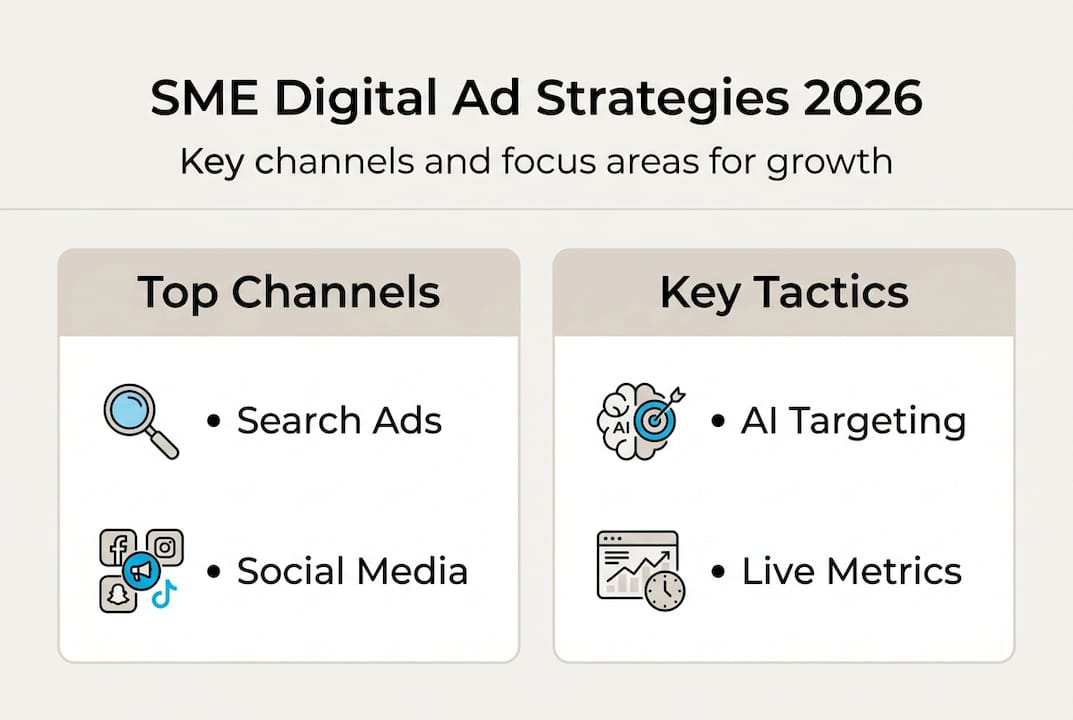
AI-integrated advertising strategies are delivering stronger revenue growth across the board. Notably, 40% of micro businesses and 52% of medium businesses using AI report better outcomes from their campaigns. AI tools can automate bidding, personalise ad delivery, and flag underperforming segments faster than any manual process.
For a deeper look at how this works in practice, the digital advertising guide for SMBs is a solid starting point.
Pro Tip: Use Google Ads’ Smart Bidding or Meta’s Advantage+ campaigns to let AI optimise your bids automatically. These tools learn from your data and improve over time, often outperforming manual bidding within a few weeks.
Why most digital advertising advice misses the mark for Australian SMEs
Most advice you’ll read focuses on ad spend and platform selection. Spend more on Google. Try TikTok. Increase your Meta budget. But for Australian SMEs, that approach consistently falls short.
The real differentiator isn’t how much you spend. It’s how precisely you target and how quickly you act on data. A $500 campaign with sharp audience targeting and weekly optimisation will outperform a $5,000 campaign running on assumptions every single time.
We’ve seen this pattern repeatedly with local businesses across Australia. The ones that grow fastest aren’t the ones with the biggest budgets. They’re the ones who treat every campaign as a learning opportunity, iterate constantly, and align their ads tightly with specific business outcomes.
AI adoption is the other piece most businesses are ignoring. It’s not a future consideration. It’s a present advantage. Review your digital advertising campaign guide and build AI tools into your process from the start.
Pro Tip: Always iterate campaigns based on real data, not assumptions. What worked last quarter may not work today. Build a habit of weekly reviews and monthly strategy resets.
Connect with proven digital advertising solutions
If you’re ready to move from strategy to action, Titan Blue has the resources to help you get there faster. We work with Australian SMEs every day, building campaigns that generate real leads and measurable growth.
Explore our digital advertising campaign guide to build your next campaign with confidence. If you’re in retail, our tutorial for boosting retail sales walks you through a proven step-by-step process. And if you want a full-service partner to handle strategy, creative, and optimisation, Titan Blue is here to help. Get in touch now and let’s build something that actually works for your business.
Frequently asked questions
How much should an Australian SME invest in digital advertising?
90% of Australian SMEs name limited budgets as their biggest challenge, so start with high-intent channels like paid search and track ROI carefully before scaling spend.
Which digital advertising channels work best for Australian SMEs?
Search advertising delivers the highest ROI for high-intent actions, as shown by its $8.0 billion share of the Australian market, while social media works well for targeted promotions and brand building.
How can SMEs measure digital advertising success?
Track CTR, conversion rate, and overall ROI on a weekly basis, then use those insights to pause underperformers and reallocate to winning campaigns consistently.
Is AI worth adopting for SMEs in digital advertising?
Absolutely. 40% of micro businesses and 52% of medium businesses using AI-integrated ad strategies report stronger revenue growth and better campaign outcomes.
Recommended
- Digital advertising campaign guide for Australian SMEs
- Why digital advertising works: proven results for Australian SMEs
- What is digital advertising? A guide for Australian SMBs
- Types of digital marketing Australian businesses need in 2026
Make Titan Blue a preferred source in Google
One click tells Google to surface our articles more often in Top Stories, AI Overviews and AI Mode.

This Week in Australian AI Search: Google’s UGC Data Program
Google's UGC Fresh Data Program and Indexing API quota update, plus our Google AI Mode…

Google AI Mode Adds Official Links: What It Means for Australia
Google is adding more links to AI Mode and testing an official websites section. Here…

Best AEO and GEO Agencies in Australia (2026): 7 Compared
Best AEO agency and GEO agency in Australia, compared: seven agencies, what their own pages…