


Before you start the hunt for a restaurant digital marketing expert, it’s crucial to figure out what your business actually needs to get ahead. This clarity is the single most important step. It ensures you hire a partner who can solve your specific problems, not just throw a generic marketing template at you. It’s the difference between spending money blindly and making a strategic investment that delivers real results.
Defining Your Restaurant's True Digital Marketing Needs

Before you jump into interviews and proposals, you need to do a clear-eyed audit of your restaurant's current digital footprint. This initial homework will change your search from a vague "we need more marketing" into a focused mission with clear objectives. A true expert will appreciate this groundwork; it lets them build a strategy that directly tackles your pain points and growth opportunities.
This isn't about becoming a marketing guru overnight. It's simply about asking the right questions to diagnose the health of your online presence. Think of it like a chef checking their pantry before planning the daily specials—you need to know what you’ve got before you can decide what you need.
Perform a Practical Self-Audit
Start by putting yourself in your customers' shoes. How do they find you right now? Open a private browser window and search for your restaurant's category in your local area, like "best Italian restaurant in Broadbeach" or "cafe near me". Where do you show up? Are you on the first page, or are you buried somewhere no one will ever see?
This simple exercise reveals your current visibility. Now, it's time to dig a little deeper into these key areas:
- Website Performance: Is your site mobile-friendly and fast? Can a customer find your menu, opening hours, and booking link within five seconds? A high bounce rate or low time on page are red flags that your website isn’t pulling its weight.
- Google Business Profile (GBP): Is your profile complete and accurate? This means recent photos, updated hours, a current menu, and, crucially, responses to reviews. Your GBP is often the very first impression a potential diner has of your business.
- Social Media Presence: Look beyond just the follower count. Are you getting real engagement—comments, shares, and direct messages? Is your content driving actual bookings or just earning passive likes?
- Online Reputation: What are people saying about you on Google, Zomato, and other review platforms? Analysing review sentiment can uncover operational issues you need to fix or highlight strengths you should be promoting.
This self-audit gives you the raw data you need. It moves you from making assumptions to having evidence-based insights about where your marketing is falling short.
From Vague Ideas to Tangible Goals
With your audit done, you can now set specific, measurable goals. Vague ideas like "increase brand awareness" are impossible to measure and lead to unfocused, ineffective campaigns. A restaurant digital marketing expert needs clear targets to aim for.
Instead of "more online orders," a much better goal is "increase direct online delivery orders through our website by 25% within six months to reduce reliance on third-party apps." This goal is specific, measurable, achievable, relevant, and time-bound (SMART).
The core idea is that your goal shouldn't just be to 'be online'; it's to use your online presence to solve real-world business problems. Whether it's filling tables on a quiet Tuesday night or building a waitlist for a special event, every digital action should connect back to a tangible business outcome.
For example, if your audit revealed poor local search visibility, a primary objective should be improving your rankings. To see just how powerful this can be and get a better understanding of what's involved, check out this detailed guide on local SEO for restaurants. This will help you articulate exactly what you need from a marketing professional.
Your final list of goals will become the foundation of your entire hiring process. It will guide your interview questions, help you evaluate proposals, and ultimately serve as the benchmark for measuring the success of your chosen expert.
The Essential Skills of a Top-Tier Restaurant Marketer
Hiring a generalist marketer to grow your restaurant is like asking a pastry chef to run the grill station. They might know the basics, but they just don't have the specialised skills to get real results. A genuine restaurant digital marketing expert brings a specific blend of technical know-how and deep industry savvy.
You need someone whose skills go far beyond just scheduling a few posts on social media. They have to live and breathe the local digital world where your future diners are making their decisions. Knowing what to look for is how you separate a true professional from a marketing generalist who will waste your budget.
Mastery of Local Search and Visibility
The modern diner's journey almost always starts with a search. A top-tier expert knows that showing up in local search results isn’t just important—it's everything. We're not talking about generic SEO; we're talking about total domination of the hyper-local searches that drive customers through your door tonight.
Here’s what that looks like in practice:
- Deep Google Business Profile (GBP) Management: They should treat your GBP not as a static listing, but as your most important digital storefront. This means obsessively optimising every section, using Google Posts for promotions, actively managing the Q&A, and making sure your menu and photos are always current and mouth-watering.
- A Real Local SEO Strategy: A true expert will talk about building local citations, getting featured by local food bloggers, and optimising your website with specific keywords for your suburb or city. Their entire goal is to make your restaurant the only logical answer when someone searches "best pizza near me" or "waterfront dining Gold Coast".
- Proactive Review Management: They need a solid plan for managing your reputation on Zomato, TripAdvisor, and Google. This isn't just about responding to reviews; it's about actively encouraging happy customers to leave them and, crucially, handling all feedback—good or bad—in a way that shows you're committed to incredible service.
A skilled marketer understands that a high ranking on Google is pointless if the search result itself—your GBP listing—doesn't make a potential diner's mouth water. It’s the combination of technical optimisation and compelling content that converts a searcher into a customer.
Expertise in Visual Storytelling and Social Engagement
In the Australian market, social media is a huge discovery engine. In fact, new data shows a staggering 47% of diners find new restaurants through platforms like Instagram and Facebook. For comparison, only 8% are swayed by individual influencers, which proves just how vital a strong, brand-owned social presence is.
Your marketing expert has to be a master of visual storytelling. Learn more about harnessing social media's power by exploring our insights on finding a social media management specialist.
This is about more than just posting pretty pictures. It’s about creating content that stops someone mid-scroll and makes them feel something about your restaurant. They should be brilliant at creating:
- High-quality, "thumb-stopping" photos and short-form videos (like Instagram Reels and TikToks) that put your food, atmosphere, and team in the spotlight.
- Content that tells your story and builds a real community, sparking user-generated content and genuine conversations.
- A content calendar that’s tied directly to business goals, whether that’s promoting high-margin dishes or driving bookings for a special event.
The same research shows that with nearly a third of diners using Google for discovery, 48% of restaurant operators have now committed to paid advertising. You can discover more insights about these 2025 Australian restaurant trends and how they are shaping marketing priorities.
Future-Proofing with AI and Answer Engine Optimisation
The way people find information is changing fast. With the rise of voice assistants and AI search engines like ChatGPT, your marketing has to keep up. A forward-thinking restaurant digital marketing expert will already be deep into what's called Answer Engine Optimisation (AEO).
AEO is all about structuring your website’s data so AI can easily understand it and serve it up as a direct answer. For example, when someone asks their smart speaker, "Where can I get a gluten-free brunch with outdoor seating?", AEO is what makes your restaurant the answer.
This is becoming non-negotiable, with 74% of Australians now comfortable using AI for things like booking tables. A great marketing partner should also be using the best AI tools for digital marketing to work smarter and get better results, especially as we look toward 2026.
How to Find and Vet Your Ideal Marketing Partner
Once you know what you’re trying to achieve, you can start the hunt for the right restaurant digital marketing expert. Think of this as finding a business partner, not just hiring someone to tick off a to-do list. You need a specialist with a real track record in Australia’s tough hospitality scene—someone who gets the local market and how Aussies find their next meal online.
The best people often aren’t just sitting at the top of a Google search. Word-of-mouth referrals are gold in this industry. Chat with other restaurant owners you respect and ask who’s running their digital marketing. You’ll also find top-tier talent through local business groups and professional networks, where reputations are built on genuine results.
After you've got a shortlist, the real work starts. It’s time to look past the slick sales pitch and figure out if they actually have the strategic mind to solve your problems.
Moving Beyond Surface-Level Interviews
A flashy portfolio or a well-written resume only shows you the highlight reel. You need to dig deeper with questions that force them to think on their feet and reveal how they’d actually tackle your challenges. Forget the generic interview questions; get specific to the restaurant world.
Your interview should feel less like a test and more like a collaborative strategy session. Lay out your real business problems and see how they react. Their answers will tell you whether you’re talking to a strategic partner or just an order-taker.
The most telling conversations happen when you put a potential partner on the spot. Their ability to break down a problem and come up with a smart, creative solution is a much better sign of future success than any polished case study they bring along.
Use these kinds of questions to steer the conversation and see how they think:
- How would your local SEO strategy differ for a multi-location restaurant group compared to a single neighbourhood café?
- How do you prove the ROI of a social media campaign beyond just likes and shares? Which metrics actually point to our bottom line?
- Walk me through your process for building a content strategy for a new menu launch.
- What’s your approach to reputation management? How would you handle a sudden wave of negative reviews after a bad service night?
- How would you split our budget between paid ads and organic marketing to build sustainable, long-term growth?
- Which marketing automation or AI tools have you found genuinely work for restaurants, and why?
These questions make them show you their expertise, not just tell you about it.
Verifying Their Track Record
After the interview, it’s time to do your homework. Any credible restaurant digital marketing expert will gladly provide case studies and references. As you review their past work, look for results that line up with the specific goals you’ve set for your own business.
This infographic breaks down the core skills a modern restaurant marketer needs. It's a blend of dominating local search, creating stunning visuals, and staying ready for what's next.
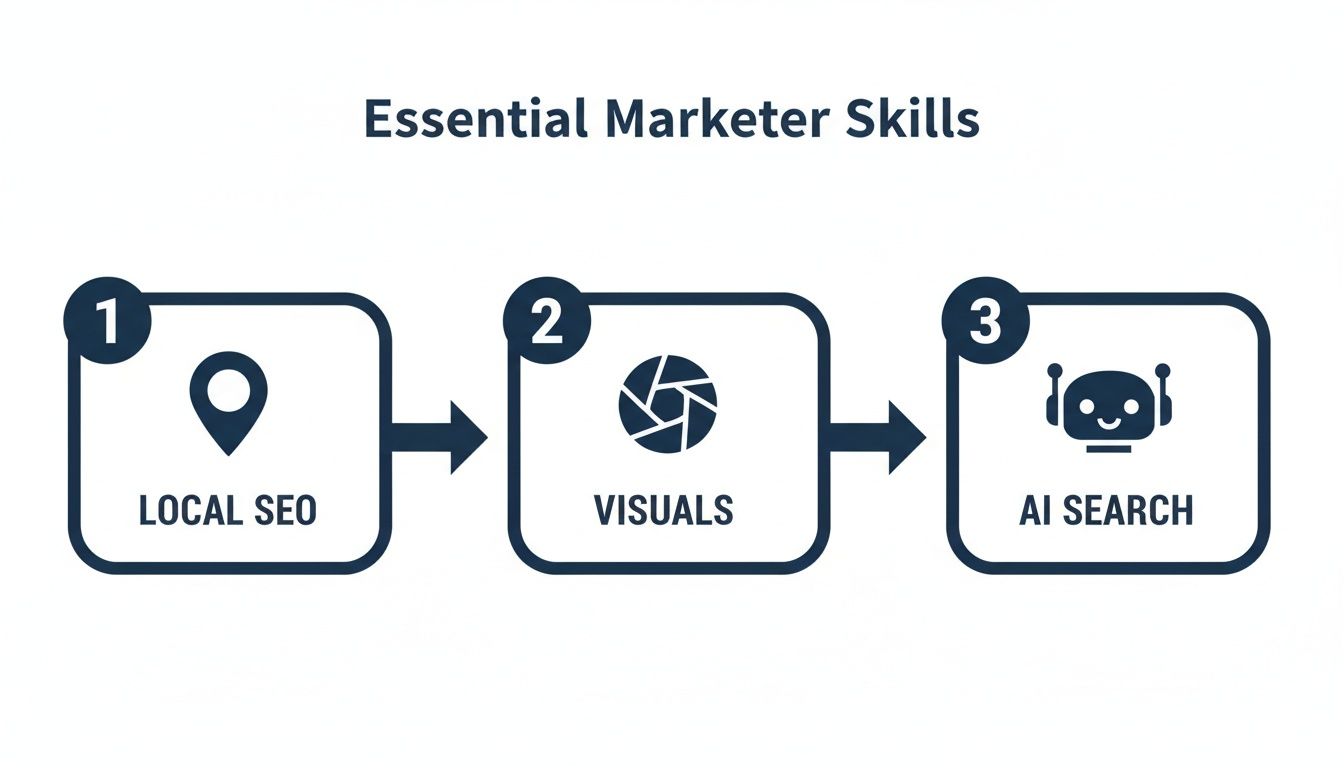
Success starts with a strong local SEO foundation, gets amplified by great visual content, and is future-proofed by embracing AI-driven search.
When you look at their case studies, don’t get distracted by the big, flashy numbers at the end. Ask about the starting point. Did they turn around a struggling restaurant, or just help an already-popular spot get a little more popular? The context is everything.
Finally, always, always check their references. When you get a past client on the phone, ask pointed questions about what it was really like to work with them.
- Communication and Reporting: How often did they communicate? Was the reporting clear, and did you always feel like you knew what was going on?
- Problem-Solving: Can you give me an example of a challenge they helped you solve? How did they handle it?
- Measurable Results: What was the single biggest impact they had on your business? Did they help you hit your goals for bookings, revenue, or customer growth?
- Proactivity: Did they bring fresh ideas to the table, or did they just wait for you to tell them what to do?
This process might feel a bit full-on, but it's essential for building a partnership that actually delivers. Taking the time now to find a genuine marketing agency will save you from a world of headaches, wasted money, and missed opportunities later. A thorough vetting process ensures you find an expert who will become a true asset to your growth.
Decoding Pricing Models and Setting a Realistic Budget
Talking about money can be tricky, but making a smart investment in a restaurant digital marketing expert starts with understanding exactly how they charge for their services. When you start getting proposals, you'll see a few common pricing models pop up. Knowing the pros and cons of each will help you choose the right fit for your restaurant's goals and cash flow.
The most popular structure you'll encounter is a monthly retainer. Think of this as a fixed fee you pay each month for an agreed-upon scope of work, like ongoing SEO, social media management, and content creation. It’s perfect for long-term brand building and creating consistent momentum in a competitive market.
Another common option is a project-based fee. This model is ideal for one-off initiatives with a clear start and finish, like a website redesign, a launch campaign for a new location, or getting your initial local SEO foundation set up properly. You just pay a single, agreed-upon price for the entire project.
Common Pricing Models Explained
Each model really does suit different needs. A retainer provides stability and lets your marketing partner get to know your business inside and out over time. On the other hand, a project fee gives you cost certainty for a specific, defined outcome without locking you into a long-term commitment.
There's also a third, less common model: performance-based pricing. With this setup, a portion of the expert’s fee is tied directly to hitting specific KPIs, like a certain number of online bookings or a target cost-per-acquisition. While it sounds great in theory, it can be complex to structure fairly and is often mixed with a base retainer anyway.
It's important to understand that the right financial model is crucial. A retainer is like having a salaried team member focused on steady growth, while a project fee is like hiring a specialist contractor for a specific renovation. Both are valuable, but they solve different problems.
Ultimately, choosing the right structure comes down to your immediate needs and long-term ambitions. If you’re serious about sustained, ongoing growth, a retainer is almost always the best path forward.
Establishing Your Budget in the Australian Market
Figuring out a realistic budget is often one of the biggest hurdles for restaurant owners. Here in Australia, you can expect monthly retainers for a comprehensive digital marketing service—covering local SEO and social media—to typically start from $2,000 to $5,000+ per month for a single-location restaurant.
That figure is just for the management fees, though. It’s absolutely critical to remember the other costs involved. For a closer look at what to expect, our overview of SEO pricing packages provides some valuable context for the Australian market.
Beyond what you pay your restaurant digital marketing expert, you also need to budget for these often-forgotten expenses:
- Advertising Spend: This is the money you pay directly to platforms like Google and Meta to run your ads. Your agency manages this budget for you, but it's a separate cost. A good starting point for a local restaurant is usually between $500 to $2,000 per month.
- Software and Tools: Some agencies bundle software costs into their retainer, while others bill for them separately. These might include subscriptions for SEO tools, social media schedulers, or email marketing platforms.
- Content Creation Assets: Let’s be clear: professional photography and videography are not optional. They are essential. You have to budget for periodic professional shoots to keep your visual content fresh, appealing, and high-quality.
By planning for these extra costs from the beginning, you create a complete financial plan without any nasty surprises down the road. It ensures your marketing investment is sustainable and properly set up for success.
Onboarding Your Expert and Measuring True Success

You’ve signed the contract and picked your new marketing partner. It’s easy to think the hard part is over, but this is where the real work kicks off. A messy or rushed start leads to confusion and slows down results, so getting the onboarding right is crucial for a successful partnership.
Think of it like prepping your kitchen before a busy dinner service. A well-organised setup ensures everything runs smoothly when it matters most. This initial stage is all about handing over the keys to your digital assets and agreeing on how you’ll track progress together.
The Onboarding Checklist Your Partnership Needs
The first week is all about access and alignment. To hit the ground running, your new restaurant digital marketing expert needs access to your digital world. But here’s a critical rule: always retain ownership of your accounts. Your expert should only ever be granted manager or user access—never full ownership.
Handing over login details needs to be secure and organised. Use a password manager to share everything safely. Here’s what they’ll need to get started:
- Website Backend: Access to your CMS (like WordPress or Squarespace) is a must for them to handle SEO tweaks, update content, and install tracking codes.
- Google Analytics: This is non-negotiable for tracking website traffic, seeing how users behave, and measuring conversions. Grant them user-level access to analyse data and create reports.
- Google Business Profile: They'll need manager access to optimise your listing, reply to reviews, and upload fresh photos and posts.
- Social Media Accounts: Give them admin or editor access to your Facebook, Instagram, and other profiles so they can manage content and run ad campaigns.
- Email Marketing Platform: They'll need access to your Mailchimp or Klaviyo account to manage your subscriber lists and build out campaigns.
Once they have the keys, the next step is a proper kickoff meeting. This is your chance to go deep on your business goals, your target audience, and your brand's unique voice. The more context you give them, the faster they'll start producing work that sounds and feels like you.
Defining What Meaningful Reports Look Like
A great marketing partner doesn’t just flood your inbox with reports full of confusing jargon and vanity metrics like 'likes' or 'impressions'. Success is measured by how marketing actually impacts your restaurant's bottom line. Your monthly report should tell a clear story about what’s working, what isn't, and why.
It needs to focus on the numbers that restaurant owners care about—the metrics that prove you’re getting a real return on your investment.
A meaningful report moves beyond vanity metrics to connect digital activity directly to business outcomes. It answers the most important question: "Did our marketing efforts put more bums on seats and increase our revenue?"
Your expert should be tracking and reporting on these key performance indicators (KPIs) every single month. You can get a better feel for what to look for by exploring these top Google Analytics metrics for restaurants.
Your monthly marketing report should always cover these essentials:
- Online Reservations: The total number of bookings coming from your website, Google Business Profile, and other digital channels.
- Website Traffic by Source: This shows you where your visitors are coming from (e.g., organic search, social media, paid ads) and which channels are performing best.
- Cost Per Acquisition (CPA): How much you're spending in marketing to get one new booking or customer.
- Google Business Profile Actions: Tracking clicks to call, requests for directions, and clicks to your website from your Google listing.
- Local SEO Keyword Rankings: Monitoring your rank for searches like "best burgers in Broadbeach" shows if you’re becoming more discoverable.
Driving Repeat Business and Phenomenal ROI
Any good restaurant digital marketing expert knows that getting new customers in the door is only half the job. The real money is in bringing them back again and again. This is where direct channels like email and SMS become absolute gold for building loyalty and driving repeat business.
These channels let you talk directly to your best customers, and the results can be staggering. We’re seeing email and text marketing deliver blockbuster returns for Aussie restaurants. Personalised, automated emails, for example, are generating a massive 12X more revenue per send than generic mass blasts.
And with 47% of consumers preferring texts for things like reservation reminders, SMS campaigns boast an incredible 24X ROI, pulling in an average of $2,835 in revenue per campaign.
By setting up a regular rhythm of communication and focusing on metrics that actually reflect growth, you and your new expert will build a transparent, results-focused partnership. This approach keeps strategies aligned with your goals and allows for quick adjustments based on real data to maximise your return.
Frequently Asked Questions
Hiring a digital marketing expert for your restaurant is a big step, and it’s completely normal to have a few questions before you commit. We get it. You want straight answers from someone who’s been in the trenches.
Here are some of the most common questions we hear from restaurant owners, along with the no-nonsense answers you need to make the right call.
How Long Until I See Real Results?
This is the big one, and the honest answer is: it depends, but you need to be patient. You'll see some quick wins, for sure. Things like optimising your Google Business Profile can start showing results within the first 1-3 months.
But the real, sustainable growth from something like local SEO? That takes time. You’re typically looking at 4-6 months before you see a significant, lasting impact. Think of it like building a strong foundation for your restaurant's online presence—it doesn’t happen overnight, but it’s built to last. A good expert will be upfront about these timelines.
Is It Better to Hire a Freelancer or an Agency?
The right choice here really comes down to your budget and what you’re trying to achieve.
A freelance restaurant digital marketing expert can be a great, cost-effective option if you have a very specific need. Say, you just need someone to run your Instagram or manage a single ad campaign. Freelancers often have deep expertise in one or two key areas.
An agency, on the other hand, brings a whole team of specialists to the table—experts in SEO, paid ads, content, and strategy, all working together. If you're aiming for serious, multi-channel growth, an agency’s comprehensive approach is almost always the more powerful path.
What Is a Realistic Marketing Budget for a Small Restaurant?
There’s no magic number, but a realistic starting point for a small restaurant in the Australian market is usually between $1,500 and $4,000 per month. This typically covers the management fees for core services like local SEO and social media.
It’s crucial to realise this doesn't include your actual ad spend. The money you pay directly to Google or Meta for ads is a separate budget on top of the management fee. A good partner will help you figure out an ad spend that aligns with your growth targets.
Why Must I Always Own My Digital Assets?
This is non-negotiable, and we can't stress it enough. You must always retain ownership of your digital assets. This means your website domain, your social media accounts, your Google Business Profile, and any ad accounts.
A reputable marketer will operate as a "manager" or "user" on your accounts. If someone insists on setting these up in their own name, it’s a massive red flag.
If you part ways, they could hold your entire online presence hostage, forcing you to start over from scratch. Owning your assets protects your brand and your investment, full stop.
Ready to stop guessing and start growing? The team at Titan Blue Australia combines over 25 years of industry experience with a deep understanding of what it takes for restaurants to succeed online. We deliver custom digital strategies that drive real results. Let's build your success story together.
Make Titan Blue a preferred source in Google
One click tells Google to surface our articles more often in Top Stories, AI Overviews and AI Mode.

How to Make Your Website AI Friendly: The 2026 Step-by-Step Guide
How to make your website AI friendly: a step-by-step 2026 guide to getting crawled, structured…

Web Design for AI Search Optimisation: The 2026 Build Guide
Web design for AI search optimisation: crawlable HTML, clear architecture, accessible UX and trustworthy content…

AEO Web Design: How to Build Websites AI Can Cite
AEO web design creates websites that AI systems can find, understand and cite through clear…