

Last updated:
If you're running a restaurant, plumbing business, construction firm, or solar company in Australia, you've probably felt the same tension. You know people are searching for what you sell. You also know Google Ads can work. But between quoting jobs, managing staff, dealing with suppliers, and keeping cash flow steady, you don't have time to become a media buyer, tracking specialist, copywriter, and analyst as well.
That’s usually the point where business owners start asking whether hiring a google ads agency is sensible, or just another monthly cost with unclear value. The answer depends on one thing. Do you need more than clicks? Most local businesses do. They need booked tables, qualified phone calls, quote requests, and jobs that turn into revenue.
A good agency helps you buy attention with discipline. A bad one burns budget and sends over tidy reports full of graphs that don’t connect to actual sales.
Is a Google Ads Agency Right for Your Business
A lot of small business owners come to Google Ads after trying to do it themselves. They’ve boosted a few campaigns, added some keywords, watched traffic come in, and then hit the same wall. The phone doesn’t ring enough, the leads are mixed quality, and nobody can clearly explain where the money went.
That frustration is reasonable. Google Ads looks simple from the outside. Pick keywords, write an ad, set a budget. In practice, it’s closer to running a live auction where every wrong setting costs money.

When doing it yourself stops making sense
If your business depends on local intent, Google Ads can be powerful. A person searching for an emergency plumber, dinner booking, or solar quote isn't casually browsing. They’re often close to making a decision. The challenge is that local intent is expensive to buy poorly.
You should seriously consider an agency if any of these sound familiar:
- You’re getting clicks but not leads: That usually points to weak intent matching, poor landing pages, or broken conversion tracking.
- You can’t tell which suburb, postcode, or service is profitable: Without proper structure, spend gets blended together and the account becomes hard to steer.
- You’re too busy to review campaigns properly: Google Ads rewards active management. Neglect shows up fast in wasted spend.
- You’ve outgrown guesswork: Once ad spend starts affecting cash flow, decisions need to be based on lead quality and revenue, not hope.
What you’re really hiring
You’re not hiring someone to “put ads on Google”. You’re hiring a team to make decisions under pressure. That includes budget allocation, keyword intent, location control, call tracking, landing page alignment, and reporting that ties back to business outcomes.
For businesses comparing providers, looking at experienced PPC marketing agencies in Australia can help frame what proper campaign management should include. The right partner should make the account easier to understand, not more mysterious.
Practical rule: If an agency can’t explain how ad spend turns into booked work in plain English, they’re not ready to manage your money.
What a Google Ads Agency Actually Does
Monday morning in Brisbane. A roofing company has spent through half its weekly budget before lunch. The phone has rung, but two calls were outside the service area, one was a supplier, and another wanted a repair the business does not even offer. The problem is rarely “Google Ads”. The problem is account control.
A good agency sets up that control. For Australian service businesses, that means building campaigns around how people search by suburb, urgency, device, and service type. A plumber in Parramatta gets different searches from a solar installer in Geelong or a restaurant in Fitzroy taking group bookings for Friday night.
The work starts with structure. If campaign setup is sloppy, the platform learns from mixed signals and budget drifts into low-value traffic. A capable agency separates services, locations, and stages of intent so bids, ads, and landing pages match the job you want more of.
For example:
- Trades: Separate emergency work from planned work, and split high-margin services from lower-value jobs.
- Hospitality: Break out brand searches, booking terms, event enquiries, and gift voucher traffic.
- Solar: Treat research queries, rebate-related searches, and quote-intent terms differently because they convert differently.
That structure supports the day-to-day decisions that affect profit:
- Keyword and search term control: Add the terms worth paying for, then block the ones that waste budget.
- Location settings: Focus on serviceable suburbs and postcodes instead of paying for clicks from anywhere in the state.
- Ad copy: Write ads that reflect the offer, local area, and reason to contact now.
- Landing page matching: Send people to the page that fits the search, not a generic homepage.
- Bid strategy setup: Choose bidding based on lead volume, tracking quality, and margin tolerance, not Google’s default suggestion.
Then comes ongoing management. This is weekly work, sometimes daily in busy accounts. Agencies review search terms, adjust budgets, test ad variations, refine schedules, and watch for changes in lead quality. If a Melbourne electrician starts getting too many switchboard upgrade enquiries but wants more emergency callouts, the account needs to reflect that quickly.
Tracking is a big part of the job, and it is where plenty of accounts fall apart. Clicks are easy to count. Useful conversions are harder. A proper setup tracks phone calls, form submissions, booked jobs, and, where possible, which campaigns produce actual revenue. Without that, an agency is optimising for activity instead of business outcomes.
Good management also has to account for where search is heading. Google Ads does not sit in isolation anymore. AI Overviews, map results, review signals, and the business information large language models pull into answers all affect what happens before and after the click. For local Australian businesses, that means ad performance is often tied to the strength of your service pages, FAQs, reviews, and local entity signals. Paid search works better when the rest of your digital presence helps Google and AI systems understand who you serve, where you work, and why customers choose you.
That is one reason many businesses look for Google Ads management services rather than basic campaign setup. Setup gets an account live. Management keeps it commercially useful.
Reporting is the last piece, but it should influence every decision. Small business owners need answers they can use this week, not a dashboard full of trivia. Which suburb is producing booked work. Which service line is too expensive. Which keywords bring researchers instead of buyers. Whether mobile calls are turning into jobs. Those are the questions an agency should be able to answer clearly.
That is what a Google Ads agency does. It sets the account up properly, keeps wasted spend under control, reads the signals coming back, and adjusts fast enough to protect margin.
The Measurable Benefits of Hiring an Expert Agency
A Brisbane electrician can burn through a week’s ad budget by Wednesday and still have nothing useful to show for it except a few price-shopping calls and a couple of job seekers. The account may look busy. The business owner still has gaps in the diary. That is the primary reason to hire an expert agency. Better management improves the commercial return from the same spend.
For Australian local service businesses, the measurable benefit is rarely more traffic on its own. It is more booked jobs, more quote requests from the right suburbs, and fewer wasted clicks from people outside your service area or outside your price range. In practice, that matters more than any lift in impressions or click-through rate.
Better outcomes that show up in the business
A capable agency usually improves performance in places owners feel straight away:
- Higher lead quality: More calls and form fills from people ready to book, not just browsing.
- Lower wasted spend: Fewer irrelevant search terms, fewer bad locations, and less budget leaking into weak time slots.
- Stronger conversion rates: Better landing pages, cleaner mobile paths, and ad copy that matches what the customer wants.
- Clearer cost control: Faster decisions on what to cut, what to scale, and which services can carry a higher acquisition cost.
- More useful reporting: Results tied to jobs, revenue, and margin instead of activity metrics.
I have seen this play out across trades, hospitality, and solar. A plumber does not need 40 extra clicks from the other side of the city. They need five more calls from the suburbs their team can reach fast. A venue in Melbourne does not need broad awareness during a quiet midweek period. It needs bookings that fill profitable sessions. A solar installer needs fewer tyre-kickers and more homeowners who are actually ready for a site assessment.
Expertise protects margin
As click costs rise, small mistakes stop being small. Loose keyword match types, poor negative keyword control, weak suburb targeting, and generic landing pages all increase cost without improving the sales pipeline. An experienced agency cuts that waste early and keeps adjusting as the account changes.
That work is not glamorous. It is operational.
It includes shifting budget toward higher-value services, trimming search terms that bring researchers instead of buyers, testing ad copy against local intent, and fixing conversion paths on mobile where many service leads start. Those decisions can be the difference between a campaign that keeps a crew busy and one that just burns cash.
There is another benefit many agencies still miss. Strong Google Ads performance now overlaps with how your business appears in AI-generated answers, map results, review summaries, and local search features. For Australian businesses, paid search works better when service pages, FAQs, suburb content, and review signals are strong enough for both Google and LLM-driven search experiences to understand what you do, where you work, and why customers choose you. An agency that only manages bids is solving half the problem.
If you want a clearer sense of what return-focused management looks like in practice, this guide on maximising ROI with Google Ads management is a useful reference point.
Understanding Google Ads Agency Pricing Models
Pricing causes more confusion than it should. Most business owners don’t mind paying for expertise. What they mind is paying for a model that rewards the wrong behaviour.
A google ads agency can charge in several ways, but the important question isn’t just “what does it cost?” It’s “what does this pricing model encourage the agency to do?”

Percentage of ad spend
This is common when budgets are larger or variable. The agency charges a percentage of the monthly media spend.
The upside is simplicity. As your ad spend grows, the agency fee scales with it. That can make sense when the account becomes more complex, a natural consequence of higher spend.
The downside is incentive. If the fee is tied directly to spend, the agency may have less financial reason to recommend pulling back in areas that aren’t performing. That doesn’t mean the model is wrong. It means you need clear accountability around lead quality and profitability.
Flat monthly fee
A fixed monthly management fee gives you predictability. Many local service businesses prefer this because cash flow is easier to plan around, and there’s less ambiguity about the agency’s invoice.
This model often works well when:
- The campaign scope is stable: Same services, same regions, same general management load.
- You want cleaner budgeting: Media spend and management costs stay separate.
- You value steady oversight: The agency is not rewarded for budget increases alone.
The risk is under-servicing. If the fee is too low, the agency may not devote enough time to strategic work, testing, and tracking.
Hybrid and performance-linked models
Some agencies use a blend of base fee plus performance component. In theory, this aligns incentives. In practice, it depends on how “performance” is defined.
If the performance measure is shallow, such as traffic volume or form fills without qualification, the model can still lead you in the wrong direction. Better versions tie success to meaningful outcomes like qualified leads, booked jobs, or attributed revenue.
Pricing should match the management reality of your business, not just the agency’s sales process.
If you're comparing options, this overview of how much Google Ads costs helps frame the media side separately from management fees.
What to look for in any pricing model
Before you agree to anything, ask these questions:
- What work is included each month? Strategy, tracking, ad writing, landing page feedback, reporting, and meetings should be clear.
- Who owns the account and data? You should retain access.
- How are results judged? Not all leads have equal value.
- What happens if the campaign needs a rebuild? Clarify whether structural changes are included or extra.
The best pricing model is the one that supports honest decision-making. If the structure makes it easy for the agency to hide behind activity instead of outcomes, keep looking.
Key Questions to Ask Before You Hire an Agency
A Brisbane plumber can burn through a week’s budget on the wrong clicks before anyone notices. A Gold Coast restaurant can pay for dinner searches from people who only wanted the menu. A solar installer can generate plenty of form fills that never turn into qualified quotes. The agency you hire should be able to explain how it prevents that, in plain English.

Ask how they protect your budget
Start with waste control. For local Australian businesses, bad setup usually shows up in three places. Wrong locations, weak keyword filtering, and search term reports nobody reviews.
A good agency should be able to explain how it sets suburb, city, or service-area targeting for your business. If you only service Logan, Ipswich, or selected parts of the Northern Rivers, your ads should not drift into the wrong regions just because Google’s defaults were left untouched. The same goes for keyword exclusions. A trades business often needs to block DIY searches, job seekers, training queries, and out-of-area suburbs. A restaurant may need to filter recipe searches or people looking for jobs rather than bookings.
Ask direct questions such as:
- How do you set location targeting for a business that only services specific suburbs or regions?
- Will you use “Presence only” rather than broader default settings where appropriate?
- How do you build and maintain negative keyword lists?
- How often do you review search terms?
If the answer stays high level, keep probing. Geography settings and exclusions are not admin details. They directly affect cost per lead.
Ask what they track and how they track it
Plenty of agencies still report on clicks, impressions, and click-through rate as if that tells you enough. It does not. A small business owner needs to know what turned into phone calls, booked work, table reservations, or quote requests that passed a basic quality check.
Ask them to walk you through the tracking setup without jargon. If they cannot explain it clearly, there is a fair chance they do not fully control it. For a hospitality venue, that may mean separating booking intent from general website visits. For a solar company, it may mean tracking quote requests, call enquiries, and the later sales outcome through a CRM. For a trade business, it often means distinguishing emergency jobs from low-value tyre-kicker enquiries.
You want to know:
- Which actions count as conversions
- How phone calls are tracked
- Whether booked jobs or qualified leads can be separated from weak enquiries
- How form submissions are validated
- Whether reporting can be broken down by service, suburb, or location
This also matters for the next phase of search. AI search tools and LLM-driven results are changing how people research before they click an ad. If your agency only measures the last click and ignores what happens in your CRM, your reporting will miss part of the buying journey.
Ask how they would structure your account
Account structure tells you how the agency thinks. A weak structure usually lumps every service into one campaign, sends traffic to broad pages, and leaves Google too much room to match irrelevant searches.
Ask them to describe the account they would build for your business. Listen for specifics. A capable agency should talk about separate campaigns or ad groups by service type, urgency, location, and landing page intent. Device behaviour should come up as well, because mobile call-driven campaigns behave differently from desktop quote research.
For example, a plumbing account should usually separate urgent callout terms from planned maintenance work. A restaurant should treat booking searches differently from function enquiries and branded traffic. A solar business needs room for a longer decision cycle, broader research terms, and stronger lead qualification.
Those distinctions shape budget allocation, ad copy, and landing pages. They also affect what your business becomes known for across paid search, organic visibility, and AI-generated summaries. If an agency treats every click the same, it will struggle to build a strong signal around your highest-value services.
Later in the conversation, this video is worth watching because it highlights what business owners often miss when assessing agency claims:
Ask who actually works on the account
I have seen this problem for years. The person who wins the business is often not the person making weekly decisions in the account.
That does not always mean the work will be poor. Junior staff can be solid if the process is tight and senior oversight is real. But you need clarity before you sign.
Useful questions include:
- Who sets up conversion tracking?
- Who writes the ads?
- Who reviews search terms and bidding?
- How often is the account actively optimised?
- Will I get direct account access?
Hire based on the operating process, the visibility you get, and the standard of decision-making inside the account.
Ask what success should look like after the first few months
The first 90 days should produce learning, not excuses. Search term data should improve targeting. Conversion data should sharpen bidding. Landing page issues should become obvious. Weak suburbs, weak services, and low-quality leads should be easier to spot.
Ask how the agency responds if early results are mixed. Do they change match types, tighten locations, rewrite ads, adjust landing pages, and review lead quality with you? Do they connect campaign data back to actual sales outcomes? Can they explain how paid search supports your broader visibility as AI search tools influence who gets shortlisted before a click happens?
Titan Blue’s Google Ads management approach is one example in the market of a service that sits inside a broader digital strategy offering. The provider matters less than the standard you expect. Clear ownership. Clear reporting. Clear action when performance is off.
Real-World Success for Australian Businesses
Friday afternoon on the Gold Coast. A restaurant has empty tables for the second sitting, a plumber in Logan is screening missed calls from outside his service area, and a solar installer in Newcastle is paying for clicks from people who only want a rough price. Google Ads can help all three businesses, but the account structure, landing page, and follow-up need to match how each one makes money.
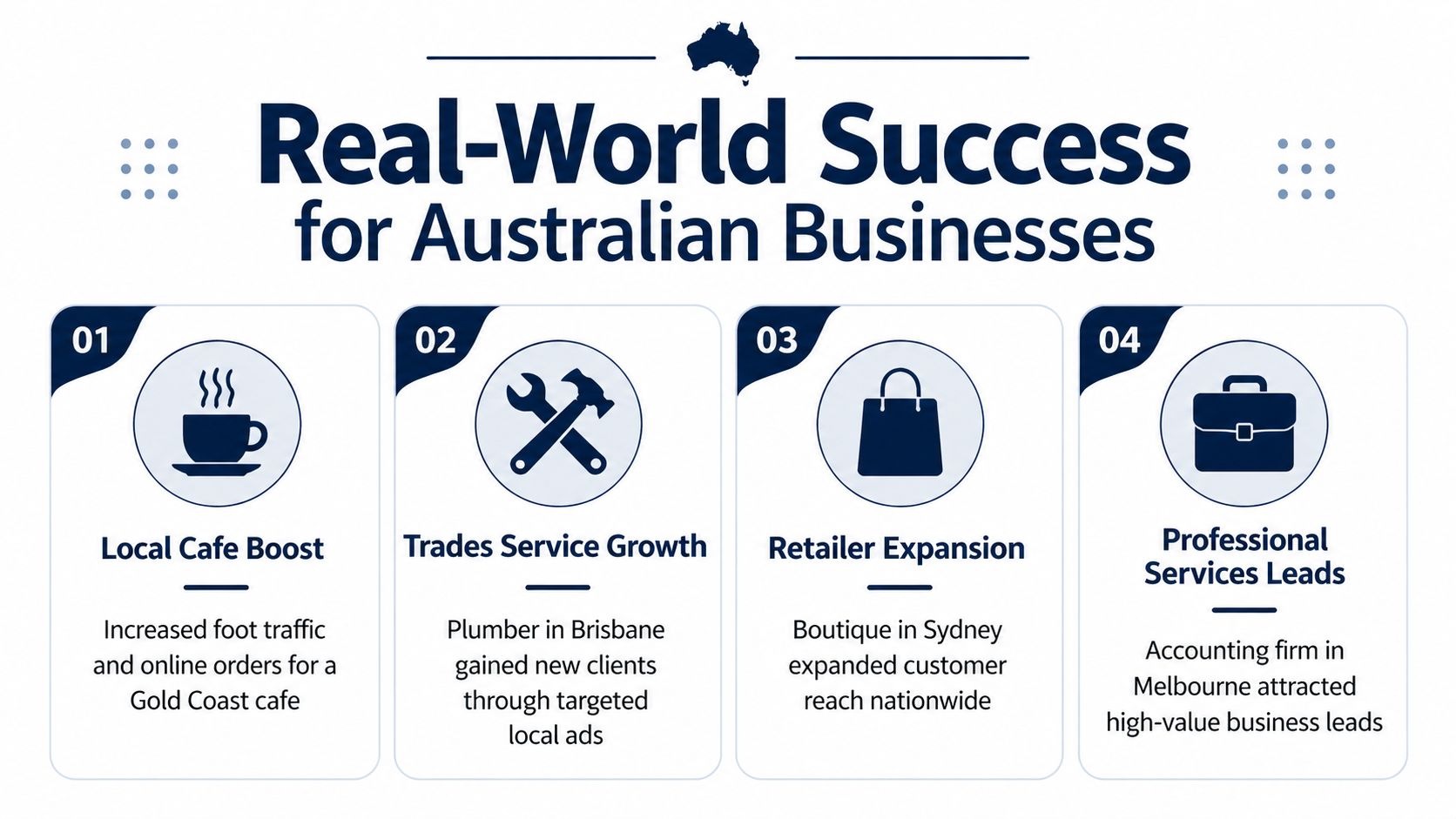
A Gold Coast restaurant chasing bookings, not just traffic
Hospitality campaigns fail when they treat every click as equal. A venue in Broadbeach or Burleigh usually needs bookings during specific trading windows, stronger visibility for high-margin sessions, and ad copy that reflects intent such as private dining, waterfront lunch, or last-minute dinner reservations.
The fix is usually straightforward. Send booking-intent searches to a page with the menu, opening hours, location, and reservation path immediately visible. Tighten ad scheduling around the hours that drive table bookings, not just website visits. Track calls, booking form submissions, and reservation platform completions so the campaign is judged on covers and revenue, not traffic volume.
I have seen restaurants waste budget on generic "best food near me" traffic while underfunding branded and high-intent local terms that fill seats.
A plumber needing urgent calls from the right suburbs
Trades are won on speed and relevance. If a blocked drain search from Ipswich lands on a slow page with a tiny phone number and no suburb references, the lead often goes to the next advertiser.
For a local plumber, the account should be built around urgent job types, mobile-first call handling, and tight geographic control. That means excluding suburbs outside the service radius, separating emergency work from lower-priority maintenance, and matching the ad message to what the customer needs now. "24/7 burst pipe repair" and "hot water system replacement" should not sit in the same ad group with the same landing page.
This is also where lead quality becomes obvious. Ten phone calls from the wrong side of Brisbane are worse than four qualified calls from the right suburbs.
A construction business trying to lower acquisition cost
Construction and project-based services usually have higher click costs and longer quoting cycles. Poor setup gets expensive fast. Broad keywords can produce a steady stream of enquiries that look fine in the dashboard but never turn into site visits, tenders, or signed work.
A better account filters earlier. Service-specific campaigns, tighter match types, stronger negative keyword work, and landing pages built around project type usually do more than aggressive bidding ever will. Performance Max can help in some cases, but only if conversion tracking is accurate, offline sales feedback is fed back into Google Ads, and the creative assets reflect the actual job mix.
Without that input, automation often chases low-value enquiries because they are easier to generate.
A solar installer dealing with a longer decision cycle
Solar is rarely a one-click sale. Homeowners compare system sizes, rebates, financing, installer reputation, and payback periods. Commercial buyers add approvals, site constraints, and board-level sign-off. A cheap lead is often just an early-stage question.
The campaigns that hold up over time separate research intent from quote intent. They use remarketing, suburb and region targeting, and landing pages that answer practical questions about savings, installation process, warranties, and grid connection. They also connect ad data to sales outcomes, because a booked consultation means far more than a form fill from someone chasing the lowest sticker price.
That same discipline now matters beyond paid clicks. A local service business should show up well in search ads and in AI-generated recommendations that shape the shortlist before a prospect visits the site. That is why smart agencies are starting to connect paid search with generative engine optimisation for AI search visibility, especially for businesses competing in crowded metro areas.
The shift is already underway. The report on AI advertising campaigns in 2026 outlines how campaign formats and buyer behaviour are changing as AI-assisted discovery becomes part of the path to enquiry.
The common thread is simple. Google Ads works best when the account mirrors the buying journey in that industry, in that suburb, with that sales process. For Australian trades, hospitality venues, and solar companies, that is the difference between paying for clicks and paying for profitable work.
The Future of Paid Search and Finding a Partner Who Is Ready
Google Ads still matters. For many local businesses, it remains one of the fastest ways to reach buyers with clear intent. But the search journey is changing. People are increasingly discovering businesses through conversational tools, recommendation engines, and AI-generated answers before they ever click a traditional search result.
That shift creates a strategic gap. Current agency content rarely explains how paid search should connect with AI Search and LLM visibility. That gap was specifically identified in this analysis of Google Ads management blind spots and AI Search strategy, which notes that businesses now need to ask how ad strategy should adapt as customers increasingly discover services through conversational AI.
Why this matters to Australian SMBs
If you run a hospitality venue, trade service, or solar business, your customer may no longer move in a straight line from Google search to website to enquiry. They may ask an AI tool for the best options nearby, compare providers through summary answers, and only then search directly.
That doesn’t mean Google Ads becomes irrelevant. It means your campaigns, landing pages, and content need to work together. The ad may capture high-intent traffic, while your site content supports credibility, local relevance, and discoverability in AI-driven environments.
A useful industry read on that direction is this report on AI advertising campaigns in 2026, which outlines how ad formats and search behaviour are evolving around Google’s AI experiences.
What a future-ready agency should already be doing
A capable partner should be thinking beyond keyword auctions. They should be asking whether your landing pages answer real customer questions clearly, whether your service pages are strong enough to support both paid traffic and AI visibility, and whether your reporting reflects changing discovery paths.
That includes work such as:
- Aligning ad messaging with deeper service content
- Building landing pages that answer conversational queries clearly
- Using search term insights to guide broader content production
- Improving the consistency of business information across digital touchpoints
- Connecting paid search with an AI-ready content strategy
A future-ready search strategy doesn’t choose between ads and AI visibility. It connects them.
For businesses exploring that next layer, generative engine optimisation is becoming part of the wider search conversation, especially where local discovery and answer-based platforms overlap.
The agency you hire today shouldn’t only know how to run campaigns. They should understand where search is heading, and build with that direction in mind.
Frequently Asked Questions
What is a realistic budget to start with for a small local business
Start with a budget you can sustain long enough to learn from. Google Ads needs enough data to show which keywords, suburbs, times, and services are worth backing. If the budget is too thin, every click feels expensive and the account never gathers enough signal to improve properly.
The better question to ask an agency is this: how will you prioritise my highest-intent services first? A sensible launch usually focuses tightly on the services and locations most likely to produce qualified leads, then expands once performance becomes clearer.
Am I locked into a long-term contract with an agency
That depends on the agency, but you shouldn’t assume long lock-ins are necessary. Some businesses prefer shorter agreements while the relationship proves itself. Others are comfortable with longer terms if the scope, reporting, and ownership of assets are clear.
What matters more than contract length is transparency. You should know who owns the Google Ads account, who controls the conversion tracking, and whether you keep access to historical data if you leave. If an agency avoids those points, ask again.
Should I hire a local Gold Coast agency or a larger national one
Neither is automatically better. The right choice depends on how well the agency understands your market, your service area, and your sales process.
A local agency may better understand suburb-level behaviour, seasonal demand, and how customers search in your region. A national agency may bring wider category exposure and larger internal teams. The deciding factor should be their ability to track outcomes properly.
That’s especially important for businesses serving multiple areas. An important but often overlooked issue is accurate attribution across locations. Agencies should be able to explain how they handle location-specific phone tracking and revenue attribution in complex customer journeys, as discussed in this video on local Google Ads performance tracking. Standard dashboards often miss true local ROI.
Choose the agency that can show you how profit is measured by service and location, not the one with the most polished slide deck.
If you want a practical conversation about whether paid search fits your business, Titan Blue Australia can help assess the opportunity across Google Ads, local search, and AI visibility, with support for businesses on the Gold Coast and across Australia.
Make Titan Blue a preferred source in Google
One click tells Google to surface our articles more often in Top Stories, AI Overviews and AI Mode.

Best Dental Website Design Agencies in Australia: 7 Compared
Best dental website design agencies in Australia 2026: seven compared on dental proof, booking, AHPRA…

Childcare Centre Website Design Australia: The 2026 Guide
Childcare centre website design Australia: show hours, ages and enrolment as text so parents and…

Electrician Website Design Australia: The 2026 Guide
Electrician website design Australia: what to build, what we found on eight Gold Coast electrician…