


TL;DR:
- AI tools enhance SEO by analyzing data faster and identifying niche opportunities for small businesses.
- Combining AI with human expertise ensures high-quality, authentic content that complies with search engine guidelines.
- Effective AI-driven SEO relies on ongoing strategy, local knowledge, and technical site optimization.
Small businesses that have combined AI tools with smart editorial strategy are seeing results that simply weren’t possible a few years ago. AI SEO case studies show outcomes like Rocky Brands achieving a 30% search revenue increase, BattleBridge generating $90k in pipeline within 90 days, and GreenLiving growing organic traffic by 187% in just 60 days. If you’re running a business in Australia and wondering whether AI-driven SEO is worth your attention, the short answer is yes. This guide cuts through the noise and gives you clear, actionable insight into how AI can work for you.
Table of Contents
- What does AI mean for SEO today?
- How AI transforms keyword research and content creation
- AI in technical SEO and structured data
- What works: AI SEO success stories and common mistakes
- AI in SEO: What most businesses get wrong (and how to get it right)
- Get ahead with AI-powered SEO solutions
- Frequently asked questions
Key Takeaways
| Point | Details |
|---|---|
| AI boosts efficiency | AI tools dramatically speed up keyword research, content planning, and site audits for SMEs. |
| Editorial review is vital | Always combine AI output with human expertise to maintain quality and avoid penalties. |
| Structured data matters | Using proper schema and local signals is essential for AI-powered search features. |
| Quality over quantity | Focus on valuable, original content instead of flooding your site with AI-generated text. |
| Blend AI with strategy | Success comes from balancing automation with clear, brand-aligned strategy and local authority. |
What does AI mean for SEO today?
With those numbers in mind, let’s examine what AI actually means for SEO today. There’s a lot of confusion out there, and it’s understandable. The term “AI” gets thrown around constantly, and for many business owners, it sounds like something reserved for tech giants and enterprise companies. That’s simply not the case anymore.
In SEO, AI refers to machine learning tools that analyse your website, identify opportunities, and support decisions across content, technical, and marketing tasks. These tools process enormous volumes of data far faster than any human team could. They surface patterns in search behaviour, flag technical issues, and suggest content improvements based on real-time signals.
Here’s what AI in SEO is not:
- A full replacement for human strategy or brand knowledge
- A guaranteed shortcut to page one rankings
- A one-time setup that runs itself without oversight
- A tool that ignores the rules Google sets for quality content
That last point matters a lot. Google’s guidance on AI search features is clear: focus on people-first, unique content, technical SEO basics, structured data, and high-quality multimedia. No special AI optimisations are needed to succeed in AI Overviews or AI Mode. The fundamentals still win.
“AI tools are most effective when they enhance human judgement, not replace it. The businesses seeing the strongest gains are those that keep editorial standards high while using AI to move faster.”
Australian SMEs have a genuine advantage here. You understand your local market, your customers, and your community in ways that no algorithm can replicate. Our AI Search Engine Optimisation guide explains how to apply that local knowledge alongside AI tools for maximum impact. When you combine both, you’re not just competing. You’re leading.
AI also supports AI competitive intelligence, giving you insight into what your competitors are doing in search and where the gaps are in your niche. For a small business owner who previously had no visibility over the competitive landscape, this is genuinely transformative.
Our SEO for small business resource breaks this down further if you want to explore the foundational principles before going deeper into AI-specific tools.
How AI transforms keyword research and content creation
Now that we know AI’s place in SEO, let’s look at how it improves content and keyword processes. This is where most business owners start to feel the impact directly.
Traditional keyword research was slow and often incomplete. You’d rely on a handful of tools, manually compare search volumes, and make educated guesses about what your audience actually wanted. AI tools change this entirely. They analyse continuous intelligence signals across billions of searches, surfacing keyword opportunities based on real-time intent and genuine gaps in existing content.
For example, an AI tool might reveal that your potential customers in Brisbane are searching for a very specific variation of your core service, one that no competitor has addressed. You can create a focused piece of content around that gap and capture traffic your competitors are missing entirely.
Comparing manual vs AI-assisted keyword research:
| Factor | Manual research | AI-assisted research |
|---|---|---|
| Speed | Hours to days | Minutes |
| Depth of intent data | Limited | Extensive |
| Real-time signals | Rarely updated | Continuously updated |
| Gap identification | Difficult | Automated |
| Human review required | Yes | Yes |
On the content creation side, AI tools can generate draft copy quickly. This is useful for scaling your output without burning out your team. But speed is not the same as quality. Case studies confirm that the businesses achieving the strongest results are those combining AI-generated drafts with genuine human review, brand voice, and original insight.

Here’s the risk: publishing scaled AI content without real value risks spam penalties, particularly following Google’s March 2026 core update. Generic AI output leads to intent mismatch, brand dilution, and quality decay. Your audience can tell the difference, and so can Google.
Pro Tip: Use AI to build a content brief and first draft, then have a team member with genuine product or industry knowledge rewrite key sections. This keeps output high without sacrificing authenticity.
For practical guidance on applying these principles, our resource on digital marketing with AI shows how to blend automation with editorial control across your broader marketing strategy.
Uniqueness is non-negotiable. Your local expertise, client stories, and specific knowledge of the Australian market are things no AI tool can produce on your behalf. That’s your competitive edge. Protect it.
AI in technical SEO and structured data
Content is only part of the puzzle. Technical SEO is vital for getting found. Here’s how AI supports that side of your strategy.
Technical SEO has historically been the most intimidating part for small business owners. It involves site speed, crawlability, indexing, schema markup, and dozens of other factors that determine whether Google can properly read and rank your website. AI-powered audit tools have made this significantly more accessible.
These tools automatically scan your site, identify critical errors, and prioritise fixes based on their likely impact on rankings. Instead of receiving a list of 200 technical issues with no context, you get a clear, ranked action plan. That’s a practical difference for a business owner without a dedicated developer on staff.
Top technical areas where AI makes the biggest difference:
- Page speed optimisation — AI tools identify exactly which elements are slowing your site and suggest specific improvements, from image compression to server response times.
- Structured data implementation — Schema markup tells search engines precisely what your content is about. It’s essential for appearing in rich results and AI-powered search features.
- Mobile usability issues — AI audits flag mobile experience problems that affect rankings across all devices.
- Internal linking gaps — AI can map your site structure and identify where links are missing or weak, improving the flow of authority across pages.
- Crawl errors and indexing issues — These prevent Google from seeing your pages entirely. AI tools detect and flag them immediately.
Structured data results for local businesses:
| Schema type | Benefit | Priority level |
|---|---|---|
| FAQ schema | Eligibility for featured snippets | High |
| LocalBusiness schema | Stronger Google Maps presence | High |
| HowTo schema | Visibility in AI Overviews | High |
| Review schema | Star ratings in search results | Medium |
| Product schema | Enhanced e-commerce listings | Medium |
Google’s guidance for succeeding in AI search prioritises structured data, concise answers of 40 to 60 words, original research and data for AI citations, and local Google Business Profile optimisation. For Australian businesses, GBP optimisation is particularly important. A well-maintained profile with accurate categories, updated hours, and genuine reviews directly influences your visibility in local search and Google Maps.
AI also supports scalable market intelligence, helping you understand how your technical standing compares to local competitors and where to focus resources for the greatest gain.
Our resource on boosting local SEO explains the specific steps Australian SMEs can take to strengthen their local search signals, from GBP management to locally relevant structured data.
A well-structured site does more than rank well. It builds trust with visitors. When your site loads fast, is easy to navigate, and provides clear answers, people stay longer and convert at higher rates. That’s the combination you’re aiming for.
What works: AI SEO success stories and common mistakes
Getting technical is helpful, but the real proof is in success stories and learning from mistakes. Let’s see what actually happens when businesses apply AI-driven SEO in the real world.
The results from documented AI SEO case studies are striking. Rocky Brands saw a 30% increase in search revenue, with 74% year-on-year growth. BattleBridge generated $90,000 in pipeline within 90 days. GreenLiving grew organic traffic by 187% in 60 days. These aren’t outliers. They reflect what’s possible when AI tools are paired with focused strategy and genuine editorial oversight.
What the successful businesses have in common:
- They used AI to speed up research and identify opportunities, not to replace thinking
- They maintained a consistent brand voice across all published content
- They prioritised structured data and local signals alongside content creation
- They reviewed every piece of AI-assisted content before publishing
- They iterated based on actual performance data, not assumptions
Now for the mistakes. These are worth taking seriously because the consequences can be severe.
Over-automation is the biggest pitfall. Some businesses, excited by the speed of AI content tools, start publishing large volumes of content with minimal review. The result is often a wave of generic, repetitive pages that confuse readers and trigger spam penalties. Google’s 2026 updates have made this risk very real. Intent mismatch, where a page nominally covers a topic but doesn’t actually answer the reader’s question, is now a common cause of ranking drops.
Brand dilution is a slower, harder-to-spot problem. When AI generates content without a human applying brand voice and genuine expertise, your website starts to sound like every other site in your industry. Visitors notice. They leave. Conversion rates drop. Rankings follow.
Pro Tip: Before publishing any AI-assisted page, ask one question: “Does this genuinely help the person searching for this?” If the honest answer is no, revise it before it goes live.
The businesses achieving effective SEO outcomes are those treating AI as a capable assistant, not an autonomous operator. Your input, your expertise, and your editorial standards are what separate you from the competition.
AI in SEO: What most businesses get wrong (and how to get it right)
The data is persuasive, but there’s a deeper lesson here for those willing to look closer. We work with businesses across Australia, and there’s a pattern we see repeatedly. Businesses get excited about AI tools, implement them quickly, then plateau or decline. The reason is almost always the same. They treated AI as a shortcut rather than a capability multiplier.
Research into AI’s impact on content and SEO highlights this tension clearly: AI boosts efficiency and productivity, but over-reliance without editorial review produces mediocre content that generates traffic without conversions, and eventually, ranking drops. The clicks come. The enquiries don’t. Business owners then blame SEO when the real issue was content quality.
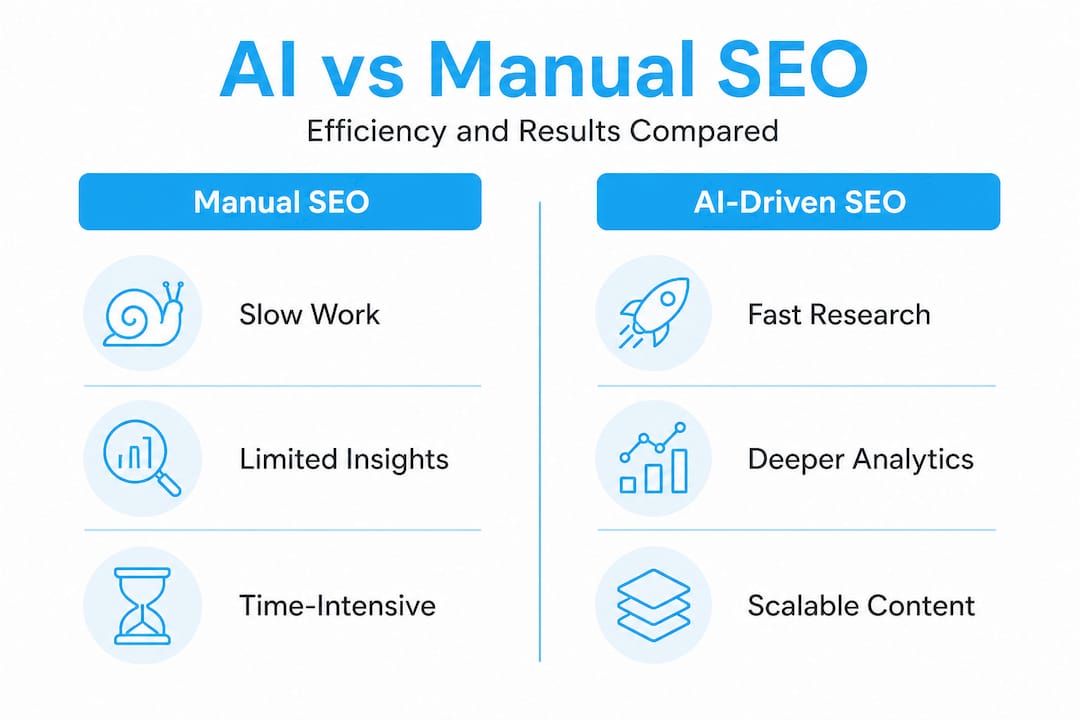
There’s also a checklist problem. Many businesses approach SEO as a series of boxes to tick. Add schema? Tick. Publish content weekly? Tick. Update GBP? Tick. But SEO is not a checklist. It’s an ongoing process of understanding your audience, refining your content, and building genuine authority in your niche.
Australian SMEs who win at SEO over the long term do a few things differently. They invest in original research, even if it’s simple, such as a customer survey or a data analysis of local trends. They answer questions their customers actually ask, not just the ones with the highest search volume. They build multimedia content including video, images, and infographics that adds real value. And they review performance monthly, adjusting based on what the data actually shows.
Consistency is more durable than novelty. Being early to a new AI tool matters less than being consistently excellent in your content and technical standards. The businesses that will lead search results in 2027 and beyond are building that excellence now.
Our team at Titan Blue provides expert search engine optimisation built on exactly this philosophy. We combine AI-driven efficiency with hands-on editorial standards and genuine local knowledge. The goal is never just rankings. It’s revenue.
Get ahead with AI-powered SEO solutions
If you’re ready to apply these approaches, here’s how you can get started with expert support.
Understanding AI’s role in SEO is one thing. Applying it consistently and correctly is another. Most business owners simply don’t have the time to manage keyword research, content production, technical audits, and performance tracking alongside running their actual business.
That’s where Titan Blue comes in. Our advanced SEO solutions are built specifically to help Australian SMEs compete and grow in an AI-driven search landscape. We handle the technical complexity so you can focus on your business. Whether you’re starting from scratch or looking to scale what’s already working, our SEO services for small business give you a clear, results-focused path forward. If you’d like to understand the full picture before committing, our SEO explained for Australian businesses resource is a great place to begin. Get in touch with Titan Blue today and let’s build something that actually grows your business.
Frequently asked questions
How can AI improve my small business SEO results?
AI uncovers hidden keyword opportunities, automates repetitive tasks, and improves content quality for stronger search performance. Documented results show businesses achieving significant traffic and revenue growth when AI tools are paired with editorial review.
Do I need special AI tools for Google’s new AI search features?
No. Google’s own guidance confirms that people-first content and strong technical SEO basics are sufficient. No specialist AI optimisation tools are required to appear in AI Overviews or AI Mode.
Can using too much AI content hurt my Google rankings?
Yes. Publishing large volumes of generic or low-value AI content risks spam penalties and ranking losses, particularly following Google’s March 2026 core update.
What’s the best way to combine AI tools and human expertise for SEO?
Use AI to speed up research, identify gaps, and produce first drafts. Then apply human review, local knowledge, and brand voice. Over-reliance without oversight consistently leads to poor results regardless of the tools used.
How important is structured data for AI-driven SEO?
Structured data is critical. Google’s guidance prioritises FAQ and HowTo schema for AI Overviews visibility, and local schema combined with GBP optimisation is especially important for Australian businesses.
Recommended
- AI Search Engine Optimisation for Australian Businesses
- A Guide to AI Search Engine Optimisation for Australian Businesses
- A Guide to AI Search for Your Business
- Enhancing Digital Marketing with AI
- Social Media Services | Boost Your Social Reach—Get Started Today — King Sixteen
- Hoe stel je google ads effectief in voor B2B – Novaturient Marketing Agency
Make Titan Blue a preferred source in Google
One click tells Google to surface our articles more often in Top Stories, AI Overviews and AI Mode.

Solar Installer Website Design Australia: The 2026 Guide
How solar installer websites in Australia should show CEC accreditation, real install proof and AI-ready…

Hotel & Hospitality Website Design Australia: 2026 Guide
Hotel and hospitality website design in Australia explained: booking flow, schema, AEO and what actually…

Restaurant Website Design Australia: The 2026 Guide
What a restaurant website in Australia needs: HTML menus, bookings, GBP sync, schema, and AI-ready…