Stay ahead with the latest tips, trends, and insights from the Titan Blue team , straight from the studio in Broadbeach.



Many Australian business owners assume ecommerce website design is purely about creating an attractive shopfront. This misconception costs sales daily. Effective ecommerce website design encompasses user experience, technical performance, search engine optimisation, and conversion strategy. For small to medium businesses in 2026, understanding what truly constitutes quality ecommerce design separates thriving online stores from struggling ones. This guide clarifies the essential components of ecommerce website design and demonstrates why investing in proper design directly impacts revenue, customer trust, and organic visibility.
Table of Contents
- What Is Ecommerce Website Design? Defining The Essentials
- How Platform Choice Affects Ecommerce Website Design And Performance
- Key Features Of Effective Ecommerce Website Design In 2026
- Practical Steps For Australian SMBs To Improve Ecommerce Website Design And Drive Growth
- How Titan Blue Can Help Transform Your Ecommerce Website Design
- Frequently Asked Questions
Key takeaways
| Point | Details |
|---|---|
| Design impacts revenue | Well-optimised platforms can double ecommerce revenue and increase organic reach by 43%. |
| Beyond aesthetics | Effective design combines performance, usability, mobile optimisation, and SEO to drive sales. |
| Platform matters | Slow, unstable sites damage customer trust and search rankings, requiring strategic platform choices. |
| Mobile-first essential | Australian shoppers expect seamless mobile experiences that convert as well as desktop. |
| Integration drives growth | Combining professional design with digital marketing strategies maximises ecommerce success. |
What is ecommerce website design? Defining the essentials
Ecommerce website design represents far more than visual styling. It combines aesthetics with user experience, technical performance, and search engine optimisation to create online stores that convert browsers into buyers. The discipline encompasses layout architecture, navigation systems, mobile responsiveness, site speed optimisation, secure payment integration, and strategic content placement.
Think of ecommerce design as the complete shopping environment, not just the storefront. Every element influences whether customers complete purchases. Navigation must guide shoppers effortlessly to products. Product pages need compelling imagery, clear descriptions, and prominent calls to action. Checkout flows require simplicity and security signals that build confidence.
Technical performance sits at the foundation. A well-designed and optimised ecommerce website builds brand reputation and drives sales through fast loading times, stable hosting, and seamless functionality. Poor performance destroys trust faster than any marketing campaign can rebuild it.
The benefits of ecommerce website design extend beyond immediate sales. Search engines reward well-structured sites with better rankings. Customers return to stores that provide smooth experiences. Integration with marketing tools enables personalisation, retargeting, and data-driven improvements.
Core components include:
- Visual hierarchy that guides attention to key products and offers
- Intuitive category structures that mirror customer thinking patterns
- Mobile-responsive layouts that adapt flawlessly across devices
- Fast-loading pages that retain impatient shoppers
- Secure checkout systems that protect customer data
- SEO-optimised product pages that capture organic search traffic
- Analytics integration that reveals customer behaviour patterns
Professional ecommerce design treats these elements as interconnected systems rather than isolated features. Changes to navigation affect SEO. Speed improvements influence conversion rates. Mobile optimisation impacts search rankings. Understanding these relationships separates amateur efforts from ecommerce website optimisation that delivers measurable business growth.
How platform choice affects ecommerce website design and performance
Your ecommerce platform determines the ceiling for design effectiveness and business outcomes. The underlying technology shapes site speed, reliability, SEO capabilities, and integration possibilities. Poor platform choices create permanent handicaps that even excellent design cannot overcome.

WooCommerce sites running on inadequate hosting frequently suffer slow load times and crashes during traffic spikes. These technical failures harm sales immediately and damage brand reputation over time. WooCommerce sites that crash frequently negatively impact customer experience and brand perception, driving potential buyers to competitors.
Shopify offers robust managed hosting, built-in security, and sophisticated SEO tools that elevate user experience and organic visibility. The platform handles technical infrastructure, allowing businesses to focus on design, products, and marketing. Real-world results demonstrate the impact. Migrating from WooCommerce to Shopify doubled revenue for Australian beauty retailer Salon Supplies whilst increasing organic impressions by 43%.
| Platform aspect | WooCommerce (poor hosting) | Shopify |
|---|---|---|
| Site speed | Often slow, plugin-dependent | Consistently fast, optimised infrastructure |
| Stability | Crashes during traffic spikes | Handles traffic surges automatically |
| SEO tools | Requires plugins, variable quality | Built-in, regularly updated |
| Security | Manual updates, vulnerability risks | Automatic, enterprise-grade |
| Scalability | Limited by hosting plan | Grows with business needs |
Platform migration requires careful planning but delivers transformative results for struggling stores. The Salon Supplies case study reveals how proper platform selection removes technical barriers to growth. Their new Shopify store provided faster page loads, zero downtime, and improved mobile experience. These improvements translated directly into higher conversion rates and better search rankings.
Pro Tip: Audit your current platform’s performance monthly. If you experience frequent slowdowns, checkout errors, or declining search visibility, platform limitations may be constraining growth. Consider whether your technology supports or sabotages your business goals.
The ecommerce web design guide approach emphasises platform selection as a strategic decision, not merely a technical one. Evaluate platforms based on your growth trajectory, technical resources, and customer expectations. The right platform becomes invisible to customers whilst empowering your team to deliver exceptional experiences. Understanding features of high-performing ecommerce sites helps identify which platform migration benefits align with your business priorities.
Key features of effective ecommerce website design in 2026
Successful ecommerce sites in 2026 share specific design and functional characteristics that drive sales and search visibility. These features work together as an integrated system, each element reinforcing the others to create seamless shopping experiences.
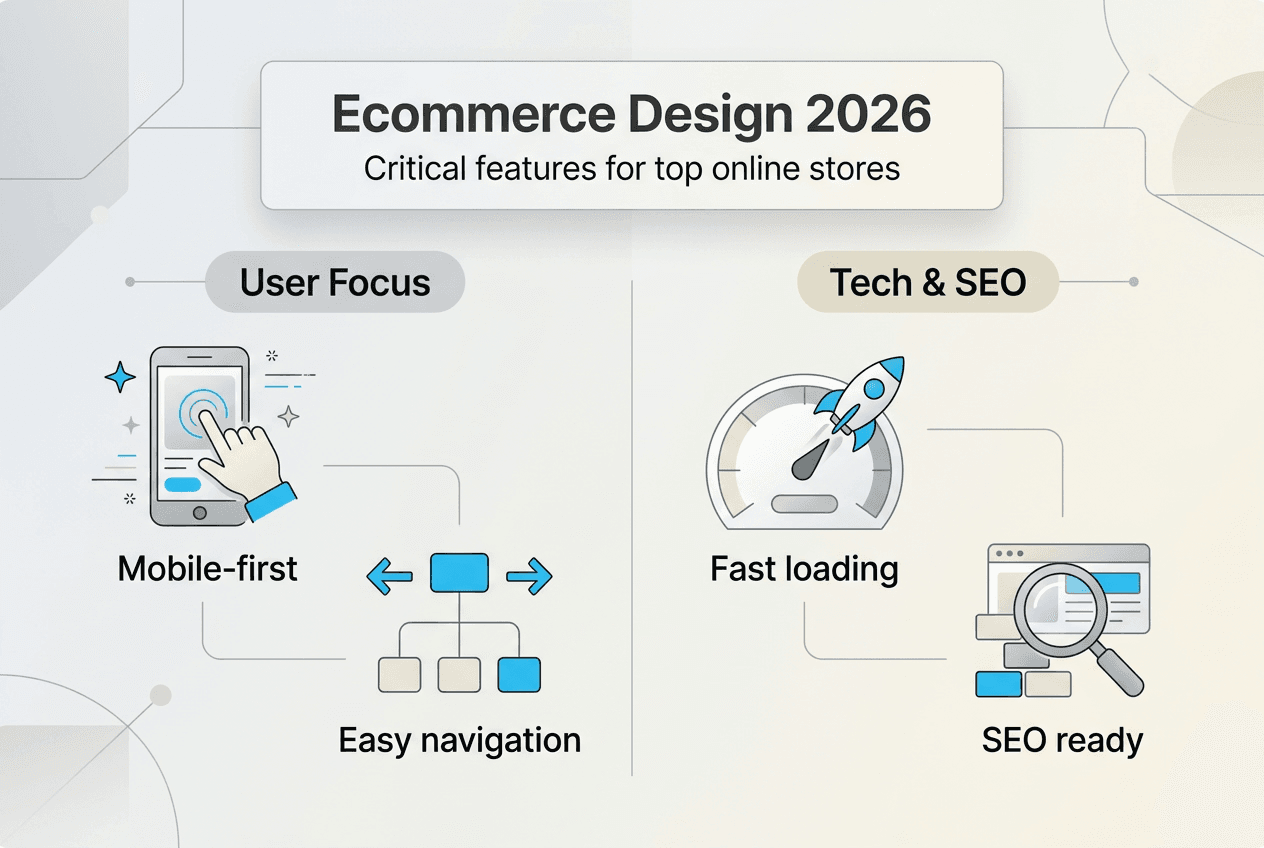
Mobile-first design stands paramount. Australian consumers increasingly shop via smartphones and tablets, expecting flawless experiences regardless of device. Responsive layouts adapt content intelligently, maintaining usability and visual appeal across screen sizes. Touch-friendly buttons, simplified navigation, and optimised images ensure mobile shoppers convert at rates matching desktop users.
Page speed directly influences both conversions and search rankings. Every second of load time costs sales. Fast-loading pages retain impatient shoppers and signal quality to search engines. A high-performing ecommerce site combines speed with usability and mobile responsiveness to drive better sales and search visibility.
Intuitive navigation reduces friction in customer journeys. Clear category structures, prominent search functionality, and logical product groupings help shoppers find desired items quickly. Breadcrumb trails show location within site hierarchy. Filters enable refinement by price, features, or ratings. Every navigation decision should answer the question: does this help customers buy faster?
SEO-optimised product pages capture organic traffic from search engines. Unique, detailed descriptions incorporating relevant keywords improve rankings. Structured data markup helps search engines understand product information, enabling rich snippets in results. High-quality images with descriptive alt text serve both accessibility and SEO. Customer reviews add fresh, keyword-rich content whilst building social proof.
Secure, streamlined checkout processes reduce cart abandonment. Multiple payment options accommodate customer preferences. Guest checkout removes unnecessary barriers. Progress indicators show completion stages. Trust signals like security badges and return policies build confidence. Autofill capabilities speed form completion.
| Design feature | Impact on business | Implementation priority |
|---|---|---|
| Mobile optimisation | Captures growing mobile commerce segment | Critical |
| Page speed | Reduces bounce rates, improves SEO | Critical |
| Intuitive navigation | Increases product discovery and sales | High |
| SEO product pages | Drives organic traffic growth | High |
| Secure checkout | Lowers cart abandonment rates | Critical |
| Professional imagery | Builds trust and showcases products | Medium |
Essential features for 2026 ecommerce success:
- Lightning-fast page loads under two seconds across all devices
- Mobile-responsive design that adapts seamlessly to any screen size
- Clear calls to action guiding customers toward purchase decisions
- Prominent search functionality with autocomplete and suggestions
- Product filtering and sorting options for easy browsing
- High-quality product photography with zoom capabilities
- Detailed, SEO-optimised product descriptions addressing customer questions
- Customer reviews and ratings building social proof
- Simplified checkout with multiple secure payment options
- Abandoned cart recovery systems recapturing lost sales
Pro Tip: Implement heatmap tracking to see exactly where customers click, scroll, and abandon. This data reveals design improvements that directly impact conversion rates, removing guesswork from optimisation decisions.
Understanding website design for user experience principles ensures every design choice serves customer needs. The high-performing ecommerce features that separate successful ecommerce designs from mediocre ones consistently prioritise user needs over aesthetic preferences.
Practical steps for Australian SMBs to improve ecommerce website design and drive growth
Small and medium Australian businesses can systematically improve ecommerce website design through strategic actions that deliver measurable results. These practical steps address common pain points whilst building foundations for sustainable growth.
Start with comprehensive performance audits. Evaluate current site speed using tools like Google PageSpeed Insights. Test mobile usability across actual devices. Review SEO performance through Search Console data. Identify technical issues causing slow loads, high bounce rates, or poor search visibility. Document specific problems before attempting solutions.
Consider platform migration if performance issues persist despite optimisation efforts. Businesses experiencing frequent crashes, slow page loads, or limited scalability should evaluate whether their current platform supports growth goals. The evidence is clear: integrating professional ecommerce web design with digital marketing strategies proves essential for Australian retail success. Platform limitations often represent the biggest barrier to improvement.
Prioritise mobile optimisation as a non-negotiable requirement. Review your site on smartphones and tablets. Test checkout flows on mobile devices. Ensure buttons are touch-friendly and text remains readable without zooming. Mobile experience directly impacts both customer satisfaction and search rankings in 2026.
Invest in professional design aligned with marketing objectives. Amateur design undermines brand credibility and wastes traffic from marketing campaigns. Professional designers understand conversion principles, accessibility standards, and SEO requirements. They create cohesive experiences that turn visitors into customers.
Implement regular content and SEO updates to maintain organic traffic growth. Search algorithms reward fresh, relevant content. Update product descriptions with customer language. Add new products promptly. Publish helpful content addressing customer questions. Monitor keyword rankings and adjust strategies based on performance data.
Actionable improvement steps:
- Conduct monthly site speed tests and address performance bottlenecks immediately
- Review mobile analytics to identify device-specific issues affecting conversions
- Update product photography to professional standards showcasing key features
- Implement structured data markup for better search engine understanding
- Add customer review systems building social proof and fresh content
- Simplify checkout flows, removing unnecessary form fields
- Set up abandoned cart email sequences recovering lost sales
- Create comparison guides helping customers choose between products
Systematic improvement process:
- Audit current performance across speed, usability, mobile, and SEO metrics
- Identify the three biggest issues constraining growth or conversions
- Prioritise fixes based on potential impact and implementation difficulty
- Implement changes methodically, testing results before moving forward
- Monitor analytics to confirm improvements deliver expected outcomes
- Document successful strategies for replication across other site areas
- Schedule quarterly reviews to maintain momentum and address new issues
Developing a comprehensive digital marketing strategy for retail ensures design improvements align with broader business goals. Understanding the role of web design in customer acquisition and retention helps prioritise investments. The ecommerce strategy case study demonstrates how systematic improvements compound into transformative business results.
How Titan Blue can help transform your ecommerce website design
Australian SMBs looking to establish or enhance ecommerce websites need partners who understand both design excellence and business outcomes. Titan Blue delivers expert web design services tailored specifically for businesses seeking competitive advantages through superior online experiences.
We improve website performance, user experience, and search engine visibility through integrated strategies addressing technical foundations and customer needs. Whether building new ecommerce sites from scratch or redesigning underperforming stores, our approach combines aesthetic appeal with conversion optimisation and SEO best practices.

Our services include complete website builds, strategic redesigns, platform migrations, and ongoing optimisation. We specialise in ecommerce web design that drives measurable sales growth whilst our ecommerce SEO services ensure your products reach customers actively searching for solutions. Partner with Titan Blue to build a winning ecommerce presence that boosts sales, strengthens brand trust, and delivers sustainable competitive advantages in the Australian market.
Frequently asked questions
What are the main components of ecommerce website design?
Ecommerce website design combines user experience, visual aesthetics, technical performance, and SEO optimisation. Key components include responsive layouts, intuitive navigation, fast page speeds, secure payment systems, and strategically placed calls to action. Professional design integrates these elements into cohesive systems that guide customers smoothly from discovery through purchase.
Why is mobile optimisation critical for ecommerce sites in Australia?
Australian consumers increasingly shop via mobile devices, expecting seamless experiences matching desktop functionality. Mobile-optimised sites capture this growing segment whilst benefiting from Google’s mobile-first indexing, which prioritises mobile experience in search rankings. Sites failing mobile users lose both immediate sales and long-term organic visibility.
How does ecommerce website design affect SEO and organic traffic?
Design decisions directly impact search rankings through technical factors like page speed, mobile responsiveness, and site structure. Well-designed product pages with optimised content, structured data, and quality imagery rank higher in search results. User experience signals like bounce rates and time on site also influence rankings, creating a virtuous cycle where good design drives better SEO performance.
What issues arise from slow or unstable ecommerce websites?
Slow sites frustrate customers, increasing bounce rates and abandoned carts. Crashes during peak periods lose immediate sales and damage brand reputation permanently. Poor performance signals low quality to search engines, reducing organic visibility. Collectively, these issues compound into significant revenue losses and competitive disadvantages that worsen over time.
When should a business consider redesigning or migrating its ecommerce site?
Redesign becomes necessary when experiencing persistent performance problems, declining conversion rates, or outdated user experiences. Platform migration makes sense if current technology limits growth, causes frequent technical issues, or lacks essential features. Businesses planning significant expansion should evaluate whether existing infrastructure supports projected growth before problems emerge.
Recommended

Web Development Gold Coast: Build for Growth and AI Search
Web Development Gold Coast: fast, secure, conversion-ready websites built for customers, Google and AI search.…

Gold Coast Web Design: What Makes a Website Work?
Gold Coast web design should attract the right people, answer their questions, earn trust and…

Website Design Gold Coast: The Process, Timeline, and What Makes a Site AI-Ready
A website design project on the Gold Coast typically runs through six stages: discovery, information…