


Australian small and medium businesses pour thousands into digital ads each month, yet many see disappointing returns. The gap between what you spend and what you earn back often comes down to strategy, not budget size. Online ads generate $152B revenue for Australian SMEs, with potential to reach $231B through better planning and tracking. This guide walks you through each step to build campaigns that deliver measurable results, from setting goals to optimising performance.
Table of Contents
- Understanding digital advertising for Australian SMEs
- Defining campaign goals and budget
- Selecting the right channels and formats
- Creating effective ad campaigns
- Tracking, optimisation, and closing the performance gap
- Common pitfalls and troubleshooting digital advertising
- Ready to accelerate your digital advertising results?
- Frequently asked questions
Key Takeaways
| Point | Details |
|---|---|
| Set realistic budgets | Allocate 7-10% of annual turnover to digital marketing and split wisely between search and social channels. |
| Choose platforms strategically | Focus on platforms delivering the best results for SMEs, like Google Ads and Meta Ads. |
| Always audit and optimise | Maximise your ROI by auditing campaign performance weekly and using AI tools with manual oversight. |
| Troubleshoot common pitfalls | Identify and address the typical causes of wasted ad spend with regular reviews and adjustments. |
| Measure and improve | Track results using clear metrics to close the performance gap and unlock greater growth. |
Understanding digital advertising for Australian SMEs
Digital advertising covers paid promotions across search engines, social media platforms, display networks, and video channels. For Australian SMEs, it offers precise targeting, measurable outcomes, and the ability to reach customers exactly when they’re searching for your products or services.
Why does this matter for your business? Traditional advertising casts a wide net with uncertain results. Digital ads let you target specific demographics, locations, and behaviours whilst tracking every click and conversion. You see exactly what works and what doesn’t.
Key benefits for Australian SMEs:
- Reach local customers searching for your services right now
- Control spending with daily budgets and bid adjustments
- Track performance in real time and adjust campaigns immediately
- Scale successful campaigns without proportional cost increases
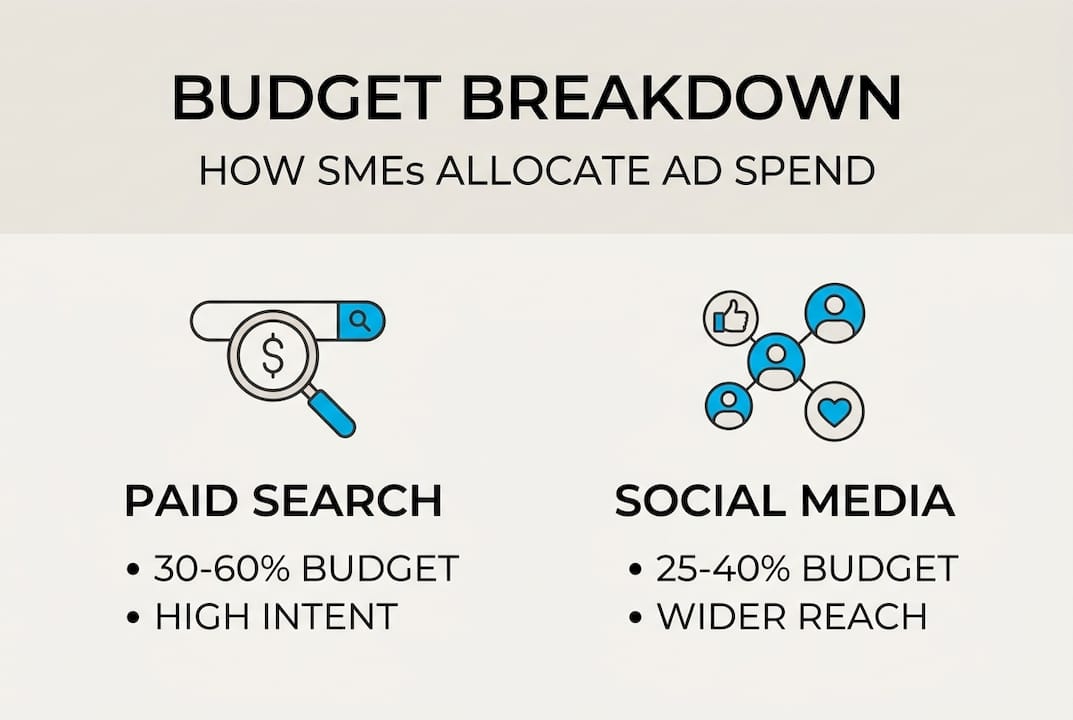
Australian SMEs should allocate 7-10% of annual revenue to digital marketing, with 30-60% directed to paid search and 25-30% to social ads. This allocation reflects where Australian customers spend their time online and where conversion rates justify the investment.
The digital advertising basics remain consistent across platforms, but execution varies significantly. Understanding digital advertising importance helps you prioritise channels that align with your business goals rather than spreading resources too thin.
Defining campaign goals and budget
Clear goals separate successful campaigns from expensive experiments. Start by identifying what you want to achieve: more website traffic, qualified leads, direct sales, or brand awareness. Each goal requires different campaign structures and metrics.
SMART goals for digital advertising:
- Specific: Define exactly what success looks like (50 qualified leads, not just “more leads”)
- Measurable: Choose metrics you can track (conversion rate, cost per acquisition)
- Achievable: Set targets based on industry benchmarks and your current performance
- Relevant: Align campaign goals with broader business objectives
- Time-bound: Establish clear timeframes for evaluation (monthly, quarterly)
For budget allocation, Australian SMEs should allocate 7-10% of annual revenue to digital marketing. Within that budget, split spending strategically across channels based on where your customers are most active.
| Campaign Goal | Primary Metric | Typical Budget Split |
|---|---|---|
| Lead generation | Cost per lead | 50% search, 30% social, 20% display |
| Direct sales | Return on ad spend | 60% search, 25% social, 15% remarketing |
| Brand awareness | Impressions, reach | 30% search, 40% social, 30% display |
| Website traffic | Click-through rate | 45% search, 35% social, 20% display |
Pro Tip: Start with 70% of your budget on proven channels and reserve 30% for testing new platforms or audiences. Review performance monthly and shift budget towards what’s working. This approach minimises risk whilst allowing room for discovery.
Your budget should flex based on seasonality and business cycles. Increase spending during peak periods when customer intent is highest, and scale back during slower months. Track digital marketing tips to refine your approach as you gather performance data.
Selecting the right channels and formats
Choosing the right advertising channels determines whether your budget works efficiently or drains without results. Each platform serves different purposes and reaches customers at various stages of their buying journey.
Core advertising channels for Australian SMEs:
- Search advertising: Captures customers actively searching for your products or services
- Social media ads: Builds awareness and engages customers based on interests and behaviours
- Display advertising: Maintains visibility across websites your customers visit
- Video advertising: Demonstrates products and tells your brand story visually
Paid search and social are primary channel investments for Australian SMEs because they deliver the highest conversion rates and most precise targeting options.

| Platform | Best For | Typical Cost | Key Advantage |
|---|---|---|---|
| Google Ads | High-intent searches | $2-15 per click | Captures active buyers |
| Meta Ads | Visual products, local services | $0.50-5 per click | Detailed audience targeting |
| LinkedIn Ads | B2B services | $5-20 per click | Professional targeting |
| Display Networks | Brand awareness | $0.20-2 per click | Wide reach, lower cost |
Mixing channels reduces risk and reaches customers at multiple touchpoints. Someone might see your social ad, then search for your business name, then click a display ad before converting. This multi-touch approach builds familiarity and trust.
Start with Google Ads strategies if you offer services people actively search for. Add social media ad services to build awareness and retarget website visitors who didn’t convert initially.
Creating effective ad campaigns
Building campaigns that convert requires attention to targeting, creative elements, and campaign structure. Each component must work together to guide customers from awareness to action.
Step-by-step campaign setup:
- Define your audience: Use demographic data, location targeting, and behavioural signals to reach ideal customers
- Structure campaigns logically: Group similar products or services together for easier management and optimisation
- Write compelling ad copy: Focus on benefits, include clear calls to action, and address customer pain points directly
- Design attention-grabbing visuals: Use high-quality images or videos that showcase your offering clearly
- Set appropriate bids: Start with automated bidding, then refine based on performance data
- Create dedicated landing pages: Match ad messaging to landing page content for higher conversion rates
Your ad creative makes the difference between clicks and scrolls. Headlines should promise specific benefits or solutions. Body copy must be concise and action-oriented. Images need to stop the scroll whilst clearly representing your offering.
Pro Tip: Integrate AI for bidding and copy suggestions, but audit results weekly. AI tools optimise faster than manual adjustments, but they can’t replace human judgment about brand voice and strategic direction.
Audience targeting determines who sees your ads. Start broad to gather data, then narrow targeting based on which segments convert best. Use remarketing to re-engage website visitors who didn’t convert on their first visit.
Campaign structure affects both performance and management efficiency. Organise campaigns by product category, service type, or geographic region. This structure makes it easier to allocate budget, analyse performance, and optimise individual campaign elements.
Follow crafting Google Ads best practices for search campaigns, and apply content marketing tips to create ad copy that resonates with your audience.
Tracking, optimisation, and closing the performance gap
Launching campaigns is just the beginning. Sustainable results come from consistent tracking, analysis, and refinement based on real performance data.
Essential metrics to monitor:
- Click-through rate (CTR): Measures ad relevance and appeal
- Conversion rate: Shows how many clicks turn into desired actions
- Cost per acquisition (CPA): Tracks how much you spend to gain each customer
- Return on ad spend (ROAS): Calculates revenue generated per dollar spent
- Quality Score: Indicates ad relevance and landing page experience
Regular auditing closes the performance gap between average and exceptional results. Online ads generate $152B for Australian SMEs, with potential to reach $231B through better tracking and optimisation.
Weekly optimisation framework:
- Review search terms and add negative keywords to prevent wasted spend
- Analyse conversion data to identify high-performing audiences and placements
- Test new ad variations against current best performers
- Adjust bids based on device, location, and time-of-day performance
- Update landing pages to improve conversion rates
Audit search terms, negatives, and conversions weekly to avoid waste. AI-powered tools accelerate optimisation, but human oversight ensures strategic alignment and catches errors automated systems miss.
Small, consistent improvements compound over time. A 10% increase in conversion rate or 15% reduction in cost per click might seem modest, but these gains significantly impact profitability over months and years.
Use troubleshooting Meta campaigns techniques when social ads underperform, and apply Google Ads optimisation strategies to search campaigns that plateau.
Common pitfalls and troubleshooting digital advertising
Most campaign failures stem from preventable mistakes. Recognising these issues early saves budget and accelerates results.
Frequent mistakes Australian SMEs make:
- Setting vague goals without clear success metrics
- Spreading budget too thin across too many channels
- Neglecting mobile optimisation when most traffic comes from phones
- Ignoring negative keywords, leading to irrelevant clicks
- Using generic ad copy that doesn’t differentiate from competitors
- Sending traffic to homepage instead of relevant landing pages
- Failing to track conversions properly, making optimisation impossible
- Abandoning campaigns too quickly before gathering sufficient data
When campaigns underperform, start troubleshooting systematically. Check targeting settings first, then review ad creative, then examine landing page experience. Often, the issue lies in misalignment between these elements rather than a single fatal flaw.
Integrate AI for bidding and copy, but audit weekly to catch drift and waste. Automated tools optimise towards the metrics you specify, but they can’t judge whether those metrics align with broader business goals.
Low conversion rates usually indicate problems with landing pages, offer clarity, or audience targeting. High costs per click suggest competitive keywords or poor Quality Scores. Low click-through rates point to weak ad creative or irrelevant targeting.
Proactive auditing prevents small issues from becoming expensive problems. Set calendar reminders for weekly reviews, and establish clear benchmarks for when to pause, adjust, or scale campaigns.
Learn from using Meta Ads effectively and master using Google Ads to avoid platform-specific pitfalls.
Ready to accelerate your digital advertising results?
You now have a structured approach to digital advertising that works for Australian SMEs. The difference between wasted budget and profitable campaigns comes down to strategic planning, consistent optimisation, and expert execution.
Many business owners find that professional support accelerates results whilst freeing time to focus on core operations. We specialise in building and managing campaigns that deliver measurable returns for Australian businesses.
Our digital advertising tutorial shows real results from retail clients who transformed their online presence. We combine strategic planning with hands-on campaign management across Google Ads, Meta platforms, and other channels that matter for your business.
Whether you need help launching your first campaign or optimising existing efforts, our social media ad services deliver the expertise and ongoing support that turns advertising spend into business growth. Get in touch to discuss how we can help you close the performance gap and achieve the results your business deserves.
Frequently asked questions
How much should an Australian SME spend on digital advertising?
Australian SMEs should allocate 7-10% of annual revenue to digital marketing, with budgets split between paid search and social ads. Start with this benchmark, then adjust based on your industry competitiveness and growth goals.
What digital advertising channel works best for small Australian businesses?
Google Ads and Meta ads are the top-performing channels for most Australian SMEs in 2026. Search ads capture high-intent customers, whilst social ads build awareness and enable precise targeting based on interests and behaviours.
How can I improve the results of my digital ad campaigns?
Regularly audit your campaigns, refine targeting, update creative, and use AI-powered tools to optimise bidding and ad copy. Weekly reviews of search terms, negative keywords, and conversion data prevent waste and identify opportunities for improvement.
What is the main reason digital advertising fails for SMEs?
Campaigns often fail from lack of clear goals, poor targeting, neglecting regular audits, and spreading budgets too thin. Success requires focused strategy, consistent optimisation, and patience to gather sufficient performance data before making major changes.
Can digital advertising really boost my business revenue?
Online ads generate $152B for Australian SMEs, with potential to reach $231B through better strategy and tracking. The right approach, combined with regular optimisation, can substantially grow your revenue by reaching customers exactly when they’re ready to buy.
Recommended
- What is digital advertising? A guide for Australian SMBs
- Digital Marketing in Australia A Growth Guide – Titan Blue Australia
- Why digital advertising matters for Australian businesses
- Digital marketing checklist for Australian SMBs in 2026
Make Titan Blue a preferred source in Google
One click tells Google to surface our articles more often in Top Stories, AI Overviews and AI Mode.

Solar Installer Website Design Australia: The 2026 Guide
How solar installer websites in Australia should show CEC accreditation, real install proof and AI-ready…

Hotel & Hospitality Website Design Australia: 2026 Guide
Hotel and hospitality website design in Australia explained: booking flow, schema, AEO and what actually…

Restaurant Website Design Australia: The 2026 Guide
What a restaurant website in Australia needs: HTML menus, bookings, GBP sync, schema, and AI-ready…