


Last updated:
A lot of small business owners are in the same spot right now. The phone still rings. Regulars still come back. Referrals still matter. But when someone nearby searches for a service you offer, your business barely shows up, or worse, it shows up below operators you know aren’t better than you.
That’s frustrating because the issue usually isn’t the quality of the business. It’s the lack of a clear digital strategy for small business. A good operator can run a great café in Broadbeach, install solar properly, or handle plumbing emergencies faster than anyone else, then still lose work online because their website is outdated, their Google Business Profile is neglected, and their content doesn’t answer the questions customers now ask search engines and AI tools.
In 2026, your digital presence does the work that used to rely on foot traffic, memory, and word of mouth alone. It answers questions after hours, qualifies leads, supports bookings, builds trust, and helps people choose you before they ever call. That’s why businesses that take digital seriously tend to outperform those that treat it as an afterthought. In Australia, 43% of digitally mature SMEs grow at over 10% annually compared to 14% of those with low digital maturity, according to the 2023 CSIRO findings referenced here.
From Local Gem to Digital Powerhouse
A local business owner often sees the same pattern. They know their trade. They know their customers. They’ve built a reputation the hard way. Yet online, they feel invisible.
Take a typical example. A plumber on the Gold Coast has years of experience, solid reviews from happy customers, and a ute booked most weeks. But when someone searches for emergency help, a larger franchise appears first, a directory scrapes the lead, and an AI summary surfaces answers from businesses that have structured their information better. The local expert gets missed.
A café owner faces the same problem in a different form. The food is good, the service is warm, and the venue looks great in person. Online, though, the menu is hard to find, booking details are buried, and the business doesn’t appear clearly when people ask AI-driven search tools where to eat nearby.
That’s where a proper roadmap matters. Digital strategy isn’t a pile of disconnected tasks. It’s not “do some SEO”, “post on Instagram”, and “maybe run ads later”. It’s a sequence of decisions about how customers discover you, what they see first, what convinces them, and what makes them act.
Practical rule: If your digital presence doesn’t make it easier for a customer to choose you, it’s decoration, not strategy.
A strong strategy turns your website, search visibility, reviews, social channels, and customer data into one system. That’s the difference between being online and being effective online. If you want the broader picture first, this guide to digital marketing for small business is a useful starting point.
Laying Your Strategic Foundation
Most wasted marketing spend comes from one problem. Businesses start promoting before they’ve worked out what they’re promoting, who they’re talking to, and what’s getting in the way.
That’s like building a house on sand. You can spend on ads, reels, content, and website upgrades, but if the basics are wrong, the results stay patchy.

Know the customer behind the click
Start with the actual customer, not the imaginary “target audience” that sounds tidy in a workshop. A restaurant owner needs to know whether customers are looking for quick weekday lunches, date-night ambience, family convenience, or group bookings. A solar installer needs to know whether buyers are focused on savings, energy independence, property value, or simple trust that the job will be done properly.
Listen to the language people use when they call, email, leave reviews, or ask questions in person. That language should shape your website headings, service pages, FAQs, Google Business Profile updates, and ad copy.
A practical way to do this is to write down:
- What they ask first. This might be price, timing, availability, location, or whether you service a particular suburb.
- What they worry about. For trades, that’s often trust, urgency, mess, or unexpected cost. For hospitality, it’s usually menu fit, ease of booking, parking, or atmosphere.
- What makes them choose. Fast response, proof of quality, clear service areas, before-and-after work, or recent photos often matter more than polished slogans.
If your digital strategy for small business isn’t built around actual customer questions, it won’t hold up in search or in AI results. Search engines and LLMs reward clarity.
Study the market without becoming obsessed with competitors
You do need to know what else is out there. You don’t need to spend weeks stalking every competitor’s feed.
Look for gaps instead. Most small businesses can spot them quickly once they stop admiring what others are doing and start evaluating where customers still feel friction.
For example:
- Weak local pages. Many businesses claim to service an area but provide no suburb-specific information.
- Thin service explanations. Plenty of websites say what they do without explaining how the process works.
- Poor review handling. Some businesses collect reviews but never respond, which wastes trust signals.
- No answer-focused content. Customers ask practical questions, yet businesses publish generic promotional copy.
The best opportunity is often where your competitors are present but unhelpful.
That’s especially true for AI visibility. If a customer asks a chatbot who installs solar in a specific area, or where to find a restaurant with suitable options for a group, the systems that feed those answers look for structured, consistent, trustworthy information.
If you want a deeper framework for this planning stage, this breakdown of what a digital marketing strategy is helps put the moving parts into order.
Audit what you already own
Before changing anything, get honest about the assets you already have. Most businesses are sitting on underused value.
Check these areas properly:
- Website performance. Is it fast on mobile? Are service pages clear? Can a visitor contact you without hunting around?
- Google Business Profile. Are trading hours accurate? Are categories right? Do photos reflect the current business?
- Social accounts. Are they active, relevant, and aligned with the brand, or abandoned and inconsistent?
- Reviews and reputation. Are reviews recent? Do they mention the services and suburbs you want to be known for?
- Content library. Have you already answered common questions somewhere that could be improved instead of rewritten from scratch?
A good audit doesn’t need to be fancy. It needs to be blunt. If the site is slow, say it. If the booking path is clunky, fix it. If your social media attracts the wrong audience, stop feeding it for the sake of appearances.
That foundation work isn’t glamorous, but it’s where good strategy starts.
Setting Clear Goals and Measurable KPIs
A lot of digital work fails because the business never defined success properly. Teams get busy, agencies produce activity, reports fill up with charts, and nothing ties back to the outcome the owner cares about.
That’s one reason this stage matters so much. According to an IBISWorld 2025 AU SME report, 70% of digital initiatives fail due to poor change management or unclear objectives, and one practical safeguard is setting business-first KPIs such as a 15% local search share, as noted in this summary of the AU SME finding.
Stop chasing vanity metrics
Not every metric deserves your attention. Page views can be useful. Followers can be useful. Reach can be useful. None of them mean much on their own if they don’t lead to enquiries, bookings, calls, or sales.
A restaurant should care more about booked tables, function enquiries, and repeat visits than random likes. A construction firm should care more about qualified quote requests than a spike in traffic from people outside its service area.
Here’s the difference:
- Vanity metric. “Our Instagram post got strong engagement.”
- Business KPI. “The booking page generated more completed reservations after that campaign.”
- Vanity metric. “Traffic increased.”
- Business KPI. “More visitors from target suburbs submitted quote forms.”
If a metric can’t help you decide what to do next, it probably doesn’t deserve a front-row seat in your reporting.
Build goals around the way your business makes money
Good goals are specific enough to guide action. They should match your business model, sales cycle, and operational capacity.
For a plumber, a useful goal might be increasing quote requests from the service area and reducing time wasted on low-quality leads. For a hospitality venue, it might be lifting online bookings for quieter periods or generating more direct enquiries for events. For a solar business, it might be improving the quality of leads by educating buyers before they request a consultation.
A practical goal usually has five parts:
- Specific. Name the outcome clearly.
- Measurable. Choose a number or a defined event.
- Achievable. Match it to available budget and team capacity.
- Relevant. Tie it to revenue, retention, or efficiency.
- Time-bound. Give it a deadline.
The key is restraint. Don’t set ten goals. Pick a few that matter and run the business around them.
Connect marketing data to customer management
Many small businesses lose the thread by tracking leads in one place, enquiries in another, invoices somewhere else, and social messages in a team member’s phone. Then they wonder why reporting feels vague.
A CRM closes that gap. It lets you connect the first click to the final sale and often reveals which channels produce real customers rather than noise. If you want a practical overview of that side of operations, how CRM transforms Australian businesses is worth reading because it explains the operational side of growth, not just the marketing side.
The simpler your KPI system is, the more likely your team will use it. That’s the standard to aim for.
Mastering Your Digital Visibility in 2026
Digital visibility used to mean ranking in Google and maybe showing up on Maps. That’s no longer enough. Customers still search in the traditional way, but they also ask direct questions inside AI tools, voice interfaces, map platforms, and search results that answer the question without sending the click.
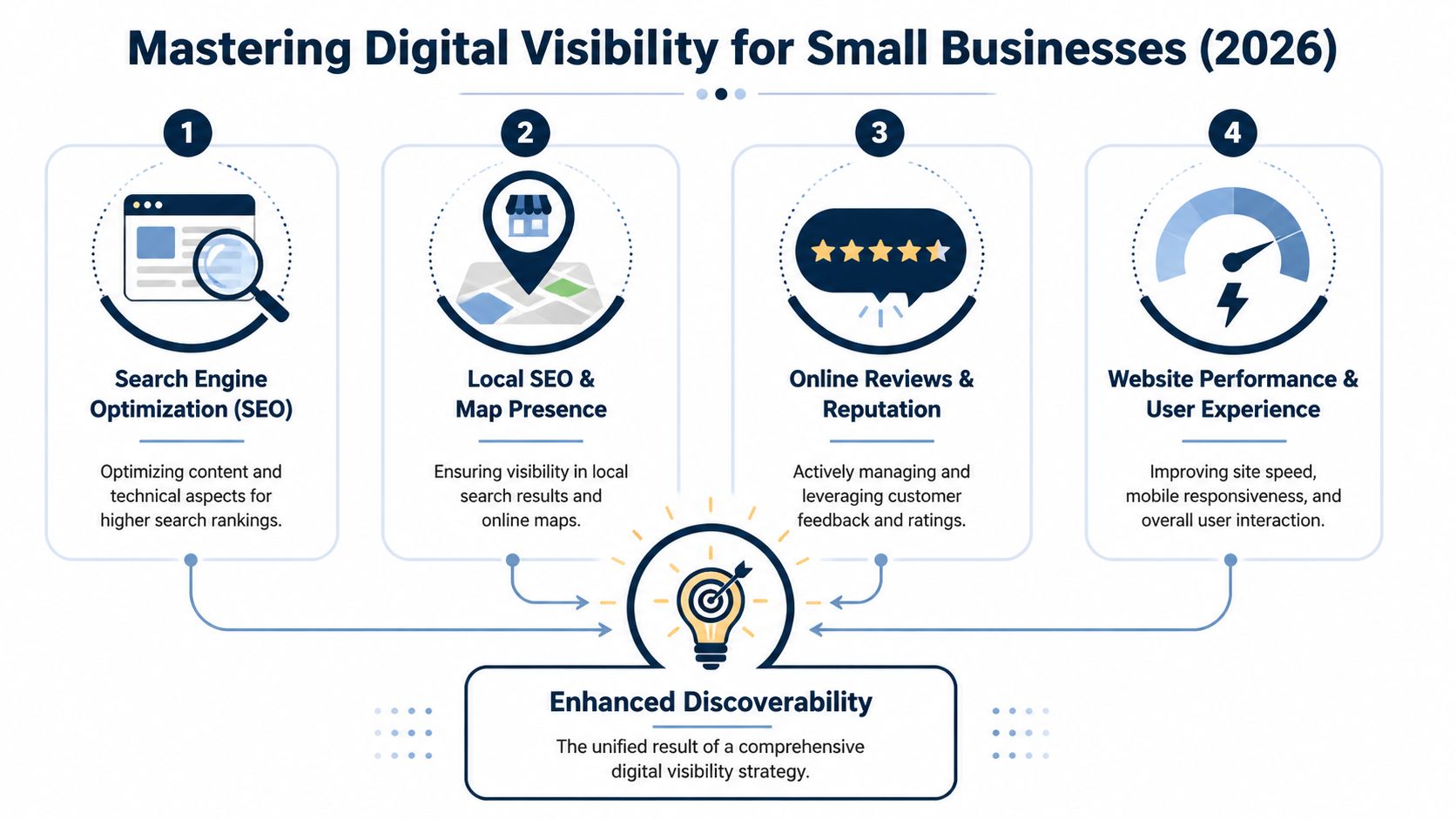
That changes how a digital strategy for small business needs to work. Your website, local SEO, reviews, and answer-focused content can’t sit in separate silos. They need to support one another.
Your website is the operating base
Every other channel points back to the site. Ads send traffic there. Your Google Business Profile links there. Social posts validate it. AI systems look for clear, structured information on it.
If the website is slow, confusing, or thin on substance, the whole strategy weakens.
For small business, a high-performing site usually gets the basics right:
- Clear service pages. One service per page, written in plain language.
- Obvious contact paths. Phone, form, booking, and location details should be easy to find.
- Mobile-first layout. Users are unlikely to judge your site from a desktop in an office. They will evaluate it from a phone in a car park, on a lunch break, or after hours.
- Trust signals. Reviews, project photos, service areas, accreditations, and FAQs reduce hesitation.
Don’t overcomplicate it. A customer should know within seconds whether you do the work they need, where you do it, and what to do next.
SEO is structure, not stuffing
Traditional SEO still matters, but the old habit of cramming keywords into every heading is dead weight. Good SEO now is about organising information so people and machines can understand it quickly.
That means your site should answer practical questions with precision. A plumbing page should explain services, response areas, common issues, and next steps. A restaurant page should make menu, location, bookings, parking, and trading details simple to confirm.
Strong SEO for local businesses usually includes:
- Service pages matched to intent. Not just “Plumbing Services”, but pages built around the work customers search for.
- Location relevance. Clear service areas, suburb references where appropriate, and consistent business details.
- Internal linking. Help users and search engines move logically through the site.
- Useful FAQs. These support both rankings and answer extraction in AI systems.
For local operators, SEO for local businesses remains one of the strongest levers because it improves visibility where buying intent is already high.
Local search wins happen in the details
For trades, hospitality, and service businesses, local visibility often decides whether the lead goes to you or someone else.
Your Google Business Profile is part listing, part conversion page, part trust layer. Many small businesses set it up once and leave it stale. That’s a mistake. Customers use it to check opening hours, call buttons, directions, photos, reviews, and recent activity before they even look at the website.
The work that lifts local visibility is rarely glamorous:
- Keep categories accurate
- Upload current photos
- Respond to reviews thoughtfully
- Publish updates when useful
- Make sure name, address, and phone details stay consistent across platforms
For restaurants, local search is tightly connected to decision-making. So are reviews, photos, and menu clarity. If you want an outside perspective on that customer journey, this guide on attracting and retaining restaurant diners is useful because it focuses on what nudges someone from browsing to booking.
Good local SEO doesn’t just help people find you. It helps them stop searching.
AEO is no longer optional
This is the shift many businesses still haven’t processed. Search behaviour has changed. Customers now ask AI tools full questions instead of typing two or three blunt keywords.
They don’t just search “plumber Gold Coast”. They ask which plumber can fix low water pressure, services their suburb, and has reliable reviews. They don’t just search “Broadbeach restaurant”. They ask where to book dinner for a group, with a certain atmosphere, near parking, open at a specific time.
That’s where Answer Engine Optimisation, or AEO, comes in. It means creating and structuring content so AI systems can extract, trust, and present your information as an answer.
This matters because only 15% of small businesses in Australian construction and hospitality have an AEO strategy, while 62% of consumers use AI chatbots for local service queries, creating a 40% visibility gap in zero-click searches, according to the Sensis 2025 Digital Report summary referenced here.
What AEO looks like in practice
AEO isn’t magic. It’s disciplined clarity.
Businesses improve AI visibility when they:
- Write direct question-and-answer content. Use real customer questions, not internal jargon.
- Structure pages cleanly. Strong headings, concise answers, supporting detail, and obvious next steps.
- Add useful FAQs to service pages. Not filler. Practical questions people ask before buying.
- Keep local facts consistent. AI tools rely on consistency across your website, business listings, and public references.
- Show evidence. Reviews, credentials, service areas, and process explanations support trust.
A solar company might publish a page answering whether solar is still worth it for a particular type of household and what the installation process involves. A café might answer whether it takes group bookings, offers particular menu options, or is suitable for early breakfasts near a local precinct. A plumber might answer common emergency questions with suburb relevance and service availability.
The point isn’t to flood the site with content. The point is to publish the right answers in the right format.
Reviews, reputation, and machine trust
Reviews influence people. They also influence discoverability.
A healthy review profile gives search engines and AI systems extra confidence that your business is active, relevant, and trusted. But a pile of stars without context is weaker than detailed feedback that mentions specific services, outcomes, and locations.
Ask for reviews in a way that encourages useful detail. Then respond properly. Thank the customer. Mention the work where appropriate. Stay human. Avoid robotic copy-and-paste replies.
That does two things. It improves trust with future customers, and it strengthens the business signals that modern search systems rely on.
One system, not four separate jobs
Businesses get better results when they stop treating website performance, SEO, local search, reviews, and AEO as separate marketing tasks owned by different people who don’t speak to each other.
They’re one visibility system.
If the website is fast but the service pages are vague, you lose. If the SEO is solid but the Google Business Profile is neglected, you lose. If the local listing is strong but your content doesn’t answer questions clearly enough for AI extraction, you lose.
When those pieces line up, small businesses punch above their size. That’s what future-proof visibility looks like in 2026.
Amplifying Your Message with Content and Social Media
A lot of businesses make the same mistake with content and social media. They try to be everywhere, produce too much, and end up sounding like everyone else.
That approach drains time, burns budget, and gives the owner one more thing to resent.

Pick channels that fit the business
Content should match how customers buy. Trades usually need trust, proof, speed, and local relevance. Hospitality often needs visual appeal, atmosphere, timing, and repeat engagement. Construction and higher-consideration services need explanation, evidence, and follow-up.
That means the right channels vary.
A plumber may get more value from a strong Google Business Profile, a practical website FAQ, review generation, and occasional local social content than from trying to dance across every platform. A restaurant may benefit from strong visual storytelling on Instagram, regular booking-focused updates, review responses, and timely offers tied to quieter periods.
ABS data from 2024 shows that 76% of Australian small businesses use digital platforms for marketing, and businesses with optimised digital presences, including active social media management, saw 41% higher customer retention rates, as referenced in this 2024 Australian small business marketing summary.
That doesn’t mean every platform is worth your effort. It means the right platform, used well, can strengthen retention as well as reach.
Content should answer, show, and reassure
Most small business content fails because it talks about the business instead of helping the customer make a decision.
Useful content generally does one of three jobs:
- Answer. Clarify common questions before the customer asks them directly.
- Show. Demonstrate the quality of the work, venue, process, or result.
- Reassure. Remove uncertainty around timing, pricing approach, what happens next, or whether you service a certain area.
For trades, that could look like short videos explaining common issues, before-and-after job photos, or articles that explain when a repair is urgent and when it can wait. For hospitality, it might be menu highlights, behind-the-scenes preparation, venue walk-throughs, or seasonal booking prompts.
If you want to build content with purpose instead of posting randomly, content marketing for small business is a good framework because it ties content to commercial outcomes.
Content works best when it removes friction. It doesn’t need to be clever. It needs to be useful.
Use paid reach when speed matters
Organic content builds trust over time. Paid campaigns help when you need momentum, sharper targeting, or more control.
That can make sense when:
- You’ve launched a new service
- You need leads in a specific area
- You want to promote a time-sensitive offer
- You’re supporting a strong page that already converts
The mistake is boosting weak content or sending paid traffic to pages that don’t do the selling. Paid media amplifies whatever already exists. If the message is vague or the page is poor, the budget just helps more people bounce.
A short explainer can help clarify how video fits into that mix:
Consistency beats volume
You don’t need an endless stream of content. You need a repeatable rhythm your business can sustain.
That might mean one strong article a month, a handful of useful social posts each week, regular review requests, and a few focused campaigns through the year. For many small businesses, that outperforms ambitious content calendars that collapse after three weeks.
The businesses that get traction are rarely the ones making the most noise. They’re the ones saying the right thing, on the right channels, often enough that customers remember them.
Smart Budgeting and Proving Your Digital ROI
Small business owners are right to be cautious with marketing spend. Cash flow matters. Margins matter. Time matters. If the investment can’t be tied back to something commercial, it starts to feel like a gamble.
That pressure is real. With 71% of Australian SMBs citing budget as their top barrier, and 52% of QLD SMBs pausing digital investments after post-2025 rate hikes, careful allocation matters. The same source notes that AI automation cut operational costs by 28% for early adopters in solar and plumbing, according to this Australian small business digital transformation summary.
Start with priorities, not channels
Don’t ask, “How much should I spend on social media?” first. Ask what the business most needs.
If lead flow is inconsistent, the budget may need to favour search visibility, local SEO, and conversion improvements. If awareness is the issue, content and targeted ads may deserve more attention. If leads exist but follow-up is weak, the best investment might be CRM setup, automation, or landing page fixes rather than more traffic.
A practical budget discussion usually comes down to three buckets:
- Foundation. Website fixes, landing pages, analytics, tracking, and local profile optimisation.
- Visibility. SEO, AEO, reviews, content, and local search work.
- Acceleration. Google Ads, paid social, remarketing, and short-term campaigns.
Businesses waste less when they fund these in order instead of chasing the shiny option first.
Track the whole path from click to customer
ROI becomes clearer when you track a few core actions properly. For most small businesses, that means watching calls, forms, bookings, quote requests, and key page visits inside tools such as Google Analytics 4 and your CRM.
That doesn’t require a huge reporting stack. It requires discipline.
Review questions like these each month:
- Which channels generated enquiries
- Which enquiries were qualified
- Which pages influenced the conversion
- Which campaigns produced real customers
- Where did prospects drop off
If a campaign generates traffic but no quality leads, that’s useful information. If a page gets plenty of visits but few conversions, that points to a messaging or UX issue. If one service line converts far better than another, budget allocation should respond to that.
Keep ROI simple enough to use
Most owners don’t need a complex attribution model to make better decisions. They need a practical way to tell whether spend is creating commercial value.
At its simplest, ROI is about comparing what you spent with what came back in revenue or margin. Even if your sales cycle is longer, you can still evaluate lead quality, booking volume, close rates, and customer value over time.
The point of measurement isn’t to create prettier reports. It’s to make the next budget decision easier.
For paid search specifically, this overview of how much Google Ads cost is useful because it helps frame spend in terms of competition, targeting, and business goals rather than guesswork.
When businesses treat measurement as part of operations, not just marketing, the budget conversation gets a lot less emotional.
Your Digital Strategy Is a Marathon Not a Sprint
A digital strategy for small business isn’t a one-off project you tick off and forget. Search changes. AI visibility changes. Customer behaviour changes. Your own business changes too.
That’s why the strongest operators treat digital as an ongoing business function. They review what customers are asking, tighten the website, improve local visibility, publish useful content, measure the right KPIs, and adjust. Then they do it again.
The businesses that win online usually aren’t the loudest. They’re the most consistent. They build a solid foundation, choose sensible goals, get visible where customers are already looking, and keep refining what works.
That approach suits small business because it’s practical. You don’t need endless activity. You need a system that gets sharper over time.
If your business needs a clearer plan, Titan Blue Australia helps small businesses across the Gold Coast and Australia build digital strategies that are grounded in real commercial outcomes. From custom websites and SEO to AEO, AI Search visibility, social media management, and long-term digital growth, the focus stays where it should be. On helping good businesses get found and chosen.
Make Titan Blue a preferred source in Google
One click tells Google to surface our articles more often in Top Stories, AI Overviews and AI Mode.

Best Dental Website Design Agencies in Australia: 7 Compared
Best dental website design agencies in Australia 2026: seven compared on dental proof, booking, AHPRA…

Childcare Centre Website Design Australia: The 2026 Guide
Childcare centre website design Australia: show hours, ages and enrolment as text so parents and…

Electrician Website Design Australia: The 2026 Guide
Electrician website design Australia: what to build, what we found on eight Gold Coast electrician…