


TL;DR:
- Effective social media management involves strategy, content creation, engagement, platform oversight, and analytics.
- Focus on 1-3 platforms, create valuable content, and track metrics tied to business outcomes.
- Prioritize authentic relationships over volume to build trust and generate measurable results.
What is social media management? Essential guide for SMBs
Most business owners think social media management means posting a photo on Facebook and calling it a day. It doesn’t. Real social media management is a structured, ongoing process that covers strategy, content creation, audience engagement, platform oversight, and performance analysis. Done right, it connects directly to your business goals and drives measurable results. Effective SMM starts with 1 to 3 platforms, content calendars, and metrics tied to business outcomes. This guide breaks down what social media management actually involves and how Australian small to medium-sized businesses can use it to grow.
Table of Contents
- What social media management really means
- Core strategies for effective social media management
- Tailoring your platform and content choices
- Measuring success: Analytics and business outcomes
- Rethinking social media management for small businesses
- Accelerate your results with expert support
- Frequently asked questions
Key Takeaways
| Point | Details |
|---|---|
| Focus your efforts | Start with one to three social platforms that matter most to your customers rather than spreading too thin. |
| Strategise and systemise | Use content pillars, batching, and editorial calendars for consistent, impactful social media activity. |
| Connect activity to outcomes | Measure what matters by tracking leads and ROI, not just likes or followers. |
| Tailor your content | Customise posts by platform and business objective for best results. |
| Revisit and refine | Regularly analyse your data and refine your strategy to keep improving performance. |
What social media management really means
Let’s clear something up. Social media management is not just scheduling posts. It is a multi-layered discipline that, when done properly, becomes one of your most powerful tools for building trust, generating leads, and keeping your business visible to the right people.
At its core, social media management covers five distinct areas:
- Strategy: Deciding which platforms to use, who you are trying to reach, what your goals are, and how content fits into your broader marketing plan.
- Content planning: Building an effective content plan that maps out what you will publish, when, and why. This includes content pillars, themes, and formats.
- Engagement: Responding to comments, messages, reviews, and mentions in a way that builds relationships and keeps your audience coming back.
- Platform management: Keeping your profiles updated, monitoring performance, and adapting your approach as platform algorithms shift.
- Analytics: Reviewing the numbers to understand what is working, what is not, and where you should invest your time and energy next.
The most common misconception is that social media is a broadcast channel. Many business owners treat it like a digital billboard, pushing out promotional content and expecting sales to follow. That approach rarely works. Audiences on social platforms are looking for connection, information, and value. If all you do is advertise, people scroll past.
Real social media management means showing up consistently with content that serves your audience, not just your sales targets. It means replying to a customer’s question on Instagram at 7pm, or posting a behind-the-scenes video that builds personality around your brand. These actions compound over time.
“The businesses that win on social media are the ones treating it as a relationship-building tool, not just a sales channel.”
For Australian SMBs, this is especially relevant. Local audiences respond well to authentic, community-focused content. They want to know who is behind the business, whether you share their values, and whether you are worth their trust before they spend a cent.

Key methodologies for SMBs include developing content pillars, batching content, using calendars, and posting three to five times per week on one to three platforms. These are not arbitrary recommendations. They reflect what actually produces sustainable results without burning out your team or budget. For more practical guidance tailored to Australian businesses, the marketing tips for SMBs on our site cover the broader digital picture.
Core strategies for effective social media management
Understanding what social media management is gets you halfway there. Knowing which strategies to apply gets you the rest of the way. Let’s break down the methods that consistently deliver results for small businesses.
1. Define your content pillars. Content pillars are the three to five core themes your brand consistently talks about. For example, a Gold Coast café might use pillars like seasonal menus, local community events, behind-the-scenes preparation, and customer spotlights. Pillars give you a repeatable structure so you never stare at a blank screen wondering what to post.
2. Batch your content creation. Instead of creating posts one at a time, dedicate a block of time each week or fortnight to produce multiple pieces at once. Batching reduces decision fatigue, keeps your quality consistent, and ensures you always have content ready to go. A two-hour session can produce a full week of posts.
3. Use a content calendar. A calendar maps out exactly what publishes on which day across which platform. It prevents gaps, avoids repetition, and helps you plan around campaigns, promotions, or seasonal events. Even a simple spreadsheet works. The discipline of having a calendar changes everything.
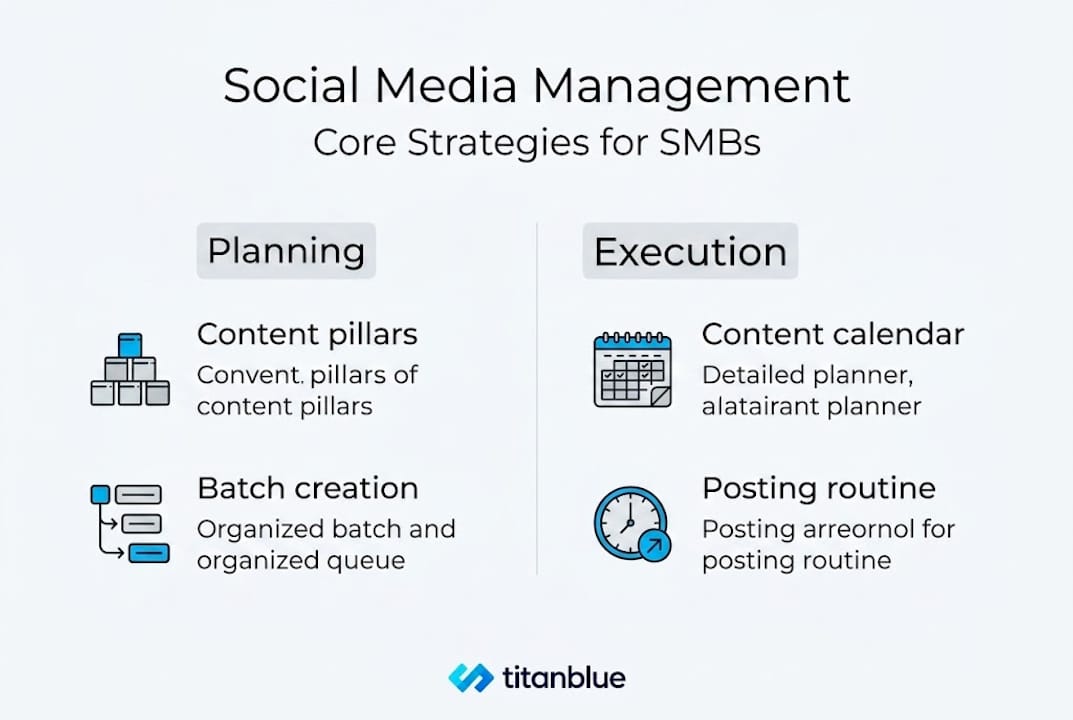
4. Stick to a posting frequency that’s sustainable. The optimal posting frequency for most SMBs is three to five times per week. Posting less than three times often leads to algorithm penalties and audience disengagement. Posting seven days a week without a team behind you usually leads to burnout and declining quality.
5. Follow the 80/20 rule. Eighty per cent of your content should provide genuine value to your audience: tips, insights, entertainment, community updates. Twenty per cent can be promotional. This ratio keeps your feed useful rather than sales-heavy, which actually leads to more sales over time.
| Strategy | What it involves | Likely result |
|---|---|---|
| Content pillars | Themed content categories | Consistent brand voice |
| Batching | Bulk content creation | Time savings, quality control |
| Content calendar | Scheduled publishing plan | Fewer gaps, better planning |
| 3 to 5 posts per week | Regular posting rhythm | Algorithm favour, engagement |
| 80/20 value rule | Mostly helpful, some promo | Audience trust and sales |
Applying these strategies does not require a large budget. It requires discipline and a clear plan. Start with one platform, master these methods, then expand. Creating content that pops is easier when you have a structure to work within. You can also explore our guide to shareable content and what makes content people love to develop your approach further.
Pro Tip: If you are a service-based business, your strongest content pillar is almost always social proof. Client testimonials, before-and-after results, and case studies perform better than product photos in most industries. Test this with your audience and let the data guide you.
Tailoring your platform and content choices
Not every platform deserves your time. One of the most expensive mistakes Australian SMBs make is trying to be everywhere at once. They spread their energy across Facebook, Instagram, LinkedIn, TikTok, and Pinterest, then wonder why nothing is gaining traction. Focus beats volume every time.
Start by asking where your customers actually spend their time online. A B2B consultancy in Brisbane will find more traction on LinkedIn than on TikTok. A fashion boutique on the Gold Coast will thrive on Instagram. A local tradesperson might find Facebook Groups the most direct route to new clients. Your platform choice should follow your audience, not trends.
Here is a breakdown of the major platforms and where they typically perform best:
| Platform | Best content type | Audience strength |
|---|---|---|
| Video, community posts, ads | Broad demographic, local groups | |
| Visuals, stories, reels | 18 to 40, visual brands | |
| Articles, case studies, B2B content | Professionals, business owners | |
| TikTok | Short video, trends | Under 35, entertainment-focused |
| Infographics, lifestyle visuals | DIY, fashion, home, food |
Starting with 1 to 3 platforms and using metrics tied to business leads and ROI gives you far better returns than spreading thin. Once you have identified your platforms, align your content types accordingly.
Key tips for focusing your platform efforts:
- Choose platforms based on where your target audience already spends time, not personal preference.
- Audit your current accounts. Remove or archive profiles you cannot commit to maintaining properly.
- Adapt content formats to each platform rather than posting identical content across all channels.
- Measure which platform drives the most website clicks, enquiries, or conversions, not just which one gets the most likes.
- Review your platform strategy every three to six months as audience behaviours shift.
If you are unsure where to start or how to evaluate your options, looking at how SMM companies in Australia approach platform selection can give you useful context. And if managing it all feels like too much, choosing a marketing agency that understands your industry and target audience is a legitimate next step.
Pro Tip: Before committing to any platform, spend 30 days consuming content on it as a user. Observe what formats get engagement, which accounts your competitors run, and how your audience interacts. This research phase saves months of trial and error.
Measuring success: Analytics and business outcomes
You can post brilliantly crafted content every single day and still not know if it is actually helping your business. That is the trap many SMBs fall into. Without measurement, social media management becomes guesswork.
Effective social media management ties metrics to actual business outcomes like leads and ROI, not just raw follower counts or post impressions. Follower numbers are vanity metrics. What matters is whether social media is generating enquiries, website visits, or sales.
Here are the steps to build a simple but effective measurement process:
- Set SMART objectives before you start. SMART stands for Specific, Measurable, Achievable, Relevant, and Time-bound. Instead of “grow our Instagram,” try “increase Instagram profile visits by 25 per cent in 90 days.”
- Track the metrics that connect to revenue. These include website clicks from social, lead form completions, product page visits, and direct messages that convert to bookings or sales.
- Use platform-native analytics first. Facebook Insights, Instagram Professional Dashboard, and LinkedIn Analytics are free and provide reliable data on reach, engagement, and audience demographics.
- Connect Google Analytics to your social traffic. Use UTM parameters in your links to see exactly which posts are driving website traffic and what those visitors do once they arrive.
- Review and adapt monthly. Set a monthly review date. Compare your results against your SMART objectives. Adjust your content mix, posting times, or platforms based on what the data tells you.
Statistic: Businesses that actively track social media ROI are significantly more likely to report consistent growth in lead quality compared to those that post without a measurement framework.
Common analytic mistakes to avoid:
- Measuring reach without tracking click-through rates or conversions.
- Focusing on likes rather than saves, shares, or link clicks.
- Comparing your metrics to large brands with teams and budgets you do not have.
- Only reviewing data when something goes wrong rather than on a consistent schedule.
- Ignoring audience demographics data when deciding what content to produce next.
For a detailed look at growing your SMB ROI through social media, we have put together a resource specifically for Australian businesses navigating this in 2026. The key takeaway is simple: measure what matters to your business, not what looks impressive in a screenshot.
Rethinking social media management for small businesses
Here is something most social media advice will not tell you: more is rarely better. The dominant narrative pushes volume. Post every day. Be on every platform. Chase every trend. For small businesses with limited time and resources, this advice is not just unhelpful, it is actively harmful.
The businesses we see getting the best results are not the ones posting seven days a week across five platforms. They are the ones showing up three to four times a week with content that is genuinely useful, visually consistent, and true to who they are. Authenticity is not a buzzword here. It is a competitive advantage that large brands with corporate communications teams genuinely struggle to replicate.
Vanity metrics are a distraction. Ten thousand followers who never buy from you are worth less than five hundred engaged, loyal customers who share your content and refer their friends. When you anchor your content planning perspective to real business outcomes rather than popularity contests, everything shifts.
Our honest advice: resist the urge to copy what big brands do. Your size is your strength. You can respond personally, tell real stories, and build genuine relationships at a scale a corporation never could. Lean into that. Fewer, better actions will always beat more, scattered ones.
Accelerate your results with expert support
If you have made it through this guide, you now understand that social media management is a serious business discipline, not a casual activity. Applying everything here takes time, skill, and consistency. For many business owners, that is a real constraint.
Titan Blue works with Australian SMBs to take this pressure off your plate entirely. Whether you need a full practical SMM guide to build your own approach, or you are ready to hand over execution to a team that delivers measurable results, we have the solutions. Our expert SMM solutions are built around your goals, your audience, and your industry. Explore the full range of digital marketing for SMBs and find out what a focused, strategic approach can do for your business. Get in touch now.
Frequently asked questions
What is the difference between social media management and social media marketing?
Social media management covers content scheduling, engagement, and analytics as an ongoing process, while marketing focuses specifically on running paid or organic campaigns to grow your audience or drive sales.
How often should small businesses post on social media?
Posting three to five times per week on your primary platforms delivers consistent engagement without overextending your resources or compromising content quality.
Which social media platforms are best for Australian SMBs?
Australian SMBs should focus on one to three platforms where their target audience is most active, with Facebook, Instagram, and LinkedIn being the strongest starting points for most industries.
What’s the most important metric to track in social media management?
The most valuable metrics are those tied to real business outcomes. Prioritise leads and actual ROI over raw engagement figures like likes or follower counts.
Recommended
- Social Media Managers Brisbane Guide to Boost SMB Growth
- Social Media Marketing Company: Your guide to a social media marketing company
- what is social media management? A Practical Guide to Growing Your Brand
- A Guide to Social Media Marketing Services
Make Titan Blue a preferred source in Google
One click tells Google to surface our articles more often in Top Stories, AI Overviews and AI Mode.

Solar Installer Website Design Australia: The 2026 Guide
How solar installer websites in Australia should show CEC accreditation, real install proof and AI-ready…

Hotel & Hospitality Website Design Australia: 2026 Guide
Hotel and hospitality website design in Australia explained: booking flow, schema, AEO and what actually…

Restaurant Website Design Australia: The 2026 Guide
What a restaurant website in Australia needs: HTML menus, bookings, GBP sync, schema, and AI-ready…