


TL;DR:
- Nearly half of all Google searches have local intent, yet many Australian SMEs neglect local SEO, losing daily customer opportunities. Local SEO enhances visibility in location-specific search results, driving qualified leads, and building reputation through reviews and citations. Investing early and consistently in local SEO offers long-term competitive advantages and measurable growth for small businesses.
Nearly half of all Google searches have local intent, yet most Australian small and medium businesses spend little to nothing on local search engine optimisation. That gap is costing them customers every single day. Consumers search for services near them constantly, whether it is a plumber on the Gold Coast or a café in Melbourne. If your business does not appear in those results, your competitor does. This guide explains exactly what local SEO is, why it delivers strong returns for Australian SMEs, and what practical steps you can take right now to make your business more visible where it matters most.
Table of Contents
- What is local SEO and why does it matter?
- Five compelling reasons to invest in local SEO
- Comparing local SEO to other digital marketing tactics
- Practical steps to kickstart your local SEO success
- Avoiding common local SEO pitfalls
- The uncomfortable truth about local SEO most business owners miss
- Partner with experts to elevate your local SEO results
- Frequently asked questions
Key Takeaways
| Point | Details |
|---|---|
| Local relevance matters | Appearing in local searches means more customers can actually find and visit your business. |
| Start with the basics | Claiming your Google Business Profile and ensuring accurate listings provides a fast SEO win. |
| Investment pays dividends | Consistently improving local SEO can deliver higher ROI compared to many paid ads. |
| Avoid common pitfalls | Ignoring accuracy or reviews can undermine your SEO efforts and hurt your reputation. |
| Early action wins | Getting ahead in local SEO now helps you build lasting authority over later competitors. |
What is local SEO and why does it matter?
Local SEO (search engine optimisation) is the process of making your business more visible in search results that include a geographic component. Think of searches like “restaurants near me,” “plumber Gold Coast,” or “accountant Brisbane CBD.” These searches signal strong buying intent. The person is not just browsing. They are ready to take action.
General SEO focuses on ranking for broad keywords with national or global audiences in mind. Local SEO narrows that focus to a specific area. It puts your business in front of people who are physically close to you and actively looking for what you offer. That difference matters enormously for small and medium businesses.
Here is what local SEO specifically targets:
- Google Business Profile listings (the map results that appear at the top of local searches)
- Location-specific keywords on your website pages
- Business citations across online directories like Yellow Pages and True Local
- Customer reviews on Google and other platforms
- Local backlinks from community websites, local media, and industry directories
The local SEO importance cannot be overstated. Search intent has shifted dramatically over the past few years. People expect hyper-relevant results that match not just their query but their exact location. Google’s algorithms now factor in proximity, relevance, and prominence when deciding which businesses to show in local results.
Pro Tip: Even if you have a strong general website, you can still be invisible in local searches if you have not specifically optimised for your area. Local SEO is a separate discipline that requires its own strategy.
For Australian businesses operating in competitive markets, local SEO is often the fastest path to qualified leads. Someone searching “emergency electrician Broadbeach” is not exploring options. They need help now. Appearing at the top of those results is not just good marketing. It is business survival.
Five compelling reasons to invest in local SEO
Now that we understand what local SEO is, let us dig into the real-world reasons you should prioritise it for your business.
-
It dramatically increases your visibility in local search results. When your business appears in the Google Maps “local pack” (the three business listings shown above organic results), you gain massive exposure. These listings capture a significant share of clicks, especially on mobile devices. Most people never scroll past the first few results.
-
It drives higher foot traffic and direct enquiries. People who find a business through local search are highly motivated. Local SEO for small business works because these visitors are not casual browsers. They are actively looking for a solution in your area. That translates to phone calls, form submissions, and in-store visits at a far higher rate than broad traffic sources.
-
It builds your online reputation through reviews and citations. Local SEO encourages and helps you manage customer reviews, which directly influence purchasing decisions. A business with 50 genuine five-star reviews stands out clearly against a competitor with none. Consistent business citations (your name, address, and phone number listed across directories) also signal authority and trustworthiness to search engines.
-
It positions you for mobile and voice search dominance. Voice assistants like Siri and Google Assistant rely heavily on local SEO data to answer queries like “Where is the nearest dentist?” Mobile searches with local intent are growing rapidly, and businesses that have optimised for local SEO capture this traffic automatically.
-
It delivers a high return on investment for SMEs. Unlike paid advertising, which stops working the moment you stop spending, local SEO builds lasting visibility. The improving online visibility benefits compound over time. An investment made today continues to generate enquiries months and years down the track.
Statistic callout: 76% of people who search for something nearby on their smartphone visit a related business within 24 hours. That is the purchasing power behind a strong local SEO strategy.
Local SEO is not reserved for big brands with large marketing budgets. In fact, smaller businesses often have an advantage in local markets because they can hyper-focus on a specific suburb or region, which is much easier to dominate than a national keyword landscape.
Comparing local SEO to other digital marketing tactics

To help you decide where to invest your limited marketing budget, let us compare local SEO with other popular tactics side by side.
| Tactic | Cost | Targeting | Duration of results | Best suited for |
|---|---|---|---|---|
| Local SEO | Low to medium | Highly targeted by location and intent | Long-term, cumulative | SMEs wanting sustained local visibility |
| Google Ads (paid search) | Medium to high (ongoing) | Keyword and location targeting | Short-term, stops with budget | Quick wins or highly competitive markets |
| Meta Ads (Facebook/Instagram) | Medium (ongoing) | Demographic and interest-based | Short-term, audience-dependent | Brand awareness and retargeting campaigns |
| General (national) SEO | Medium to high | Broad keyword targeting | Long-term | Businesses serving national audiences |
| Social media organic | Low | Followers and engagement-based | Limited without paid boost | Community building and brand personality |
The table above makes one thing clear. Local SEO offers the strongest combination of precise targeting, long-term results, and cost efficiency for most Australian SMEs. Paid ads have their place, particularly for new businesses that need immediate enquiries before organic rankings build. But relying solely on ads is expensive, and the results vanish the moment you pause your campaigns.
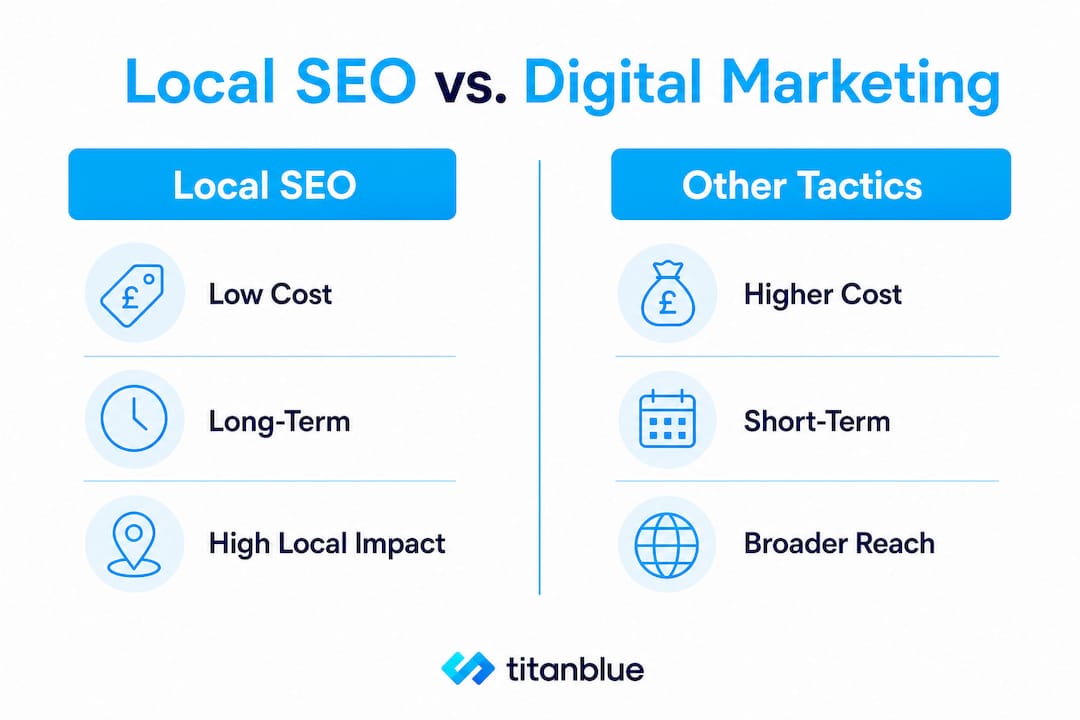
Small business SEO tips consistently point to the same conclusion: a well-executed local SEO strategy reduces your dependence on paid advertising over time, which lowers your customer acquisition cost significantly.
Pro Tip: A smart approach combines local SEO with selective paid advertising. Use Google Ads to capture immediate leads while your local SEO rankings build in the background. Once your organic visibility is strong, you can reduce ad spend and rely more heavily on free search traffic.
For most SMEs starting out, local SEO is the right first investment. It builds a foundation of authority and visibility that all other marketing tactics can benefit from.
Practical steps to kickstart your local SEO success
Ready to put local SEO into action? Here are concrete steps any Australian business can start with today.
-
Claim and optimise your Google Business Profile. This is the single most impactful action you can take. Ensure your business name, address, phone number, trading hours, and website are accurate. Add high-quality photos, select the correct business categories, and write a compelling business description. A fully optimised profile significantly improves your chances of appearing in the local pack.
-
Ensure consistent NAP data across all directories. NAP stands for Name, Address, and Phone number. Inconsistencies across directories like Yellow Pages, Yelp, True Local, and Hotfrog confuse search engines and reduce your local rankings. Audit your listings and correct any discrepancies.
-
Gather customer reviews and manage your reputation actively. Ask satisfied customers to leave a Google review after each positive interaction. Respond to every review, including negative ones, professionally and promptly. Reviews are a major ranking factor in local SEO and a powerful trust signal for potential customers.
-
Develop locally relevant website content. Create dedicated location pages if you serve multiple suburbs or cities. Write blog posts about local events, community news, or industry topics relevant to your area. This signals to Google that your business is genuinely active and relevant in that location.
-
Track your performance using basic analytics. Google Search Console and Google Analytics show you which keywords are bringing traffic, where visitors are coming from, and how they behave on your site. Use this data to refine your strategy over time.
| Action | Priority level | Time to complete | Expected impact |
|---|---|---|---|
| Claim Google Business Profile | Critical | 30 minutes | High |
| Fix NAP consistency in directories | High | 1 to 3 hours | High |
| Request 10 new customer reviews | High | Ongoing | High |
| Create location-specific web pages | Medium | 2 to 5 hours each | Medium to high |
| Set up Google Search Console | Medium | 45 minutes | Medium (tracking) |
| Publish 2 locally relevant blog posts | Low to medium | 3 to 4 hours each | Medium (long-term) |
If you want tailored support with these steps, exploring professional improving local search results guidance can accelerate your progress significantly. For businesses that need hands-on help, local SEO optimisation services provide a structured path to faster results.
Avoiding common local SEO pitfalls
Even with good intentions, it is easy to make costly mistakes when tackling local SEO. Let us make sure you know what to avoid.
-
Inaccurate business listings. If your address or phone number is wrong in even one directory, it can hurt your rankings and cause customers to contact you incorrectly. Audit all listings regularly.
-
Ignoring online reviews. Businesses that never respond to reviews, or worse, have no reviews at all, signal low engagement to both Google and potential customers. Make review management a weekly habit.
-
Keyword stuffing on location pages. Cramming suburb names into every sentence does not fool Google. It reads awkwardly to visitors and can result in a ranking penalty. Write naturally for people first. Keyword optimisation comes second.
-
Neglecting mobile optimisation. Most local searches happen on smartphones. If your website is slow to load or difficult to navigate on mobile, you will lose customers before they even read your content. A mobile-friendly site is non-negotiable.
-
Failing to track key metrics. Without tracking rankings, traffic, and conversions, you are operating blind. You need data to know what is working and where to adjust.
“Local SEO without measurement is just guesswork. The businesses that grow fastest are the ones that review their data consistently and adapt quickly.” This principle applies to every market in Australia, from the Gold Coast to regional towns.
Pro Tip: Set a monthly reminder to review your Google Business Profile insights and Search Console data. Even 30 minutes of analysis each month can reveal opportunities and problems before they affect your revenue significantly.
Following trusted local SEO tips helps you stay ahead of these pitfalls and build a sustainable presence that grows over time.
The uncomfortable truth about local SEO most business owners miss
Here is something that does not get said enough. Most business owners treat local SEO like an option. Something they will get to eventually, once things settle down, once revenue picks up, once they have more time. That thinking is exactly why their competitors are pulling ahead right now.
The businesses investing in SEO marketing for small business today are not doing so because they have money to burn. They are doing so because they understand something critical: online authority compounds. A business that starts building local SEO rankings this year will be significantly harder to displace in two years. The early mover advantage in local search is real, and it is measurable.
We see this pattern repeatedly. A business holds off on local SEO, watching a competitor slowly accumulate reviews, citations, and local content. Within 12 months, that competitor owns the top spots in local search. At that point, catching up requires double the effort. The window to act cheaply and effectively is now, not later.
Conventional wisdom says local SEO can wait until your business is more established. The data says the opposite. Businesses that invest early, even with modest budgets, build an online presence that consistently generates free, qualified leads. That is a compounding asset. Waiting is simply choosing to hand those leads to someone else.
Partner with experts to elevate your local SEO results
Applying everything in this article takes time, skill, and consistency. If you are juggling day-to-day business operations, local SEO can easily fall down the priority list.
That is where Titan Blue comes in. Based on the Gold Coast and working with Australian SMEs across the country, we specialise in building the kind of local SEO presence that generates genuine enquiries and sustained growth. From optimising your Google Business Profile to crafting locally relevant content and managing your citations, our team handles the technical and creative work so you do not have to. Explore our full range of SEO services or read our practical SEO marketing guide to understand how a tailored strategy can work for your specific business. Get in touch today and let us map out your path to stronger local visibility.
Frequently asked questions
How quickly can I see results from local SEO?
Most businesses see noticeable improvements within 3 to 6 months of consistent local SEO effort, though competitive markets may take longer to show significant ranking changes.
What are the most important ranking factors for local SEO?
The key factors are accurate business listings, positive customer reviews, proximity to the searcher, and locally relevant website content working together consistently.
Do I need a website for local SEO to work?
A professional website strongly strengthens your local SEO, but even without one, claiming and optimising your Google Business Profile is an essential first step that delivers real results.
How does local SEO help me attract more local customers?
Local SEO places your business directly in front of people searching for your services in your area, converting high-intent searches into phone calls, visits, and enquiries.
What is the difference between local SEO and general SEO?
Local SEO targets searches with geographic intent, focusing on customers near your physical location, while general SEO targets broader keywords without a specific geographic focus.
Recommended
- Boost Your Business with Local Search
- How to Boost Your Local Business with SEO in 2024
- Improve Your Business’s Online Visibility in Your Community
- Grow with seo for a small business: A Local Guide to Winning Customers
Make Titan Blue a preferred source in Google
One click tells Google to surface our articles more often in Top Stories, AI Overviews and AI Mode.

How to Make Your Website AI Friendly: The 2026 Step-by-Step Guide
How to make your website AI friendly: a step-by-step 2026 guide to getting crawled, structured…

Web Design for AI Search Optimisation: The 2026 Build Guide
Web design for AI search optimisation: crawlable HTML, clear architecture, accessible UX and trustworthy content…

AEO Web Design: How to Build Websites AI Can Cite
AEO web design creates websites that AI systems can find, understand and cite through clear…