


TL;DR:
- In 2026, high-quality, strategic content based on user intent and genuine value is key to SEO success. Publishing fewer, well-optimized, and authoritative pages outweighs quantity, helping build longstanding search visibility. Regularly refining and consolidating content ensures sustained site authority and improved rankings over time.
Most business owners assume that publishing more blog posts will automatically push their rankings higher. It feels logical. More pages, more chances to be found. But this belief is costing Australian businesses time, money, and real search visibility. More content is not always better for SEO due to maintenance costs, internal competition, content decay, and Google deprioritising low-value pages. What actually moves the needle in 2026 is strategic, high-quality content built around genuine value and user intent. This guide breaks down exactly how to do that.
Table of Contents
- Why content is the backbone of SEO success
- How Google evaluates content: The E-E-A-T framework
- Core methodologies for content-led SEO: What works in 2026
- Avoiding outdated pitfalls: The danger of content sprawl and redundancy
- Our perspective: Why strategic content trumps content quantity in 2026
- Take your SEO content strategy further with Titan Blue
- Frequently asked questions
Key Takeaways
| Point | Details |
|---|---|
| Quality beats quantity | Well-crafted, expert-driven content outperforms generic mass publishing for SEO results. |
| E-E-A-T matters most | Google’s focus on expertise, authoritativeness, and trust means credible content is essential for ranking. |
| Content strategy is critical | Using methods like topic clusters and audits ensures your content grows site visibility and avoids decay. |
| Avoid content sprawl | Publishing excessive or duplicate pages harms SEO, so focus on strategic, high-value topics. |
Why content is the backbone of SEO success
With the myth of quantity debunked, let’s explore the actual value content brings to your SEO.
Google uses your content as its primary lens for judging whether your site deserves to rank. Every page you publish is an opportunity to demonstrate relevance, answer a specific question, and signal expertise. But not all content carries the same weight. Thin, superficial pages that cover a topic without depth are increasingly invisible in search results. What ranks well in 2026 is content that thoroughly addresses user intent, answers follow-up questions, and demonstrates genuine knowledge.
Strong content marketing and SEO work together because search engines are trying to match users with the most useful, credible result. When your content consistently delivers that, Google rewards it with higher placement.
The data is compelling. A meta-analysis of 10 studies conducted between 2022 and 2024 found that SEO strategies driven by content quality, keyword optimisation, and backlinks yielded a high effect size of d=1.049 in increasing organic rankings and traffic. That is a statistically significant outcome, confirming that quality-focused content strategy is not just theory. It produces measurable results.
Here is what separates high-performing content from the noise:
- Depth and completeness: Pages that answer the full query, not just part of it
- Relevance to user intent: Matching what the visitor actually needs at that moment
- Topical authority: Covering a subject consistently across multiple related pages
- Originality: Offering insights, data, or perspectives not found elsewhere
- Readability: Clear structure, short paragraphs, and scannable formatting
“Content quality is no longer a differentiator — it’s the baseline. What separates top-ranking pages is how well they satisfy the full intent behind the search.”
| Content quality indicator | Low-value content | High-value content |
|---|---|---|
| Word depth | Skims the surface | Covers topic thoroughly |
| User intent match | Partial or generic | Precise and specific |
| Supporting evidence | None or vague | Data, examples, citations |
| Internal linking | Isolated page | Connected to related content |
| Update frequency | Set and forget | Regularly reviewed and refreshed |
Getting this right consistently is what builds your site’s authority over time. It is not a one-off task. It is an ongoing process of refinement.
How Google evaluates content: The E-E-A-T framework
Knowing that not all content is equal, it is critical to grasp exactly how Google judges what makes a page truly valuable.
Google uses a quality assessment model known as E-E-A-T, which stands for Experience, Expertise, Authoritativeness, and Trustworthiness. Understanding these four pillars is essential if you want your content to rank, particularly in competitive or sensitive industries.
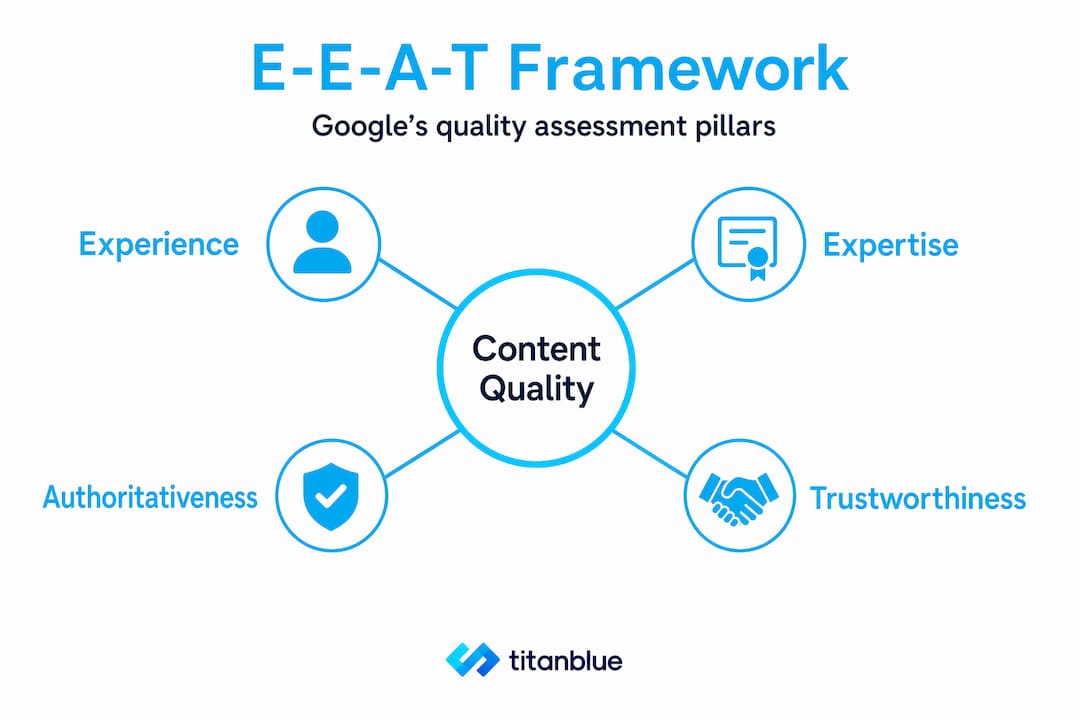
Google evaluates content quality by prioritising firsthand experience, expert authorship, authority from citations, and trust through accuracy and transparency, especially for YMYL (Your Money or Your Life) topics. YMYL includes anything that can significantly impact a person’s health, finances, safety, or legal standing. If your business operates in these spaces, Google’s standards for your content are stricter than average.
Here is how each element of E-E-A-T applies to your content:
- Experience: Has the content creator actually done the thing they are writing about? First-hand experience carries real weight. A trade business sharing lessons from 15 years on the tools has genuine experience. A generic article written by someone with no relevant background does not.
- Expertise: Does the content reflect a solid understanding of the subject? This means accurate information, appropriate use of industry terminology, and the ability to answer nuanced questions.
- Authoritativeness: Are other credible sources referencing or linking to your content? Authority is built externally through backlinks, mentions, and citations from respected sources within your industry.
- Trustworthiness: Is your site transparent, accurate, and secure? This includes having clear contact details, an up-to-date privacy policy, SSL security, and consistent accuracy across your pages.
It is worth knowing that E-E-A-T requirements are contextual. Higher standards apply for YMYL topics, and lower standards apply for non-sensitive ones. Critically, trust overrides every other factor. If Google deems your content untrustworthy, no amount of expertise or authoritativeness will compensate.
Aligning your content with E-A-T principles in SEO is not about ticking boxes. It is about genuinely building a site that users and search engines can rely on.
| E-E-A-T factor | How to demonstrate it |
|---|---|
| Experience | Author bios, case studies, first-hand accounts |
| Expertise | Accurate, detailed content with industry-specific knowledge |
| Authoritativeness | Backlinks from credible sites, industry mentions |
| Trustworthiness | Secure site, transparent policies, cited sources |
Pro Tip: Add an author bio to key content pages. Include credentials, years of experience, and a link to a professional profile. This small addition can meaningfully strengthen your E-E-A-T signals.
Core methodologies for content-led SEO: What works in 2026
With an understanding of E-E-A-T, let us look at which specific content strategies drive results for small businesses in 2026.
The days of targeting a single keyword per page and hoping for the best are over. Modern content strategy requires a more structured approach. Key methodologies for 2026 include keyword clustering by intent, topic clusters with pillar pages linking to supporting pages, on-page optimisation covering titles, headers, and schema markup, internal linking, and regular content audits to combat decay.
Let us break these down into practical steps you can apply right now.
Keyword intent clustering
Rather than chasing individual keywords, group them by the intent behind the search. Someone searching “what is SEO” is in research mode. Someone searching “SEO agency Gold Coast” is ready to buy. These require completely different content. When you understand how to write website content for SEO based on intent, your pages attract the right visitors at the right moment in their decision-making process.
Pillar pages and topic clusters
A pillar page covers a broad topic in depth, and supporting pages (called cluster pages or spoke pages) cover specific subtopics in detail. Each spoke links back to the pillar, and the pillar links out to the spokes. This structure signals to Google that your site has thorough, organised expertise on a subject. It also makes it easier for users to navigate your content. For small business owners working without a dedicated content team, this approach lets you build authority systematically rather than randomly.
Here are the core steps to build a topic cluster:
- Choose a broad topic central to your business (e.g. “local SEO for tradies”)
- Write a pillar page covering that topic at a high level
- Identify five to ten subtopics related to your pillar (e.g. “Google Business Profile tips”, “local citation building”)
- Publish individual pages for each subtopic and link them back to the pillar
- Internally link your pillar page out to each supporting page
- Review and update the cluster every six months
On-page optimisation
Every page needs to be technically sound as well as well-written. This means optimising your title tag, meta description, H1 and H2 headings, image alt text, and page URL. Adding schema markup (structured data that helps Google understand what your page is about) can also improve how your content appears in search results, including rich snippets and FAQ-style answers.
Content audits
A content audit is a systematic review of every page on your site. You are looking for pages with declining traffic, thin content, keyword cannibalisation (two pages competing for the same term), and outdated information. The practical SEO marketing guide for small businesses recommends treating content audits as quarterly maintenance, not an emergency response. When you prune, consolidate, or update underperforming pages, your stronger pages benefit from the consolidated authority.

Pro Tip: Use Google Search Console to identify pages that rank on page two or three for relevant queries. These are your best candidates for a quick content refresh. Adding depth, updating statistics, and improving internal links can push them onto page one without starting from scratch.
Understanding your SEO traffic growth strategies means accepting that the best results come from working smarter on fewer, better pages rather than publishing endlessly.
Avoiding outdated pitfalls: The danger of content sprawl and redundancy
With so many methodologies available, it is also vital to avoid common traps that could undermine your SEO gains.
Content sprawl happens when a website accumulates dozens or hundreds of pages that were published without a clear strategy. It feels productive to keep publishing. But the reality is that low-quality or redundant pages actively drag down your site’s performance. Publishing more content is no longer reliable for SEO growth, and Google increasingly deprioritises sites where low-value pages dilute overall quality.
Here is how content sprawl typically damages your site:
- Keyword cannibalisation: Multiple pages competing for the same search term split your authority and confuse search engines about which page to rank
- Crawl budget waste: Google has a limited amount of time to crawl your site. Low-value pages consume that budget and reduce how frequently your important pages get indexed
- Thin content penalties: Pages with minimal substance signal to Google that your site does not prioritise quality, which can depress rankings across your entire domain
- Internal competition: Your own pages start competing against each other, reducing the effectiveness of your link structure
- Maintenance burden: Every page you publish requires ongoing maintenance. Without updates, pages decay and become liabilities
Statistic: Sites that regularly prune and consolidate low-performing content often see measurable ranking improvements within 60 to 90 days, as Google recrawls and reassesses the overall quality of the site.
The solution is not to stop publishing. It is to publish with purpose. Before you create any new page, ask: does this serve a specific, clearly defined user need? Does it target a distinct search intent? Does it add something that does not already exist on my site? If the answer to any of these is no, hold off.
For effective content for SEO, the standard to aim for is simple: every page on your site should be there because it earns its place. If it does not drive traffic, generate leads, or support a page that does, it is a candidate for consolidation or removal.
Pro Tip: Merge multiple thin blog posts on similar topics into one definitive guide. Redirect the old URLs to the new page. You preserve any existing link equity and create a single, authoritative resource that is far more likely to rank.
Our perspective: Why strategic content trumps content quantity in 2026
Here is something we see consistently with the businesses we work with across Australia. The ones who obsess over publishing frequency almost always hit a ceiling. They have 200 blog posts and wonder why their organic traffic is flat. The ones who take a different approach, publishing fewer but far more considered pieces, build compounding momentum over time.
This is not coincidental. When you concentrate your effort on content that genuinely serves your audience, covers a topic thoroughly, and is supported by strong internal linking and credible sourcing, each page you publish does more work. It attracts links. It satisfies multiple related search queries. It keeps visitors on your site longer. All of these signals tell Google your site is worth ranking.
Chasing volume is also a resource problem. Small business owners do not have unlimited time. Writing ten average posts a month costs the same effort as writing two exceptional ones. The difference is that the exceptional posts continue generating traffic for years. The average ones decay, compete with each other, and eventually need to be cleaned up.
We also see businesses underestimate the importance of E-A-T for business websites. In 2026, trust is currency. Google’s algorithm is better than ever at detecting whether a site is a genuine authority or simply trying to game its way to the top. The businesses that win in search are the ones that have built real credibility, real depth, and real value into their online presence.
Our honest view: SEO is no longer a shortcut game. It is a long-term investment in being genuinely useful and trustworthy online. The businesses that understand this early gain a compounding advantage over competitors still chasing page count.
Take your SEO content strategy further with Titan Blue
If this article has made you rethink your content approach, you are already ahead of most. Understanding the principles is the first step. Putting them into practice consistently is where the real work begins.

At Titan Blue, we work with small and medium-sized businesses across Australia to build SEO content strategies that actually perform. Whether you need a full explanation of SEO for Australian businesses or you are ready to engage expert SEO services to handle the heavy lifting, we can help. Our SEO service packages are designed to deliver measurable, sustainable growth. No fluff, no filler content, no guesswork. Just strategic content and SEO that builds your visibility and drives real enquiries. Get in touch today and let’s put your content to work.
Frequently asked questions
What is E-E-A-T and why does it matter for SEO?
E-E-A-T stands for Experience, Expertise, Authoritativeness, and Trustworthiness, and it is Google’s framework for assessing whether content is high-quality and credible enough to rank. It matters because pages that fail these standards are increasingly unlikely to appear in competitive search results.
How often should I update my website’s content for SEO?
You should review and refresh key pages at least twice a year to combat content decay. Regular audits and refreshes are now considered essential maintenance rather than optional extras in any solid SEO strategy.
Is publishing lots of blog posts still effective for SEO in 2026?
No. Publishing more content alone no longer guarantees improved rankings. Quality, structure, and alignment with search intent now matter far more than sheer volume in determining how well your pages perform.
What are topic clusters and how do they help SEO?
Topic clusters group related content around a central pillar page, improving your site’s topical authority and helping both users and search engines navigate your expertise. This structure is one of the most effective ways to build sustained organic visibility in 2026.
Does Google penalise duplicate content on my website?
Google rarely issues a direct penalty, but redundant and low-value pages can reduce your site’s overall authority and ranking potential by diluting crawl budget and splitting topical signals across competing pages.
Recommended
- How content marketing drives real SEO results
- Effective SEO Marketing for Small Business Success – Titan Blue Australia
- Why SEO is Important for your Business | Titan Blue
- Small business SEO strategies that drive real growth
Make Titan Blue a preferred source in Google
One click tells Google to surface our articles more often in Top Stories, AI Overviews and AI Mode.

Solar Installer Website Design Australia: The 2026 Guide
How solar installer websites in Australia should show CEC accreditation, real install proof and AI-ready…

Hotel & Hospitality Website Design Australia: 2026 Guide
Hotel and hospitality website design in Australia explained: booking flow, schema, AEO and what actually…

Restaurant Website Design Australia: The 2026 Guide
What a restaurant website in Australia needs: HTML menus, bookings, GBP sync, schema, and AI-ready…