

You've probably seen it already.
You search for something like “how to stop a leaking hot water system” or “best suburb brunch near me”, and before the normal results, Google shows a big AI summary. Sometimes it cites a few businesses. Sometimes your competitor is in there. Sometimes nobody clicks through because the answer is already on the page.
That's what Google AI Overviews optimisation is about now. Not gaming a new feature. Not chasing shiny AI jargon. It's about making sure your business is one of the sources Google can understand, trust, and reuse during user queries.
For Australian trades, restaurants, hospitality venues, and service businesses, that changes the job of SEO. Your website still matters. Your Google Business Profile still matters. But the format, structure, and proof signals matter more than a page full of generic sales copy.
Why AI Overviews Are Your New Digital Shopfront
A customer in Parramatta has a leaking hot water system at 7 pm. They search “why is my hot water system leaking from the bottom” on their phone. Before they see your website, they see Google's AI summary. If your business is part of that answer, you're in the conversation early. If not, a competitor is shaping the decision before the customer even starts comparing prices.

For a local business, that summary now works like your digital shopfront. It sits above a lot of the usual blue links and often answers the first question a customer has. Google treats AI Overviews as part of Search, so the job is still to make your site useful, clear, and easy to interpret. There is no separate trick. There is only better execution.
That changes how small business owners should look at SEO.
A brochure-style site can still rank for a branded search. It usually struggles when someone asks a real-world question such as “how often should a restaurant grease trap be cleaned” or “why is my split system leaking water”. Google needs a clear answer it can lift, summarise, and trust. A page full of generic claims about quality service gives it very little to work with.
The practical rule is simple. If a customer asks it on the phone, your site should answer it on the page.
For plumbers, sparkies, cafés, restaurants, cleaners, and other Australian service businesses, the opportunity sits earlier in the buying cycle. People search problems before they search providers. They want a straight answer first, then they decide who to call or where to book. Businesses that explain the issue clearly often earn attention before the quote request comes in.
That is where AI search optimisation services become a practical piece of digital marketing, not a buzzword. The work is usually straightforward. Tighten up weak pages, answer real customer questions, improve page structure, and give Google stronger signals about what your business does, where you do it, and why your information deserves to be reused.
Why local businesses feel the shift faster
Local service queries are messy and specific. People search by suburb, urgency, symptom, price concern, and service type, often in the same query. “Emergency plumber Newtown leaking tempering valve” is very different from a broad search for “plumber Sydney”. AI Overviews are better suited to those detailed questions than an old-school home page written for one broad keyword.
That creates a trade-off. Broad pages help cover service categories. Specific pages help you surface for the questions people ask. Local businesses need both, but the specific pages usually do more of the heavy lifting in AI results.
What actually changes for the business owner
Three shifts matter.
- The first impression moves higher up the page. Customers can form an opinion before they reach your website or Google Business Profile.
- Early research searches influence later enquiries. Helpful answers build trust before someone is ready to call.
- Clear information beats louder branding. Google can summarise a direct, well-structured answer more easily than polished marketing copy.
If a competitor keeps appearing in these summaries, it is rarely random. Their site is usually doing a better job of answering the question in plain English, with enough structure and evidence for Google to use it.
Crafting Content for AI Consumption
Most business websites are written to sound professional. That's often the problem.
AI systems don't reward fluff. They reward pages that answer a question directly, then support the answer with enough detail to prove it's credible. For Google AI Overviews optimisation, that means changing how you write service pages, FAQs, and local landing pages.
The most practical benchmark comes from Respona's guide to Google AI Overviews optimisation. Use question-led H2 and H3 headings, place a short direct answer immediately below, and rewrite priority sections so they can stand alone in 40 to 60 words.
What answer-first writing looks like
A weak version on a plumber's page might say:
“We provide a wide range of hot water system services for residential and commercial clients across the Gold Coast. Our experienced team can assess issues and recommend the right solution for your property.”
That sounds fine to a human skimming quickly. It's poor extraction material.
A stronger version looks like this:
How do I know if my hot water system needs replacing
If your hot water system is leaking, producing rusty water, running out quickly, or making unusual noise, it may need replacement rather than repair. A licensed plumber can inspect the unit, confirm the fault, and advise whether repair is still practical.
Then you expand with bullets:
- Leaks around the tank: Often signal internal failure rather than a simple valve issue.
- Rust-coloured water: Can indicate corrosion inside the system.
- Inconsistent temperature: Suggests the unit is no longer heating reliably.
- Age and condition: Older systems usually become less economical to keep repairing.
That opening answer gives Google something usable. The supporting bullets give the page context and depth.
A hospitality example that works better
A café page often makes the same mistake. It talks about ambience, community, and “great coffee” but never answers practical search questions.
Try this instead:
Does your café take walk-ins on weekends
Yes, we accept walk-ins on weekends, but peak breakfast hours fill quickly. If you're visiting with a larger group or want an indoor table, booking ahead gives you a better chance of getting your preferred time.
That's clearer than a paragraph about “welcoming locals and visitors alike”.
Short answers don't make your page thin. They make each section usable.
How to rewrite existing pages
Don't start by creating twenty new blog posts. Start with the pages that already matter.
Use this sequence:
-
Pick high-priority pages
Focus on service pages, booking pages, menus, local landing pages, and FAQs. -
Turn headings into real questions
Replace generic headings like “Our Process” with “How does solar panel installation work?” -
Answer first, then elaborate
The first sentence should address the exact question. Don't warm up for three lines. -
Break dense copy into chunks
Use bullets, short steps, and short supporting paragraphs.
For a deeper look at how this style supports search performance beyond AI results, see how content powers SEO and business growth.
What doesn't work? Keyword-stuffed city pages, generic “ultimate guides” with no clear answers, and content written to impress peers instead of helping customers.
Implementing Technical Signals for Machine Readability
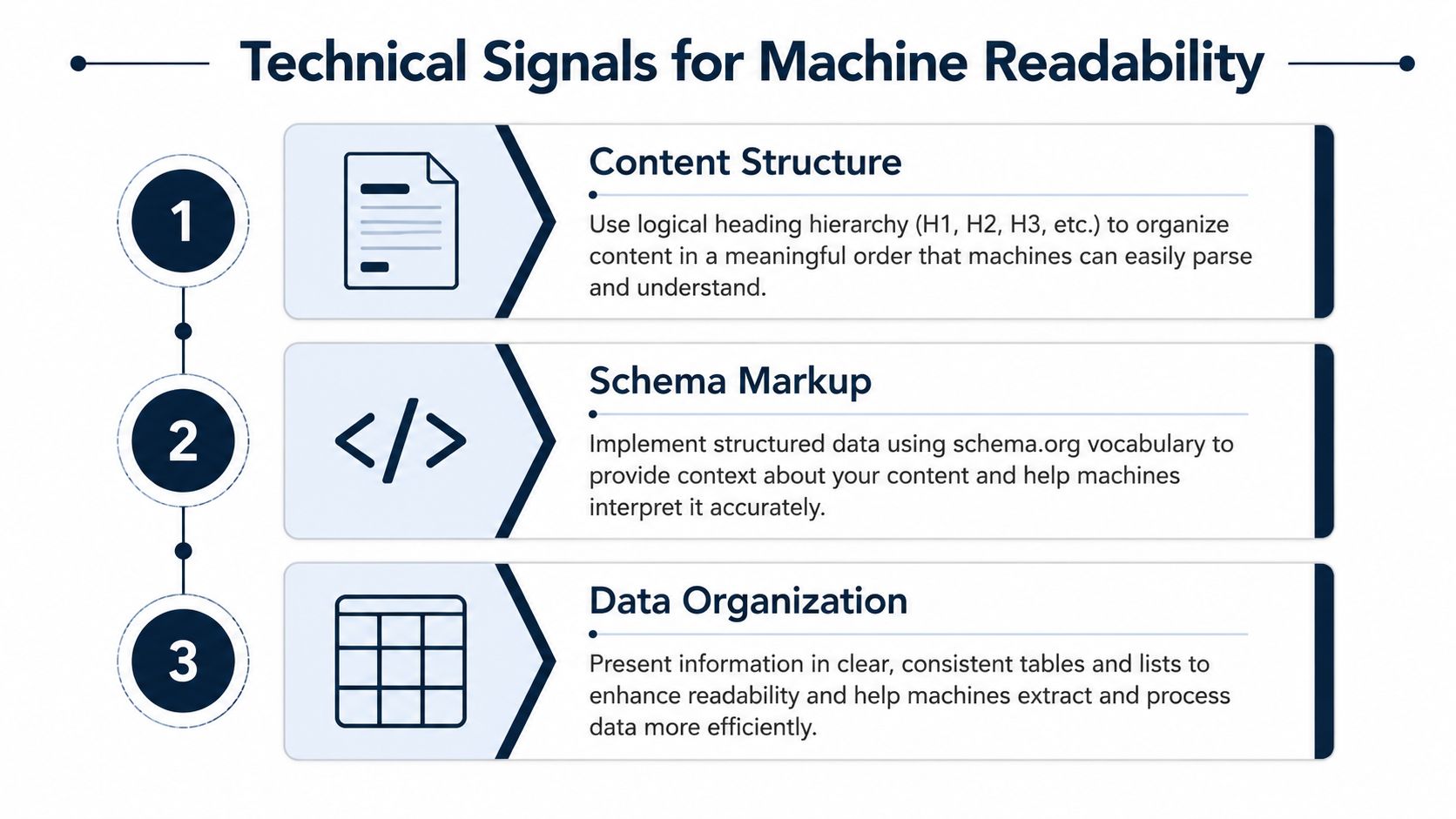
Good writing is only half the job. The other half is making the page easy for machines to classify.
Think of schema markup and heading structure like labels on moving boxes. If every box just says “stuff”, unpacking is slow and messy. If one box says “Kitchen. Plates”, another says “Office. Cables”, and another says “Bathroom. Towels”, the move goes faster because each item has context.
That's what technical structure does for Google.
Get the heading hierarchy right
Start with the basics.
Your page should have one clear H1 that describes the page topic. Beneath that, your H2s should break the topic into major questions or sections. H3s should support the H2s with follow-up details.
A solar installer page might look like this:
- H1: Solar Panel Installation Gold Coast
- H2: How does solar installation work
- H2: How long does installation take
- H2: What affects the cost of a solar system
- H3: Roof type
- H3: System size
- H3: Switchboard requirements
That hierarchy helps users scan, and it helps Google separate one answer from another.
Use schema where it fits naturally
Three schema types are usually the most useful for local SMEs doing Google AI Overviews optimisation.
-
FAQ schema
Use this on pages that answer common customer questions. Good fit for plumbers, restaurants, clinics, builders, and service-area pages. -
HowTo schema
Useful when a page explains a step-based process. This works better for educational content than for pure sales pages. -
Article schema
A solid option for blog posts and informational resources where the page is clearly editorial.
Local businesses should also make sure the site communicates core business details consistently. If your services, suburbs, opening hours, or contact information vary across pages, Google gets mixed signals.
Machine-readable content is still human content. The best technical work supports clarity. It doesn't replace it.
What to check before you publish
A page is usually ready when it passes these practical checks:
- The page answers one core intent: Don't mix five different topics onto one page.
- The first answer appears high on the page: Don't bury it under banners or filler copy.
- Lists are marked up as lists: Don't fake bullets with random line breaks.
- Schema matches visible content: If the page says one thing and the markup says another, that creates avoidable confusion.
If you're cleaning up broken or outdated markup, this guide on fixing incorrect schema markup issues is a useful reference point.
What doesn't work here is overengineering. You don't need to plaster every page with every schema type. You need clean implementation that accurately reflects the content.
Proving Your Authority and Expertise
Google doesn't just need content it can parse. It needs content it can trust.
That's where many small business websites fall short. They publish decent information, but they don't show who's behind it, why the business is credible, or whether the business is consistent across the web. In AI results, that missing context matters.

A useful way to think about this comes from Hello Digital's article on Google AI Overviews optimisation. Google's AI systems synthesise answers from multiple sources and add citations, which makes a clean entity footprint important. For local Australian businesses, over-optimising generic blog posts may matter less than having consistent business data, local landing pages, positive reviews, and rich media that Google can confidently reuse.
Authority is built from several small signals
A trustworthy site rarely relies on one thing. It usually combines several.
- A proper About page: Include your trading history, service areas, team background, licences where relevant, and what you do.
- Visible authorship or business attribution: If advice appears on the site, make it clear whether it comes from the business owner, head chef, licensed technician, or operations team.
- Reviews that match your services: Reviews aren't just star ratings. They reinforce what you're known for.
- Consistent business identity: Your name, address, phone, and service details should line up across your site and profiles.
A plumbing company with a detailed About page, staff bios, suburb pages, review signals, and project photos looks more trustworthy than a business with fifty keyword blogs and no visible proof it exists beyond a form.
Rich media helps if it supports the page
Many businesses treat photos and videos as decoration. Used properly, they support credibility.
A restaurant can publish menu pages, venue photos, opening hours, booking details, and short clips that show the actual space. A trade business can show completed work, service explanations, and short videos answering common call-out questions. If you include video, a transcript or well-written supporting copy gives Google more usable context.
For businesses reviewing their trust signals and content quality together, this overview of E-E-A-T principles and website impact is worth reading.
What usually wastes time
Two things commonly go wrong.
First, businesses publish generic articles on broad topics that have nothing to do with their service footprint. A local electrician doesn't need a bloated article trying to explain the full history of household wiring.
Second, they hide proof. The site doesn't show credentials, real work, reviews, or local relevance. The copy might be polished, but it feels anonymous.
A credible local business should look local, sound experienced, and leave evidence across more than one page.
That combination is much harder for competitors to copy than another templated blog post.
Winning Locally with Hyper-Specific Tactics
A customer in Southport searches “emergency plumber near me” at 7:10 pm. Google shows an AI Overview, a map pack, and a short list of businesses that look credible enough to call. If your business is missing from that mix, it does not matter that your blog post ranks for a broad plumbing term. The job goes to the business that looks closest, clearest, and easiest to trust.
For Australian SMEs, local AI visibility is less about chasing raw traffic and more about showing up in the moments that lead to calls, bookings, direction taps, and branded follow-up searches. A Melbourne restaurant, Brisbane plumber, or Gold Coast solar installer does not need generic national SEO advice. They need pages and profiles that match how local customers search.

AI Overviews can answer part of the question before a click happens. That changes how local businesses should judge performance. A cited page may drive fewer visits but still produce more calls or bookings because the customer has already seen the brand in search and only needs one more prompt to act.
Build pages around suburb plus service intent
Local service pages still matter, but only if they do a real job.
A single “Service Areas” page rarely gives Google enough context for specific local queries. Separate pages work better when they match a clear service and a clear place, such as:
- Emergency Plumber Southport
- Blocked Drain Repairs Robina
- Solar Panel Installation Sunshine Coast
- Waterfront Dining Broadbeach
The difference is in the detail. Strong local pages mention the problems common in that area, the type of property you usually work on, response expectations, nearby landmarks where relevant, and the next step. For a plumber, that might mean older pipework in a suburb with established homes. For a restaurant, it might mean pre-event dining near a stadium or late trading near a nightlife strip.
Thin suburb pages waste time. If every page says the same thing with a suburb name swapped out, Google has little reason to treat them as distinct.
Tighten your local entity signals
Your website does not work alone. Google compares what your site says with what appears in your Google Business Profile, review platforms, directories, and local mentions.
Inconsistent details create friction. Old phone numbers, mismatched trading hours, outdated service lists, or suburb claims that do not line up across profiles make your business harder to trust algorithmically and harder for customers to contact.
For local AI visibility, clean alignment usually beats publishing more content.
Use this practical check:
- Google Business Profile: keep categories, opening hours, service descriptions, booking links, and photos current
- Service pages: match the services and locations you want to win
- Reviews: ask customers to mention the job type and suburb naturally
- Proof assets: add project photos, menus, FAQs, and short videos where they support the decision
If you want a structured way to check those gaps, run a quick AI visibility audit for local service businesses.
A short explainer can help your team think about these search changes in plain language:
Measure what leads to revenue
Local businesses often use the wrong scoreboard.
A restaurant can appear for “best lunch near the convention centre,” get fewer website visits, and still improve results if more people search the venue name, tap directions, or book through Google. A plumber can show up for “what causes low water pressure,” miss the first click, and still win the job after the customer sees the business again in Maps or a branded search.
Track actions that show buying intent. Calls. Direction requests. Booking clicks. Branded searches. Quote requests from suburb pages. Those are the signals that tell you whether local AI visibility is helping the business, not just the analytics report.
Your AI Overviews Audit and Monitoring Checklist
If your site isn't being cited, don't guess. Audit it.
The challenge is bigger now because AI Overviews can take up 42% of desktop screen space and 48% on mobile, and this correlates with a 34.5% decrease in click-through rates for top-ranking pages according to WordStream's AI Overviews statistics analysis. If your page is pushed down, being “already ranking well” isn't enough. You need to be the source inside the summary or close to it.
Content checks
Run through these first.
- Check if your key pages answer real customer questions. If the page only sells and never explains, it's weak AI citation material.
- Check if headings are phrased clearly. Generic headings such as “Benefits” or “Solutions” are less useful than direct questions.
- Check if each major section can stand alone. If a subsection makes no sense without the whole article, rewrite it.
Audit shortcut: Read only the headings and first sentence under each one. If the page still makes sense, the structure is usually on the right track.
Technical checks
Here, preventable mistakes surface.
- Check if one page targets one clear intent.
- Check if lists, steps, and FAQs are properly formatted.
- Check if schema matches the visible content on the page.
- Check if internal links connect related topics naturally.
If you need a structured starting point, an AI visibility audit helps identify where pages are hard for AI systems to interpret.
Authority and local checks
These often explain why two similar pages perform differently.
- Check if your About page proves you're a real operator.
- Check if reviews, project examples, menus, or case-style proof exist on site.
- Check if business details are consistent across your site and profiles.
- Check if your local pages are local, not duplicated templates.
Monitoring what matters
You don't need fancy reporting to start.
Track a shortlist of your most important informational and local-intent queries in Google Search Console. Manually review how those results look in search. Watch whether your business appears in citations, whether branded searches increase, and whether calls, booking enquiries, and map actions move in the right direction.
If impressions rise while low-value clicks dip, don't panic. For many local businesses, that's exactly where the interpretation needs nuance. The question isn't “did traffic go up?” It's “did more qualified customers take action?”
If you want help turning your website into something Google can cite, Titan Blue Australia works with Australian businesses on SEO, AI search readiness, content structure, and local visibility. For trades, hospitality, restaurants, and service businesses, the practical goal is simple. Get found earlier, get understood clearly, and turn search visibility into real enquiries.
Make Titan Blue a preferred source in Google
One click tells Google to surface our articles more often in Top Stories, AI Overviews and AI Mode.

Solar Installer Website Design Australia: The 2026 Guide
How solar installer websites in Australia should show CEC accreditation, real install proof and AI-ready…

Hotel & Hospitality Website Design Australia: 2026 Guide
Hotel and hospitality website design in Australia explained: booking flow, schema, AEO and what actually…

Restaurant Website Design Australia: The 2026 Guide
What a restaurant website in Australia needs: HTML menus, bookings, GBP sync, schema, and AI-ready…