


You're probably in one of three situations right now.
Your phone rings, but not consistently enough. Your website exists, but you're not sure whether it's helping or just sitting there. Or you've paid for “marketing” before and ended up with a monthly report full of clicks, impressions, and vague promises while bookings, quote requests, or job enquiries barely moved.
That's where most small business owners get stuck. A plumber knows plumbing. A restaurant owner knows service, margins, and staffing. A builder knows how to price, schedule, and deliver work. Very few of them should also have to become experts in Google Business Profile, landing page structure, Meta Ads, conversion tracking, schema, and AI search behaviour.
A good agency sits in the same category as a sharp accountant or a reliable solicitor. It handles a specialised business function that matters to growth. In Australia, that matters even more because the Digital Economy Strategy identifies digital capability as a national growth priority. For trades, hospitality, and construction businesses, your competition isn't only the operator down the road anymore. It can be a better-positioned business from another suburb, city, or state.
If you want a basic grounding first, this overview of digital marketing basics is a useful companion. The more important point is simpler. Digital marketing agency work isn't about jargon. It's about making it easier for the right customer to find you, trust you, and contact you.
Demystifying Digital Marketing Agency Work
When most business owners hear “agency”, they picture one of two things. Either it's a creative team making websites and social posts, or it's a mysterious black box that burns budget and sends glossy reports at the end of the month.
More practical than that, digital marketing agency work is the daily job of removing friction between customer intent and business action. If someone needs an emergency plumber, the work is to help that person find the right service page, trust the business quickly, and call. If someone is choosing a restaurant for Friday night, the work is to make the venue visible, appealing, and easy to book.
What that looks like in real business terms
For a small service business, agency work often touches questions like these:
- Can customers find you locally: Are you showing up for suburb and service searches, or are competitors collecting those calls?
- Does your website convert: When someone lands on your site, do they know what you do, where you work, and how to take the next step?
- Is your message clear: Can a busy customer tell in a few seconds why they should choose you?
- Are you tracking the right outcomes: Are you measuring calls, enquiries, and bookings, or only traffic?
An experienced agency doesn't just “do marketing”. It prioritises the jobs that are closest to revenue.
Practical rule: If a marketing activity can't be connected to visibility, trust, or conversion, it's usually a distraction.
Why business owners often feel confused
The confusion comes from how fragmented the industry can be. One provider sells websites. Another sells SEO. Another runs ads. Another posts on social media. A small business owner ends up trying to coordinate four moving parts without a clear growth plan.
Good agency work pulls those parts together. It treats your website, local search presence, content, reviews, ads, and reporting as one system. That's how a business stops thinking in channels and starts thinking in outcomes.
The Core Services a Digital Agency Provides
Most agencies list services like they're menu items. That's not how clients experience them. Clients experience problems first. No leads. Poor-quality leads. Empty booking slots. Too much reliance on referrals. A website that looks fine but doesn't produce work.
The main services matter because each one solves a different business problem. If you want to see how these pieces fit together, Titan Blue's digital marketing services show the typical mix a full-service agency handles for SMEs.
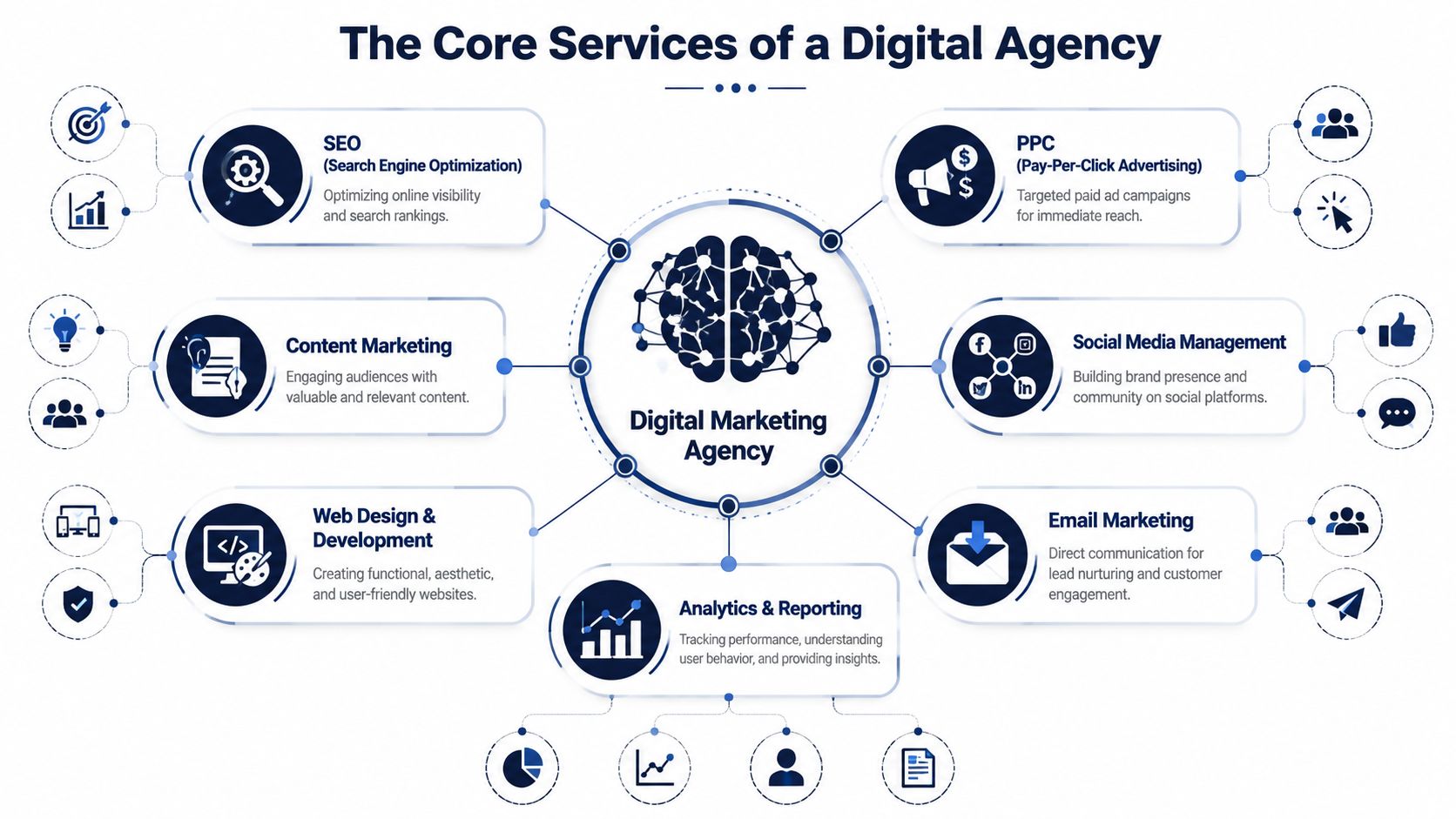
SEO gets you found
Search Engine Optimisation is the work of making your business easier to discover in search. For a trades business, that usually means service pages, suburb relevance, technical site health, clear internal linking, and local signals that support rankings. For hospitality, it often includes location intent, menu or service visibility, and branded search support.
This isn't just about traffic. It's about showing up when intent is strong. For local trades and hospitality, nearby mobile searches can convert quickly. Google reports that 76% of people who search on a smartphone for something nearby visit a related business within a day, and 28% of those searches result in a purchase, as cited in this discussion of local search conversion behaviour.
AEO helps you become the answer
Answer Engine Optimisation, or AEO, is where agency work is changing fast. Traditional SEO asks, “How do we rank?” AEO asks, “How do we get selected as the answer?”
That changes the work. Agencies now structure content so machines can understand it cleanly. That includes:
- Service definitions: Clear explanations of what you do and who it's for
- FAQ content: Direct answers to common customer questions
- Entity clarity: Consistent naming of services, locations, and business details
- Structured data: Schema that helps search systems interpret the page properly
For a solar installer, this might mean creating pages that answer practical buying questions. For a builder, it could mean content around approvals, timelines, materials, and project types. The goal is to make your business easy to retrieve, summarise, and trust.
Web design turns attention into action
Your website is your sales environment. Not your brochure.
A good agency treats web design as conversion work. That means clear calls to action, sensible page flow, trust signals, mobile usability, and copy that answers the customer's immediate questions. On a trades site, a strong page often wins because it gets to the point fast. On a hospitality site, design has to support both confidence and desire.
What usually fails is easy to spot. Slow pages. Generic headlines. Stock-standard service descriptions. Contact forms that ask too much. Important information buried below the fold.
A website shouldn't make a customer think harder. It should make the next step easier.
Paid media buys speed
SEO and AEO build durable visibility. Paid media buys reach and speed.
Google Ads can capture high-intent demand when someone is ready to act. Meta Ads can create demand or support remarketing. Paid campaigns work well when the offer is clear, the targeting is disciplined, and the landing page is built to convert.
They work badly when businesses send paid traffic to weak pages, run broad campaigns without service focus, or chase cheap clicks instead of qualified enquiries.
Social media supports trust and recall
Social media rarely fixes a broken lead pipeline on its own. It does help with trust, visibility, community, and proof of activity.
For restaurants, it can influence booking decisions. For trades and builders, it often plays a supporting role by showing completed work, team credibility, and customer feedback. The mistake many businesses make is expecting social posts alone to deliver direct sales without strong local search, a good website, and clear offers behind them.
Inside the Agency A Typical Project Workflow
Most clients don't need to know every internal process. They do need to know what they're paying for and how the work moves from discussion to results.
A solid agency relationship follows a rhythm. It's not random activity. It's a sequence of diagnosis, build, launch, review, and adjustment.
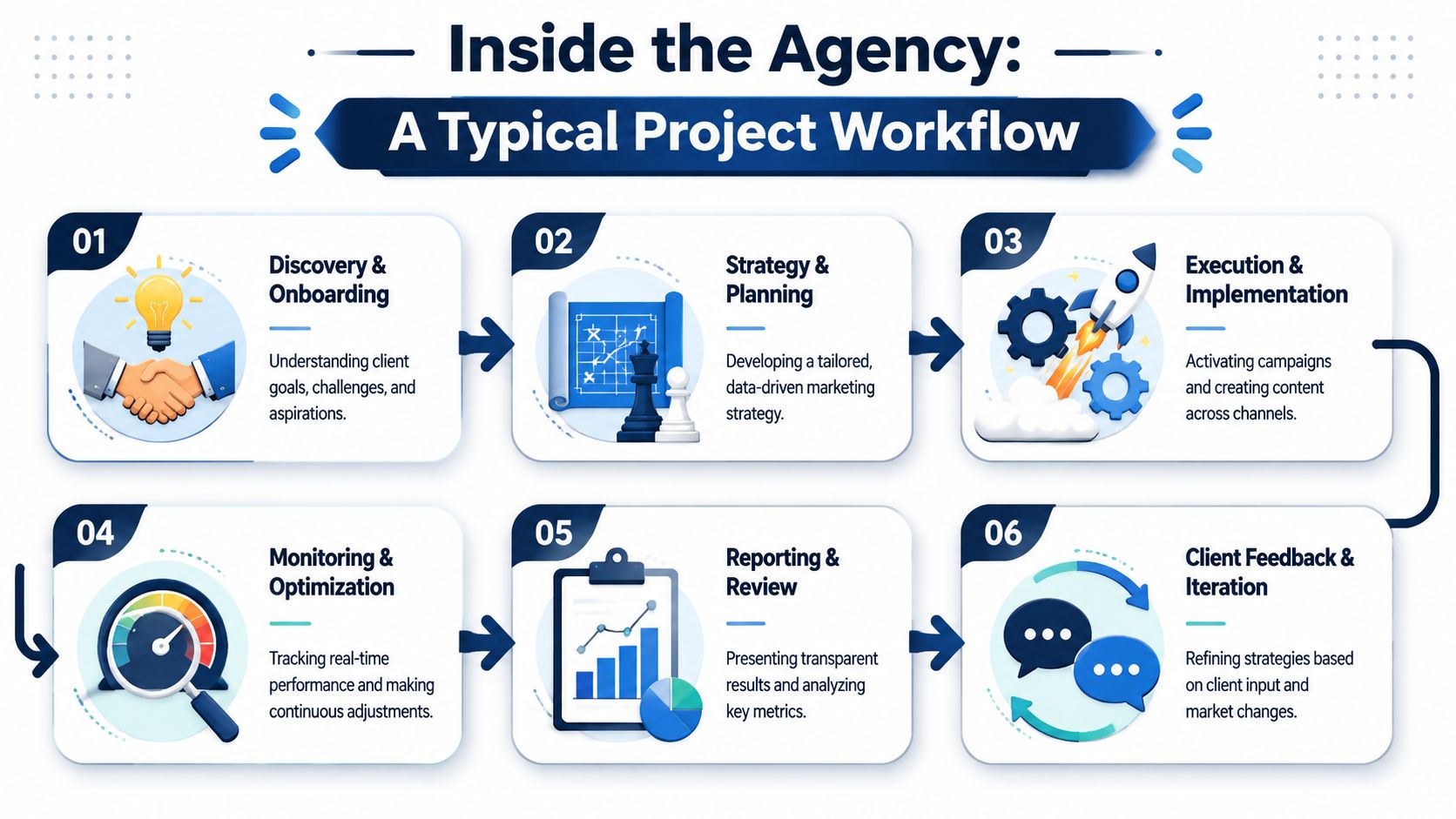
Discovery starts with the business, not the channel
The first conversations should sound more like operations and sales than marketing. A capable agency asks where your margins are strongest, which jobs you want more of, which suburbs matter, how leads are handled, and what a good customer looks like.
If the first meeting jumps straight into “we'll do SEO and social” without understanding the business model, that's a warning sign.
For businesses planning a rebuild or stronger lead funnel, this often connects directly to website design and development work, because the site usually becomes the hub for every other channel.
Strategy decides what deserves attention first
Once the agency understands the business, it should prioritise. That's one of the biggest differences between experienced agency work and task-based freelancing.
A restaurant might need local visibility, booking friction removed, and stronger branded search. A plumber may need service-area pages, call-focused landing pages, and a cleaned-up Google Business Profile. A construction firm might need authority-building content and better qualification on contact forms.
Common early priorities often include:
- Fixing weak conversion points: Contact forms, phone prompts, booking paths, page speed, mobile layout.
- Cleaning up search signals: Page structure, metadata, service pages, location relevance, internal links.
- Aligning content with intent: Building pages around the actual questions customers ask before they contact you.
Execution is where the craft shows
This is the part clients usually imagine as “the marketing”. Copy gets written. Pages get built. schema gets added. Ads go live. Tracking is configured. Social calendars are planned. Landing pages are improved.
What matters here isn't busyness. It's fit.
A smart agency doesn't publish content just to meet a quota. It produces assets that support a search intent, a sales objection, or a conversion step. That's why some months produce fewer visible deliverables but more business value.
Reporting should change decisions
Good reporting isn't a scoreboard. It's a management tool.
The agency should tell you what happened, why it happened, what changed, and what happens next. If reporting never influences strategy, it's theatre.
The best agency relationships don't feel like outsourcing. They feel like having a specialised growth team that already knows your business.
Understanding Agency Pricing and Engagement Models
Agency pricing confuses people because they compare it to buying a single product. It's not. You're buying access to skill, time, systems, judgement, and execution across multiple disciplines.
That's why the cheapest quote is often the most expensive decision. If the work is shallow, disconnected, or badly prioritised, you still lose money even if the monthly fee looks modest.
The main ways agencies charge
Most digital marketing agency work falls into a few common models.
- Monthly retainers: Best when the work is ongoing. SEO, AEO, content, ads, reporting, and website improvements all benefit from continuity. This model suits businesses that want compounding gains rather than one-off fixes.
- Project fees: Useful for a site build, a landing page set, a tracking setup, or a one-time audit. Good for contained deliverables. Less useful when the business also needs continuous optimisation.
- Performance-linked arrangements: These sound attractive, but they can get messy fast. Lead quality, sales process, response time, and seasonality all affect outcomes. If those variables aren't controlled, disputes follow.
If you're comparing providers, this overview of SEO packages and pricing helps frame what usually sits inside a recurring engagement versus a defined scope.
What you're actually paying for
A client isn't just paying for someone to “do SEO” or “run ads”. They're paying for a team that may include a strategist, writer, designer, developer, ad manager, and account lead. They're also paying for the judgement that comes from seeing patterns across many campaigns and many industries.
That matters because small businesses usually don't need a full internal department. They need the right specialist at the right moment.
The trade-off clients should understand
A retainer gives an agency room to improve the whole system. A project gives you a contained outcome. Neither is automatically better.
Choose based on the problem:
- If your business needs momentum over time, a retainer usually fits.
- If you need one major asset fixed first, a project can make sense.
- If someone promises easy wins without understanding your sales process, walk away.
Price matters. Scope, capability, and fit matter more.
How AI and Answer Engines Are Redefining Agency Work
Search used to be mostly a race for blue links. That model is weakening.
Users now ask longer questions, expect direct answers, and increasingly encounter AI-generated responses as part of their search journey. In Australia, that shift matters because agency work now has to account for visibility across AI search experiences and conversational results, as noted in this coverage of the changing marketing skill landscape and answer-focused search.
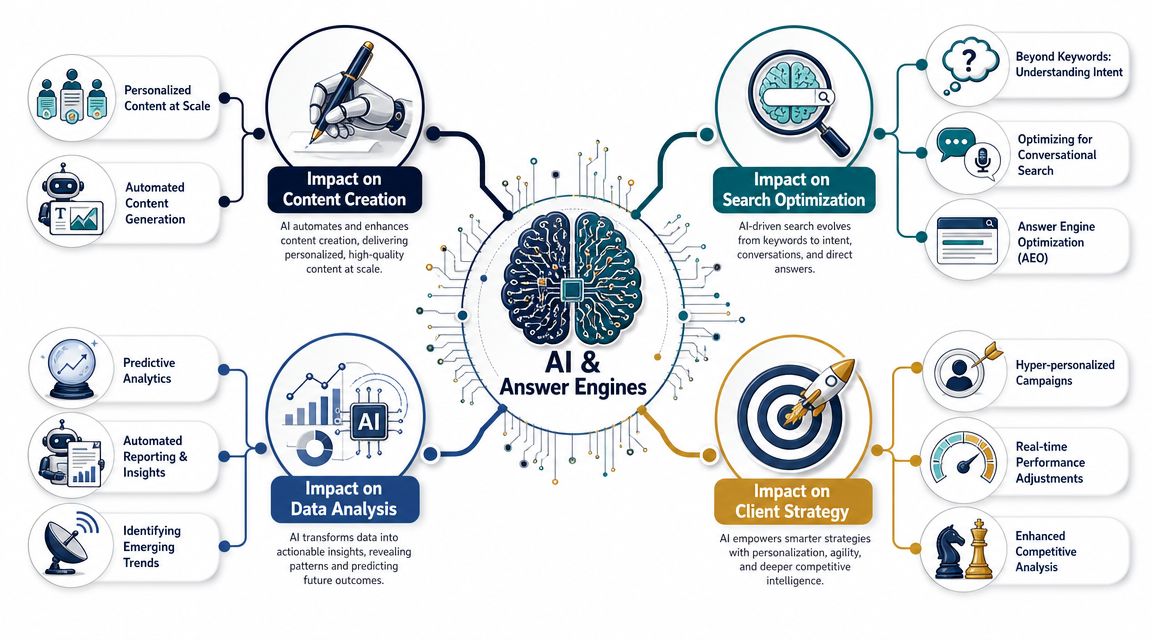
That changes what clients should expect from an agency. Ranking still matters. But being referenced, summarised, and selected as the answer matters just as much.
What classic SEO misses
Classic SEO often focused too narrowly on keywords, title tags, backlinks, and ranking positions. Those pieces still matter, but they don't fully solve for how AI systems retrieve and present information.
If your page is vague, thin, or poorly structured, it may rank modestly and still fail to become part of an answer. If your content is clear, specific, and built around real customer questions, it has a better chance of being useful in both traditional and AI-driven search environments.
For businesses trying to adapt, AI search strategy is now part of practical agency work, especially when local service businesses need to be surfaced not just as a result, but as a reliable recommendation.
What AEO changes in day-to-day work
AEO shifts the agency's job in a few clear ways.
- Content gets tighter: Pages need concise, direct explanations before they get clever.
- Structure matters more: FAQs, service breakdowns, location detail, and internal links help systems understand context.
- Authority becomes broader: One page won't carry the whole category. Agencies build topical depth across related pages.
- Trust signals matter: Reviews, consistency, service clarity, and credible on-site information support selection.
Here's a practical example. A builder may want to rank for renovation terms. In an AI-search model, the better question is whether the builder's site clearly explains renovation types, process, timelines, costs, council considerations, and service areas in a way a machine can confidently summarise.
This short video gives useful context on where that shift is heading.
What works and what stops working
What works now is more disciplined than flashy.
Build pages that answer real questions in plain language, support those answers with clear service detail, and connect them logically across the site.
What stops working is also clear. Thin suburb pages with swapped place names. Blog content written only to hit keyword variants. Generic service pages that could belong to any competitor in any city.
AI hasn't made agency work easier. It has made lazy work easier to spot.
Measuring Success What Good Results Really Look Like
A lot of businesses get trapped by vanity metrics because they're easy to report and hard to challenge. Traffic went up. Reach increased. Engagement improved. Those numbers can be fine. They can also be irrelevant.
If you run a trades business, the question is whether more qualified people are calling or submitting quote requests. If you run a restaurant, it's whether more people are booking, calling, or searching for your brand by name after discovering you.
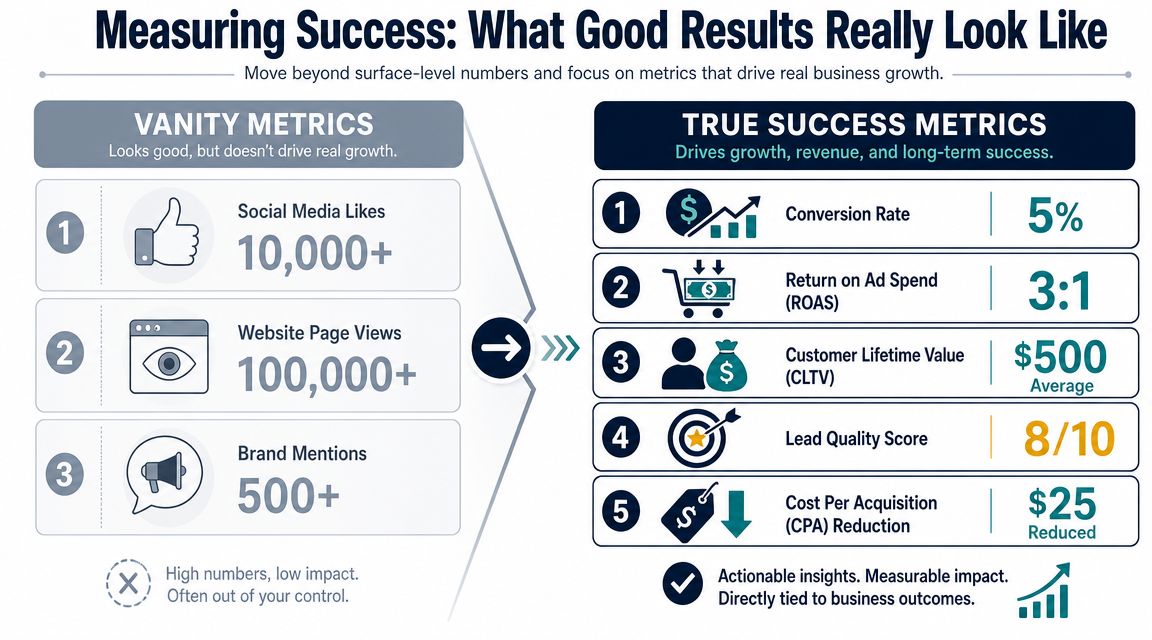
The numbers that impress and the numbers that matter
There's nothing wrong with watching traffic or social activity. The mistake is treating them as proof of business performance.
The more useful lens is this. In a competitive market, agencies should benchmark lead quality, assisted conversions, and branded-search growth rather than traffic alone, as explained in this article on how digital agency work should be measured.
Better questions to ask your agency
Instead of asking, “How many visits did we get?”, ask questions like these:
- Which channel brought the best enquiries: Not the most clicks. The best enquiries.
- Are leads becoming easier or harder to win: That tells you whether targeting and page quality are improving.
- Are more people searching our business by name: That can signal stronger brand recall and trust.
- Which pages assist conversions: Not every page closes the deal directly. Some pages remove doubt and help the final action happen later.
What good reporting sounds like
Useful reporting is plain English tied to business outcomes.
A good agency says your service page for a profitable category is attracting stronger intent, your branded search is improving, and your quote form completion rate is weaker on mobile than desktop. Then it proposes fixes.
A weak agency says impressions are up and posts performed well.
If a report can't help you decide where to spend, fix, or scale next month, it isn't good reporting.
Keep the score in business terms
For most SMEs, the strongest reporting rhythm combines three levels:
- Visibility indicators: Search presence, local exposure, branded demand.
- Conversion indicators: Calls, forms, bookings, direction requests, qualified enquiries.
- Commercial indicators: Job value, lead quality, close rate, repeat business.
That's the standard worth holding an agency to. Not whether the graph points up, but whether the business moves forward.
A Small Business Guide to Choosing Your Digital Partner
Choosing an agency isn't like hiring a supplier for stationery or uniforms. You're choosing a partner that can influence your pipeline, your reputation, and how customers judge you before they ever speak to you.
That means chemistry matters. Clarity matters. Strategic thinking matters. The right agency should care about your business model, not just your marketing checklist.
Ask questions that reveal how they think
Forget polished pitches for a moment. Ask practical questions.
- Have you worked with businesses that sell the way we sell: Trades, hospitality, and construction all have different customer journeys.
- How do you define success for a client like us: If the answer starts and ends with traffic, keep looking.
- What would you fix first in our current setup: Strong agencies prioritise quickly.
- How do you approach AI search and answer visibility: If they only talk about rankings, their model may be dated.
- How often do you review strategy, not just output: Activity alone doesn't produce growth.
Listen closely to how they answer. Good agencies explain trade-offs. Weak ones promise everything.
Watch for the warning signs
Plenty of red flags show up early if you know where to look.
- Generic proposals: If the scope looks identical to what every other business gets, the strategy is probably thin.
- Overpromising speed: Good work can create early movement, but durable gains take steady refinement.
- No interest in lead handling: If your team misses calls or responds slowly, marketing performance suffers. A serious agency will ask about that.
- Reporting theatre: Fancy dashboards don't mean much without interpretation and action.
Choose a partner, not an order taker
The strongest agency relationships feel collaborative. The agency should challenge weak assumptions, tell you when a page won't convert, and push back when a channel doesn't fit your current objective.
That's especially important now because digital marketing agency work spans more than ads or rankings. It includes content systems, search interpretation, user behaviour, conversion design, and AI-era visibility. A business owner doesn't need a vendor who says yes to every request. They need a partner who knows what to do next and why.
When you find the right fit, the relationship becomes simpler. You stop chasing random tactics. You start building a clearer path from online visibility to real enquiries, bookings, and sales.
If your business needs a clearer digital growth plan, Titan Blue Australia works with Australian SMEs in trades, hospitality, construction, and service industries on website design, SEO, AEO, social media management, and AI search strategy. The focus is straightforward: stronger visibility, better-qualified leads, and digital work that supports real business outcomes.
Make Titan Blue a preferred source in Google
One click tells Google to surface our articles more often in Top Stories, AI Overviews and AI Mode.

Future Proof Website Design Australia: 2026 Guide
Future proof website design Australia means modular architecture, schema and AEO built in from day…

Web Design for Google AI Overviews: The 2026 Guide
How web design earns Google AI Overview citations in 2026: answer-first structure, schema, tables and…

Web Design for ChatGPT Visibility: The 2026 Guide
What makes a website visible in ChatGPT answers: crawler access, structured data, and answer-first content.…