

Last updated:
TL;DR:
- Effective café marketing requires alignment with operational capabilities to ensure consistent delivery and genuine engagement.
- Active management of Google Business Profiles, local SEO content, social media, email marketing, and digital loyalty programs significantly boost local visibility and customer retention.
Running a café is full-on. You’re managing staff, suppliers, and service all at once. Then someone tells you that you also need to be posting on Instagram, updating your Google listing, sending emails, and ranking on Google. Where do you even start? That’s exactly why a focused digital marketing checklist for cafes matters. Not a generic list of tactics, but a practical framework built around how cafés actually operate. This guide cuts through the noise and gives you the specific steps that drive real foot traffic, repeat customers, and local visibility.
Table of Contents
- Key takeaways
- 1. Your digital marketing checklist for cafes starts with alignment
- 2. Claim and actively manage your Google Business Profile
- 3. Build a content-led local SEO presence
- 4. Use social media as a visual menu and community board
- 5. Set up email marketing for direct repeat business
- 6. Add a digital loyalty programme and mobile ordering
- 7. Prioritise tactics based on impact, effort, and cost
- My take: marketing only works when operations can back it up
- Ready to get your café’s digital presence sorted?
- FAQ
Key takeaways
| Point | Details |
|---|---|
| Local SEO drives foot traffic | Keeping your Google Business Profile active weekly puts you in front of high-intent local searchers. |
| Social media works as a visual menu | Authentic, real-time content outperforms polished generic posts for local café discovery. |
| Loyalty programmes lift spend | Loyalty members spend 12% more per visit, making retention a high-ROI priority. |
| Email delivers the highest ROI | At $36 to $42 return per dollar spent, email marketing is one of your most cost-effective tools. |
| Fewer tactics done well beats many done poorly | Focus on two or three channels and execute them consistently before adding more. |
1. Your digital marketing checklist for cafes starts with alignment
Before you touch a single platform, ask one question: does this tactic match what my café can actually deliver, every single day?
This is the criteria that separates effective cafe marketing strategies from ones that burn out owners and confuse customers. A promotion you cannot sustain will hurt your reputation faster than no promotion at all.
Here is what to assess before adding any tactic to your plan:
- Operational fit: Can your team handle the demand this tactic might generate without dropping service quality?
- Measurability: Can you track whether it is working, even in a basic way?
- Local focus: Does it help people in your suburb or area find you specifically?
- Repeatability: Can you maintain it weekly, not just for a fortnight?
- Cost against return: Is the time or money investment proportionate to the likely result?
The most common marketing mistakes cafés make come from chasing tactics that look impressive but do not connect to how the business actually runs. Running a big giveaway campaign, for example, might flood your inbox with entries but attract people who will never become regulars.
Pro Tip: Before starting any new marketing activity, write down how you will measure its success in 30 days. If you cannot answer that clearly, the tactic may not be right for your café yet.
2. Claim and actively manage your Google Business Profile
Most cafés set up their Google Business Profile once and forget about it. That is a missed opportunity. Active GBP management correlates directly with higher local search rankings, and the difference between updating weekly and never updating is significant.
Your Google Business Profile checklist should include:
- Complete and accurate NAP: Name, Address, and Phone number, exactly matching your website
- Add at least five high-quality photos of your interior, food, and coffee
- Select the correct primary and secondary business categories
- Post a weekly update featuring a special, event, or new menu item
- Respond to every review within 24 hours, positive or negative
- Keep trading hours current, including public holidays and seasonal changes
On schema markup: adding LocalBusiness schema to your website reinforces your local SEO signals, but it must match your Google Business Profile exactly. Opening hours, address, and phone number need to be identical across both. Be aware that third-party reviews cannot be pulled into your website schema legally. Only reviews hosted directly on your site qualify, and misusing schema risks a manual penalty from Google.
| GBP action | Frequency | Impact on local ranking |
|---|---|---|
| Add new photos | Weekly | High |
| Post updates or specials | Weekly | High |
| Respond to reviews | Within 24 hours | High |
| Update trading hours | As needed | Medium |
| Check NAP consistency | Monthly | High |
For deeper local SEO tactics, the guide on local SEO for restaurants covers how to build out location-specific content that targets the suburbs and neighbourhoods your customers come from.
3. Build a content-led local SEO presence
Ranking on Google for searches like “best flat white in your suburb]” takes more than a claimed Google profile. [Targeting long-tail, low-volume keywords with dedicated location pages can generate meaningful traffic within four to six weeks.
Create pages on your website for specific areas you serve. A page titled “Coffee in Broadbeach” or “Café near Pacific Fair” speaks directly to someone searching with intent to visit. These pages should include your story, your menu highlights, parking or transport details, and genuine local context.
Publishing consistent content also signals to Google that your site is active and relevant. A simple blog covering topics like your coffee origin, seasonal menu changes, or upcoming events can build authority over time without requiring a marketing degree to write.
4. Use social media as a visual menu and community board
Your café’s social media presence is not about going viral. It is about being the most visible, most relatable café in your local area.
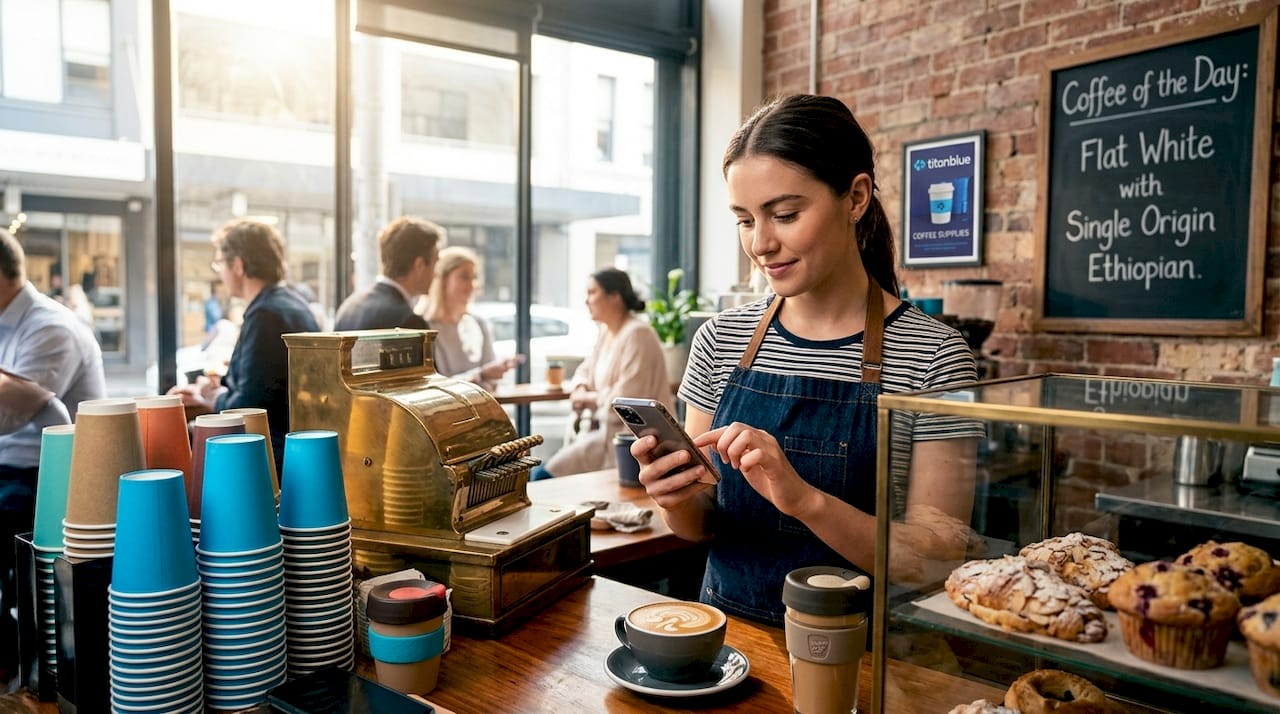
Content that answers “what is happening at the café right now” consistently outperforms generic content in terms of local discovery and real follower engagement. Show the morning setup. Film the barista pulling a perfect shot. Share a photo of today’s special written on the chalkboard.
Your café social media checklist should cover:
- Platform priority: Focus on Instagram and Facebook for most Australian cafés. TikTok suits cafés with a younger demographic and someone comfortable on camera.
- Geotags every post: Always tag your suburb and location so your posts surface in local searches.
- Local hashtags: Use specific tags like #GoldCoastCafe or #BroadbeachCoffee rather than generic ones like #coffee. Branded local hashtag campaigns grow reach and engagement with minimal extra effort.
- User-generated content: Ask customers to tag your café and reshare their posts. This builds trust and reaches new audiences without you creating anything new.
- Batch and schedule: Set aside two hours per week to photograph and schedule content. This stops the “we forgot to post” cycle.
Pro Tip: Create a shared photo folder on your phone where staff can drop candid café shots throughout the week. You will always have fresh content ready to schedule without scrambling.
5. Set up email marketing for direct repeat business
Email is the most underutilised channel in online marketing for coffee shops. At a return of $36 to $42 per dollar spent, it is also the most cost-effective. Automated emails, though they make up just 2% of total sends, account for 37% of sales. That ratio matters.
Start with a simple setup:
- A welcome email sent automatically when someone joins your list
- A monthly newsletter covering new menu items, events, and a loyalty reward
- A re-engagement email for subscribers who have not visited in 60 days
Collect emails at the counter, through your Wi-Fi login, or via a loyalty sign-up. Keep the list growing organically, and segment it when you can. Segmenting your list by visit frequency or purchase preference can increase revenue by up to 760% compared to sending the same message to everyone.
6. Add a digital loyalty programme and mobile ordering
Paper loyalty cards get lost, forgotten, and stamped fraudulently. Digital loyalty solves all three problems and gives you data on customer behaviour.
Loyalty members spend 12% more per visit on average. They also visit more frequently. That combination makes a digital loyalty programme one of the highest-return investments a café can make.
Key points to consider when implementing loyalty and mobile ordering:
- Choose a platform that integrates with your POS. Square, Lightspeed, and similar systems offer built-in loyalty features.
- Promote it actively. Put it on your counter display, your social posts, and your email welcome series.
- Mobile ordering has grown 25% in adoption since the pandemic, and customers who order ahead tend to spend more per transaction.
- Keep the reward structure simple. One point per dollar spent, redeemable for a free coffee, is easy to understand and easy to deliver.
- Use loyalty data to time your email sends. If a regular has not visited in three weeks, a personalised nudge with a reward offer can bring them back.
7. Prioritise tactics based on impact, effort, and cost
Not every tactic deserves equal attention. Here is a direct comparison to help you decide where to start, based on your café’s size and available time.
| Tactic | ROI potential | Setup effort | Ongoing time per week | Best for |
|---|---|---|---|---|
| Google Business Profile | Very high | Low | 30 minutes | All cafés |
| Local SEO content | High | Medium | 1 to 2 hours | Cafés with a website |
| Email marketing | Very high | Medium | 1 hour | Cafés with a mailing list |
| Social media (Instagram/Facebook) | Medium to high | Low | 2 to 3 hours | All cafés |
| Digital loyalty programme | High | Medium | 30 minutes | Cafés with repeat customers |
| Paid social ads | Medium | Medium | 1 hour | Cafés launching or promoting events |
The digital marketing tips for cafes that work best are the ones executed consistently, not the ones that sound the most exciting. If you have one staff member helping with marketing, start with Google Business Profile and email. Add social media once those are running reliably.
Measure what you can. Track your Google Business Profile views monthly. Watch your email open rates. Check how many loyalty members you are adding each week. Small numbers tracked consistently are more useful than occasional deep dives.
My take: marketing only works when operations can back it up
I’ve worked with café owners who invested heavily in content marketing and social ads, only to see their Google reviews tank because the in-store experience couldn’t match the expectation they’d built online. It’s a trap that’s easier to fall into than most people realise.
In my experience, the most common failure point is when marketing and operations are treated as separate concerns. The marketing team, or in most cafés, the owner on a Sunday night, creates a campaign that the Monday morning team has no idea about and no capacity to support.
What I’ve found actually works is this: only market what you can deliver on your worst day. If your coffee is consistently excellent but your food service slows at peak hour, promote your coffee and your vibe. Don’t run a campaign about your brunch menu if brunch service is already stretched.
The cafés I’ve seen build genuine digital traction are the ones that treat every customer experience as the real marketing. Their online presence simply reflects and amplifies what is already happening in the room. That is the standard worth building toward.
— Richie
Ready to get your café’s digital presence sorted?
If you’ve worked through this checklist and realised your website isn’t pulling its weight, or your local search visibility is letting you down, that is where Titan Blue comes in.
Titan Blue is a Gold Coast digital marketing and web design agency that works with hospitality businesses across Australia. From café SEO services that put you on the map locally, to professional web design for hospitality that converts visitors into regulars, the team builds digital presences that actually perform. Get in touch with Titan Blue today and find out what a properly structured digital strategy can do for your café.
FAQ
What should be on a digital marketing checklist for cafes?
Your checklist should cover Google Business Profile management, local SEO content, social media posting, email marketing, and a digital loyalty programme. Focus on tactics you can maintain consistently rather than those that require a large one-off effort.
How often should cafes update their Google Business Profile?
Active cafés should update their Google Business Profile at least once per week with new photos, a post about a special or event, and responses to any new reviews. Weekly activity correlates with stronger local search rankings.
Is email marketing worth it for small cafes?
Yes. Email marketing returns between $36 and $42 for every dollar spent, making it one of the highest-ROI channels available to cafés. Even a basic monthly newsletter with a loyalty incentive can drive meaningful repeat visits.
Which social media platforms work best for cafes?
Instagram and Facebook are the most effective for the majority of Australian cafés. Geotag every post with your suburb and use specific local hashtags to reach people actively searching for cafés in your area.
How do digital loyalty programmes compare to paper stamp cards?
Digital loyalty programmes track customer behaviour, integrate with your email marketing, and remove the risk of lost or fraudulent cards. Loyalty members spend an average of 12% more per visit than non-members.
Recommended
- Digital Marketing Strategy for Restaurants: Your 2026 Plan
- Digital Marketing Checklist for Small Business: 7 Essential Steps – Titan Blue Australia
- Digital marketing checklist for Australian SMBs in 2026
- Digital Marketing Checklist for Small Business: 7 Essential Steps – Titan Blue Australia
Make Titan Blue a preferred source in Google
One click tells Google to surface our articles more often in Top Stories, AI Overviews and AI Mode.

This Week in Australian AI Search: Google’s UGC Data Program
Google's UGC Fresh Data Program and Indexing API quota update, plus our Google AI Mode…

Google AI Mode Adds Official Links: What It Means for Australia
Google is adding more links to AI Mode and testing an official websites section. Here…

Best AEO and GEO Agencies in Australia (2026): 7 Compared
Best AEO agency and GEO agency in Australia, compared: seven agencies, what their own pages…