


Last updated:
You've probably felt this already. You've got solid listings, a decent local name, and properties in good suburbs, but the enquiries don't line up with the effort going out. The portal ads are live, the socials are active, and your team is busy, yet the website isn't producing enough direct leads and your brand isn't building the kind of local authority that compounds over time.
That's where the role of a real estate marketer has changed.
In Australia, and especially in competitive markets like the Gold Coast, a real estate marketer isn't just the person who writes ad copy or organises brochures. The job now is to build a system that makes you easier to find, easier to trust, and easier to contact. If that system is weak, even strong agents end up relying too heavily on portals, paid spend, or personal hustle to keep momentum going.
What Is a Real Estate Marketer in 2026
A real estate marketer in 2026 is part strategist, part operator, and part translator between your brand and buyer intent. They turn property knowledge into discoverable digital assets. They don't just “promote listings”. They shape how sellers, buyers, investors, and local owners encounter your business online.
The outdated version of the role was campaign-based. Put an ad in market, boost a post, print some collateral, then hope enquiry volume lifts. That still has a place in some situations, but it won't carry an agency or a solo agent for long.
The modern version is different. A real estate marketer looks at your whole demand path:
- How people find you through Google, maps, AI-driven discovery, social platforms, referrals, and branded search
- What they see first on your listing pages, suburb pages, agent bio pages, and Google Business Profile
- What convinces them that you understand their situation
- How they convert through calls, forms, appraisals, SMS, email, and follow-up workflows
The role is closer to growth strategy than promotion
If you're selling apartments in Broadbeach, family homes in Robina, or investment stock across the northern Gold Coast, the job isn't limited to getting attention. It's to attract the right attention.
That means matching channel, message, and offer to a real local audience. A first-home buyer under borrowing pressure needs different messaging from a downsizer in Mermaid Waters. A strata owner wants clarity and certainty. An investor cares about numbers, time, risk, and tenant demand. A seller comparing agencies wants proof that your reach turns into qualified conversations, not just impressions.
Practical rule: If your marketing could belong to any agent in any suburb, it won't win much in your suburb.
A capable marketer also pushes back on weak habits. They'll tell you when a glossy campaign looks good but won't convert. They'll tell you when the website is leaking leads. They'll tell you when your content is too generic, your enquiry form is too hard to use, or your listing pages bury the value proposition under clutter.
What agents should expect from the role
You should expect a marketer to improve commercial outcomes, not just produce activity. That includes better local visibility, stronger lead capture, cleaner follow-up, and sharper positioning in the segments you want.
If you want a practical benchmark for what that can look like, this guide to marketing for real estate outlines the mix of digital channels and conversion-focused thinking agencies now need.
A real estate marketer in 2026 isn't optional if growth matters. The market is noisier, privacy is tighter, search is changing, and buyers are more selective. Someone needs to own the system, not just the artwork.
The Core Skills of a Modern Real Estate Marketer
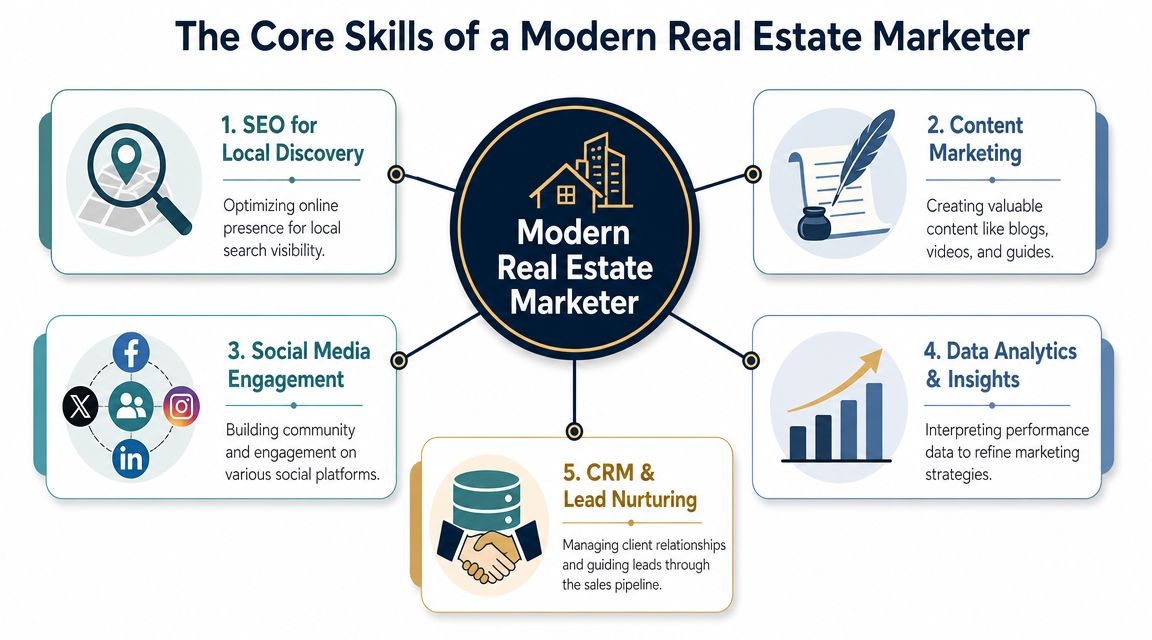
The strongest real estate marketers usually share five skills. Not in theory. In the day-to-day work that moves enquiries.
Local SEO and listing performance
Local SEO still does heavy lifting because most property intent begins with a place, a property type, or an agent name. People search for suburb terms, school-zone terms, investment areas, appraisal intent, and agent comparisons. If your site isn't structured to answer those searches, you lose ground before your campaign even starts.
That includes listing pages, suburb guides, service pages, and agent bios. Each needs crawlable content, clear headings, useful local context, and a strong next step.
The technical part matters more than many agents realise. Google's Core Web Vitals guidance treats INP below 200 ms as good and LCP below 2.5 s as good, according to this property listing performance reference. For real estate sites, that's not a developer-only issue. Slow hero images, oversized gallery assets, and heavy map widgets make listing pages feel sluggish, especially on mobile, and that directly hurts lead-form completion.
Content that answers real questions
Content marketing works when it reduces uncertainty.
A lot of agents publish updates that say very little. “Market still strong.” “Great result for our vendor.” “Just listed.” That content fills a feed but rarely builds authority. Better content answers a concrete local question:
- Buyer-focused: What should a family know before buying in Varsity Lakes?
- Seller-focused: How do presentation choices affect buyer perception in a coastal apartment campaign?
- Investor-focused: What should an investor compare before choosing between two nearby suburbs?
- Owner-focused: What does a realistic appraisal process look like right now?
AI search has made this more important. Clean, direct answers tend to travel further than puff pieces.
Write content the way you'd answer a serious question in a listing presentation. Clear, local, and useful.
Paid media and message discipline
Paid ads still have a role, but weak operators use them as a substitute for strategy. Better marketers use paid channels to test messages, support launches, retarget warm traffic, and reach segments that organic search won't capture quickly enough.
If you're writing nurture emails or campaign follow-ups, details like subject line style affect open behaviour. For teams refining outbound communication, this guide on email subject line capitalization is a useful reference because it helps keep promotional emails readable and consistent rather than shouty.
Social media, analytics, and CRM follow-through
Social media is useful for community familiarity, proof of activity, and trust signals. It's less useful as a standalone lead engine if everything you publish is self-congratulatory. The content that earns attention is usually local, observational, and tied to a real audience problem.
The fifth skill is what separates marketers from content producers. They track what happens after the click. If SEO drives traffic to a suburb page but nobody enquires, the problem may be the page structure, offer, or CTA. If paid campaigns generate leads but they don't progress, the issue may sit in qualification or CRM follow-up.
For agents looking to strengthen that search side with specialist support, a dedicated SEO specialist can help align technical performance, local targeting, and conversion paths.
How to Build a Winning Marketing Channel Strategy
Most underperforming real estate marketing isn't failing because one channel is bad. It's failing because the channels don't work together.
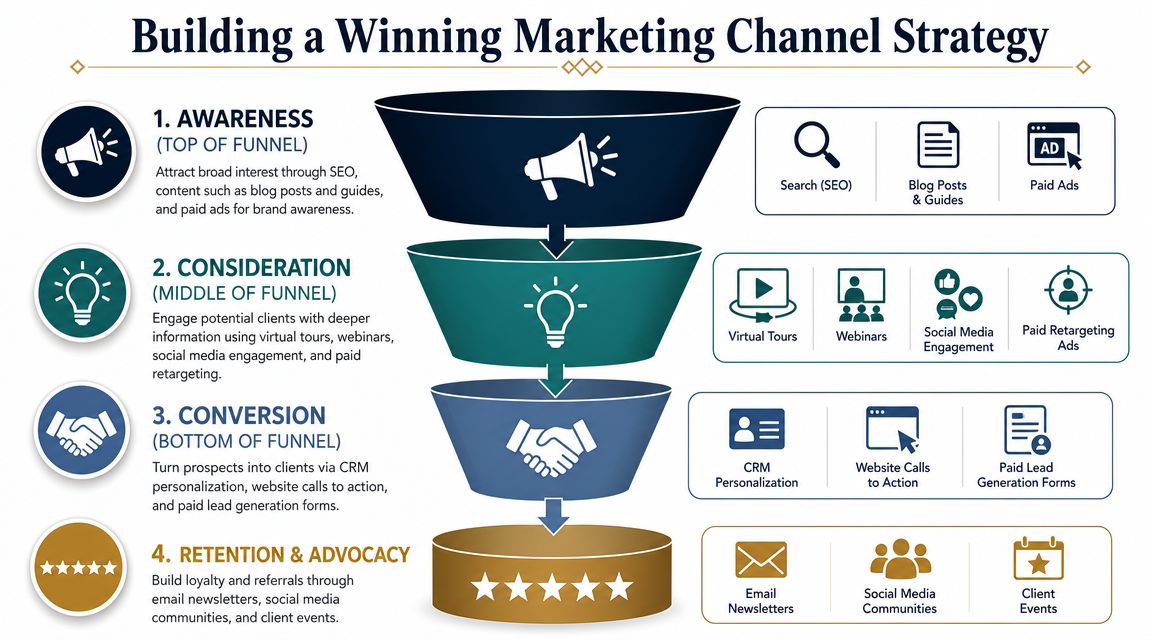
A strong channel strategy has to do three jobs at once. It needs to create awareness, capture intent, and keep a usable relationship with prospects after the first interaction. In Australia, that has become more important because marketing is moving into a more privacy-restricted environment, with tighter expectations around consent and data use. A practical 2026 approach is to focus on first-party data capture, consent-led CRM segmentation, and owned channels such as email, SMS, and Google Business Profile, as noted in this guidance on privacy-aware real estate marketing strategy.
Owned, earned, and paid need different jobs
A lot of agencies blur these together. That's a mistake.
Owned channels are the assets you control. Your website, listing pages, suburb guides, email database, SMS list, and Google Business Profile sit here. These should hold your best evergreen value because they keep working after a campaign ends.
Earned channels include reviews, organic search visibility, referrals, and branded mentions. You don't fully control them, but good work improves them over time.
Paid channels include Google Ads, Meta campaigns, boosted listings, and remarketing. They're useful when you need speed, testing, or coverage for a campaign launch.
The strategy question isn't “Which channel is best?” It's “Which channel should do which job?”
A practical channel model for an agent
Here's a sensible structure for a local agent or boutique agency:
-
Use SEO and local content for discovery
Suburb pages, service pages, and educational articles should answer the questions people type when they're early in the process. -
Use paid media for controlled reach
Promote appraisal offers, launch key listings, and retarget visitors who looked but didn't enquire. -
Use CRM and email for progression
Once someone raises a hand, don't push them back into the ad ecosystem. Move them into a consent-based follow-up path you control. -
Use Google Business Profile for trust and action
This is often where searchers decide whether to call, click, or keep comparing.
A broad planning framework can help, but only if it gets adapted to property behaviour. This explainer on digital marketing strategy is useful because it frames channels as coordinated parts of one system rather than isolated tactics.
What doesn't work anymore
Three habits keep wasting budget.
First, sending all traffic to a generic homepage. Listing intent should land on a listing. Appraisal intent should land on a seller page. Local information intent should land on a suburb resource.
Second, relying on third-party platforms to hold all your audience data. If the platform changes the rules, your reach disappears with it.
Third, measuring success by visibility alone. Reach without capture is expensive noise.
For agents comparing campaign formats, the practical examples in Adwave real estate marketing are a useful outside reference because they show how different advertising formats fit different property goals.
Measuring What Matters Key KPIs for Real Estate
Most agents can tell you how many likes a post got. Fewer can tell you which channel produced the last three qualified appraisal leads.
That's the gap.
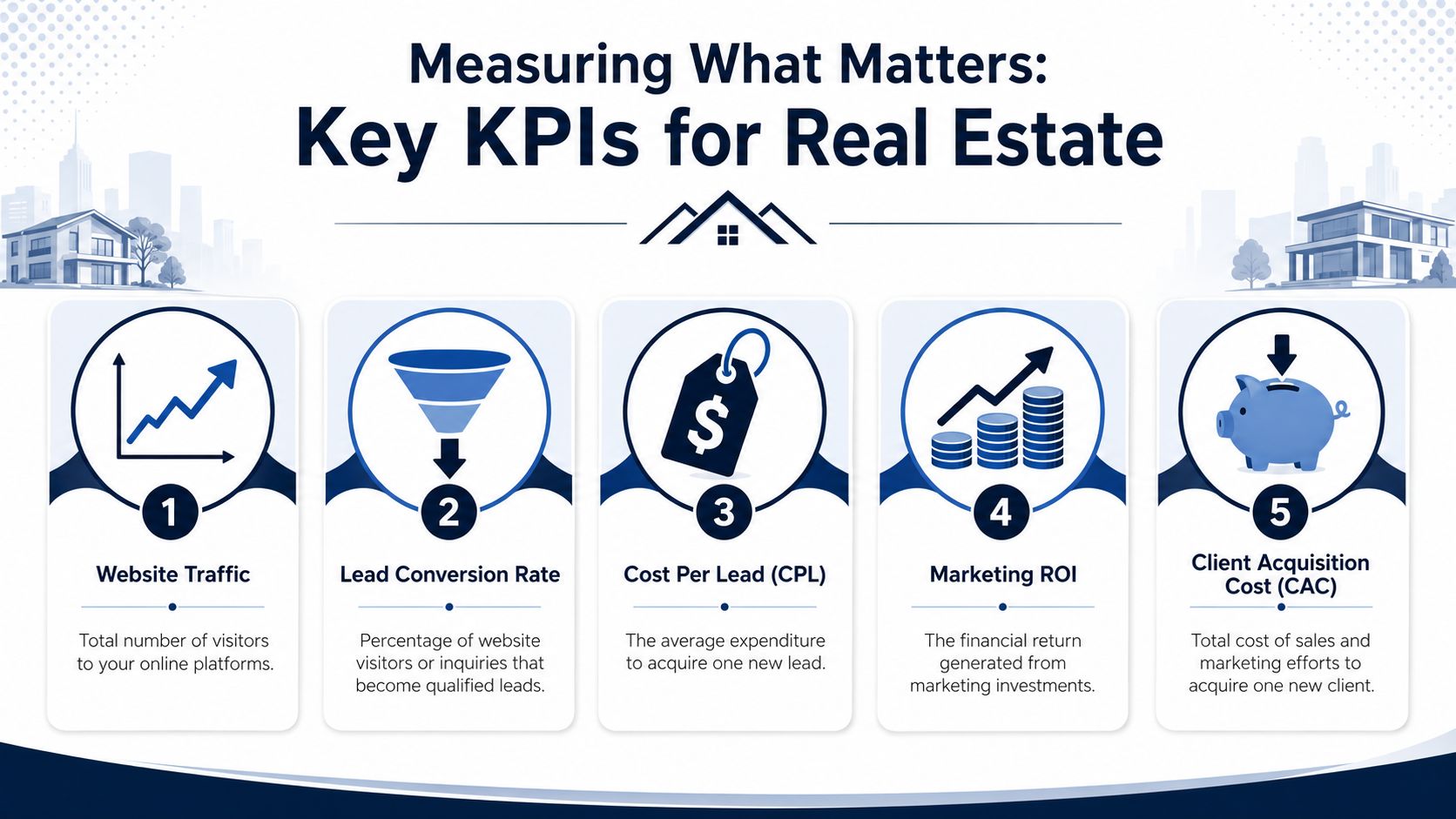
A real estate marketer should pull attention away from vanity metrics and toward operational metrics. You don't need a giant dashboard. You need a short list that helps you decide what to fix, what to scale, and what to stop.
Vanity metrics versus decision metrics
Vanity metrics look encouraging but often don't help you act. Think post reach, page likes, raw impressions, or video views with no next-step behaviour attached.
Decision metrics are different. They tell you whether the marketing is creating commercial movement.
Focus on indicators like these:
-
Qualified lead volume
Not every enquiry counts equally. Separate tyre-kickers from people who fit the property, timing, or service. -
Landing page conversion rate
If a listing page gets traffic but almost no calls or form submissions, the issue may be message clarity, mobile usability, or CTA placement. -
Lead-to-appointment movement
This tells you whether your channel is attracting the right people or filling the CRM with weak contacts. -
Source quality by channel
Organic search, paid campaigns, social referrals, and direct traffic all behave differently. Track them separately.
Useful test: If a metric goes up, can you name the business action you'd take next? If not, it's probably not a KPI.
How to read channel performance properly
SEO shouldn't be judged by rankings alone. A page can rank and still fail commercially if it targets the wrong intent or sends users to a dead end. For paid media, cost only matters when paired with lead quality. Cheap leads can waste more time than expensive ones.
Content marketing needs a longer view. A suburb guide or seller resource may assist conversion before the user ever fills a form. That doesn't make attribution easy, but it does mean you should look at assisted conversions and on-site behaviour, not just last-click credit.
If your current reporting is messy, these Google Analytics metrics are a practical starting point because they help you narrow reporting to the measures that accurately reflect user intent and commercial action.
What to review every month
A monthly review doesn't need to be complicated. It does need honesty.
Check which pages attracted the most relevant traffic, which enquiry sources turned into real conversations, where users dropped off on mobile, and which campaigns generated activity without producing sales opportunity. That's usually enough to show where the next round of effort belongs.
Your First Steps Practical Marketing Tactics
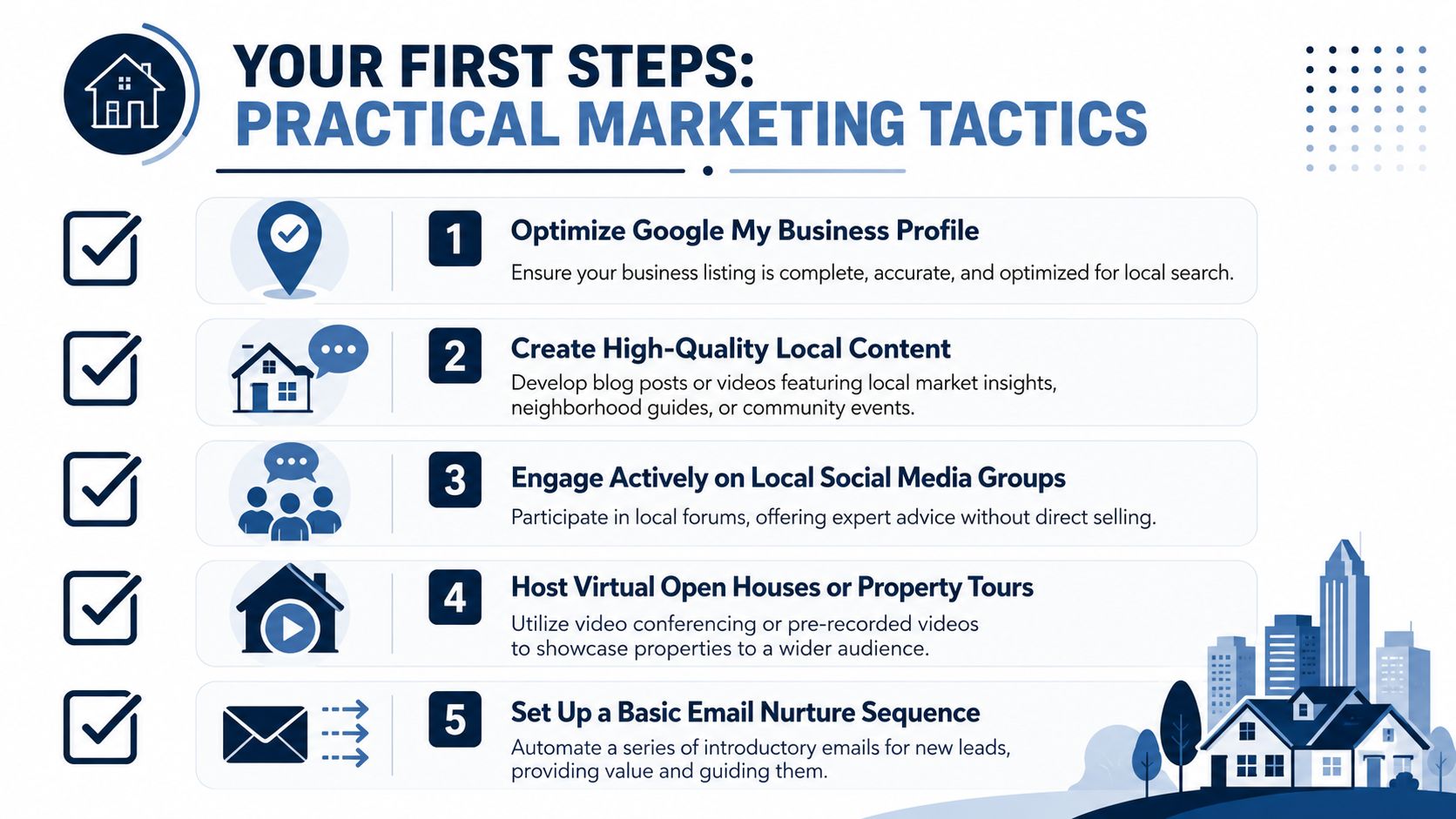
If your marketing feels scattered, don't rebuild everything at once. Start with moves that tighten local visibility, improve lead capture, and sharpen your message for the right segment.
Australia's market pressure has made generic messaging weaker. Buyer intent is being shaped by affordability, investor calculations, and transaction realities, and the segments gaining attention include downsizers, probate or estate sales, strata owners, and investors, according to this summary of Australian niche real estate positioning. If your message still says little more than “sell faster” or “great results”, you're blending into the pack.
Start with one niche and one local area
Don't try to be everything to everyone across the whole coast.
Pick one niche and one service area where you already have experience, stock, or relationships. That could be downsizers in Palm Beach, investor-oriented apartments in Surfers Paradise, or probate-related property support across the Gold Coast.
Then adjust the message.
A downsizer campaign should reduce uncertainty around timing, presentation, and next-step planning. An investor campaign should speak to yield logic, maintenance burden, tenant appeal, and hold-versus-sell decisions. A strata owner usually wants clarity around building context, buyer fit, and sales process friction.
Use AI for local content discovery, not final thinking
AI tools are useful when they help you work faster on ideation. They're less useful when agents let them write vague suburb fluff.
Use an LLM to brainstorm:
- Local questions buyers ask about a suburb, property type, or school catchment
- Objections specific to a niche such as renovation costs, body corporate concerns, or inherited property decisions
- Content angles for owned channels including FAQs, appraisal pages, email sequences, and Google Business Profile updates
Then edit everything with local judgement. If you wouldn't say it face-to-face in a listing appointment, don't publish it.
A good AI prompt gives you draft angles. It does not replace local market knowledge.
Five practical moves worth doing now
Tighten your Google Business Profile
Make sure categories, service areas, contact details, business description, and imagery are current. This supports branded search, local map visibility, and trust.
Build one suburb page properly
Not fifty thin ones. One. Include buyer concerns, seller context, local amenities, property style patterns, and a relevant CTA.
Create one niche landing page
If you want probate, downsizer, or investor work, build a page that speaks directly to that audience's concerns.
Set up a short nurture sequence
Email or SMS follow-up should answer the next logical question, not just repeat “Are you still interested?”
Review your listing templates
Check whether the first screen on mobile sells the property. If the key value proposition is buried under clutter, fix the layout before you buy more traffic.
A practical tool stack might include Google Business Profile, Google Analytics, Search Console, your CRM, Canva for quick assets, and an AI assistant for ideation. Agencies that also want support on AI search visibility and content structure may use Titan Blue Australia alongside their own in-house tools and CRM workflows.
Hiring Your Real Estate Marketer A Checklist
If you're ready to hire, don't get distracted by polished proposals. A good-looking deck is easy to produce. Strategic judgement is harder.
The right real estate marketer should be able to explain how they'll improve your visibility, conversion path, and follow-up system in your market. Not in abstract language. In plain English.
Questions worth asking
Ask how they approach local intent. If they can't talk clearly about suburb pages, listing structure, Google Business Profile, mobile conversion, and lead routing, they probably haven't spent much time in service-led local search.
Ask how they define success. If the answer revolves around impressions, awareness, or “more exposure” without a path to qualified enquiry, keep digging.
Ask how they handle segmentation. Australian property audiences aren't one lump. A marketer should be comfortable talking about different seller and buyer groups, and how messaging changes by niche.
Here are the questions I'd put on the table:
-
How will you prioritise channels for my market?
They should justify why SEO, paid ads, email, GBP, or social matter for your mix. -
What will you measure each month?
Look for lead quality, conversion behaviour, and channel-specific outcomes, not just traffic volume. -
How do you improve underperforming pages?
Good marketers talk about testing offers, layout, copy, forms, speed, and CTA logic. -
How do you use first-party data?
They should understand consent, segmentation, and owned audience building. -
What do you need from me to make the work succeed?
Strong operators know they need access, feedback loops, and local insight.
Red flags that should slow you down
The biggest red flag is certainty where uncertainty is normal.
If someone guarantees top rankings, guaranteed lead volume, or instant market dominance, they're either overselling or they don't understand how volatile digital channels can be. Good marketers make informed projections and explain dependencies. They don't promise fantasy.
Another warning sign is channel obsession. If they only talk about Meta ads, only talk about SEO, or only talk about content, they may be trying to fit your business into their preferred service instead of building around your actual needs.
If a marketer can't explain trade-offs, they probably haven't managed enough real campaigns.
Watch for reporting theatre too. Some agencies drown clients in dashboards because the underlying outcomes are weak. You want someone who can say, clearly, what improved, what didn't, why, and what happens next.
What a better hiring decision looks like
A better hire usually sounds measured. They ask about your suburbs, stock mix, seller profile, CRM, past campaigns, and sales process. They care about where leads stall. They want to know which audiences are profitable and which ones waste your team's time.
That's the kind of judgement you should buy.
If you want a broader decision framework before signing anyone, this guide on how to choose an SEO company in 2026 is useful because the same evaluation logic applies to digital partners in property. Look for strategic clarity, realistic expectations, and evidence that they understand your local market rather than recycling generic agency language.
If you want a real estate marketing approach built for Australian search behaviour, privacy-aware lead generation, and stronger visibility across Google and AI-driven discovery, Titan Blue Australia helps businesses develop SEO, websites, content, and digital strategy from its Broadbeach base on the Gold Coast.
Make Titan Blue a preferred source in Google
One click tells Google to surface our articles more often in Top Stories, AI Overviews and AI Mode.

Google Search Controls Update: What Australian Sites Need
Google updated its Search controls page on 21 Oct 2026, now listing the generative AI…

Bing Topics Portfolio: What It Means for Australian Sites
Microsoft Bing launched Topics Portfolio in AI Performance. What it shows, whether it reaches Australia,…

Best Medical Practice Website Design Agencies in Australia: 7 Compared
Best medical practice website design agencies in Australia, compared: seven picks, what each page shows,…