

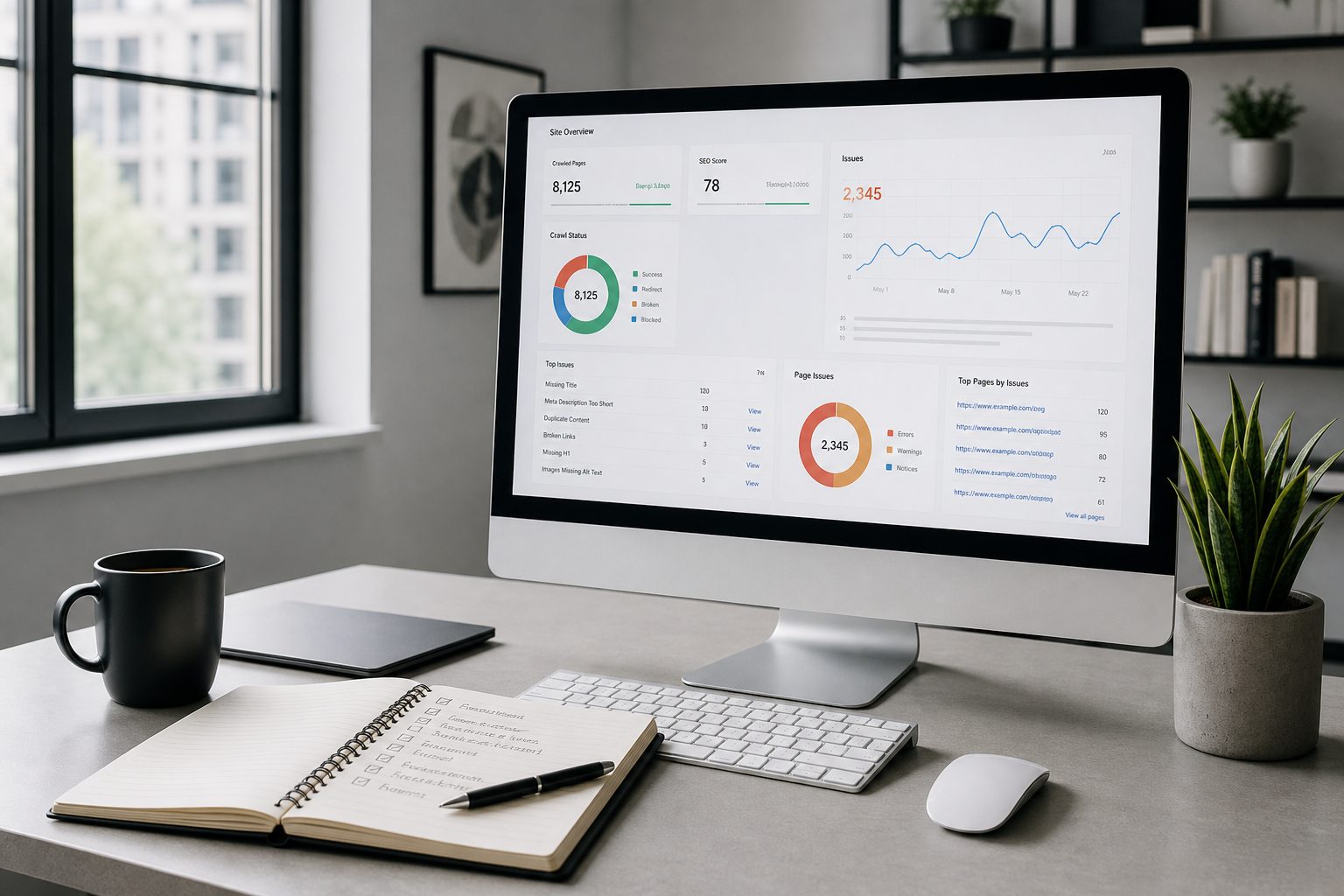
An AI readiness assessment tells you whether AI search engines like ChatGPT, Google AI Overviews, and Perplexity can find, understand, and cite your business. It covers eight critical areas — from technical crawler access to content structure, schema markup, authority signals, and measurement. Use this checklist to score your website against each area, identify the gaps dragging your AI visibility down, and prioritise exactly what to fix first. Most Australian businesses fail on at least three of these areas without knowing it.
Australian businesses are facing a fundamental shift in how customers find them. According to the Australian Bureau of Statistics, AI adoption accelerated sharply in 2024–25, and MYOB data shows SMEs using AI are growing 2.8 times faster than those that aren’t. But adoption of AI tools is different from being visible in AI search — and most businesses are confusing the two.
This checklist covers 45 assessment points across eight categories. Work through them systematically, score yourself honestly, and you’ll have a clear picture of your AI search readiness — and exactly where to focus your efforts.
How to Use This Checklist
Each section includes a set of checks. Mark each one as ✅ Done, ⚠️ Partial, or ❌ Not done. At the end, tally your score using the scoring guide. A score below 70% means your website is actively losing ground to competitors in AI search results — even if your traditional SEO rankings look healthy.
Work through the categories in order. Category 1 (Technical Crawlability) is the foundation — if AI bots can’t access your site, nothing else matters.

Category 1: Technical Crawlability (8 Checks)
Before an AI engine can cite your business, its crawlers must be able to reach, read, and index your content. This is the most overlooked area — and the most immediately fixable.
1.1 — AI Bots Are Not Blocked in robots.txt
Check your robots.txt file (at yourdomain.com.au/robots.txt). Confirm it does not disallow the following crawlers:
GPTBot(OpenAI / ChatGPT)ClaudeBot(Anthropic / Claude)PerplexityBot(Perplexity)Google-Extended(Google AI Overviews training)Applebot-Extended(Apple Intelligence)
A blocked AI crawler cannot cite your content — full stop. Many businesses accidentally block these bots when adding security rules or using generic Disallow: / directives for non-Google crawlers.
1.2 — An XML Sitemap Exists and Is Linked from robots.txt
Your XML sitemap helps AI crawlers discover all your pages efficiently. Confirm it exists at /sitemap.xml or /sitemap_index.xml, and that the sitemap URL is referenced in robots.txt with a Sitemap: directive.
1.3 — No noindex Directives on Key Pages
Pages with <meta name="robots" content="noindex"> are invisible to AI engines. Audit your service pages, blog posts, and location pages to ensure none are accidentally noindexed.
1.4 — HTTPS Is Active Across the Entire Site
All your pages should load over HTTPS with no mixed-content warnings. Non-secure pages signal low trust to both AI engines and human users. Check for HTTP links embedded in secure pages using a tool like Screaming Frog or the Chrome DevTools Security panel.
1.5 — No Orphan Pages (Every Page Has Internal Links)
Orphan pages — those with no internal links pointing to them — are difficult for crawlers to discover. Run a site crawl to identify pages that only appear in your sitemap but receive zero internal links. These pages have near-zero AI citation potential.
1.6 — Canonical Tags Are Implemented Correctly
If you have duplicate or similar content across multiple URLs (common on eCommerce sites and blogs with tag/category pages), canonical tags must point AI crawlers to the definitive version. Missing or self-contradicting canonicals create confusion about which page to cite.
1.7 — llms.txt File Exists (Optional but Recommended)
The emerging /llms.txt standard provides AI systems with a plain-text index of your most important pages, written in a format optimised for language model consumption. Perplexity and several academic AI crawlers currently support it. While not yet universal, creating one is low-effort and positions you ahead of the field. More at llmstxt.org.
1.8 — JavaScript Rendering Doesn’t Hide Critical Content
If your key content — services, pricing, testimonials, FAQs — only appears after JavaScript executes, some AI crawlers may never see it. Audit your critical pages in a browser with JavaScript disabled (or use Google Search Console’s URL Inspection tool) to confirm the content appears in the raw HTML.
Not sure if AI bots can access your site? Titan Blue’s AI Readiness Audit service → checks all of this for you.
Category 2: Content Structure and Clarity (7 Checks)
AI engines don’t just index your pages — they extract specific information to build answers. Your content must be structured so that this extraction is effortless. Poorly structured content, even if informative, is rarely cited.
2.1 — Every Page Has a Clear, Single Topic
Each page on your site should address one primary topic or intent. If a single page tries to cover your services, your team, your blog, and your pricing all at once, AI engines can’t cleanly extract the answer to a specific question from it.
2.2 — Headings Form a Logical Hierarchy (H1 → H2 → H3)
Use one H1 per page (your main topic), H2 for major sections, and H3 for sub-points. AI engines use heading structure to understand the architecture of your content and identify which section answers which question. Skipped heading levels or multiple H1s signal disorganised content.
2.3 — Your Business Offering Is Clear Within the First 100 Words of Key Pages
On your homepage and service pages, AI engines look for a concise statement of who you are, what you do, and who you serve — within the opening paragraph. If your page opens with a decorative banner image and a generic tagline, AI engines may struggle to classify your business accurately.
2.4 — Short Paragraphs (3 Sentences Maximum)
Dense walls of text are harder for AI engines to parse and extract from. Write in short, self-contained paragraphs. Each paragraph should make one point and support it. This structure makes it far easier for AI to extract your content as a clean, quotable answer.
2.5 — Lists and Tables Are Used for Comparative or Multi-Item Information
When you’re listing features, comparing options, or presenting steps, use <ul>, <ol>, or <table> elements rather than running them together in a paragraph. Structured data is easier for AI to extract and reformat in an answer.
2.6 — FAQ Sections Exist on Key Pages
FAQ sections are one of the highest-performing content formats for AI citation. Format each question as an H3 heading, followed immediately by a concise, direct answer in the first sentence. AI engines frequently pull FAQ answers verbatim into their responses. Every service page should have at least 5 FAQs. Learn more about optimising FAQ pages for AI search.
2.7 — Content Answers Real User Questions (Not Just Keywords)
Check your content against real search queries using Google Search Console and Google’s “People Also Ask” feature. If your content is written around keywords but doesn’t directly answer the question those keywords imply, it won’t get cited — regardless of its ranking position.

Category 3: Schema Markup and Structured Data (6 Checks)
Schema markup is machine-readable metadata that tells AI engines precisely what your content is about. It’s the single biggest technical lever for AI citation, yet fewer than 30% of small business websites in Australia have it implemented correctly.
3.1 — Organisation Schema on Homepage
Your homepage should include Organisation schema (JSON-LD format) that specifies your business name, URL, logo, contact details, social profiles, and founding date. This is how AI engines build a confident entity profile for your business.
3.2 — LocalBusiness Schema on Contact/Location Pages
If you serve a specific geographic area (and virtually every Australian business does), LocalBusiness schema on your contact page is essential. Include your business name, address, phone, opening hours, and service area. This is how you appear in local AI search results.
3.3 — FAQPage Schema on FAQ Sections
Every page with a FAQ section should have FAQPage schema that mirrors the Q&A content. This tells AI engines explicitly: “these are questions and answers.” Without schema, AI engines must infer this from formatting alone — which is far less reliable.
3.4 — Service or Product Schema on Offering Pages
Service pages should include Service schema (for agencies, consultants, tradespeople) or Product schema (for eCommerce). Include the service name, description, provider, and where available, pricing information.
3.5 — Article or BlogPosting Schema on All Blog Posts
Every blog post should include Article or BlogPosting schema with the headline, author, publish date, modified date, and image. This helps AI engines identify your content as fresh, authoritative editorial content rather than generic website copy.
3.6 — Schema Is Valid (No Errors in Google’s Rich Results Test)
Broken schema is worse than no schema — it signals carelessness to AI engines. Validate all your schema implementations at Google’s Rich Results Test. Fix any errors before they undermine your credibility.
Read our full guide on adding schema markup for AI search if you need step-by-step implementation help.
💡 Want to know where your business stands?
We run AI readiness assessments for Australian businesses every week — checking all 45 points and delivering a scored report with a clear action plan. It takes 15 minutes of your time and it is free.
Category 4: E-E-A-T and Authority Signals (6 Checks)
Experience, Expertise, Authoritativeness, and Trustworthiness (E-E-A-T) are the signals AI engines use to decide whether a source is reliable enough to cite. This is especially critical for advice-based businesses — professional services, healthcare, finance, and trades.
4.1 — Author Bios on All Blog Posts and Key Content Pages
Every piece of content should be attributed to a named author with verifiable credentials. Include the author’s name, role, years of experience, and a link to their professional profile (LinkedIn is ideal). Anonymous content scores poorly on E-E-A-T signals.
4.2 — Your About Page Demonstrates Real Expertise
Your About page is one of the highest-weighted E-E-A-T signals on your site. It should describe the team’s specific experience, credentials, years in business, and demonstrable results. Generic “we’re passionate about helping clients” copy scores near zero.
4.3 — Trust Signals Are Present (Testimonials, Awards, Affiliations)
Industry memberships, awards, certification logos, and genuine client testimonials all contribute to E-E-A-T. Ensure these appear on your homepage and service pages — not buried in a footer or hidden on a separate “Awards” page that no one visits.
4.4 — Your Business Has a Google Business Profile with Recent Reviews
Your Google Business Profile (GBP) is one of the strongest entity signals available to AI engines. Ensure your GBP is complete, verified, and has reviews posted within the last 90 days. Businesses with inactive GBP profiles are far less likely to be cited for local queries.
4.5 — Your Business Is Mentioned on Third-Party Sites
AI engines use external mentions — news articles, directory listings, review sites, industry publications — to verify that your business is real and credible. Audit your brand mentions using a tool like Google Alerts or Semrush. If you have fewer than 10 quality external mentions, this is a priority to address.
4.6 — Privacy Policy and Terms of Service Pages Exist
Basic legal pages signal to AI engines that your site is a legitimate, established business rather than a fly-by-night operation. Ensure these pages are linked from your footer and are current.
Category 5: Entity Recognition and Brand Signals (5 Checks)
AI engines build “entity models” — knowledge graph entries — for businesses they regularly encounter. The stronger your entity signals, the more consistently AI engines mention you by name, recommend your services, and cite your content.
5.1 — Your Business Name, Address, and Phone (NAP) Are Consistent Everywhere
Your business name, address, and phone number must be identical across your website, GBP, Yellow Pages, True Local, industry directories, and any other listing. Inconsistencies create conflicting entity signals and reduce AI confidence in citing you.
5.2 — You Have Profiles on LinkedIn, Facebook, and Relevant Industry Platforms
Social media profiles serve as entity anchors that help AI engines verify your business exists. Ensure your LinkedIn company page, Facebook business page, and any industry-specific directory listings are active, complete, and linked to your main website.
5.3 — Your Website Links Out to Your Social Profiles (and Vice Versa)
Bidirectional linking between your website and social profiles reinforces your entity connections. Add social media links to your website footer and ensure each social profile links back to your website URL.
5.4 — Your Brand Name Is Used Consistently in Page Titles and Content
AI engines learn your brand entity partly by seeing your name used consistently in your own content. Ensure your brand name appears naturally in page titles, meta descriptions, and the body of key pages — not just in the footer or header logo alt text.
5.5 — You Have a Wikipedia or Wikidata Entry (for Established Businesses)
For businesses with 10+ years of history, a Wikipedia presence is a strong entity signal. If you’re not eligible for Wikipedia, ensure you have a comprehensive Crunchbase profile, a well-maintained LinkedIn company page, and entries on authoritative Australian business directories.
Category 6: Page Speed and Core Web Vitals (5 Checks)
Slow pages are deprioritised by AI crawlers, which have limited crawl budgets. Page speed also directly affects user experience — and AI engines increasingly factor engagement signals into their citation decisions.
6.1 — Largest Contentful Paint (LCP) Is Under 2.5 Seconds
LCP measures how long it takes for the largest content element (usually a hero image or heading) to load. A score above 2.5 seconds places you in the “needs improvement” tier. Check yours at PageSpeed Insights.
6.2 — Cumulative Layout Shift (CLS) Is Under 0.1
CLS measures visual stability — whether elements jump around as the page loads. A score above 0.1 suggests unstable layout, which frustrates users and signals a poorly maintained site. Common causes: images without dimensions, dynamically loaded ads, and web fonts without fallbacks.
6.3 — Images Are Properly Compressed and in Modern Formats
Uncompressed images are one of the most common causes of slow page speed for Australian small business websites. Convert images to WebP format and compress them below 100KB where possible without visible quality loss. Tools like Squoosh (free) or ShortPixel (WordPress plugin) handle this automatically.
6.4 — Hosting Is Reliable with Uptime Above 99.9%
AI crawlers that encounter repeated downtime or server errors quickly deprioritise your site. Monitor your uptime using a free tool like UptimeRobot. If your site has regular downtime events, consider upgrading to managed hosting with SLA-backed uptime guarantees.
6.5 — Mobile Performance Scores Above 70 in PageSpeed Insights
Over 65% of AI searches in Australia are initiated on mobile devices. A mobile performance score below 70 signals significant rendering issues that affect both user experience and AI crawler efficiency. Run your core pages through PageSpeed Insights on mobile mode monthly.
Category 7: Answer-First Content and AEO Optimisation (7 Checks)
Answer Engine Optimisation (AEO) is the practice of structuring your content so AI engines can extract and present your answers directly. This is where most businesses fall behind — and where the biggest gains are available.
7.1 — Every Key Page Opens with a Direct Answer to Its Title’s Implied Question
If your page title is “What Is Content Marketing?”, the first sentence must directly answer that question — not build to the answer after three paragraphs of preamble. AI engines extract answers from the opening sentences of a page. If your answer isn’t in the first 100 words, it’s unlikely to be cited. Read more about Answer Engine Optimisation and how it works.
7.2 — Definition Blocks Are Present for Key Terms
For any industry term, process, or concept you explain on your site, add a clear definition block that uses the format: “[Term] is [definition].” AI engines love clean, citable definitions. These often appear verbatim in AI search responses.
7.3 — “How to” Content Uses Numbered Steps
Instructional content performs far better in AI search when it uses numbered steps rather than prose instructions. If you have “how to” guides on your site, convert them to numbered lists with one action per step. AI engines extract these as structured processes.
7.4 — Data and Statistics Are Cited with Sources
AI engines weight content more heavily when it cites verifiable data sources. Where you include statistics, percentages, or research findings, always link to the original source. Unsupported claims are passed over in favour of cited ones.
7.5 — Your Content Covers Fan-Out Queries (Sub-Questions Around the Main Topic)
When someone asks an AI engine a question, the engine decomposes it into multiple sub-queries (called “fan-out queries”) and gathers answers from multiple sources. Your content should anticipate these sub-questions and answer each one explicitly. For example, a page about “digital marketing Gold Coast” should also answer: “What does a Gold Coast digital marketing agency cost?”, “What results can I expect?”, “How long does digital marketing take to show results?”
7.6 — Long-Form Content Exceeds 1,500 Words on Pillar Topics
AI engines prefer comprehensive content from a single authoritative source over shallow content that only partially covers a topic. Pillar pages — your most important service and topic pages — should exceed 1,500 words and cover the topic thoroughly.
7.7 — Content Is Updated Regularly (Within the Last 6 Months for Key Pages)
AI engines prioritise fresh, recently updated content for queries where recency matters (most queries). Review your most important service and blog pages every six months. Update statistics, examples, and any information that has become stale. Update the “last updated” date visible on the page.
Category 8: Measurement and Monitoring (6 Checks)
You can’t optimise what you don’t measure. Most businesses have no idea whether they’re gaining or losing ground in AI search — because they’re not tracking the right signals.
8.1 — AI Search Traffic Is Tracked in GA4
Set up GA4 to track traffic from AI referrers. Create a custom segment for sessions where the traffic source includes: chatgpt.com, perplexity.ai, claude.ai, bing.com (now AI-augmented), and chat.openai.com. Monitor this segment monthly. See our guide on how to track AI search traffic.
8.2 — Google Search Console Is Active and Monitored Weekly
Google Search Console shows you which queries are driving impressions and clicks from Google’s AI-augmented results. Monitor your Performance report weekly, filtering for queries where AI Overviews are appearing (look for queries with high impressions but lower-than-expected CTR — a hallmark of AI Overview displacement).
8.3 — Brand Mention Monitoring Is Set Up
Set up Google Alerts for your business name, key team members, and your primary services (e.g. “Titan Blue”, “Richie Zengoski”, “digital marketing Gold Coast”). This tells you when AI-generated content or other sites mention your business — a key signal of growing AI authority.
8.4 — Competitor AI Visibility Is Monitored
Regularly prompt ChatGPT, Perplexity, and Google AI Overviews with queries your customers would use (e.g. “best digital marketing agency in Brisbane”, “who does AI SEO in Australia”). Track whether you, your competitors, or neither of you appears. This is the most direct measure of your AI search position.
8.5 — Core Web Vitals Are Monitored Monthly
Set up a monthly PageSpeed Insights check for your five most important pages. Many sites that launch with good performance see it degrade over time as new plugins, images, and scripts are added without performance review.
8.6 — A/B Testing Is Used to Optimise Content for AI Citations
For high-traffic pages, test different opening paragraphs and FAQ formulations to see which versions earn more AI citations. Track AI traffic to specific pages using UTM-tagged links from your GBP, social profiles, and email campaigns to measure which page versions perform better.
AI Readiness Scoring Guide
Tally your results using the following system:
| Score | Rating | What It Means |
|---|---|---|
| 40–45 ✅ | AI Ready | Strong foundation. Focus on fresh content and monitoring. |
| 30–39 ⚠️ | Developing | Good base but significant gaps. Prioritise schema and AEO content. |
| 20–29 ⚠️ | At Risk | Visible gaps that competitors are exploiting. Act now. |
| Below 20 ❌ | Not Ready | Effectively invisible in AI search. Urgent action required. |
Score each check: 2 points for Done, 1 point for Partial, 0 points for Not done. Maximum score: 90 points. Express as a percentage of 90.
Where to Start: Priority Order for Australian Businesses
If you’re working through this checklist with limited time or budget, tackle these areas first — they deliver the fastest, highest-impact improvements:
- Fix robots.txt — Ensure AI bots are explicitly allowed. This is a 15-minute fix with immediate impact.
- Add schema markup — Organisation, LocalBusiness, and FAQPage schema deliver disproportionate returns for the effort required.
- Rewrite your opening paragraphs — Lead every key page with a direct answer to its title’s question. This is the highest-leverage content change you can make.
- Add FAQ sections — Every service page needs at least 5 well-structured FAQs. These are your most likely AI citation source.
- Set up GA4 AI tracking — You can’t manage what you don’t measure. This takes 30 minutes to configure.
For Gold Coast businesses looking to accelerate their AI search visibility, Titan Blue’s Answer Engine Optimisation and Generative Engine Optimisation services cover all 45 of these checks — and implement the fixes — as part of a structured engagement.
Ready to Turn Your AI Readiness Score into Results?
Titan Blue has helped Gold Coast businesses grow their digital presence since 2001.
If your website scored below 70% on this checklist, you are losing ground to competitors in AI search every week. Let us audit your site, fix the gaps, and get you cited by ChatGPT, Perplexity, and Google AI Overviews.
Frequently Asked Questions
What is an AI readiness assessment for a website?
An AI readiness assessment evaluates whether your website can be found, understood, and cited by AI search engines like ChatGPT, Google AI Overviews, and Perplexity. It checks technical access, content structure, schema markup, authority signals, and measurement — and produces a prioritised action plan for improvement.
How do I know if my website is being cited by AI search engines?
Manually test by asking ChatGPT, Perplexity, and Google AI Overviews the questions your customers would ask (e.g. “who are the best [your service] providers in [your city]?”). Set up Google Alerts for your brand name. In GA4, create a segment for traffic from ai referrers (chatgpt.com, perplexity.ai, claude.ai). Monitor your Google Search Console for AI Overview appearances.
How long does it take to become AI search-ready?
The most impactful technical fixes — robots.txt, schema markup, crawlability — can be implemented within one to two weeks. Content improvements (FAQ sections, answer-first openings, FAQ schema) take two to four weeks to roll out across a full site. Authority signals (E-E-A-T, external mentions, entity signals) build over three to six months. Most businesses see measurable improvement in AI citations within 60 to 90 days of systematic implementation.
Does page speed affect my AI search visibility?
Yes. AI crawlers have limited crawl budgets and deprioritise slow, unreliable sites. A Largest Contentful Paint (LCP) above 2.5 seconds or consistent server errors reduce crawl frequency. Page speed also affects the engagement signals that AI engines increasingly incorporate into citation decisions.
What is the most important thing to fix first for AI readiness?
Start with your robots.txt file. If AI bots (GPTBot, ClaudeBot, PerplexityBot) are blocked, no amount of content improvement will help — those engines literally cannot see your website. After that, prioritise schema markup and answer-first content structure, as these deliver the highest return on effort.
How is AI readiness different from traditional SEO?
Traditional SEO optimises for ranking positions in a list of blue links. AI readiness optimises for being cited, quoted, or recommended by an AI engine responding to a natural language query. The audiences and mechanisms overlap significantly — good SEO helps AI readiness — but AI readiness requires additional focus on structured data, entity signals, FAQ content, and answer-first writing that traditional SEO doesn’t prioritise. Read more in our comparison of traditional SEO vs AI SEO.
Should I hire an agency to handle my AI readiness, or can I do it myself?
Many of the content checks in this assessment can be tackled in-house with time and guidance. Technical implementation — schema markup, robots.txt, Core Web Vitals — benefits from expert hands to avoid common configuration errors. The fastest results come from working with a specialist agency that handles both the technical and content layers simultaneously, rather than sequentially.
How often should I run this AI readiness assessment?
Run a full assessment every six months. AI search is evolving rapidly — what qualifies as AI-ready in mid-2026 may need updating by early 2027. For ongoing confidence, set up continuous monitoring (GA4 AI tracking, brand mention alerts, monthly PageSpeed checks) so you catch regressions between full assessments.
What Comes After the Checklist?
This assessment gives you a clear picture of where your website stands. But knowing the gaps and closing them are two very different things. Many Australian businesses complete this checklist, identify five or six urgent fixes, and then struggle to prioritise and implement them alongside their day-to-day operations.
Titan Blue has been helping Gold Coast and Australian businesses build their digital presence since 2001. Our AI Readiness Audit service goes through every item on this checklist — and the ones we haven’t published — with your specific site, produces a scored report, and creates a prioritised roadmap that fits your timeline and budget. Get in touch to find out where you stand.
Make Titan Blue a preferred source in Google
One click tells Google to surface our articles more often in Top Stories, AI Overviews and AI Mode.

How to Make Your Website AI Friendly: The 2026 Step-by-Step Guide
How to make your website AI friendly: a step-by-step 2026 guide to getting crawled, structured…

Web Design for AI Search Optimisation: The 2026 Build Guide
Web design for AI search optimisation: crawlable HTML, clear architecture, accessible UX and trustworthy content…

AEO Web Design: How to Build Websites AI Can Cite
AEO web design creates websites that AI systems can find, understand and cite through clear…