Stay ahead with the latest tips, trends, and insights from the Titan Blue team , straight from the studio in Broadbeach.



If you're running a small or medium-sized business in Australia, your online presence is your number one growth engine. This guide is a no-nonsense roadmap for building a digital marketing strategy that actually works in the Australian market, connecting you with local customers and delivering results you can measure.
Building Your Digital Foundation in Australia
A solid digital marketing strategy in Australia isn't just about boosting a few posts or running some ads. It's about building a strong foundation from the ground up.
This all starts with knowing exactly who your customers are and where they hang out online. Before you even think about spending a dollar, you need a crystal-clear picture of your ideal client.
Think about it. If you’re a plumber in Perth, your target audience isn't just "homeowners." It's probably people in specific suburbs with older plumbing, or maybe new families moving into developing areas. Doing this deep dive at the start saves you from wasting money and helps you craft a message that hits the mark.
Defining Your Business Goals
Once you know who you're talking to, the next job is to set some practical, measurable goals. Vague ambitions like "get more leads" just don't cut it. You need specific objectives. A framework like SMART (Specific, Measurable, Achievable, Relevant, Time-bound) is perfect for this.
Your goals could look something like this:
- Increase qualified quote requests by 20% in the next quarter using targeted Google Ads.
- Boost website traffic from organic search by 15% over six months by focusing on local SEO.
- Grow your local customer email list by 300 subscribers in 90 days with a compelling offer.
These defined targets give your strategy a clear direction. They also create benchmarks to measure success, letting you see what’s actually working for your Aussie business so you can double down on it. As you build this foundation, it’s also crucial to be understanding the importance of online reputation management. Your online presence is a valuable asset, and you need to protect it from day one.
Mastering Your Website and Local SEO Blueprint
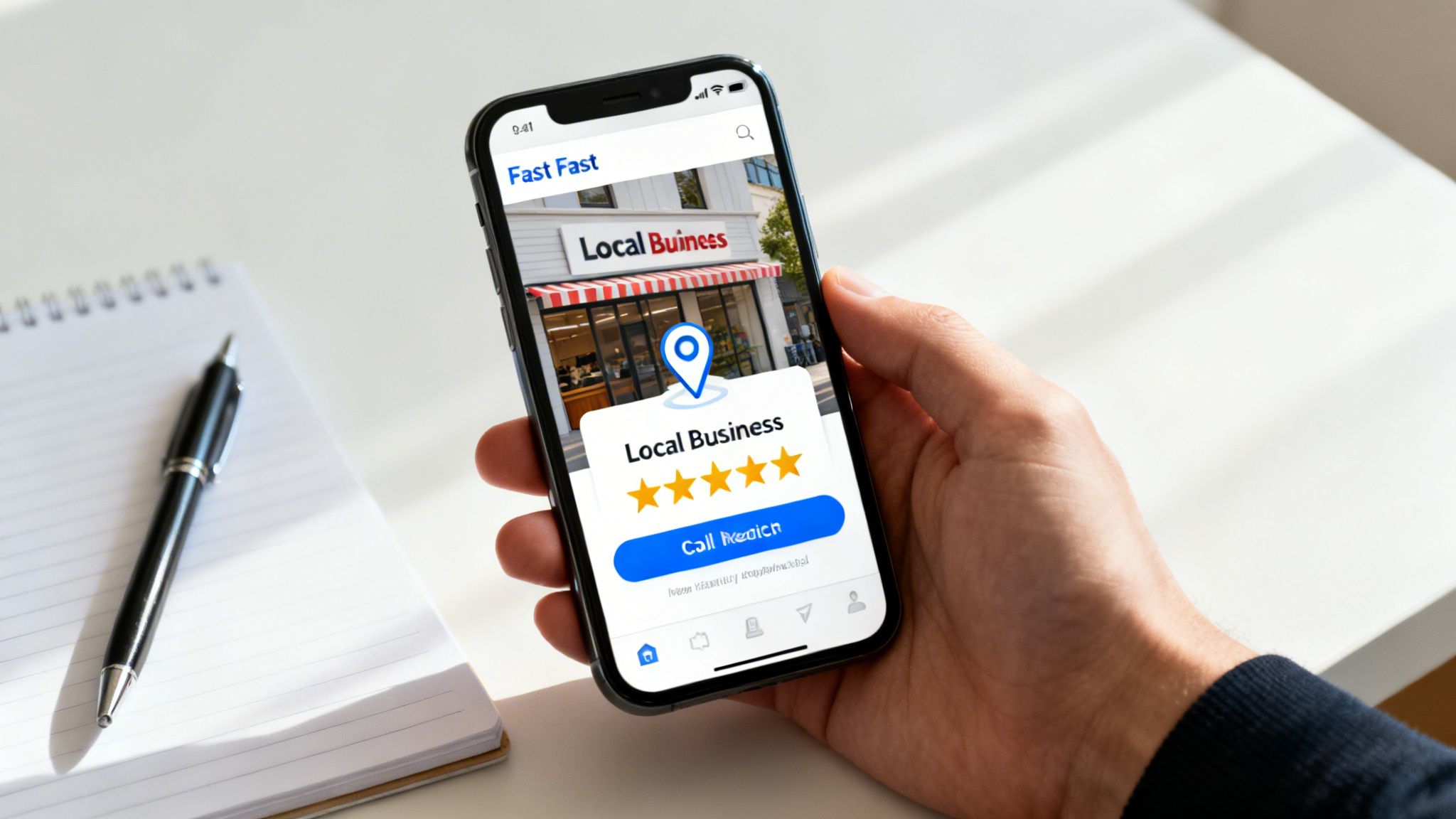
These days, your website is your digital front door. For local Aussie customers, it’s often the first place they’ll check you out. If that experience is slow, confusing, or completely broken on their mobile, you’ve lost them before you even had a chance.
That’s why a high-performance website isn’t just a nice-to-have; it’s a non-negotiable part of any digital marketing strategy in Australia.
Forget all the fancy animations and complicated designs. Whether you're a solar installer in Adelaide or a cafe on the Gold Coast, your website needs to nail three things: load fast, be effortless to use on a smartphone, and guide visitors straight to the action you want them to take.
This all comes down to responsive design, which just means your site looks and works perfectly on any device. A huge chunk of local searches happens on mobile, often when someone is out and about needing a service right now. A mobile-first approach is absolutely essential.
Designing a Website That Converts
A great website for a trade or hospitality business is built around what your customer actually wants. When someone lands on your site, they have a problem. Your job is to show them immediately that you’re the solution.
This means putting your most important information front and centre. Your phone number, a "Request a Quote" button, or your booking link should be impossible to miss. Think big, clear buttons and dead-simple navigation menus.
A plumber's website, for example, needs an "Emergency Call Out" button visible on every single page. A restaurant has to feature its menu, location, and a "Book a Table" link right at the top.
Here are a few practical design elements that get results for service businesses:
- Clear Calls-to-Action (CTAs): Use action-focused text like "Get a Free Quote Now" or "Book Your Table Online." Make the buttons pop with a contrasting colour.
- Simple Navigation: Keep your main menu to the absolute essentials: Home, Services, About Us, and Contact. A cluttered menu just frustrates people and sends them packing.
- Trust Signals: Show off customer testimonials, industry certifications, or "before and after" photos of your work. This stuff builds instant credibility and makes potential clients feel confident.
- Service Area Information: Be crystal clear about the suburbs or regions you serve. This not only attracts the right local customers but is also a massive green light for local search engines.
Dominating Local Search Results
Having a brilliant website is only half the job; customers have to be able to find it. This is where local Search Engine Optimisation (SEO) becomes your secret weapon. Local SEO is all about fine-tuning your online presence to pull in more business from relevant local searches. For a deep dive, check out our guide on what is local SEO and why it matters.
The absolute heart of your local SEO strategy is your Google Business Profile (GBP). This free listing is what shows up in Google Maps and the "local pack" results when someone searches for a service like yours nearby. An incomplete or neglected profile is a huge missed opportunity.
Your Google Business Profile should be treated as a dynamic, interactive storefront, not just a listing. It's often the first and only impression a local customer will have of your business online. Treating it as a top priority is one of the highest-return activities in any local digital marketing strategy.
To turn your GBP into a lead-generating machine, you need to be active. Regularly upload new photos of your jobs, post updates about specials, and answer customer questions quickly.
Most importantly, you need to actively encourage and respond to customer reviews. A steady stream of positive reviews is arguably the number one factor influencing both your ranking and a customer's decision to get in touch.
Building local citations is the other key pillar here. A citation is simply any online mention of your business's name, address, and phone number (NAP). Keeping your NAP details consistent across high-quality Australian directories proves your legitimacy to search engines and locks in your connection to a specific area.
Expanding Your Reach with Content, Social, and Paid Ads

With your website and local SEO acting as a solid home base, it’s time to get proactive. This is where you turn up the volume and start reaching out to customers where they spend their time.
We do this with a powerful combination of smart content creation, engaging social media, and targeted paid advertising. These three aren’t separate tasks; they work together to get your name out there, build a loyal following, and, most importantly, bring in immediate, high-quality leads. This isn't about posting for the sake of it—it's about getting a measurable return on your efforts.
Creating Content That Connects and Converts
Forget generic blog posts no one reads. Real content marketing is about answering your customers’ biggest questions and proving you're the expert they can trust. For a local Aussie business, this means creating content that’s practical, visual, and directly ties into the services you offer.
Put yourself in your customer's shoes. What are they actually searching for?
A construction firm in Brisbane could build a stunning project gallery of a recently completed home, showcasing their craftsmanship. It’s a thousand times more powerful than a simple list of services. A Melbourne restaurant could film a quick, mouth-watering video of the chef plating up a new special—making customers hungry before they even think about booking.
Here are some content ideas that we see working wonders for trades and hospitality businesses:
- Project Walkthroughs and Galleries: For builders, plumbers, or solar installers, high-quality photos and videos of finished jobs are your number one sales tool. They offer undeniable proof of your skills.
- 'How-To' Guides and Videos: A quick video showing a homeowner how to fix a dripping tap or a guide on choosing the right solar system instantly positions you as a helpful, trusted expert.
- Meet the Team Features: People buy from people. A quick intro to your staff helps humanise your business and builds a genuine connection with your local community.
The goal is always to create content that solves a problem or sparks curiosity. This approach doesn't just attract potential customers; it gives you a library of valuable assets to share across all your marketing channels. For more ideas, check out our guide on proven content marketing best practices.
Building a Community with Social Media
For a local business, social media isn't about vanity metrics like follower counts. It’s about building a real community and engaging with the people who are most likely to walk through your door or give you a call. For most Australian small businesses, that means focusing your energy on Facebook and Instagram.
Your aim should be to become a welcome part of your local customers' daily scroll. A hospitality business could run a simple poll asking what special they should run next week. A tradie could share a glowing customer review (with their permission, of course), celebrating a job well done.
It's crucial to remember that social media is a conversation, not a billboard. The most successful local businesses use it to listen to their community, share their personality, and offer genuine value, not just to broadcast advertisements.
This conversational style builds the kind of loyalty that keeps your business top-of-mind. Use short-form video on Instagram Reels or Facebook Stories to offer behind-the-scenes glimpses of your work. These authentic, unpolished moments often get the best engagement because they feel real.
Generating Immediate Leads with Paid Ads
While content and social media are fantastic for building your brand over the long haul, sometimes you just need the phone to ring now. This is where paid advertising, especially on Google and social platforms, becomes a non-negotiable part of your digital marketing strategy in Australia.
Paid ads give you the incredible power to place your message directly in front of people who are actively searching for what you do.
Think of it like this:
- Google Ads are your go-to for capturing high-intent leads. When someone in Sydney desperately searches for an "emergency plumber near me," you can make sure your business is right at the top of the page, ready to solve their problem.
- Social Media Ads (on Facebook or Instagram) let you target customers based on their location, interests, and even their online behaviour. A solar installer can run ads targeting homeowners in specific postcodes who've shown an interest in renewable energy.
The Aussie market for digital advertising is competitive and growing. After hitting AUD $17.2 billion in FY2025, spending is still on the rise. While search ads command the largest share, video advertising has exploded, now accounting for nearly 30% of all digital ad spend. With digital making up 74% of the total advertising pie, you need a smart, targeted approach to cut through the noise.
The best part about paid ads is that every single dollar is trackable. You can set a firm budget, test different ad copy and visuals, and see exactly which campaigns are driving phone calls, form fills, or bookings. This data empowers you to constantly refine your strategy, ensuring your ad spend delivers a solid, measurable return.
Future-Proofing Your Strategy with AI and Data Privacy
The way you connect with customers is always changing, thanks to new tech and shifting expectations. To keep your digital marketing effective, you need to look ahead and be ready to adapt. Right now, the two biggest forces you need to pay attention to are the rise of AI in search and the growing importance of data privacy.
For Australian small and medium businesses, this isn't about jumping on every new trend. It’s about making smart, strategic moves to stay visible and trusted. This means understanding how AI is changing search and, just as importantly, respecting your customers by handling their data responsibly.
Preparing for the Age of Answer Engines
The days of just typing keywords into Google are fading. People are now asking direct questions to AI assistants and this shift means your old SEO tactics need an upgrade. We're moving from Search Engine Optimisation (SEO) to Answer Engine Optimisation (AEO).
AEO is all about structuring your website's content so AI models can easily grab it and serve it up as a direct answer. When someone asks, "Who is the best emergency plumber in Brunswick?", an AI sifts through the web for the most direct, trustworthy, and clearly presented information. Your goal is to be that source.
To get there, your content needs to be built for clarity and authority. Instead of simply listing your services, start creating dedicated pages that answer common customer questions in detail. Think about what your customers are really asking.
For instance, a solar installer could create a page titled, "How Much Do Solar Panels Save on Electricity Bills in Queensland?" and fill it with detailed breakdowns. A restaurant could answer, "What Are the Best Gluten-Free Options in Carlton?" by listing specific menu items. And a builder could write a guide on "The Process for a Home Extension in Sydney's Northern Beaches," walking through each step.
By creating content that directly answers these questions, you’re not just helping your human visitors; you’re feeding AI the exact information it needs to recommend your business. This is a critical adjustment for any forward-thinking strategy. To get a better handle on this, you can learn more about how AI is changing search engines in our detailed article.
Building Trust Through Data Privacy and Compliance
In a world where customers are more aware than ever of how their data is being used, trust is everything. Simply following the law isn’t enough anymore; you have to show that you respect customer privacy at every turn. This is especially true here in Australia, where we have strict rules around data collection.
Getting a handle on the Australian Privacy Principles is non-negotiable for any compliant digital marketing effort. These principles dictate how businesses must handle personal information. A fantastic, easy-to-understand Australian Privacy Principles guide can help you get to grips with your obligations.
The heart of a privacy-first approach is moving away from unreliable third-party data and focusing on ethically collected first-party data. This is the information customers give you directly and willingly. First-party data is your most valuable marketing asset. It’s accurate, relevant, and comes with built-in consent, making it the foundation of a sustainable and ethical digital marketing strategy.
The best way to collect this data is by offering genuine value in return.
- Newsletters: Offer a monthly newsletter with exclusive tips, project highlights, or special offers. Just be upfront about what subscribers will get.
- Lead Magnets: Create a valuable resource—like a downloadable guide, a checklist, or a free consultation—that customers can get by providing their email.
- Loyalty Programs: Offer discounts or rewards to customers who sign up for your loyalty program.
With Australia's advertising market projected to hit USD $27.8 billion by 2034, the digital space is only getting more crowded. On top of the competition, businesses also have to navigate Australia's strict privacy laws. Even with 97.1% internet penetration and 21.0 million active social media users, success hinges on building a trusted brand, which starts with respecting privacy. You can find out more about the growth of Australia's advertising market and its strategic challenges. By being transparent and ethical in how you collect and use data, you’ll build long-term relationships that are far more valuable than any short-term marketing win.
Creating Your Tactical 90-Day Implementation Plan
A great digital marketing strategy is a solid start, but it’s just a document until you put it into action. Let’s be honest, a plan gathering dust on a shelf won’t bring in a single new customer. This is where we get our hands dirty and turn those big ideas into real, measurable growth for your business.
We’ll break down how to set a realistic budget, focus on the performance metrics that actually make a difference, and map out a clear 90-day plan. It’s time to stop planning and start doing.
Setting a Realistic Digital Marketing Budget
For most Aussie small businesses, the big question isn’t if you should invest in digital marketing, but how much. There's no magic number, but a good rule of thumb is to allocate around 7-12% of your total revenue toward your marketing efforts.
If you’re in a really competitive space or you're in a high-growth phase, you might even push that closer to 15%.
The key is to start with a budget you can actually sustain without it feeling like a financial burden. Think of it as an investment, not an expense. For a solar installer just starting in a new suburb, this could mean running a tightly focused Google Ads campaign targeting a few specific postcodes, rather than blowing the budget on a broad brand awareness campaign.
You can approach your budget in a few different ways. The most common method is using a percentage of revenue, which allows your investment to scale as you grow. Alternatively, you can use goal-based budgeting by working backwards from your targets. For example, if you need 50 leads and your cost per lead is $40, you'll need a $2,000 budget for that activity.
This investment reflects a massive shift in how Australian businesses are connecting with customers. By 2034, Australia's digital marketing software market is forecast to hit USD 4,676.6 million, growing at a 10.21% compound annual rate from 2026. This spending is a direct response to how we shop now, with eight in ten Aussie households shopping online back in 2023. With over 97% of mobile connections expected to be on high-speed 4G or 5G networks by 2026, that trend is only going one way.
Identifying KPIs That Actually Matter
To know if that budget is actually working, you have to track the right numbers. It’s easy to get distracted by vanity metrics like social media likes or impressions, but those don't pay the bills. Your Key Performance Indicators (KPIs) need to be tied directly to business results.
For a trade or hospitality business, your most important KPIs will almost always come down to:
- Number of Qualified Leads: How many real quote requests or phone calls did you get?
- Cost Per Lead (CPL): How much did you spend to get each of those leads?
- Conversion Rate: What percentage of people visiting your website actually took action (filled out a form, made a booking, etc.)?
- Customer Acquisition Cost (CAC): What was the total cost to land one new paying customer?
It's essential to focus on the metrics that sit closest to your revenue. A high number of website visitors is nice, but a high number of quote requests is what grows your business. Tracking these real-world results is the only way to prove your digital marketing ROI.
Your Tactical 90-Day Roadmap
Big goals can feel overwhelming. A 90-day plan breaks your strategy into manageable sprints, letting you build momentum, score some early wins, and adjust your approach based on what the data tells you.
Months 1-30: Foundation and Quick Wins
The first 30 days are all about getting your technical house in order and launching activities that target high-intent customers.
Your first move is to get your analytics right. Make sure Google Analytics 4 is correctly installed with proper conversion tracking. You can't improve what you don't measure. Next, give your Google Business Profile a blitz. Add new photos, publish a few posts, answer all the questions, and run a simple campaign to get 5-10 fresh customer reviews.
Finally, launch a hyper-targeted ad campaign. Start small with a Google Ads campaign focused on your single most profitable service and a tight geographic area. Think "bottom-of-funnel" keywords like "emergency plumber inner west sydney." You're fishing for people who need you right now.
Months 31-60: Content and Engagement
With a solid foundation, month two is about building authority and actually talking to your audience.
This is the time to publish two core pieces of content. Write high-value blog posts answering common customer questions. Something like "How to Choose a Builder for Your Renovation" or "What's the ROI on Solar Panels in Victoria?" works wonders.
Then, find a social media rhythm. Post consistently on your main platform—say, three times a week on Facebook. Share your new blog posts, photos of recent work, and a customer testimonial. You also need to start building your email list. Add a simple lead magnet to your site, like a downloadable checklist or a "10% off your first service" offer. This is how you start owning your audience.
Months 61-90: Optimisation and Scaling
The third month is all about looking at the results and doubling down on what's working.
Analyse and optimise your ad spend. Dive into your Google Ads performance. Cut the keywords that aren't bringing in leads and put more budget behind the ones that are. It's time to be ruthless.
Next, expand your content library. Write another two articles, and maybe create a short video walkthrough of a recent project to share on your site and social media. Finally, review and refine everything. Look at your analytics. Which channels are driving the best leads? Which articles are getting the most reads? Use these insights to map out your next 90 days.
Our digital marketing checklist for small business can give you some more detailed guidance to help you stay on track.
This timeline illustrates how short-term actions build toward a long-term vision.
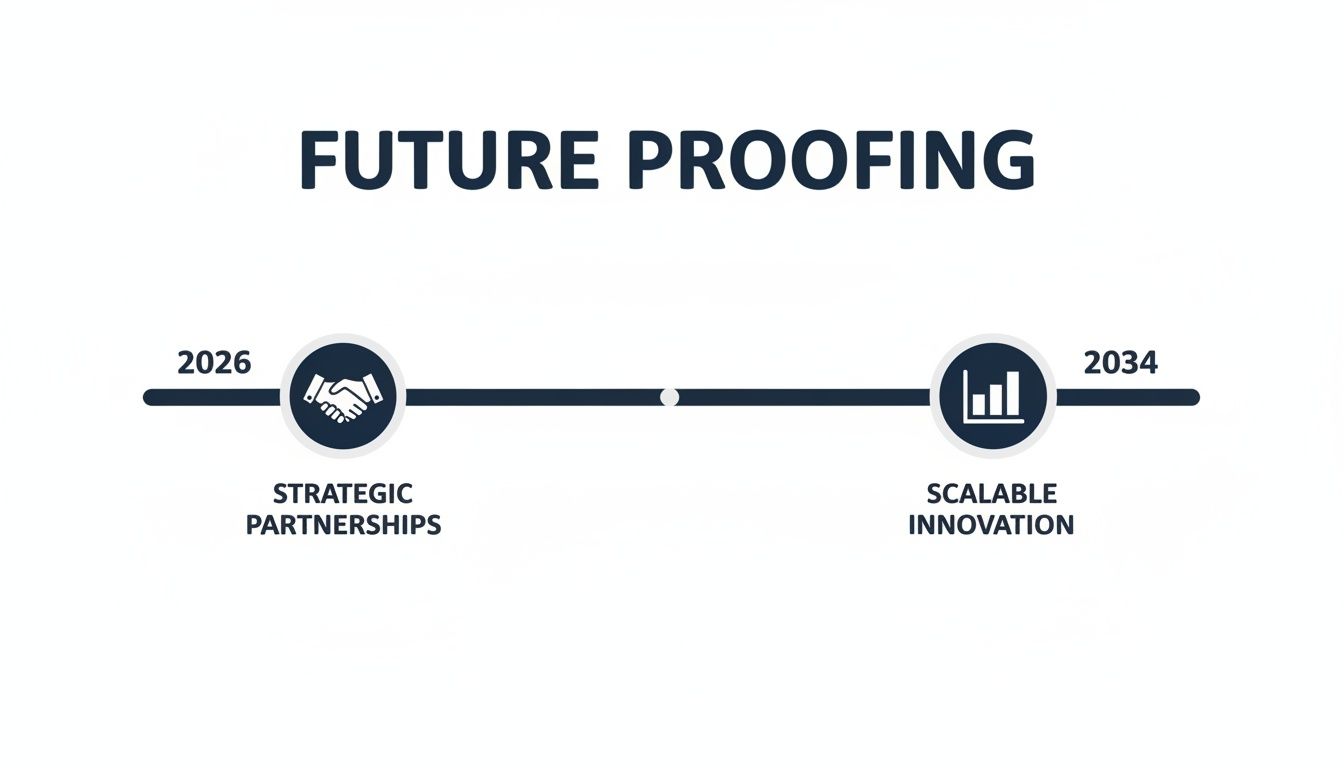
It’s all about how foundational moves now, like building strategic partnerships by 2026, set the stage for long-term, scalable growth and market leadership by 2034.
Your Digital Marketing Strategy Questions Answered
When you’re mapping out your online marketing, it’s easy to get bogged down with questions. Most Aussie business owners we talk to find themselves wrestling with the same core challenges.
Getting straight, practical answers is the only way to move forward with confidence. So, let's tackle some of the most common queries we hear to help you build a solid digital marketing strategy in Australia.
How Much Should a Small Business in Australia Budget for Digital Marketing?
There’s no magic number here, but a solid rule of thumb for Australian SMBs is to set aside 7-12% of your total revenue for marketing.
If you’re in a serious growth phase or a competitive field like solar or construction, you might even need to push that closer to 15% to make a real dent in the market.
The most important thing is to start with a budget you can actually sustain. From there, you can track your return on investment (ROI) and double down on what’s working. Your first spend should always go to high-impact activities that bring in customers now, like local SEO and targeted Google Ads.
Which Social Media Platform Is Best for My Australian Business?
The best platform is always the one where your customers are hanging out. It’s that simple.
For tradies, builders, or restaurants targeting homeowners, platforms like Facebook and Instagram are gold. They’re visual, making them perfect for showing off finished projects, a great meal, or building a local community around your work.
On the other hand, if your business is more in the B2B space, you can’t ignore LinkedIn. It’s the place to be for professional networking and building authority. A classic mistake is trying to be everywhere at once—it’s far smarter to master one or two channels where you can genuinely connect with your audience.
How Long Does It Take for Local SEO to Show Results?
You can definitely get some quick wins, sometimes within a few weeks, by doing things like properly optimising your Google Business Profile.
However, a proper local SEO strategy—the kind that builds real momentum—typically takes 3-6 months to deliver significant results. It's a marathon, not a sprint. SEO is a long-term investment in your business, not a quick fix for leads.
Consistency is what builds lasting authority and a steady flow of free traffic. That means regularly creating local content, getting a steady stream of customer reviews, and building out your local business citations. The work you put in today will pay off for years to come, creating a growth engine that just keeps running.
Ready to build a powerful digital marketing strategy that delivers real results? For over 25 years, Titan Blue Australia has been helping Australian businesses grow with custom website design, SEO, and digital strategies that work. Start your journey by visiting us at https://titanblue.com.au.

How to Choose a Web Designer on the Gold Coast
Choose a web designer on the Gold Coast with confidence. Compare strategy, process, performance and…

Web Development Gold Coast: Build for Growth and AI Search
Web Development Gold Coast: fast, secure, conversion-ready websites built for customers, Google and AI search.…

Gold Coast Web Design: What Makes a Website Work?
Gold Coast web design should attract the right people, answer their questions, earn trust and…