

Last updated:
A lot of hospitality owners are in the same spot right now. The venue looks sharp, the food is right, the rooms are well presented, staff know how to look after guests, and regulars keep coming back. Yet when someone searches for a place to eat, stay, or book nearby, that business barely appears.
That gap is where most booking leakage happens. People don’t compare every venue in town. They compare the handful Google, Maps, and now AI-powered search surfaces put in front of them first. If your restaurant or hotel isn’t visible there, your real-world quality doesn’t get a chance to compete.
Good seo for hospitality industry businesses isn’t about chasing vanity rankings. It’s about showing up when intent is high, making the venue easy to trust, and turning that visibility into calls, direction requests, table bookings, room enquiries, and direct reservations.
Why Your Great Venue is Invisible Online
A familiar pattern shows up across the Gold Coast. A restaurant can have a strong menu, good service, and a fit-out that photographs beautifully, but its Google Business Profile is half-finished, its website titles are vague, and its photos don’t reflect what guests see when they walk in. A boutique hotel can offer better value and a more memorable stay than larger operators, yet still lose attention because its location signals, amenity details, and content structure are weak.
That doesn’t mean the business is failing. It means the digital layer isn’t doing its job. Search engines can’t infer quality from your atmosphere, your plating, or your front desk experience. They need signals. Clear location relevance, complete business information, strong site performance, useful content, and a reputation profile that gives new guests confidence.
What owners often get wrong
The most common issue isn’t a lack of effort. It’s effort aimed at the wrong things.
- They focus on appearance over discoverability. A stylish website means little if it loads slowly, hides key booking information, or doesn’t target the searches guests make.
- They rely too heavily on Instagram. Social can support demand, but it doesn’t replace search when a customer is actively looking for “Broadbeach dinner” or “family-friendly hotel Gold Coast”.
- They treat SEO as a one-off setup. Hospitality search changes constantly because menus change, seasons change, guest questions change, and Google changes.
Practical rule: If a first-time customer can’t find your venue within a few searches, your business is still invisible in the moments that matter most.
The cost of being the best-kept secret
Being hard to find online creates a chain reaction. You miss discovery traffic. You lose direct enquiries. You become more dependent on third-party platforms to bring demand back to you. That usually means less control over margins, less control over the guest relationship, and less ability to shape the booking journey.
If your business isn’t showing up properly in local search, start with the basics of why a business may not be showing up on Google. For hospitality operators, that problem usually comes down to weak local signals, poor site structure, or incomplete profiles rather than a single technical fault.
Good venues don’t automatically become visible venues. Search has to be built.
Your Local Foundation Mastering Google and Maps
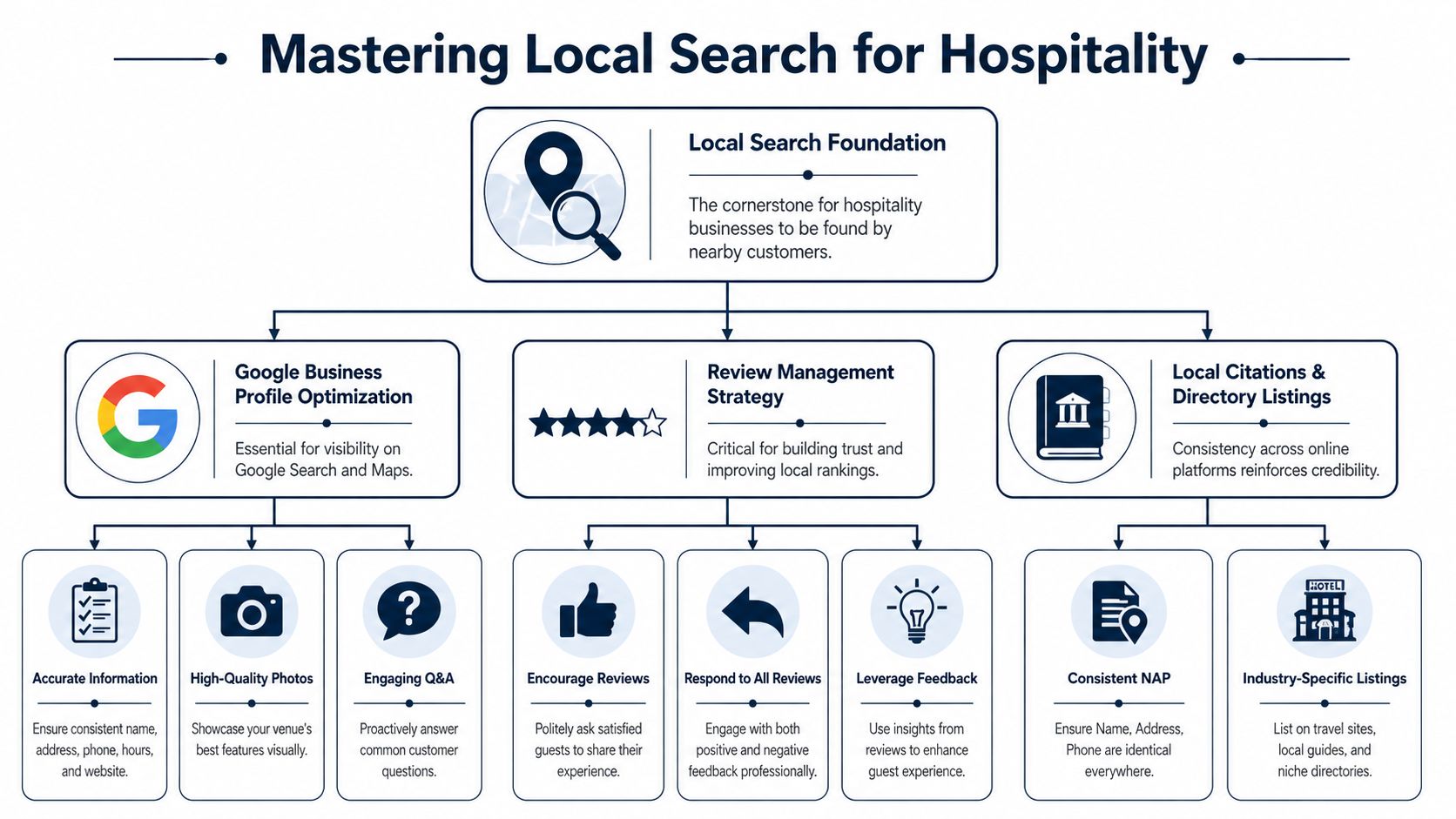
If customers can’t find you on Google Maps, you’re operating with one hand tied behind your back. Local search is the front door for hospitality. It catches people who are nearby, planning, comparing, or ready to act.
Australian hospitality benchmarks show that properties fully optimising Google Business Profile can see a 35-50% uplift in impressions within Google Maps and local search results via O'Rourke Hospitality's hotel SEO checklist. That matters because local visibility is often the difference between getting considered and being skipped.
Start with your Google Business Profile
Your Google Business Profile isn’t a directory listing anymore. It’s a live sales asset. For many hospitality businesses, it gets seen before the website does.
The basics have to be exact:
-
Business name
Use your real trading name. Don’t stuff location terms or service phrases into it.
-
Address and phone
Keep these consistent everywhere your business appears online. If your address is abbreviated one way on your website and another way on a directory, you create trust issues for search engines.
-
Primary and secondary categories
Choose categories that reflect the actual business. A restaurant shouldn’t try to rank as everything. A hotel shouldn’t skip obvious service categories tied to guest intent.
-
Opening hours
Keep them current, especially around public holidays and seasonal changes.
-
Website and booking links
Send visitors to the most relevant page. If you run a venue with events, accommodation, dining, and functions, don’t make every click land on the homepage.
A lot of venues underperform because these details are left untouched for months. Search doesn’t reward neglect.
Photos drive action
Hospitality is visual. People want to see what arrival feels like, what the dining room looks like at service, whether the rooms look current, and whether the venue matches the occasion they have in mind.
Use recent, professional images for:
- Exterior shots that help guests recognise the venue on arrival
- Interior atmosphere that shows layout, style, lighting, and seating
- Food and beverage imagery that reflects actual service, not generic stock
- Rooms and amenities if you’re in accommodation
- Event spaces if you target weddings, functions, or corporate bookings
If your venue also handles private events, styling and furniture presentation matter more than many owners realise. Even a practical article like this guide on hiring chairs near me is a useful reminder that event search intent often starts with visual setup expectations, not just venue capacity.
A weak profile photo set tells guests your venue may be outdated, even when it isn’t.
Use questions and reviews properly
Most venues leave the Q&A section unmanaged. That’s a mistake. Customers ask the same things over and over. Parking. Dietary options. Pet policies. Ocean views. Late check-in. Accessibility. Corkage. Child-friendly seating.
Add those answers before people need to ask. It improves trust and helps search engines understand the venue more clearly.
Reviews need a system too. Not a one-off push when business is slow. A system.
- Ask at the right moment. After a positive check-out, after a successful event, or after strong table service.
- Respond to all review types. Thank positive reviewers. Address negative feedback calmly and specifically.
- Use review language as insight. Guests often hand you the exact phrases they value most. Waterfront dining. Quiet room. Great coffee. Friendly staff. Easy parking. Those themes can strengthen your on-site copy too.
Here’s the practical test. Search your venue name, then search the category and suburb you want to be found for. If the profile looks incomplete, outdated, or thin next to nearby options, fix that first.
Support your profile with local consistency
Google doesn’t assess your profile in isolation. It checks whether the same business details appear consistently across the web. That includes travel sites, local directories, and industry listings.
Many hospitality businesses fall into disarray with their online presence. Old phone numbers remain live. Previous trading names still appear. Duplicate listings create conflict. Booking platforms show different details from the website.
Clean this up methodically. Then strengthen local relevance on your site itself through pages and content tied to the areas you serve. If you want more practical guidance on that process, this overview of local SEO for restaurants is worth reading.
A good local setup isn’t glamorous. It’s disciplined. But it’s the part of seo for hospitality industry businesses that often drives the fastest real-world impact.
A short walkthrough can help if your team needs a visual reference point:
Building a High-Performance Digital Venue
A hospitality website works like a venue itself. If the plumbing fails, guests notice. If the lighting doesn’t work, guests notice. If the entrance is confusing, guests leave. Your website behaves the same way. Technical SEO is the infrastructure that keeps the experience usable.

For Australian hospitality websites, Google classifies First Input Delay under 100ms as “Good”, while FID above 300ms can trigger “Poor” scores in mobile-first indexing, according to Innsight’s technical SEO guidance. That matters because a large share of travel searching happens on mobile, where impatient users won’t wait around for clunky pages.
Fast pages win more bookings
Slow menu pages, image-heavy room pages, and bloated homepages undermine user experience. Owners often think, “The site works on our end.” But on a mobile connection, with heavy scripts and oversized images, “works” can still feel frustrating.
Check these areas first:
- Hero images. Compress them before upload. Hospitality sites often use oversized banners that look impressive in design review and painful in real use.
- Third-party widgets. Booking tools, chat plugins, popups, review widgets, and tracking scripts all add weight.
- Mobile menus. If users have to fight the navigation to find rooms, functions, or bookings, the page is underperforming.
- Form friction. Too many fields, poor spacing, and awkward tap targets hurt enquiries.
The pages that usually need the most work
Not every page on a hospitality site carries equal booking weight. Focus first on the pages closest to action.
Homepage
This should confirm location, offer, audience, and next step immediately. If a user lands here and still can’t tell whether you’re a boutique hotel, a beachside restaurant, or an event venue, the page isn’t clear enough.
Rooms or menu pages
These pages need detail. Guests compare specifics. They want to know what’s included, what the space feels like, and whether the venue suits their needs.
Functions and weddings pages
Many venues bury this opportunity. If you host events, give those pages proper structure, practical information, and a clear enquiry path.
Your website shouldn’t make guests hunt for basics. If they have to search for the booking button, room features, parking, or menu details, the site is leaking conversions.
What to ask your developer
You don’t need to write code to manage technical SEO well. You do need to ask sharper questions.
Ask your web team to review:
- Core Web Vitals performance
- Mobile usability across key templates
- Image compression and next-gen formats
- Broken links and redirect issues
- Indexing problems in Google Search Console
- Structured navigation and internal linking
If your venue runs events, launches promotions, or shifts seasonally, your site also needs flexible pages that can be updated without rebuilding everything. Hospitality content changes too often for rigid websites.
For teams managing launches, activations, or venue events, broader event-focused resources can help sharpen the promotional side too. This Marketing and Promotion guide is useful because it frames how digital assets should support event demand, not just sit there looking polished.
A lot of restaurant and accommodation operators discover that the issue isn’t that they need more pages. They need better-performing pages. If your current site feels good visually but weak commercially, review what strong restaurant websites do differently. The best ones remove friction before the booking moment.
Your Content Menu and Online Reputation
Hospitality content should do two jobs at once. It should help search engines understand what you offer, and it should help people decide whether your venue feels right for them. If it only does one, it underperforms.
Many hospitality sites frequently fall flat. They publish generic copy about “exceptional service” and “memorable experiences” that could belong to any venue in any suburb. Search engines can’t separate you from the pack, and guests don’t get a real reason to choose you.
Write the pages guests actually need
Good hospitality content is specific. It answers practical questions and sells the experience without sounding inflated.
Strong examples include:
- Location pages that tie your venue to actual areas and nearby demand
- Detailed menu or room pages that explain features clearly
- FAQ pages covering parking, dietary needs, family suitability, check-in times, pet policies, or event capacity
- Local guides such as what to do nearby, where to stay before an event, or dining options around your venue
- Function and occasion pages for birthdays, weddings, corporate dinners, or long lunches
In Australia, 76% of local mobile searches lead to a store visit within 24 hours, according to Event Temple’s hospitality SEO article citing Google data. That’s why local intent content matters so much in hospitality. A search isn’t always casual browsing. It’s often a near-term decision.
Your photos are part of your SEO
Search visibility gets people to the page. Visual proof helps convert them once they arrive.
For hospitality, imagery should show:
- Real service moments
- Actual rooms, dishes, and spaces
- Lighting and atmosphere at relevant times of day
- Venue context, including views, street presence, or nearby environment
Stock-style imagery weakens trust. Over-edited imagery does too. Guests want confidence that what they book is what they’ll get. If your visual assets are dated or inconsistent, professional photography for business often has a bigger commercial impact than rewriting another generic paragraph.
Better content doesn’t mean more words. It means clearer answers, stronger proof, and fewer gaps between the search and the booking decision.
Reputation is part of the conversion path
Online reviews do more than influence trust. They shape how people interpret everything else they see. A polished site paired with unresolved review complaints creates doubt. A modest site paired with strong, recent, detailed reviews can still convert well.
Handle reputation with discipline:
-
Ask for reviews from satisfied guests consistently
Don’t leave this to chance or only ask regulars.
-
Respond with care
Thank people specifically. Don’t paste the same template response under every review.
-
Fix repeat complaints operationally
If reviews mention slow service, noisy rooms, unclear parking, or poor booking communication, that isn’t just a marketing issue.
-
Reflect strengths in your copy
If guests repeatedly praise your ocean outlook, gluten-free options, or friendly event coordination, those points should appear on the site in clear language.
What doesn’t work anymore
A few habits still hang around in hospitality marketing and they don’t help much.
- Keyword stuffing suburb names into every paragraph
- Thin pages built only to target a phrase
- Uploading a PDF menu with no proper page content
- Ignoring negative reviews and hoping they disappear
- Using copy that sounds like every other venue
Good content makes your venue easier to find and easier to trust. Good reputation management removes doubt. Together, they do far more than a prettier homepage alone.
The Future of Bookings with Advanced SEO and AI
Search is changing shape. Your venue still needs solid local SEO and a fast website, but that’s no longer the whole picture. Hospitality businesses now have to think about how search engines and AI systems interpret, summarise, and present their information before a user even clicks.
That’s where structured data and Answer Engine Optimisation come in. If traditional SEO helps you rank, AEO helps you become the answer.
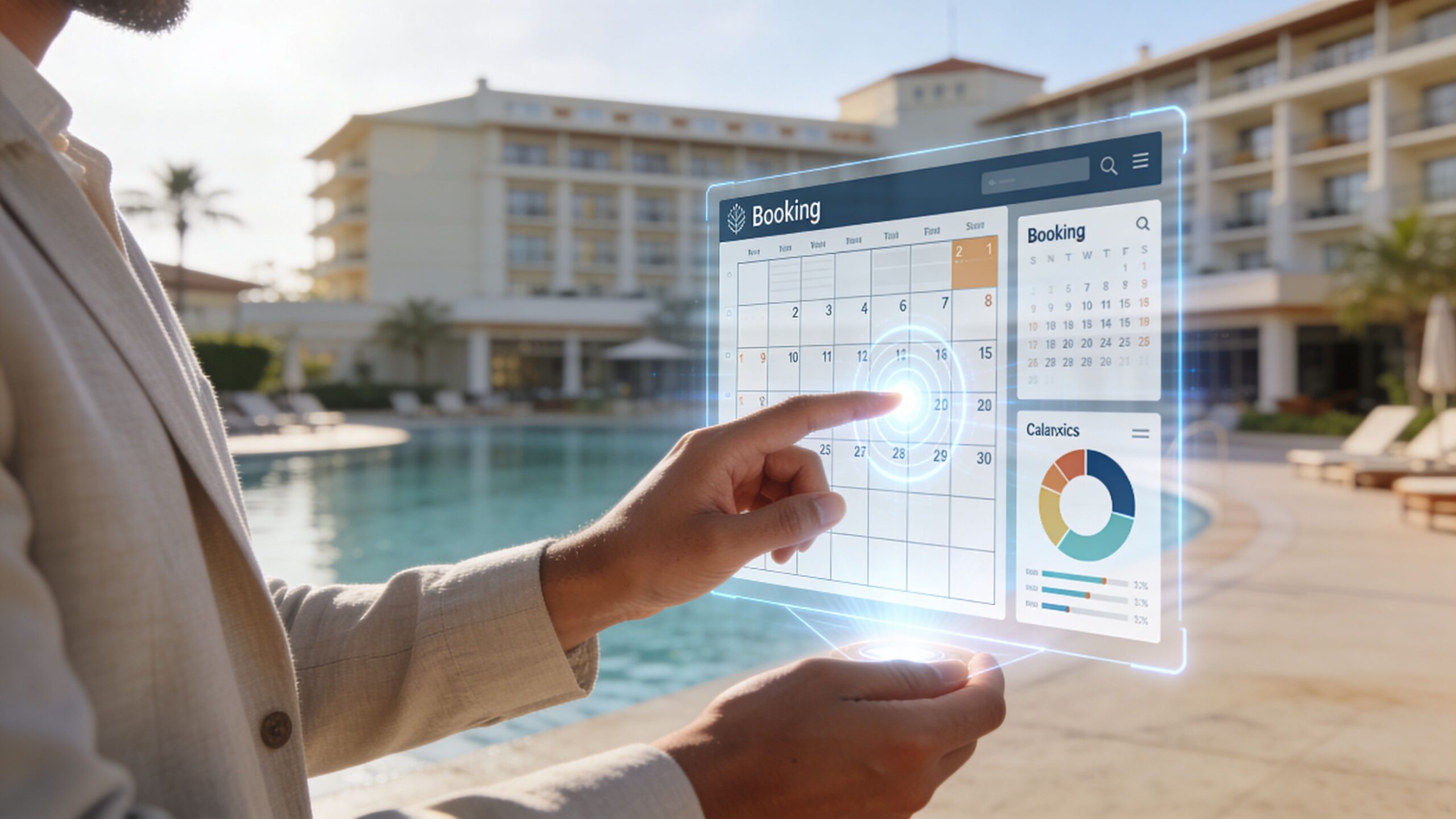
Structured data helps machines understand your venue
Structured data is code that labels your content clearly for search engines. It tells Google and other systems what a page is about in a way they can process more confidently.
For hospitality, that usually means marking up things like:
- Business type
- Opening hours
- Address details
- Menus
- Amenities
- Reviews
- Event information
- FAQ content
Without it, search engines have to infer meaning from your page layout and wording. With it, you reduce ambiguity.
For a hotel, that can mean making room types, amenities, and property details easier to interpret. For a restaurant, it can mean helping systems understand cuisine, service style, reservation details, and common guest questions.
AEO is the next layer
AI-driven search isn’t theoretical anymore. In Australian hospitality, Google’s AI Overviews influence 15-20% of travel searches, while only 12% of Gold Coast hotels have structured data for AEO, according to Figment Design’s article on hospitality visibility and bookings.
That gap is the opportunity.
If someone asks an AI tool for “a Broadbeach hotel with ocean views and late check-in” or “a pet-friendly pub near Broadbeach with dietary options”, the systems that get cited tend to have clearer entity signals, stronger FAQ structures, and cleaner page organisation.
What AEO content looks like in practice
AEO content doesn’t read like robotic SEO copy. It reads like direct, useful answers.
Here’s what works better:
- Specific FAQ sections that answer real booking questions cleanly
- Clear amenity pages with details rather than broad claims
- Location pages that connect the venue to landmarks, suburbs, and use cases
- Comparison-friendly wording that helps systems distinguish your venue from generic alternatives
- Consistent facts across profile, site, and listings
What works poorly:
- Vague brand slogans
- Thin pages with almost no informational depth
- Buried answers hidden in image sliders or tabs
- Important venue details trapped inside PDFs
- Inconsistent room, menu, or service descriptions across platforms
Search engines rank pages. AI systems often extract answers. If your site doesn’t state things clearly, another venue’s site will.
Think in questions, not just keywords
Hospitality owners often still think in old-school terms such as “we want to rank for hotel Gold Coast” or “restaurant Broadbeach”. Those keywords still matter, but AI search is pushing the market toward question-led discovery.
Useful hospitality questions include:
- Is your venue suitable for families?
- Do you cater to gluten-free, vegan, or allergy-aware dining?
- Is there parking nearby?
- What’s the check-in arrangement after hours?
- Do rooms have balconies, ocean views, or kitchenettes?
- Can you host private events or business functions?
- Is the venue walkable to beaches, convention spaces, or transport?
Build pages and FAQs that answer those questions plainly. Then support them with clean headings, strong internal links, and structured data.
If you’re looking closely at how this shift affects visibility beyond standard rankings, this overview of AI search is worth your time. The businesses that adapt early won’t just rank better. They’ll be easier for AI systems to cite confidently.
The trade-off owners need to accept
AEO isn’t about clever hacks. It often requires simpler writing, tidier page structure, and better data hygiene. Some owners resist that because they want more stylised websites or minimal-copy pages. That can look premium, but it often makes machine understanding worse.
The best-performing hospitality sites in AI-era search usually do something very simple. They say exactly what the venue offers, who it suits, where it is, and how to book. Then they reinforce those facts consistently across the site.
That discipline is becoming a competitive edge.
Measuring Success and Your Action Plan
SEO only matters if it changes business performance. More visibility is useful. More qualified visibility is better. What you really want is stronger direct demand from the right searches.
In hospitality, success usually shows up first in practical signals. More phone calls from search. More direction requests. More booking form submissions. Better enquiry quality. More pages appearing for local and occasion-based searches. Better direct booking contribution relative to third-party dependency.
The metrics that matter to owners
You don’t need to stare at dashboards all day. You need a handful of indicators tied to bookings and foot traffic.
Watch these first:
-
Google Business Profile activity
Track calls, direction requests, website clicks, and booking actions.
-
Search Console query data
See which searches are triggering impressions and clicks, especially local and high-intent phrases.
-
Landing page performance
Check which pages attract traffic and whether those pages lead to enquiries or bookings.
-
Booking and enquiry pathways
Review whether users drop off on room pages, menu pages, or function forms.
-
Review trends
Look for repeated praise and repeated friction points.
What AI-informed personalisation is changing
Advanced SEO is starting to shape not just what ranks, but what gets clicked and what converts. According to HSMAI Asia-Pacific’s summary on AI SEO in hospitality, Australian hotels using machine learning for search intent prediction saw a 35% increase in organic traffic from personalised content. Treat that as a forward-looking signal rather than a shortcut.
For owners, the takeaway is practical. Generic pages are weakening. Content aligned to real guest intent is strengthening. If families, event planners, weekend couples, or business travellers all land on the same vague page, you’re making the user do too much interpretive work.
A simple review rhythm
Most hospitality businesses don’t need more marketing meetings. They need a monthly review habit.
Use a process like this:
-
Check what people searched
Use Google Search Console to review the queries bringing impressions and clicks.
-
Check what they saw
Search your own brand, your service category, and your suburb on mobile. Review the profile, the map result, and the visible pages.
-
Check where they landed
In analytics, review your top organic landing pages and whether they support action.
-
Check where friction appears
Look at mobile usability, slow pages, poor forms, or missing information.
-
Check guest language
Review Google feedback and use that wording to improve copy, FAQs, and amenity descriptions.
Good SEO management isn’t guessing what Google wants. It’s watching how guests search, where they hesitate, and what information they need before they commit.
Your practical action plan
If you run a hotel, restaurant, pub, cafe, resort, or venue, this is the order I’d work in.
First, clean up local search foundations
Claim and verify your Google Business Profile. Fix business details everywhere they appear. Update photos. Add booking links. Populate common questions and answers. Make sure your profile looks current and complete.
Then, improve the pages that carry revenue intent
Focus on homepage clarity, menu or room pages, event pages, and contact or booking pages. Remove friction. Make your location, offer, and next action obvious.
Next, strengthen content quality
Write for actual guest questions. Build useful FAQs. Publish local relevance pages and occasion-based pages. Replace vague claims with clear specifics.
After that, deal with technical performance
Review site speed, mobile usability, indexing issues, image compression, and page structure. Hospitality sites often lose conversions here without realising it.
Then, prepare for AI search
Add structured data where appropriate. Format content so AI systems can interpret it cleanly. Answer long-tail questions directly. Keep facts consistent across the web.
Finally, measure what leads to revenue
Track calls, bookings, direction requests, enquiries, high-intent landing pages, and visibility for local searches. Don’t judge success only by rank positions.
What works and what doesn’t
To keep this practical, here’s the blunt version.
What works:
- Clear location relevance
- Complete Google Business Profiles
- Useful, specific venue content
- Strong imagery tied to real experience
- Fast, mobile-friendly booking paths
- FAQ content written for real questions
- Structured data that supports machine understanding
- Consistent review generation and response habits
What doesn’t:
- Generic brochure copy
- Slow, image-heavy sites with poor mobile UX
- Empty or neglected business profiles
- Thin landing pages created only for keywords
- Important venue details hidden in PDFs
- Inconsistent business details across the web
- Waiting for social media alone to drive discovery
SEO for hospitality industry businesses works best when it’s treated like operations, not decoration. The venues that win are usually not the ones doing one flashy tactic. They’re the ones doing the fundamentals thoroughly, then adding AI readiness on top.
Titan Blue Australia helps hospitality businesses turn search visibility into real enquiries, bookings, and foot traffic. From local SEO and website performance to AI search strategy and Answer Engine Optimisation, the team brings over 25 years of digital experience to businesses across the Gold Coast and Australia. If you want a practical strategy that improves how your venue appears in Google, Maps, and AI-driven search, visit Titan Blue Australia.
Make Titan Blue a preferred source in Google
One click tells Google to surface our articles more often in Top Stories, AI Overviews and AI Mode.

ChatGPT GPT-6 Search Upgrade: What It Means for Australia
OpenAI rolled out GPT-6 to ChatGPT on 7 October 2026 with faster search. Here is…
Best Dental Website Design Agencies in Australia: 7 Compared
Best dental website design agencies in Australia 2026: seven compared on dental proof, booking, AHPRA…

Childcare Centre Website Design Australia: The 2026 Guide
Childcare centre website design Australia: show hours, ages and enrolment as text so parents and…