Grow with web and digital marketing: A practical guide for Australian businesses
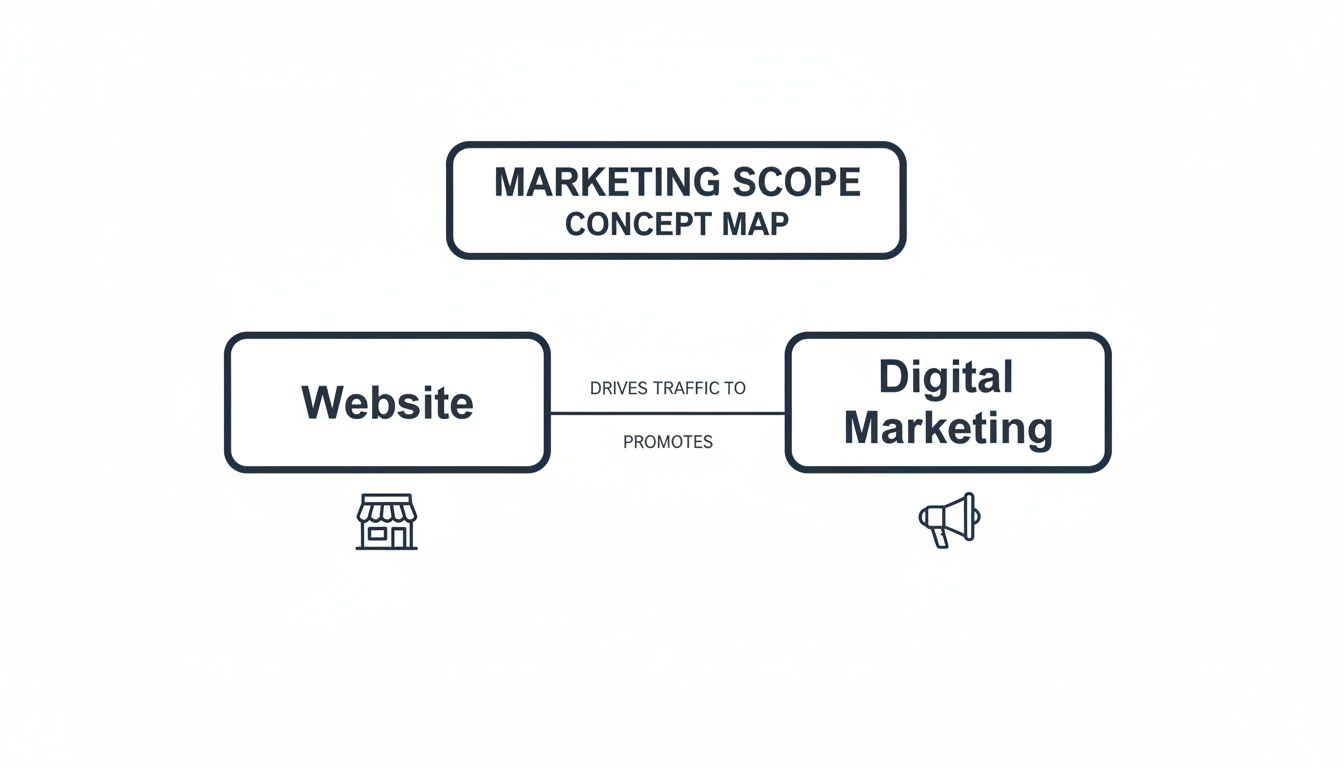
When it comes to web and digital marketing, the difference is pretty straightforward. Web marketing is all about your website—the destination. Digital marketing covers everything else you do online to get people there. Think of it this way: one is your shop, the other is the entire network of roads leading customers right to your front door.
Why Your Website Is Just the Beginning
Imagine you’ve just launched a stunning new website. It looks brilliant, showcases your products or services perfectly, and captures your brand's essence. That's the result of great web design. But if that website is sitting on a quiet digital backstreet with no signs pointing to it, it won’t get any traffic. No traffic means no sales and zero growth.
This is where the bigger picture of web and digital marketing comes into play. It's the full promotional toolkit you need to drive a steady stream of customers to your online doorstep. It’s the bright neon signs on the digital highway, the targeted ads, and the valuable content that makes people not just find your business, but get excited about it.
For small and medium-sized businesses across Australia, getting this right is non-negotiable. A website is the foundation, but it’s only the starting line.
From a Digital Asset to a Growth Engine
On its own, a website is just a passive digital brochure. But when you wrap an integrated digital marketing strategy around it, that brochure transforms into an active, lead-generating machine for your business. The strategy is what connects your website to all the places your customers are already spending their time online.
To really get ahead, your business needs to show up across multiple digital touchpoints, creating a powerful synergy where every channel works together to drive results.
Here are the key pieces that turn your website from a simple online presence into a proper business tool:
Discoverability: Making sure customers find you on Google the moment they search for the services you offer.
Engagement: Building a community and starting conversations on social media platforms where your ideal audience hangs out.
Direct Communication: Nurturing leads and staying in touch with existing customers through targeted email marketing.
Authority: Proving you're a trusted expert in your industry by sharing valuable, informative content.
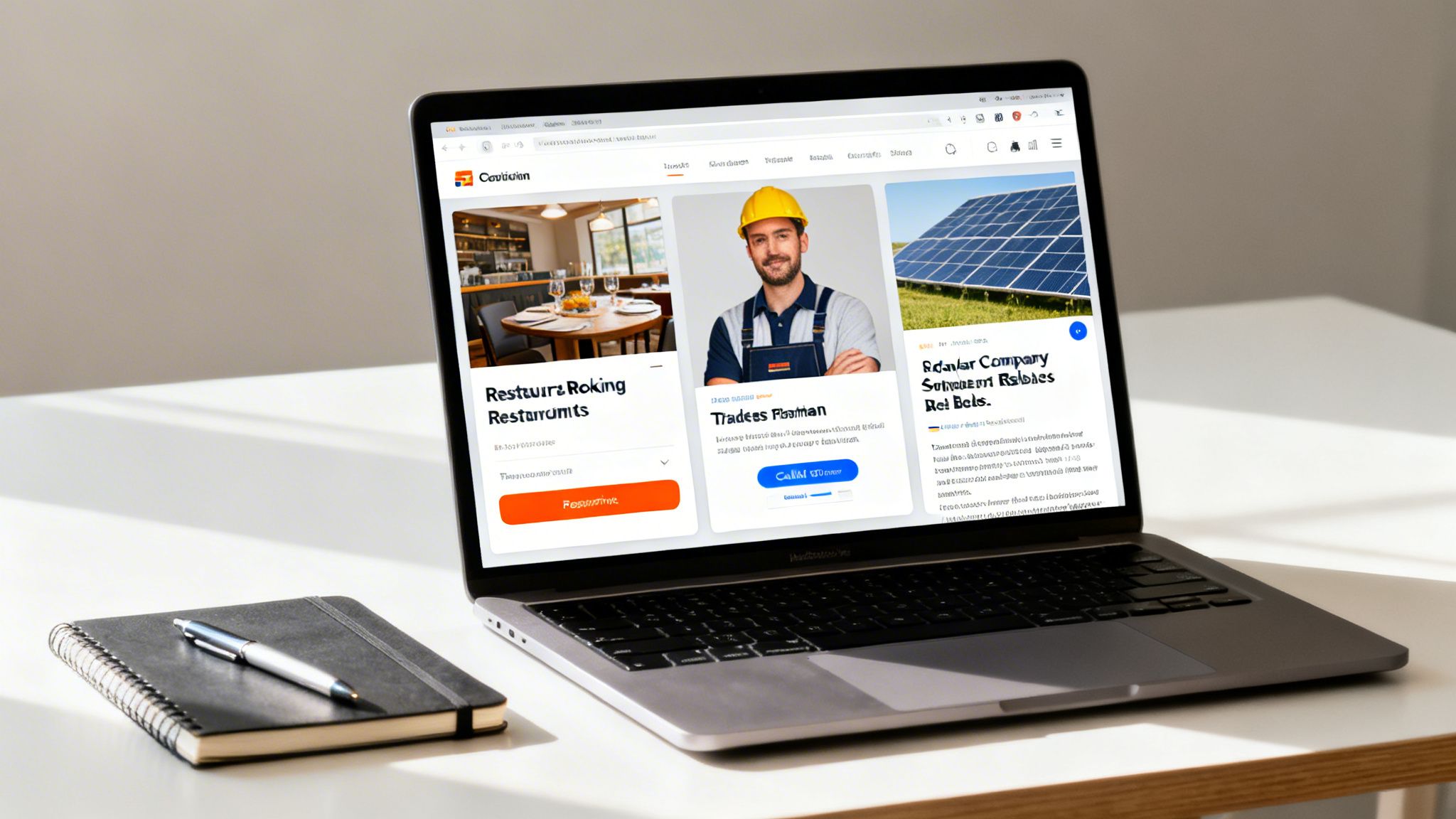
This guide will break down these concepts for Aussie businesses, whether you’re a local restaurant in Broadbeach, a plumber servicing Queensland, or a solar installer on the Gold Coast. We’ll show you why just having a website isn't going to cut it in 2026 and how a connected web and digital marketing strategy is your ticket to reaching a massive online audience.
If you're just starting out, understanding what goes into a strong digital foundation is key, and you can learn more about what's involved in effective Australian web design. Now, let's look at how to make sure your business doesn't just survive online—it thrives.
Trying to figure out all the different ways you can promote your business online can feel overwhelming. It’s like being handed a dozen different road maps, all leading to different places. The world of web and digital marketing is full of these different routes, or channels, and each one has a unique role to play in helping Australian businesses find and win over new customers.
This section is your guide to those channels. We’ll break down the core components that actually drive results, so you can choose the right path for your business—whether you’re running a busy restaurant on the Gold Coast or you’re a tradie serving customers across Queensland.
This simple visualisation shows how it all works together. Think of your website as the destination, while digital marketing provides all the different roads that get customers there.
The key takeaway is that a website on its own has a pretty limited reach. But when you pair it with a smart digital marketing strategy, its power to attract a steady stream of customers grows massively.
Search Engine Optimisation (SEO): The Digital Handshake
Search Engine Optimisation, or SEO, is all about making your website the most trusted and relevant result when someone searches for your services on Google. It’s about earning that top spot through your reputation, not by paying for it.
When a potential customer searches for "emergency plumber in Broadbeach," SEO is what gets your business to show up right at the top of the page. It involves fine-tuning your website’s content, structure, and authority so that Google sees you as the best solution to that person's problem. Good SEO builds long-term, organic traffic that you don’t have to pay for with every single click.
Paid Advertising (PPC): The Express Lane to Customers
Paid advertising, often called Pay-Per-Click (PPC), is like buying a billboard that only your ideal customers can see. Instead of shouting your message to everyone, you can zero in on specific demographics, locations, and even the exact phrases people are searching for.
You only pay when someone actually clicks on your ad, which makes it an incredibly efficient way to get immediate traffic and leads. For a restaurant launching a new winter menu, a targeted ad campaign on Facebook can start driving bookings from local foodies almost instantly.
The investment in this space is growing for a reason. In fact, Australian digital ad spend hit AUD $16.4 billion in 2024 and is still climbing. With 34.1 million mobile connections in Australia—more than our actual population—a mobile-first approach is no longer just an option; it's essential for success.
Social Media Marketing: Your Digital Town Square
Social media marketing is about building a community where your customers already hang out. It’s less about the hard sell and more about making a genuine connection. It's your business's town square, where you can share your story, join conversations, and build a loyal following.
Platforms like Instagram and Facebook are perfect for visual businesses, like a Gold Coast cafe showing off its daily specials or a builder posting photos of a recently finished project. It’s a powerful way to stay top-of-mind and turn a one-time customer into a fan for life.
Content and Email Marketing: The Expert Conversation
Content marketing is how you become the go-to expert in your industry. By creating genuinely helpful blog posts, guides, or videos that answer your customers' biggest questions, you build trust and authority. For a solar installer, this could mean writing an article explaining new government rebates—attracting homeowners who are already researching a purchase.
Email marketing takes that relationship to the next level. It’s a direct conversation with your most engaged customers and leads. Unlike the public forum of social media, email is a one-to-one channel for nurturing those connections, sharing exclusive offers, and encouraging repeat business. It's one of the best ways to speak directly to people who've already shown they're interested in what you do.
Each of these channels offers a different way to connect with your audience. You can learn more about the specific types of digital marketing for Australian businesses in our detailed guide. By choosing the right mix, you create a powerful, cohesive strategy that brings a steady flow of customers right to your door.
Dominating Your Local Market with Targeted SEO
For most Australian service businesses, your best customers are right around the corner. A beautiful website is a great start, but it won't do you much good if local buyers can't find it. This is where web and digital marketing gets specific, and where local search optimisation becomes your secret weapon.
The goal is simple. When someone in your area searches for 'plumber in Broadbeach' or 'best cafe near me,' your business needs to pop up first. It’s not about shouting to the entire country; it’s about becoming the go-to name in your own digital neighbourhood.
Mastering Your Digital Shopfront
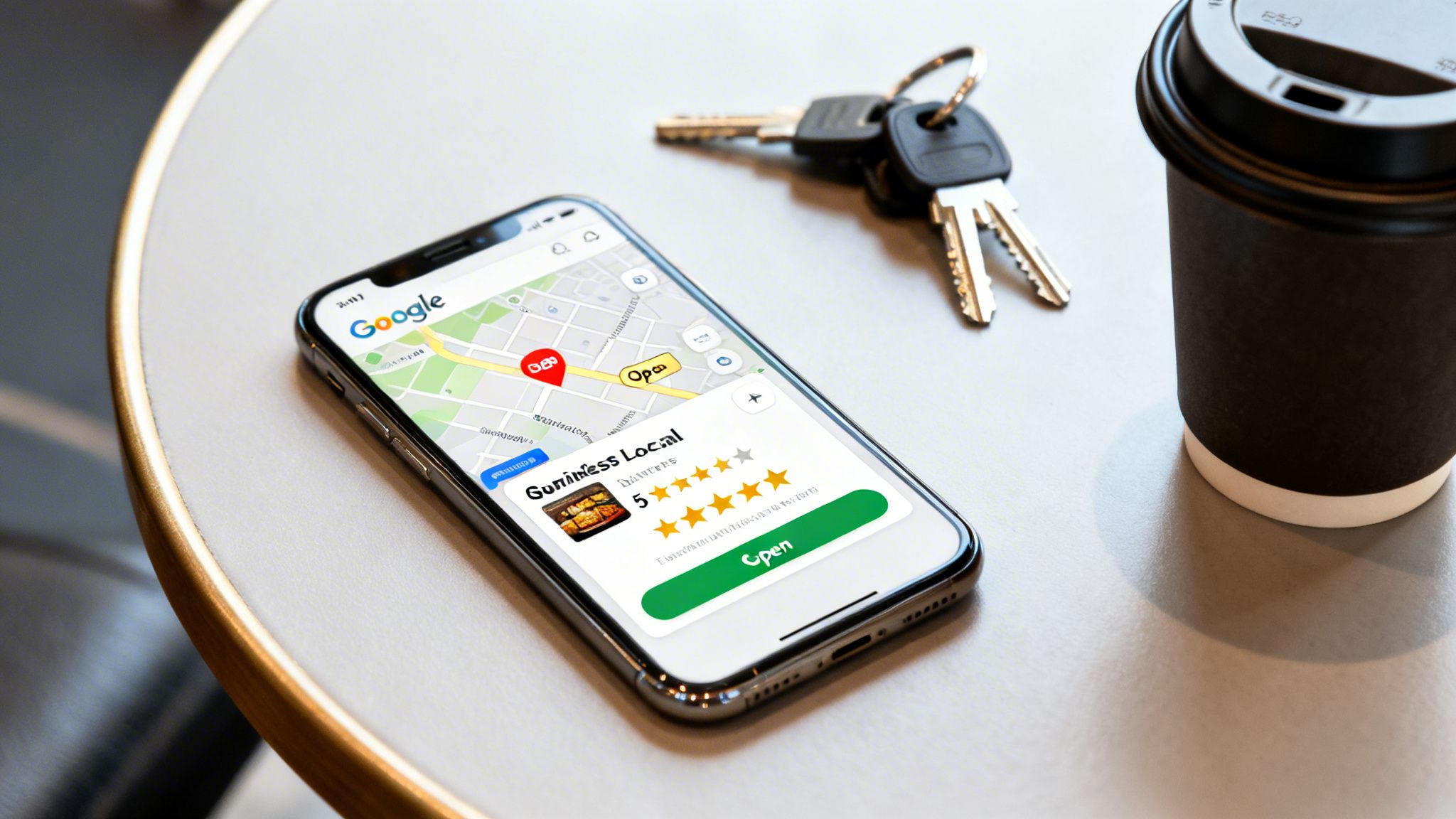
Think of your Google Business Profile (GBP) as your new shop window. For many local customers, it's the very first time they'll interact with your brand. For any business relying on foot traffic or local service calls—trades, restaurants, you name it—a well-managed profile isn't just nice to have, it's essential.
And optimising it goes way beyond just listing your address and phone number. You need to treat it as a living, breathing part of your marketing.
Here’s how to turn that profile into a customer-generating machine:
Fill Out Everything: Don't skip a single field. Add all your services, special attributes (like 'outdoor seating' for a cafe), and accessibility info. The more you tell Google, the better it can match you with people actively searching for what you offer.
Show Off Your Work: Regularly upload sharp, professional photos of your projects, your team, your location, and happy customers. This builds instant trust and shows people the quality you deliver before they even pick up the phone.
Post Regular Updates: Use Google Posts to shout about special deals, share business news, or showcase a recently completed job. It sends a powerful signal to Google—and to potential customers—that you're active, open, and ready for business.
Getting these details right makes you the obvious choice, turning casual searchers into paying customers.
Building Trust Through Reviews and Consistency
In your local area, your reputation is everything. Online, that reputation is built on customer reviews. They're the digital version of word-of-mouth, and they play a massive role in how high Google ranks your business.
You should have a system in place to encourage a steady flow of positive reviews. Make it dead simple for happy clients to leave feedback, maybe by sending them a direct link after you’ve finished a job. It’s just as important to respond to all reviews, good and bad. It shows you’re listening and that you care about providing great service.
The final piece of the puzzle is consistency. Your business name, address, and phone number (known as your NAP) must be exactly the same everywhere it's listed online—from social media profiles to industry directories. Any inconsistencies confuse search engines and can drag your rankings down. Think of it like this: you want every single sign pointing to your business to have the same, correct address.
By mastering your Google profile, encouraging reviews, and maintaining consistency, you build an unbeatable local presence. If you want to dive deeper, you might be interested in our guide on what local SEO can do for your business. This is how you make sure that when local customers are ready to buy, your business is the one they find, trust, and choose.
Preparing for the New Age of AI Search
The way your customers find you online is being completely reshaped. For years, the game was all about climbing Google’s list of blue links. But a new model is taking over. Tools like ChatGPT now let customers ask a question and get a single, conversational answer, skipping the list of websites altogether.
This shift marks the rise of Answer Engines. Your goal isn't just to rank on a page anymore; it’s to become the trusted source the AI quotes in its answer. This new discipline in web and digital marketing is called Answer Engine Optimisation (AEO).
Think about a potential customer asking their phone, "Who is the most reliable solar installer on the Gold Coast for a family home?" In this new reality, you don't want to be one of ten links they have to sort through. You want your business to be the confident, direct answer the AI serves up. This requires a whole new way of thinking about your online presence.
Becoming the Go-To Source for AI
To be the answer, you need to prove to these AI systems that you are the undisputed expert in your field. This has nothing to do with stuffing keywords or using old-school SEO tricks. It's about building a deep foundation of trust, authority, and clarity across your entire digital footprint.
AI models are built to hunt down the most reliable, accurate, and genuinely helpful information to answer a person's question. Your job is to make your business's expertise so clear and well-organised that you become the obvious choice for the AI to reference. Put simply, your content needs to directly answer the specific questions your customers are asking.
Getting your business ready for this new age of AI search requires a deliberate strategy. It’s all about organising your information so it’s easy for both people and machines to understand. The goal is to make your expertise undeniable.
Here are a few practical steps you can take to start optimising for Answer Engines:
Build Comprehensive FAQ Pages: Create detailed pages that answer every possible question someone might have about your products, services, or industry. Think like your customer and address their pain points, worries, and goals with clear, direct answers.
Use Structured Data (Schema Markup): Add schema markup to your website. This is a special code that plainly tells search engines what your content is about—for example, flagging your business hours, service areas, and customer reviews in a format machines can easily read.
Produce Authoritative How-To Guides: Write in-depth articles and guides that prove you know your stuff. For a plumber, this could be a detailed guide on "How to fix a leaking tap" or "What to do in a plumbing emergency." This content signals that you are a genuine authority.
Keep Information Accurate and Consistent: Make sure all information about your business online is correct and identical everywhere. This is especially true for your business name, address, phone number (NAP), and opening hours. AI cross-references data to verify facts, and consistency builds massive trust.
By structuring your content to provide direct, helpful answers, you're not just getting ready for the future of search. You're also creating a far better experience for your customers right now. This approach to web and digital marketing ensures you stay well ahead of the competition, ready to be found and endorsed by the next generation of search technology.
Digital Marketing Strategies in Action for Aussie SMBs
It's time to move from theory to reality. A smart web and digital marketing strategy isn't about just using a random mix of online tools. It’s about making them work together to hit real business goals—turning your online activity into phone calls, bookings, and sales.
For Australian small and medium-sized businesses, this is where the magic happens.
Let's look at what this looks like for real-world businesses. These aren't just ideas; they are proven models for growth that deliver a powerful return on investment when done right.
A Restaurant Driving Bookings with Social Ads
Picture a popular restaurant on the Gold Coast with a new seasonal menu. They need to fill tables fast, especially during the quieter mid-week nights.
Here’s how a targeted digital strategy gets it done:
The Tactic: They run short, mouth-watering video ads on Instagram and Facebook. The videos show off the new dishes and capture the restaurant's unique atmosphere.
The Targeting: The ads are precisely aimed at users within a 15km radius who’ve shown an interest in 'fine dining', 'local food', and other relevant pages.
The Result: A "Book Now" button on the ad links straight to their online booking system. It's a frictionless path from a user scrolling their feed to a confirmed dinner reservation, leading to a visible spike in mid-week revenue.
This shows how great content (the video) combined with sharp paid advertising can deliver immediate, trackable results.
A Plumber Generating High-Value Emergency Jobs
For a tradie like a plumber in Queensland, being visible at the exact moment of need is everything. An emergency call-out can be worth hundreds of dollars, so a steady flow of these jobs is what keeps the business profitable.
Success here all comes down to dominating local search.
The Tactic: The strategy is built around a perfectly optimised Google Business Profile. It’s loaded with positive reviews, clear service details, and current contact information.
The Targeting: All their effort is focused on ranking for high-intent search terms like "emergency plumber near me" and "blocked drain Brisbane".
The Result: When a homeowner’s pipe bursts, the plumber's business appears right at the top of Google's local results, complete with a "Call" button. This creates a constant stream of high-value, urgent jobs from customers who are ready to hire now.
A Solar Company Capturing Qualified Leads
A solar installation company has a much longer customer journey. Buying solar panels is a big decision that involves a lot of research. The strategy here needs to be about education and trust-building.
The Tactic: They produce helpful blog articles on topics like "government solar rebates in QLD" and "how to choose the right solar system". This positions them as a go-to expert, not just another salesperson.
The Targeting: They also run targeted search ads for keywords like "solar panel quotes Gold Coast", making sure they show up when someone shifts from researching to buying.
The Result: A homeowner finds their helpful blog via a Google search, which builds trust. Later, when they're actively seeking quotes, they see and click the company's search ad. This combination of content marketing (building authority) and paid ads (capturing intent) delivers a highly qualified lead who is much more likely to become a customer.
With AI getting more advanced, knowing how to detect AI generated content is becoming essential. It helps maintain quality and trust, especially as search engines continue to evolve.
How to Measure What Matters for Business Growth
A good web and digital marketing plan does more than just get your name out there; it should be driving real, measurable growth. But how do you know if your strategy is actually working? It’s easy to get distracted by vanity metrics like ‘likes’ and ‘impressions’, but those numbers don’t pay the bills.
It's time to focus on the figures that directly impact your bottom line. This simple shift in perspective changes your marketing from an expense into a powerful investment. When you know your numbers, you can see your return with total clarity and partner with a digital agency in complete confidence.
Let’s walk through the first steps and the key performance indicators (KPIs) that truly matter.
Starting with a Clear Roadmap
Before you can measure success, you need to know where you’re starting from. Think of this as a quick health check for your online presence. It gives you a baseline to measure all future growth against and quickly shows you where the biggest opportunities are hiding.
Your first steps should be simple and practical:
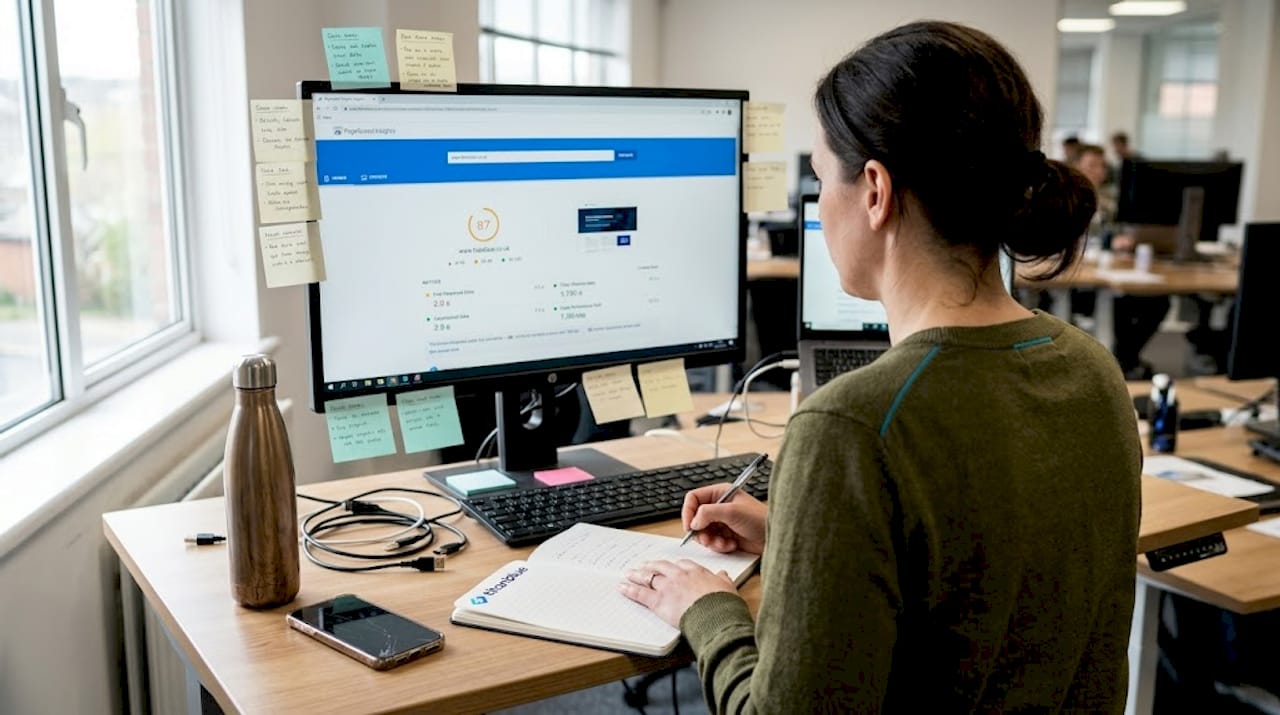
Conduct a Website Health Check: Is your site fast? Is it easy to use on a phone? Does it instantly tell visitors what you do and who you help? A basic audit can uncover some quick wins to improve the user experience and get more enquiries.
Analyse Your Online Footprint: Take a moment to see where your business currently appears online. This includes your Google Business Profile, social media accounts, and any industry directories. The key is making sure all your information is accurate and consistent everywhere.
Understanding your current position is the first step toward building a successful strategy for growth.
Focusing on Business-Critical KPIs
Key Performance Indicators are the numbers that connect your marketing activities directly to your business goals. Instead of getting lost in a sea of data, focusing on these four critical KPIs will tell you the real story of your marketing’s impact.
Lead Generation: This is the big one. How many potential customers are your digital marketing efforts bringing in? We’re talking about phone calls, website form submissions, or online bookings. Knowing your total number of leads per month is the foundation for everything else.
Customer Acquisition Cost (CAC): This tells you exactly what you’re spending to bring in one new paying customer. To figure it out, just divide your total marketing spend over a certain period by the number of new customers you gained in that same timeframe. A low CAC is a clear sign your marketing is efficient and profitable.
Conversion Rate: This metric shows what percentage of your leads become actual customers. If you got 100 leads and 20 of them turned into paying clients, your conversion rate is 20%. Improving this rate is one of the fastest ways to boost your revenue without spending a dollar more on ads.
Customer Lifetime Value (CLV): This KPI looks beyond just the first sale. It calculates the total revenue you can realistically expect from an average customer over the entire time they do business with you. A high CLV means you’re great at building loyalty and getting repeat business, which makes every new customer you bring in that much more valuable.
By focusing on these core metrics, you can cut straight through the noise. You’ll have a clear, data-driven view of what’s working, what isn't, and how your investment in web and digital marketing is fuelling genuine, sustainable business growth.
Frequently Asked Questions About Digital Marketing
Even with the best strategy in place, it’s natural to have questions about the practical side of web and digital marketing. Let's cut through the noise and get straight to the answers every Australian business owner asks. This will help you get started with real confidence.
How Much Should a Small Business Budget for Digital Marketing?
You'll often hear the old rule of thumb that suggests spending 7-10% of your total revenue on marketing. While that’s a decent starting point, a smarter way to think about it is to work backwards from your actual growth goals.
First, figure out how many new customers you actually need to hit your targets. Then, decide what you're willing to spend to get each one. For a local tradie, a higher customer acquisition cost makes sense because one job can bring in thousands. A cafe, on the other hand, operates on much smaller margins per customer.
The best approach? Don't try to boil the ocean. Start with a focused, testable budget on one or two channels you know will deliver, like local SEO. Once you see a clear return, you can confidently expand from there.
Which Digital Marketing Channel Is Best for My Business?
There’s no magic bullet here. The "best" channel is simply where your ideal customers are already hanging out. Your type of business is usually the biggest clue.
Here’s a quick guide to get you started:
For local services (plumbers, electricians): People need you now. Local SEO and Google Ads are non-negotiable for capturing that urgent search demand.
For visual businesses (restaurants, builders, designers): Your work needs to be seen. Instagram and Facebook are perfect for showing off what you do and building a loyal community.
For business-to-business (B2B) companies: You need to build trust and authority. In-depth articles and professional networking on a platform like LinkedIn are brilliant for generating high-quality leads.
Ultimately, a connected strategy across multiple channels is the goal. But to begin, just focus on mastering the single channel where your customers are most active.
How Long Does Web and Digital Marketing Take to Show Results?
This really depends on your chosen path. Paid advertising, like Google or social media ads, is like flicking a switch—it can bring in traffic, calls, and leads almost instantly. It’s a fantastic way to test what works and get the phone ringing right away.
On the other hand, organic strategies like SEO and content marketing are long-term investments. Think of them as planting a tree, not buying a bouquet. You can expect to see real, noticeable movement in your search rankings and organic traffic within 4-6 months.
While organic takes longer, the results are far more sustainable. They compound over time, delivering value long after you’ve put in the initial work.
Can I Do Digital Marketing Myself or Should I Hire an Agency?
It’s definitely possible to manage some basics yourself, like posting on a single social media account. But let’s be honest—the digital world is incredibly complex, fiercely competitive, and always changing.
Properly running SEO, managing ad campaigns across different platforms, and optimising for the new wave of AI search requires deep expertise, expensive tools, and a huge time commitment. An agency gives you a whole team of specialists who live and breathe this stuff.
Hiring experts allows you to focus on what you do best: running your business. A professional approach almost always delivers a higher and faster return than trying to juggle it all on your own.
Ready to turn your website into a growth engine with a proven strategy? Titan Blue Australia has over 25 years of experience helping businesses like yours thrive online. Learn how our custom SEO, AI Search, and digital marketing services can deliver measurable results for your business at https://titanblue.com.au.
Titan Blue is your go-to digital partner for smart, results-driven solutions. We blend strategy, creativity and tech to grow your brand and get real results fast.