


Many Australian business owners believe custom website design simply means having a unique colour scheme or an eye-catching logo. This misconception leads countless SMBs to invest in solutions that look different but function identically to thousands of other sites. True custom web design allows for unique user experience, superior performance, and seamless integration with the tools that power your operations. This guide clarifies what custom website design genuinely means for Australian businesses in 2026, helping you distinguish between superficial customisation and strategic digital infrastructure that drives measurable growth.
Table of Contents
- What Custom Website Design Really Means For Your Business
- Common Misconceptions And Limitations Of Templated Sites
- Why Structure And Adaptability Matter More Than Just Looks
- Applying Custom Design Principles To Australian SMB Websites
- Explore Custom Web Design Solutions With Titan Blue
- What Is Custom Website Design?
Key takeaways
| Point | Details |
|---|---|
| Custom design transcends aesthetics | Genuine custom websites prioritise unique user journeys, performance optimisation, and seamless business tool integration rather than just visual differentiation. |
| Template limitations restrict growth | Off-the-shelf solutions impose rigid structures that prevent scalability, creative expression, and adaptation to evolving business requirements. |
| Adaptability drives long-term value | Structurally flexible websites accommodate content expansion, team workflows, and shifting user behaviours without requiring complete rebuilds. |
| Business alignment determines success | Effective custom design begins with clearly defined goals and measurable KPIs that connect website functionality directly to revenue outcomes. |
What custom website design really means for your business
When Australian SMBs explore website options, they often encounter agencies using “custom design” to describe anything from minor template modifications to fully bespoke digital platforms. Understanding the genuine definition matters because it determines whether your website becomes a growth asset or a constraint.
Custom website design tailors every element to your specific business processes and customer journeys. Rather than forcing your operations into predetermined templates, bespoke development builds the structure around how you actually work. A Gold Coast retailer with unique inventory management needs requires different backend architecture than a Sydney consultancy booking client appointments. Custom web design allows for unique user experience, superior performance, and seamless integration with these distinct operational tools.
Performance represents another critical distinction. Template sites load generic code for features you may never use, slowing page speeds and frustrating mobile users. Custom development writes only necessary code, optimising every function for your audience’s devices and connection speeds. This matters enormously in Australia, where users across regional areas experience varying bandwidth capabilities.
Genuine custom design encompasses these core elements:
- Site architecture built around your content strategy and user research
- Scalable infrastructure that grows with traffic and feature requirements
- Proprietary integrations with CRM, inventory, booking, or payment systems
- Performance optimisation specific to your audience’s technical environment
- Flexible content management allowing non-technical team members to update efficiently
Pro Tip: Before engaging any designer, document three specific business outcomes you need your website to achieve, such as reducing enquiry response time by 40% or increasing regional customer bookings by 25%. These measurable goals prevent purely aesthetic decisions and ensure your investment in website design for user experience delivers tangible returns.
The distinction between custom and customised matters here. Customised often means selecting colours and fonts within a template’s constraints. Custom means building the foundation itself to match your requirements. Understanding this difference helps you evaluate proposals accurately and invest wisely in digital infrastructure that genuinely serves your business model.
Common misconceptions and limitations of templated sites
Template platforms market themselves as quick, affordable solutions for businesses wanting an online presence. Whilst they serve certain purposes, understanding their inherent constraints helps SMB owners make informed decisions about when templates suffice and when custom development becomes necessary.
Off-the-shelf solutions often impose creative and functional limitations that prevent a business from standing out in competitive Australian markets. These constraints extend far beyond visual appearance, affecting fundamental aspects of how your website supports business operations.
“Off-the-shelf solutions often impose creative and functional limitations that prevent a business from standing out, restricting both visual differentiation and the ability to integrate unique business processes that give companies competitive advantages.”
Rigid structure represents the most significant limitation. Templates organise content in predetermined patterns that suit generic businesses but rarely align with specialised service offerings or unique customer journeys. A Melbourne architect showcasing portfolio projects requires different navigation and media handling than a Brisbane equipment hire company managing availability calendars. Templates force both into identical structures, diluting their distinct value propositions.
Scalability issues emerge as businesses grow. Templates handle modest content volumes adequately but struggle when product catalogues expand, blog archives accumulate, or traffic increases substantially. Many Australian SMBs discover these limitations only after investing months building content within a template’s framework, then facing expensive migration costs to more robust platforms.
Australian businesses relying on templates commonly encounter these frustrations:
- Inability to modify checkout processes for local payment preferences or shipping calculations
- Restricted integration options with Australian accounting, inventory, or booking systems
- Performance degradation as content libraries grow beyond template optimisation thresholds
- Limited control over mobile responsiveness for complex content layouts
- Dependency on third-party plugin developers for critical functionality updates
- Cookie-cutter designs that mirror competitors using identical templates
Functional constraints prove equally problematic. Want to create a custom calculator helping customers estimate project costs? Templates rarely accommodate bespoke tools. Need to integrate your existing CRM for seamless lead management? Template platforms offer limited API access. These restrictions don’t just affect aesthetics; they directly impact conversion rates and operational efficiency.
Security and compliance present additional concerns. Templates bundle numerous features most businesses never use, creating unnecessary security vulnerabilities. For Australian businesses handling customer data, custom website design benefits include implementing only necessary functionality with appropriate privacy controls, reducing risk exposure whilst maintaining compliance with Australian privacy legislation.
Why structure and adaptability matter more than just looks
Australian SMB owners naturally focus on visual appeal when evaluating website designs. However, prioritising site architecture and long-term flexibility over immediate aesthetic impact delivers substantially better business outcomes as your digital presence matures.
The trade-off between appearance and structure isn’t absolute, but resource allocation matters. Investing heavily in custom illustrations whilst accepting rigid content architecture creates beautiful sites that frustrate content teams and limit growth. Custom web design should prioritise structure and adaptability over visual differentiation to avoid limitations as content grows and business needs evolve.
Consider how these approaches deliver different long-term value:
| Structure-focused design | Look-focused design |
|---|---|
| Flexible content types accommodate evolving offerings | Fixed layouts require developer intervention for new content formats |
| Modular components allow non-technical team updates | Rigid designs necessitate ongoing developer dependency |
| Scalable architecture handles traffic growth smoothly | Performance degrades as content and users increase |
| Adaptable navigation evolves with user behaviour data | Static menus become cluttered as business expands |
| Future-proof foundation reduces rebuild frequency | Aesthetic trends necessitate complete redesigns every few years |
Adaptability supports content team efficiency in ways that dramatically affect long-term costs. When your marketing coordinator can easily add new service pages, update case studies, or restructure navigation based on analytics insights, your website evolves continuously with market demands. Rigid structures requiring developer intervention for routine updates create bottlenecks that slow competitive response and inflate ongoing costs.
User behaviour shifts constantly. Australians increasingly research services on mobile devices during evening hours, expect video content explaining complex offerings, and abandon sites loading slower than three seconds. Adaptable architectures let you respond to these behavioural changes by restructuring content presentation, optimising media delivery, or adjusting conversion paths without rebuilding fundamental infrastructure.
Pro Tip: Involve your content team during initial design planning, not after launch. Their insights about content creation workflows, update frequency, and information architecture needs ensure the final structure supports efficient ongoing management rather than creating frustrations that require expensive modifications months later.
Structural decisions affect SEO performance more than visual choices. Search engines prioritise sites with logical hierarchies, fast loading speeds, and mobile-optimised experiences. A beautifully designed site with poor information architecture and slow performance loses visibility to structurally sound competitors with modest aesthetics. For Australian businesses competing in local markets, this structural foundation directly impacts whether potential customers discover your services through search.
The most effective approach balances both elements. Professional design creates positive first impressions and reinforces brand identity. Thoughtful structure ensures that positive impression translates into conversions and that your website design guide supports sustainable growth rather than requiring replacement as your business evolves.
Applying custom design principles to Australian SMB websites
Australian businesses face unique digital challenges that generic international design approaches often overlook. Geographic diversity, device usage patterns, regulatory requirements, and competitive dynamics all influence how custom web design should address local market realities.
Truly custom web design begins with understanding constraints specific to how Australian businesses operate, such as geographically distributed audiences, varying device capabilities, and compliance expectations. These factors should inform structural decisions from initial planning rather than becoming afterthoughts during development.
Geographic distribution affects Australian businesses differently than compact European or Asian markets. A Brisbane service provider might serve customers from Cairns to the Gold Coast, spanning areas with vastly different internet infrastructure. Regional users accessing your site via mobile networks require different optimisation than metropolitan users on high-speed connections. Custom design accounts for these variations through adaptive image delivery, progressive loading strategies, and content prioritisation that works across connection speeds.
Device diversity presents another consideration. Whilst mobile-first design has become standard globally, Australian usage patterns show significant desktop engagement for certain industries, particularly professional services and B2B sectors. Custom design analyses your specific audience data rather than applying universal assumptions, ensuring optimal experiences across the devices your customers actually use.
Implementing custom design principles for Australian SMBs involves these practical steps:
- Analyse your existing customer data to identify geographic distribution, device preferences, peak usage times, and common user journeys before making structural decisions.
- Map business processes requiring website integration, such as booking systems, inventory management, or customer portals, ensuring custom development accommodates these specific operational needs.
- Research competitor websites serving your target market, identifying gaps in user experience or functionality that custom design can address to create competitive advantages.
- Define measurable KPIs connecting website performance to business outcomes, such as enquiry conversion rates, average project values, or customer acquisition costs, providing clear success metrics.
- Plan content architecture supporting both current offerings and anticipated expansion, avoiding rigid structures that necessitate expensive rebuilds as your business grows.
- Ensure compliance with Australian privacy legislation, accessibility standards, and industry-specific regulations through custom security implementations rather than relying on generic template protections.
Local compliance deserves particular attention. Australian privacy laws, accessibility requirements, and industry regulations create obligations that generic templates may not adequately address. Custom development implements appropriate data handling, consent management, and accessibility features specific to your regulatory environment, reducing legal risks whilst improving user trust.
Mobile optimisation extends beyond responsive layouts. Australian mobile users expect tap targets sized for touch interaction, forms minimising typing through smart defaults, and payment processes supporting local preferences like PayID or direct bank transfers. Custom ecommerce web design tailors these elements to Australian user expectations rather than defaulting to international assumptions.
Search visibility requires understanding how Australians search for your services. Custom design supports effective SEO for small business through structured data markup, local business schema, and content architecture aligned with Australian search behaviour. This foundation proves far more valuable than superficial SEO tactics applied to poorly structured sites.
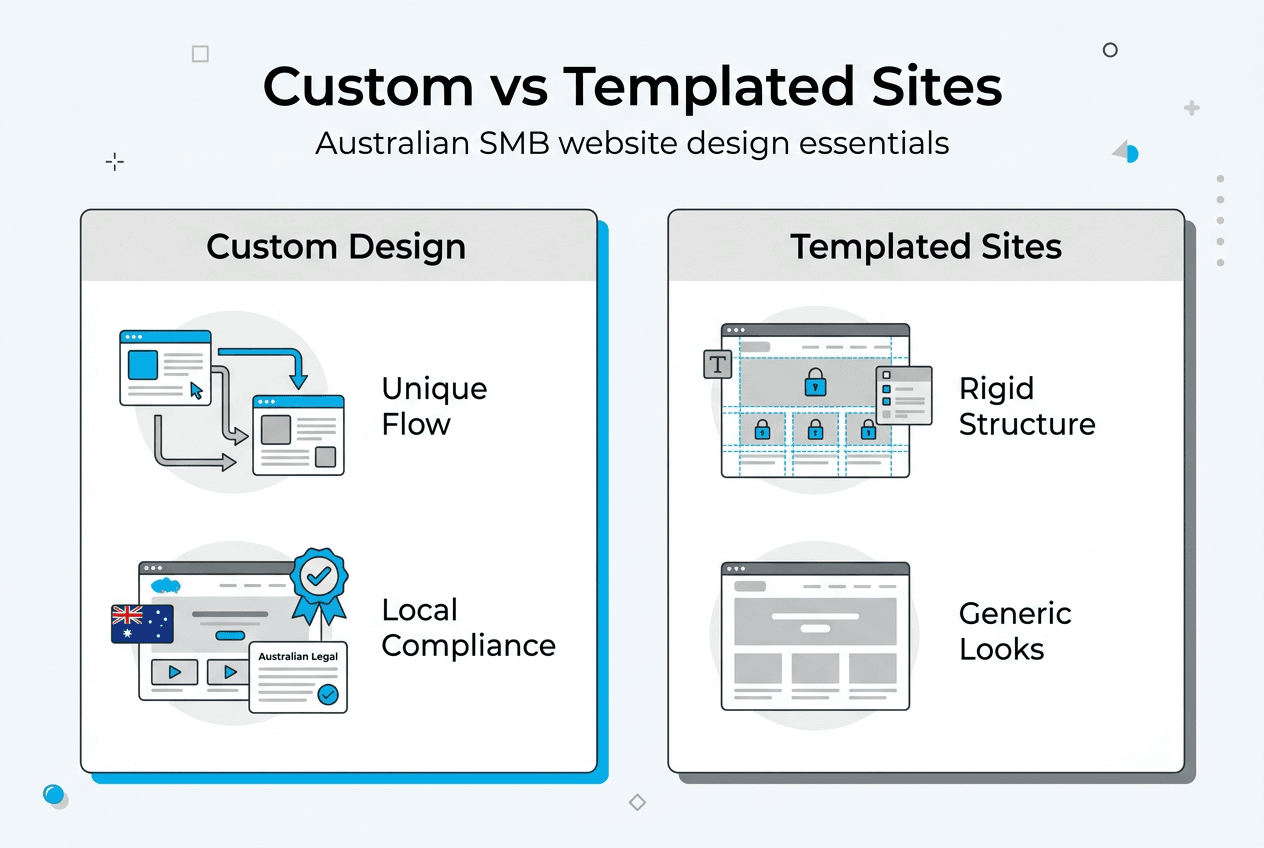
Measurable alignment with business goals separates strategic custom design from aesthetic exercises. Every structural decision should connect to specific outcomes: faster load times reduce bounce rates, streamlined forms increase enquiry conversion, integrated booking systems decrease administrative overhead. This business-focused approach ensures your investment delivers returns rather than just creating a more attractive digital presence.
Explore custom web design solutions with Titan Blue
Applying these custom design principles requires expertise in both technical implementation and Australian business realities. Titan Blue specialises in creating bespoke digital solutions for SMBs across Australia, combining strategic planning with technical excellence to deliver websites that function as genuine growth assets.
Our web design Gold Coast team works directly with business owners to understand operational needs, customer journeys, and growth objectives before touching design tools. This business-first approach ensures every structural decision supports measurable outcomes rather than purely aesthetic goals. We build websites that integrate seamlessly with your existing systems, accommodate your team’s workflows, and scale efficiently as your business expands.
Our comprehensive website design and development process addresses the complete digital ecosystem, from initial strategy through ongoing optimisation. We don’t just deliver a finished site and disappear. Our website care plans provide continuous performance monitoring, security updates, and strategic enhancements ensuring your digital presence remains competitive throughout 2026 and beyond. This ongoing partnership approach recognises that effective websites evolve continuously rather than remaining static after launch.
What is custom website design?
How does custom website design differ from using templates?
Custom website design builds site architecture, functionality, and user experience specifically around your business processes and customer needs. Templates provide pre-built structures you adapt within predetermined constraints, limiting unique integrations and scalability.
What business benefits justify custom design investment?
Custom design delivers competitive differentiation through unique user experiences, operational efficiency via seamless business tool integration, superior performance through optimised code, and long-term cost savings by eliminating expensive platform migrations as you grow.
How much does custom website design typically cost in Australia?
Australian custom website projects range from $8,000 for straightforward business sites to $50,000+ for complex ecommerce or portal solutions. Costs reflect scope, integrations, and functionality rather than just page count. Most SMB projects complete within $12,000 to $25,000.
When should a business choose custom design over templates?
Consider custom development when you require specific business tool integrations, anticipate significant growth, need unique functionality competitors lack, operate in regulated industries requiring custom compliance features, or find templates constraining your content strategy.
Does custom website design improve search engine rankings?
Custom design supports better SEO through optimised site architecture, faster loading speeds, mobile responsiveness tailored to your audience, and structured data implementation. However, ongoing content strategy and technical optimisation matter more than the custom versus template distinction alone.
How long does custom website development take?
Most Australian SMB custom website projects require 8 to 16 weeks from initial strategy through launch, depending on complexity, required integrations, content preparation, and revision cycles. Rushed timelines often compromise strategic planning that determines long-term success.
Recommended
- What is website design? A clear guide for Australian SMBs
- Custom website design benefits for Australian SMBs 2026
- A Guide to Website Design Prices in Australia – Titan Blue Australia
- Website Design Pricing in Australia Uncovered – Titan Blue Australia
Make Titan Blue a preferred source in Google
One click tells Google to surface our articles more often in Top Stories, AI Overviews and AI Mode.

Solar Installer Website Design Australia: The 2026 Guide
How solar installer websites in Australia should show CEC accreditation, real install proof and AI-ready…

Hotel & Hospitality Website Design Australia: 2026 Guide
Hotel and hospitality website design in Australia explained: booking flow, schema, AEO and what actually…

Restaurant Website Design Australia: The 2026 Guide
What a restaurant website in Australia needs: HTML menus, bookings, GBP sync, schema, and AI-ready…