

Last updated:
A great aus web design isn’t just about looking good. It’s about building a digital asset that pulls in leads, locks in bookings, and drives sales for your business around the clock. For Australian small businesses, a professional website is no longer a ‘nice to have’—it's the very core of a smart business strategy.
Think of it as your hardest-working employee, always on, and always ready to make the perfect pitch.
Why Your Website Is Your Most Important Employee
Picture your best salesperson. You know the one—they know your business inside and out, never call in sick, and can perfectly sell your value to every single person they meet. That’s what a high-performing website does for an Aussie small business in 2026.
This guide isn't about pretty pictures or fancy fonts. It’s about building a powerful tool that works tirelessly for you.
For tradies, cafe owners, and local businesses from the Gold Coast to Perth, a professional website is now the central pillar of a modern business. It’s your first impression, your main sales channel, and how most new customers will find you. If you don't have one that works, you're pretty much invisible to them.
The New Australian Digital Standard
The way Australians find and connect with local businesses has completely changed. The days of having a simple online brochure are long gone. Today, your customers expect a fast, intuitive, and personalised experience every time.
This shift is driven by near-universal internet access and fast connections across the country. It also creates a massive opportunity. A well-crafted website lets even the smallest local business punch well above its weight by meeting—and exceeding—what customers are looking for. The goal is to create a smooth journey that guides a visitor from a casual browse to taking action, whether that's asking for a quote or booking a table.
The numbers don't lie. By 2026, 98% of Australians will be online, and a massive 81% will be connected via the high-speed NBN network now that 3G is being retired. Personalisation isn't just a gimmick, either. Research shows 73% of Australian consumers prefer brands that offer tailored digital interactions, with AI-driven personalisation proven to lift conversion rates by up to 30%. You can learn more about how these shifts are shaping business by exploring the latest Australian website design trends for 2026.
From Digital Brochure to Growth Engine
Thinking of your website as just an online business card is a huge mistake. A strategic approach to aus web design transforms it from a passive page into a machine built for growth. This guide gives you a clear roadmap, starting with the basics like site performance and local SEO, and moving into the smart strategies that will turn your website into a magnet for your ideal customers.
- Lead Generation: Your website should be built to capture the details of anyone interested in what you do.
- Customer Qualification: It can answer common questions and pre-qualify leads automatically, saving you hours of phone calls.
- Brand Building: A good site consistently tells your story and builds genuine trust with your audience.
We'll walk you through how to find and work with an agency that truly gets the Australian market, making sure your investment turns your website into your most valuable business asset.
Budgeting for Your Aus Web Design Project
Thinking about your website budget is a lot like planning a commercial fit-out. A cheap, DIY job is like throwing up flimsy, temporary partitions; it might do the job for a week, but it won’t support a growing business or impress serious customers. A professional aus web design project, on the other hand, is a custom fit-out built for workflow, customer experience, and genuine growth.
This approach means shifting your mindset from seeing a website as a simple cost to recognising it as a vital, value-generating investment. So, let’s demystify what goes into building a professional website in Australia, so you can set a budget with confidence and make sure your investment delivers for years.
These figures show just how connected your Aussie customers are, making a quality website absolutely essential.
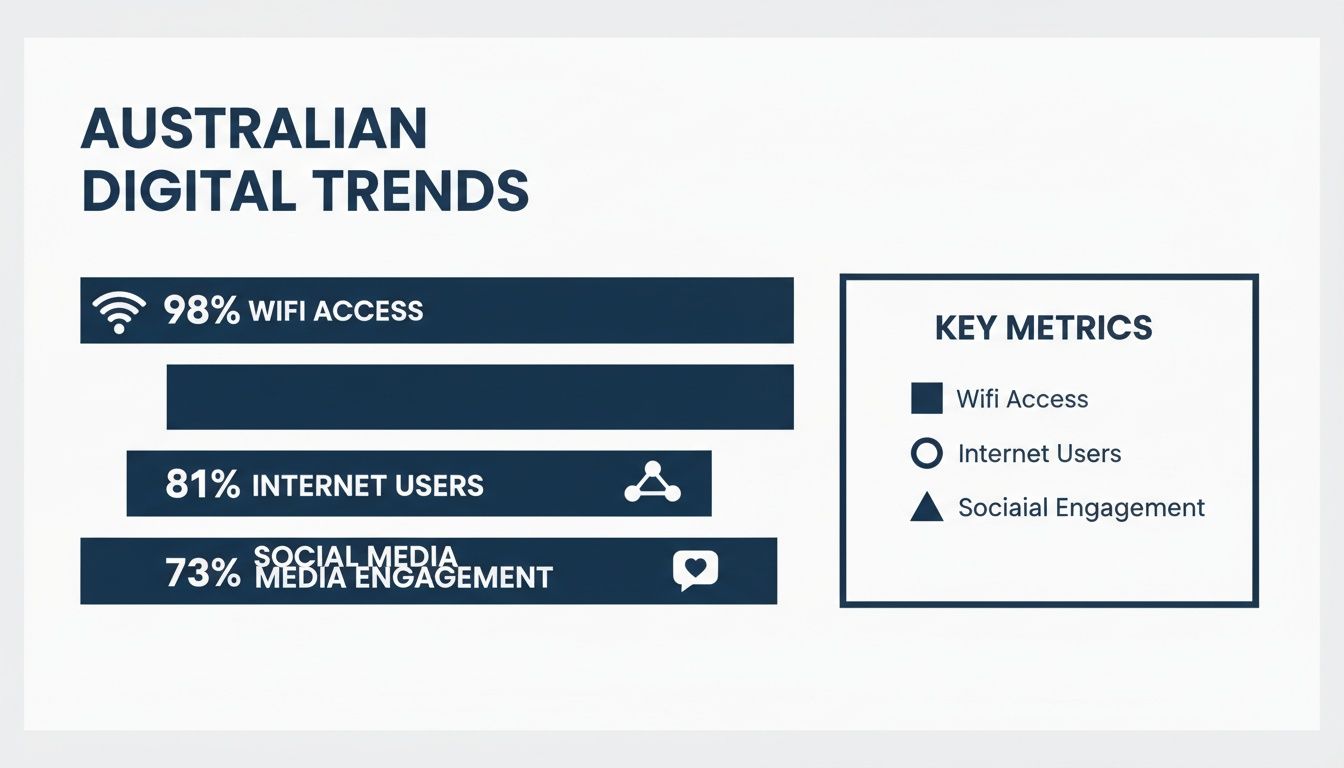
With numbers like 98% WiFi access and 81% of the population online, your customers don't just expect a digital presence—they expect a great one.
What Your Investment Actually Buys
When you work with a professional agency, you're not just paying someone to build a website; you're investing in a strategic process from start to finish. This covers discovery sessions, custom design that reflects your brand, expert development, and a solid SEO foundation. It’s what separates a high-performing digital asset from a simple online brochure.
A big factor here is the difference between a quick build and a strategic one. While DIY builders might look cheap with their low monthly fees, they come with a massive ‘time debt’. It’s easy to sink over 60 hours into tweaking a site that still doesn't hit the mark. A professional agency takes on that entire burden, delivering a polished, effective product designed for your business goals from day one.
In 2026, professional website development costs in Australia reflect this value. Agencies typically charge between $5,000 to $12,000 for a high-quality, strategic site built to attract and convert customers.
Understanding Different Price Points
Not all websites are created equal, and costs vary based on what you need it to do. Getting your head around these tiers helps you match your budget to your specific business goals. A clear scope from the beginning prevents any nasty surprises and ensures the final site does exactly what you need it to.
Here's a general guide to what you can expect at different investment levels in Australia:
- Basic Informational Sites: Starting at around $4,000, these sites are perfect for establishing a professional online presence. They’re ideal for businesses needing to showcase services, provide contact details, and build that initial brand trust.
- Lead Generation Websites: Typically ranging from $4,000 to $6,000, these sites are built with one key goal: converting visitors into leads. They include optimised contact forms, strong calls-to-action, and are designed to rank in local search for tradies, consultants, and other service businesses.
- E-commerce Websites: If you’re selling products online, expect to invest between $5,000 and $15,000+. This range covers everything from secure payment gateways and product catalogue management to customer accounts and inventory systems.
For businesses like tradies on the Gold Coast or cafes in Melbourne, this investment quickly pays for itself through a steady stream of qualified local customers. You might be interested in our guide on how much a new website should cost for a more detailed look.
Typical Project Timelines
Time is money, so knowing how long your project will take is crucial for planning. A professionally managed aus web design project follows a structured timeline to ensure everything is done right. Rushing the process almost always leads to compromises that end up costing you more down the track.
A typical timeline, from the initial chat to launching a live, lead-generating website, is between 6 to 12 weeks. This allows enough time for all the critical stages, from strategy and design concepts to development, content loading, and final testing. This structured approach guarantees your new digital asset is ready to perform from the moment it goes live.
The Anatomy of a High-Performing Aussie Website
So, what are the bits and pieces that make a website actually work for an Australian business? A high-performing aus web design isn’t just about having a pretty homepage. It's a machine with several essential parts all working together to find, keep, and convert visitors into paying customers. Let's break down the absolute non-negotiables.
To get this right, you first need to grasp the core elements of web design. These are the fundamentals that every single great website is built on.
Mobile-First Design Is Non-Negotiable
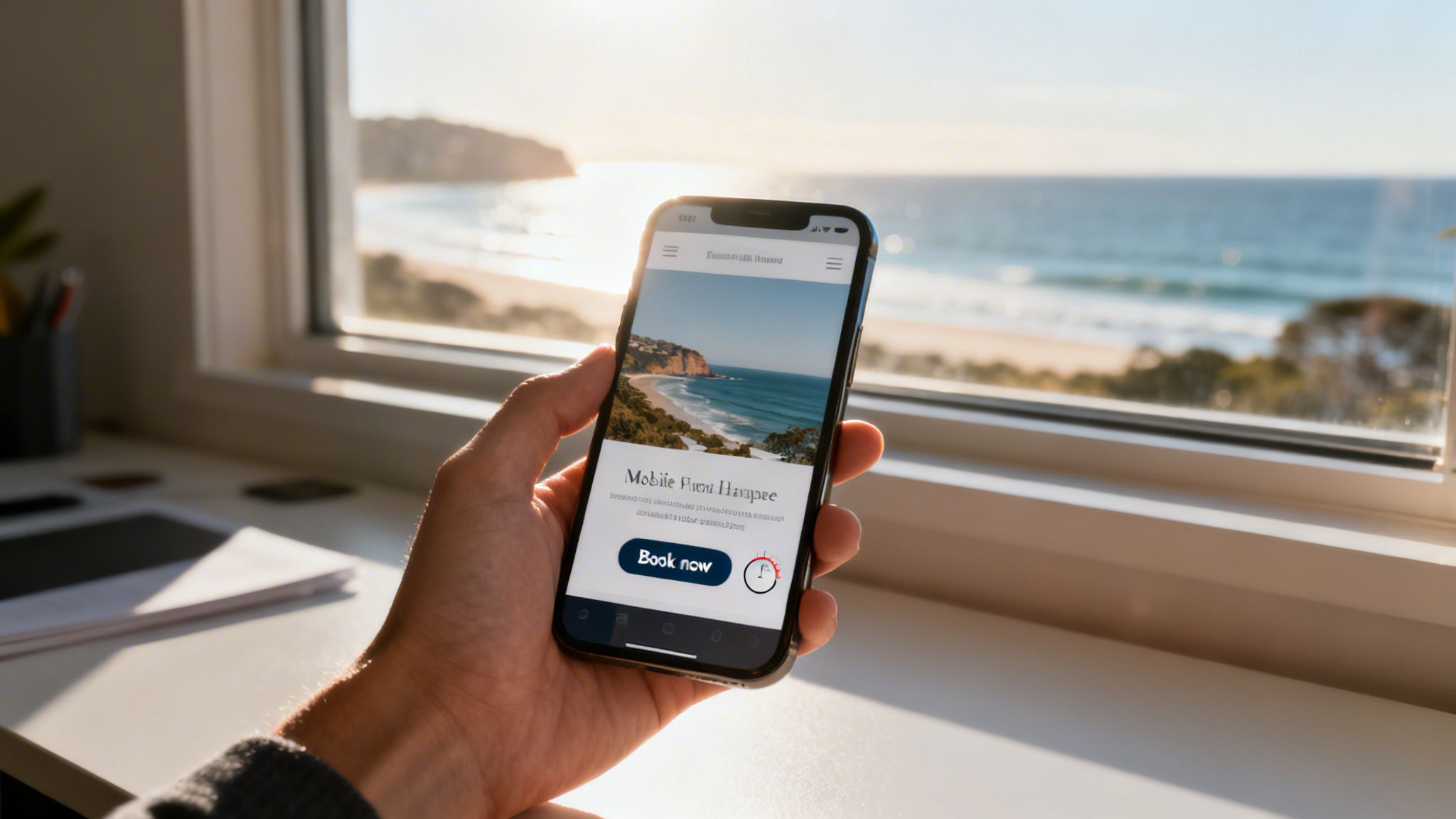
First things first, we need a complete shift in thinking. Your website is no longer a big desktop site that shrinks down to fit a phone. It’s a mobile experience, right from the get-go. With a huge number of Aussies browsing on the move, getting this wrong is a deal-breaker.
A mobile-first approach means every single element, from your navigation menu to your contact form, is designed for the smartphone user. Buttons need to be big enough to tap, text needs to be readable without pinching and zooming, and the whole experience has to feel snappy and natural on a small screen. Only after that mobile version is perfect do you even think about adapting it for bigger screens like tablets and desktops.
With over 50% of website traffic for many Aussie SMBs coming from mobile devices, this isn't just a trend; it's the new standard. Australia's 27 million smartphone users expect websites to load instantly and be easy to use with one hand. Get this right, and you'll see people stick around longer, which Google loves.
Blazing-Fast Speed and Performance
Ever been left on hold for what feels like an eternity? That’s exactly what a slow website feels like to a potential customer. It doesn’t matter how good your work is—if someone has to wait more than a couple of seconds for your page to load, they're gone. And they’re not coming back.
Site speed isn't just about keeping people happy, either. It’s a massive ranking factor for Google. A faster website signals a better user experience, and Google rewards that with better visibility in search results. This directly impacts how many new customers find you online.
To get that speed, a good web developer will focus on:
- Optimising Images: Compressing image files so they load in a flash without looking blurry.
- Minimising Code: Cleaning up all the HTML, CSS, and JavaScript to make your site as lean and efficient as possible.
- Leveraging Caching: Storing parts of your site in a visitor’s browser so it loads almost instantly when they return.
Intuitive Navigation and Clear User Experience
Once someone lands on your site, can they find what they're looking for without thinking? This is the heart of User Experience (UX) design. A clean, logical navigation acts like a good set of signposts, guiding a potential client from your homepage to the 'Contact Us' page or a 'Request a Quote' form.
Imagine a plumber’s website where you can’t find the phone number. Frustrating, right? You’ve just lost a job. Your most important information—contact details, list of services, and clear calls-to-action (CTAs)—should be impossible to miss. These CTAs, like "Call Us Now" or "Book a Free Consult," are the most important signposts of all. They tell users exactly what to do next.
The goal is to make the user's journey completely frictionless. Every click should feel logical and move them closer to solving their problem, which is ultimately why they visited your site in the first place.
Accessibility and Foundational SEO
Finally, two pillars hold up any website that's built to last: accessibility and on-page SEO.
Web accessibility simply means making sure people with disabilities can use your site. This isn't just the right thing to do; it's good business, as it opens your services to a wider audience. It involves simple practices like adding descriptions to images for screen readers and ensuring the site works without a mouse.
Foundational on-page SEO is about structuring your site so search engines like Google can easily understand what your business does and where you do it. This includes using proper headings, writing clear page titles, and using keywords related to your trade naturally in the text. When you build these elements in from the start, you create a solid foundation that makes all your future marketing efforts ten times more effective. You can learn more in our article covering the top elements of a high-performing website design.
Getting Found by Local Customers with SEO and AI
Building a brilliant website is only half the job. If your local customers can't find you online, then all that hard work might as well be invisible. This is where Search Engine Optimisation (SEO) comes in, acting as the bridge between your business and the people in your area actively searching for your services.
Think of it like setting up your shop on the main street of your town's digital equivalent. A solid local SEO strategy makes sure that when someone nearby searches "plumber in Ballarat" or "cafe in Fitzroy," your business is right there at the top of the results. It’s all about being seen at the exact moment a customer has a problem you can solve.
This section is a straightforward, practical guide to getting found by the customers right on your doorstep. We’ll also look at how to get your site ready for the next wave of search, driven by Artificial Intelligence, so you can stay well ahead of the competition.
Mastering Local Search Essentials
For any Australian small business, especially if you're in the trades or hospitality, your Google Business Profile (GBP) is your single most powerful local SEO tool. It’s that info box you see on Google Maps and in search results, showing off your business name, address, phone number, hours, and those all-important customer reviews.
Getting your GBP optimised is non-negotiable. It means filling out every single section, uploading high-quality photos of your work or venue, and making a real effort to get—and respond to—customer reviews. Good reviews send a huge signal to Google that your business is trusted and relevant to people searching locally.
Beyond your GBP, creating location-specific pages on your website is a game-changer. These are pages dedicated to the specific suburbs or regions you service.
- For a tradie: Instead of one generic "Services" page, you'd create pages like "Emergency Plumber Joondalup," "Hot Water Repair Fremantle," and "Blocked Drains Cottesloe."
- For a restaurant: You might have pages targeting what people actually search for, like "best coffee Surry Hills" or "functions venue Paddington."
These pages tell Google exactly where you operate, making you far more likely to show up for those high-intent, hyper-local searches. And to give your site's SEO and accessibility a further boost, you can use an AI alt text generator to create descriptive, keyword-rich descriptions for your images.
Preparing for the Future with Answer Engine Optimisation
The way we all search is changing. Instead of just seeing a list of blue links, search engines like Google are using AI to give direct answers to our questions. This is where Answer Engine Optimisation (AEO) comes into play, and it’s becoming essential for any modern Aus web design.
AEO is all about structuring the information on your website so that AI can easily read, understand, and use it. You’re essentially labelling all the data on your site. You’re telling the AI, "This is my phone number," "These are our opening hours," and "This is the price for this specific service."
When your site is structured this way, AI can grab that information and serve it up as the official answer to a user's question. For instance, if someone asks, "What time does [Your Cafe Name] close on Saturdays?", Google's AI can pull the answer directly from your website's code and display it instantly.
This shift means the goal is no longer just to rank #1; the goal is to be the answer. Getting this right establishes your business as the definitive source of information, putting you front and centre in AI-powered search summaries and voice search results.
AEO isn't a replacement for traditional SEO; it's the next layer. It ensures that as search technology evolves, your business remains visible and is seen as the go-to authority in your local market.
Preparing for this future means implementing something called structured data (also known as schema markup) on your website. It might sound technical, but it's a task your web design partner can handle for you. It’s a fundamental part of future-proofing your online presence. To get a deeper understanding of this topic, check out our complete guide on AI search engine optimisation and how it will impact your business.
How to Choose the Right Australian Web Design Partner
Choosing a web design agency is one of the biggest decisions you'll make for your business. This isn't just about hiring a supplier to build a webpage; it’s about finding a strategic partner who will actually help you grow. Arming yourself with the right questions is the only way to tell the good from the great.
Finding the right partner goes way beyond technical skill. You need an agency that gets the Australian market, understands your specific industry, and is genuinely committed to a long-term relationship built on shared goals and real, measurable results.
Look Beyond the Pretty Portfolio
Every agency will show you a portfolio packed with their best-looking work. And while visuals are important, you have to dig a lot deeper to see if they’re the right fit for your business. A slick design for a fashion brand means absolutely nothing if you’re a plumber in regional Queensland needing local leads.
Start by asking to see examples of websites they've built for businesses similar to yours—either in your industry or with similar goals. This proves they have experience solving the kinds of problems you face every day.
When you're looking at their work, ask specific questions that get to the heart of it:
- What was the main business goal for this project?
- How did the new website improve their lead generation or sales?
- What was the process like for that client?
This line of questioning shifts the conversation from just aesthetics to actual outcomes, which is what truly matters. It helps you understand their strategic thinking, not just their flair for design.
Ask About Their Process and Communication
A great aus web design agency will have a clear, structured process they can walk you through without hesitation. If their answer is vague or confusing, that’s a massive red flag. They should be able to explain exactly what happens at each stage, from the initial discovery and strategy sessions to design, development, and launch.
Communication is just as critical. You need to know who your main point of contact will be and how you'll get updates. A good partner will be proactive, keeping you in the loop throughout the project, not just sending an invoice at the end.
A partnership is a two-way street. Being a good client means being responsive, giving timely feedback, and trusting the experts you've hired. Clear communication and mutual respect are the foundations of a successful project that delivers genuine business growth.
Choose a Partner Who Understands Australia
There's huge value in choosing a local agency that truly gets the Australian market. They understand local consumer behaviour, regional search patterns, and all the subtle nuances that make a website connect with an Aussie audience. This is the kind of local knowledge an overseas or generic provider simply can't fake.
They’ll know that a customer in Sydney searches differently from one in Perth, and they can build a strategy around that. This local expertise is vital for effective SEO and for creating a brand voice that feels authentic and trustworthy to your customers. For a closer look at what's involved, you can learn more about professional web design and development and what a quality agency provides.
Finally, take a hard look at their proposal. A true strategic partner will give you a detailed document that outlines not just what they will do, but why they are recommending that specific approach. It should be tailored to your business goals, not a cookie-cutter template. This shows they’ve listened and are already thinking strategically about your success.
Keeping Your Website Secure and Growing Your Traffic
Getting your new website live isn't the finish line. Far from it—it’s just day one. A professional aus web design project gives you a powerful tool, but just like any other business asset, it needs ongoing attention to keep performing and stay safe.
Think of your website like your work ute or the commercial oven in your kitchen. You wouldn’t dream of skipping a service, and the same logic applies here. Consistent maintenance is the only way to keep your site running smoothly, protect it from online threats, and make sure it remains a dependable part of your business.
This isn't about just ticking a box. It’s about making sure the money you invested continues to pay off for years to come, turning your website from a static brochure into an engine for genuine growth.
Securing Your Digital Asset with Maintenance
Website maintenance isn’t just about fixing things when they break; it's about stopping them from breaking in the first place. It involves a series of routine checks and updates designed to keep your site secure, fast, and working exactly as it should.
Forgetting about maintenance is one of the quickest ways to watch your digital investment fall apart. Without it, your site can become sluggish, wide open to hackers, and might even crash completely. Any good agency will have a plan to handle these essential tasks.
Key maintenance tasks include:
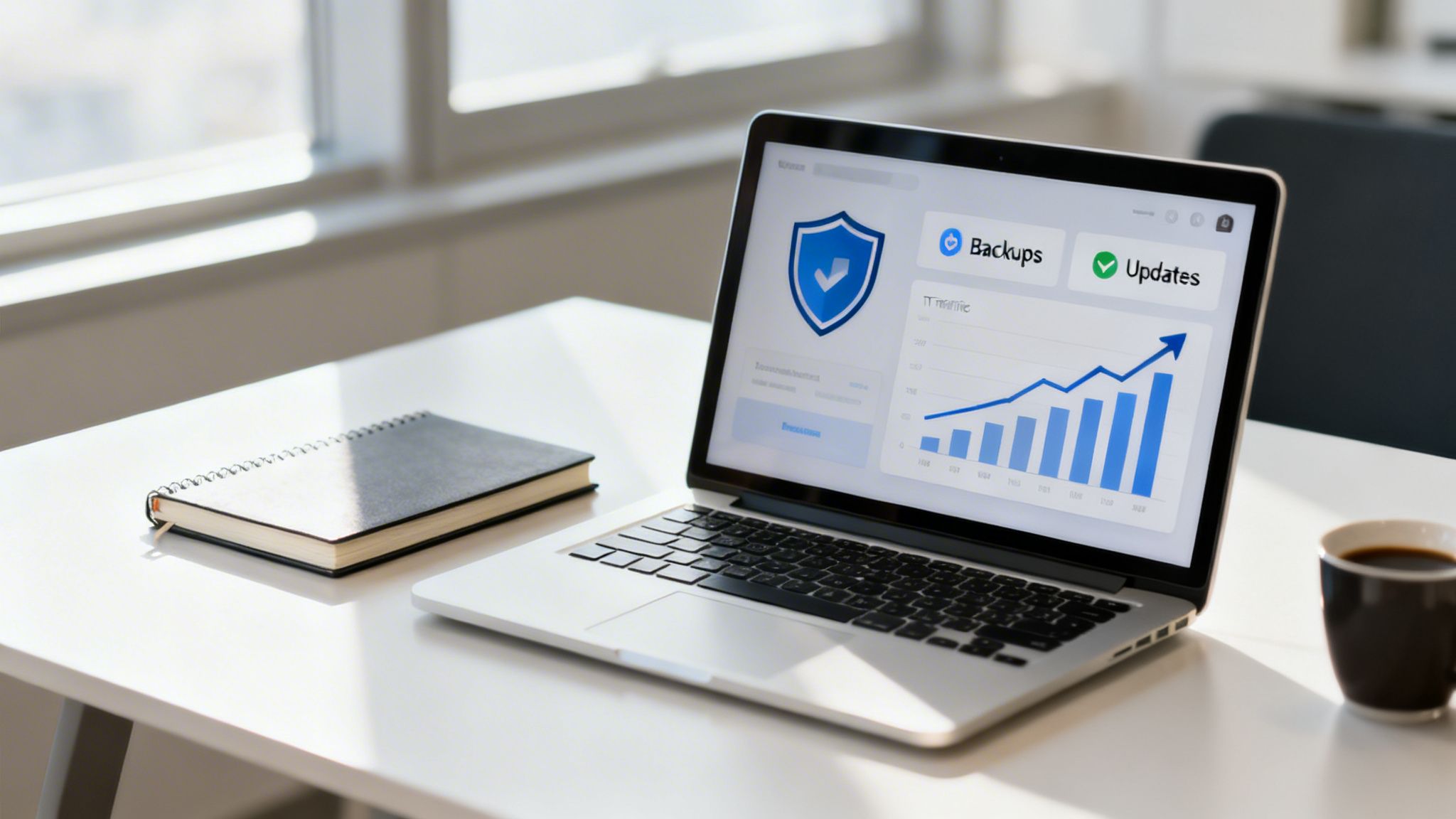
- Regular Backups: Creating full copies of your website. If the worst happens, you can restore it fast with minimal downtime or lost data.
- Security Scans: Proactively hunting for malware and other vulnerabilities to block threats before they can damage your site or your reputation.
- Software Updates: Keeping your website’s core software, plugins, and themes updated is critical for patching security holes and keeping everything compatible.
For any Australian business, this is non-negotiable. It’s the baseline for protecting your online presence. You can see what’s involved by looking into a professional website maintenance package and understanding what it covers.
Growing Your Audience with Strategic Content
Beyond just keeping the lights on, a great website needs a plan for growth. This is where strategic content—usually in the form of a blog—becomes your most powerful tool for attracting new customers and climbing the search engine rankings.
Every blog post you publish creates a brand-new doorway for potential customers to find you online. Think about the questions your customers ask you every single day. Writing articles that answer those questions directly targets what people are searching for on Google and immediately positions you as an expert.
Turning Clicks into Customers with CRO
Finally, what are you doing with the visitors you already have? Getting more traffic is one thing, but converting more of those visitors into actual leads and sales is where the real money is made. This is the whole point of Conversion Rate Optimisation (CRO).
CRO is simply the process of figuring out how people use your site and then making small, data-backed changes to encourage more of them to take action. This could be as simple as changing the colour of your "Request a Quote" button, tweaking the main headline on your homepage, or making your phone number more obvious.
These small changes can often lead to a massive lift in conversions, helping you get more business from the exact same amount of website traffic.
Common Questions About Aus Web Design
Getting a new website can feel like a massive undertaking, and it's natural to have a lot of questions. We get it. Here are some straightforward answers to the questions we hear most often from Australian small business owners just like you.
How Long Does It Take to Build a Business Website in Australia?
For a professionally built, custom website that’s designed to actually get results, you should set aside 6 to 12 weeks. This timeframe gives a good agency the space to do the job properly—from strategy and design mock-ups right through to development, adding your content, and thorough testing before it goes live.
Sure, a basic site can be slapped together faster, but rushing the process almost always means cutting corners on quality, performance, or both. A proper build allows enough time for each critical step, ensuring the final site is a tool that actually helps you hit your business goals.
Does My Trade or Hospitality Business Really Need a Blog?
Absolutely. A blog is one of the single most powerful ways to attract local customers who are already online searching for your services. Every article you publish is another hook in the water, giving Google a new page to rank and a potential customer a new way to find you.
Think about it like this:
- For a tradie: An article titled "5 Signs Your Hot Water System is Failing" can catch a homeowner in your suburb with an urgent problem they need solved right now.
- For a cafe or restaurant: A post about your new seasonal menu, a feature on a local supplier you partner with, or a heads-up about a special event helps build a local following and drives bookings.
Each post is a chance to prove you know your stuff, which gives people more reasons to trust you and pick up the phone.
What Is the Difference Between SEO and AEO?
Let’s break it down. Traditional SEO (Search Engine Optimisation) is all about convincing Google to put your webpage in its long list of blue links, hopefully as close to the top as possible.
AEO (Answer Engine Optimisation) is the next evolution. It's about structuring your website's content to be the direct answer to a question. This means AI-powered search tools can pull a specific fact—like your trading hours, a service price, or your address—straight from your site and present it as the answer, without the user even needing to click a link. It positions you as the definitive, go-to source of information.
Can I Update the Website Myself After It Is Built?
Yes, and you absolutely should be able to. Any professionally built website should include a user-friendly Content Management System (CMS) like WordPress. This puts you in the driver's seat, allowing you to make simple updates without needing any technical skills.
A reputable agency will always include training so you can confidently change text on a page, upload new photos to your project gallery, or publish your own blog articles. This empowers you to keep your site fresh and relevant, while you can leave the heavy lifting—like major technical updates and security—to your agency partner.
At Titan Blue Australia, we build strategic websites designed to grow with your business. For over 25 years, we’ve helped Australian businesses get found online with custom web design and expert digital strategy. https://titanblue.com.au
Make Titan Blue a preferred source in Google
One click tells Google to surface our articles more often in Top Stories, AI Overviews and AI Mode.

Bing Topics Portfolio: What It Means for Australian Sites
Microsoft Bing launched Topics Portfolio in AI Performance. What it shows, whether it reaches Australia,…

Best Medical Practice Website Design Agencies in Australia: 7 Compared
Best medical practice website design agencies in Australia, compared: seven picks, what each page shows,…

Shopify Website Design Australia: The 2026 Guide
Shopify website design Australia: product pages, collections, delivery info and product data that win sales,…