

In August 2025, carbonhalo.com had almost no organic search presence. Five clicks. 354 impressions. A handful of pages ranking at an average position of 59, which is page six of Google. Twelve months later the site earns over 300 organic clicks a month, appears in search 28,000 times a month, ranks for 2,166 distinct queries, and holds a top-three position for climate compliance software and best climate disclosure compliance software australia. This is what building search authority from a standing start actually looks like, including the parts that are still unfinished.
CarbonHalo is a carbon accounting and climate disclosure compliance platform. It sells into a market created by regulation: Australia’s mandatory climate reporting regime under AASB S2, phased in from 2025, which forces thousands of Australian businesses to measure and disclose emissions for the first time.
That makes it a fascinating and unusually difficult search problem, and a very different case study to a restaurant or a manufacturer.
The short answer
Between August 2025 and August 2026, Titan Blue took CarbonHalo from effectively zero organic visibility to a substantial and growing search footprint:
- Organic clicks up 621% comparing the first six months against the most recent six
- Search impressions up from 5,405 to 140,799, an increase of over 2,500%
- Ranking queries up from 268 to 2,166
- Average position improved from 59.0 to 26.4, moving from page six to page three
- Pages earning impressions up from 89 to 165
- Top three rankings for climate compliance software and best climate disclosure compliance software australia
- Monthly clicks grew from single digits to 307 in August 2026
- Two content pages now generate over 18,000 and 20,000 impressions each in a six month window
And the honest counterweight, stated up front: click-through rate fell from 3.46% to 0.96% over the same period, and a large share of current clicks are brand searches. Both of those are expected at this stage, and I explain why below rather than leaving it out.
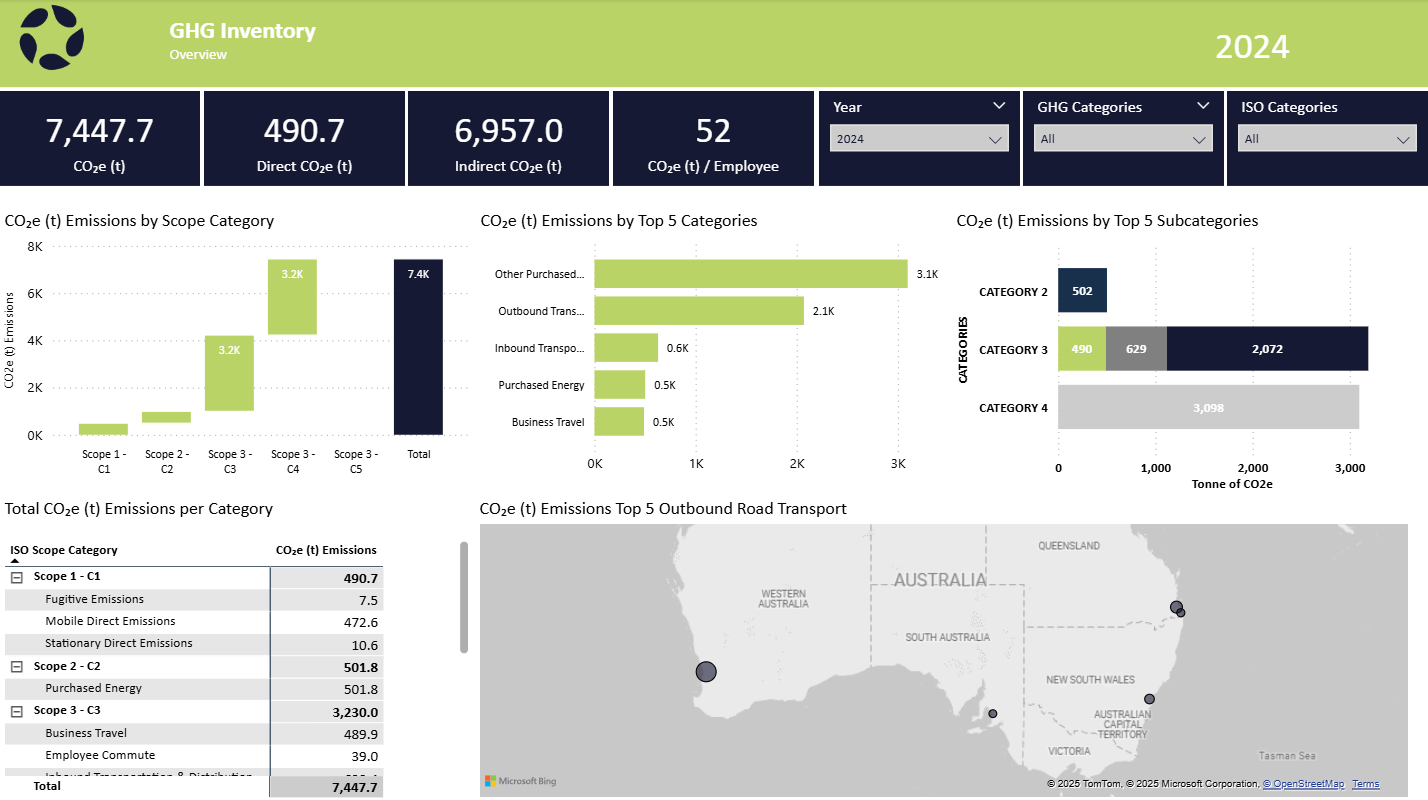
The problem: selling into a market that is still learning its own vocabulary
Most search strategies start with a known demand pool. People search for italian restaurant hope island or piano hinge every month, reliably, and the job is to win those searches.
Climate disclosure compliance is not that market. In 2025 it barely existed. The businesses that would eventually need CarbonHalo largely did not yet know:
- that the obligation applied to them
- what AASB S2 was
- what Scope 3 emissions were
- what limited assurance versus reasonable assurance meant
- that penalties attached at all
You cannot capture demand that has not formed. You have to be present as it forms.
That reframes the entire objective. The goal was not to rank for a list of commercial keywords, because the commercial keywords had almost no volume yet. The goal was to become the reference source Australian businesses find while they are working out what the regulation means for them, so that when the buying decision arrives, CarbonHalo is already the familiar name.
That is a slower, less flattering strategy in month three. It is a much stronger position in year two.
What we built
A regulatory content library, not a blog
CarbonHalo publishes structured, technical explanations of the actual compliance regime. Not thought leadership. Not opinion. Explanations of specific obligations, deadlines, standards and consequences.
The library that now drives the site’s visibility covers:
- AASB S2 compliance and the ASIC penalties attached to it
- Mandatory Scope 3 climate reporting
- AASB S2 versus IFRS S2 and where the Australian standard diverges
- Financial quantification under AASB S2
- Writing an AASB S2 climate transition plan
- The Safeguard Mechanism and carbon pricing for heavy emitters
- Limited assurance versus reasonable assurance
- Carbon accounting for Australian SMEs
Each of these is a question a finance director or sustainability lead is actively researching under deadline pressure. Each one is also a question with a right answer, which means the content can be genuinely authoritative rather than promotional.
The results by page tell you it worked:
| Page | Clicks | Impressions | Avg position |
|---|---|---|---|
| AASB S2 compliance and ASIC penalties | 61 | 2,807 | 8.2 |
| Mandatory Scope 3 climate reporting | 58 | 3,205 | 13.2 |
| Carbon accounting for Australia | 53 | 6,864 | 11.7 |
| Mandatory climate reporting | 43 | 18,669 | 19.4 |
| AASB S2 financial quantification guide | 29 | 819 | 6.5 |
| ESG and sustainability reporting Australia | 19 | 20,008 | 21.9 |
| How to write an AASB S2 transition plan | 17 | 543 | 6.6 |
Note the positions on the specific technical pages: 6.5, 6.6, 8.2. Where the question is precise, CarbonHalo ranks near the top of page one. The broad category pages sit further back at 19.4 and 21.9, which is exactly the pattern you expect while a site is still building domain authority. Specific beats broad first. Broad follows.
AEO and GEO, which this category demands more than any other
Nobody researching a regulatory obligation stops at ten blue links any more. They ask an AI assistant. “Does AASB S2 apply to my company?” is precisely the sort of question that gets answered in an AI overview or a chat assistant rather than a click.
So every piece was built to be the source those systems cite:
- The answer comes first. The question posed in the heading is answered in the opening sentence, in plain language, because that is the passage an engine extracts.
- Query fan-out is mapped deliberately. “Mandatory climate reporting” fans out into who it applies to, when each group phases in, what must be disclosed, what assurance is required, and what happens if you do not comply. Each becomes its own answerable section.
- Entities are named precisely. AASB S2, IFRS S2, ASIC, ASAE 3000, the Safeguard Mechanism, Scope 1, 2 and 3. Precision is what makes a page citable in a technical field.
- Claims are tied to the standard, not to marketing language, because a compliance audience checks.
You can see this working in the query data. The site appears for extremely long, specific research questions: comparisons of limited and reasonable assurance, ASAE 3000, particular Scope 3 categories, even named company disclosure comparisons. That is a research audience finding CarbonHalo mid-investigation, which is exactly the intent the strategy targeted.

Structure that separates the two audiences
CarbonHalo does not have one buyer, it has two, and they arrive with completely different questions.
A listed or large private entity captured in the first phase of the regime has a compliance team, an auditor, and a deadline. They search for standards: AASB S2, ASAE 3000, limited assurance vs reasonable assurance, Scope 3 emissions reporting. They want technical precision and they will check it.
A smaller business captured later, or pulled in through a supply chain requirement from a larger customer, does not know the vocabulary at all. They search for the problem: carbon accounting for SMEs, do I need to report emissions, climate reporting cost.
Serve both with the same page and you serve neither. So the site is structured with distinct paths, including a dedicated SME section which already earns 5,431 impressions in a six month window, alongside the deep compliance library aimed at the first group. Each path answers its own audience’s actual question and routes to the same product from a different angle.
This is the single most common structural failure we see in B2B SaaS sites. One generic solutions page is written to cover every buyer, and it ranks for none of them, because it is not the best answer to any specific question anyone actually types.

Technical foundations, done before the content
None of the above works on a site Google cannot crawl and trust. Before the publishing programme started, the groundwork was laid: clean URL structure, correct canonicalisation, schema markup identifying the organisation and its articles, internal linking that channels authority from the education library into the commercial pages, fast page delivery, and every new URL pushed to Google’s Indexing API and IndexNow so it is discovered within minutes of publication rather than weeks.
For a young domain this matters disproportionately. An established site can absorb technical sloppiness because its authority carries it. A twelve month old domain in a competitive technical category cannot. The 89 to 165 growth in pages earning impressions is partly a content result and partly simply the consequence of every page being crawled, understood and indexed properly.
Commercial capture at the bottom of the funnel
Alongside the education layer, the pages that matter commercially are now ranking:
- climate compliance software: position 3.3
- best climate disclosure compliance software australia: position 2.5
- aasb climate disclosure software: position 12.7
These are small-volume terms today. They will not be small-volume terms in three years, because every business captured by the regime eventually goes looking for a tool. Holding position two and three on them now, before the volume arrives, is the entire point.
The results in full
Monthly trajectory
| Month | Clicks | Impressions |
|---|---|---|
| Aug 2025 | 5 | 354 |
| Oct 2025 | 121 | 3,010 |
| Jan 2026 | 137 | 9,163 |
| Apr 2026 | 149 | 17,050 |
| Jun 2026 | 265 | 28,825 |
| Aug 2026 | 307 | 27,905 |
The impression curve is the one to watch. It has grown almost every single month, from 354 to nearly 29,000. Impressions are the leading indicator in a young site: they show Google is testing the pages against more and more queries. Clicks follow as positions consolidate, which is precisely what happened between April and August 2026 when clicks doubled.
Period comparison
| Metric | Aug 2025 to Feb 2026 | Feb to Aug 2026 |
|---|---|---|
| Clicks | 187 | 1,349 |
| Impressions | 5,405 | 140,799 |
| Average position | 59.0 | 26.4 |
| Ranking queries | 268 | 2,166 |
| Pages earning impressions | 89 | 165 |
An average position of 59 means the site was on page six. At 26.4 it is on page three, with its best technical pages sitting on page one. That is a full two-page climb across an entire domain in twelve months, in a technical category, from nothing.
The honest caveats
I would rather this page be useful than flattering, so here is what the data does not say.
Click-through rate fell, from 3.46% to 0.96%. This looks bad in isolation and is actually a normal artefact of rapid impression growth. When a site goes from 5,405 impressions to 140,799, the vast majority of that new visibility is at positions 15 to 40, where nobody clicks. CTR falls mathematically even though clicks rose sevenfold. The fix is not a CTR campaign, it is continuing to push those positions up, which is exactly what is underway.
A large share of current clicks are brand searches. Carbon halo, carbonhalo and close variants account for roughly 540 of the 1,349 clicks in the last six months, and the homepage takes 615 clicks on its own. That is typical of an early-stage build and it means the non-brand engine, while real and growing, is still young.
The top-three commercial terms have low volume today. Ranking 2.5 for best climate disclosure compliance software australia is genuinely valuable, but that term currently generates fewer than a hundred impressions in six months. We are positioning ahead of the demand curve, deliberately, and it is honest to say the payoff is largely still ahead.
Local search is not a factor here. CarbonHalo sells nationally to businesses with a compliance obligation. Their Google Business Profile activity is minimal, and we have not spent budget pretending otherwise. Note for the record: the Battery Point profile currently returns no performance data at all and needs attention as a separate task.
This is a twelve month picture, not three years. Google Search Console retains sixteen months, and CarbonHalo’s data begins on 30 August 2025. Everything above is measured from that point.
What other B2B and SaaS businesses should take from this
In a new category, publish the education before the demand exists. The businesses that will need your product are researching the problem long before they search for the solution. If you only target commercial keywords, you meet them too late and pay a competitor’s price to do it.
Watch impressions, not clicks, in the first year. Impressions tell you Google is finding more queries you are relevant to. Clicks lag by months. Judging a new site on clicks at month four causes people to abandon strategies that were working.
Expect click-through rate to fall while you are growing. It is arithmetic, not failure. New impressions arrive at low positions first.
Specificity ranks before breadth. CarbonHalo ranks 6.5 for a precise question about AASB S2 financial quantification and 21.9 for the broad ESG reporting category. Win the specific questions, accumulate authority, then contest the broad terms. Doing it the other way around does not work for a new domain.
Regulatory content compounds. A standard does not change every week. A properly built explanation of an obligation earns links, citations and rankings for years, and AI engines increasingly prefer sources that are precise, current and authored by someone with genuine standing in the field.
Own the commercial terms before they get expensive. Climate compliance software is cheap to rank for today because the category is young. In three years it will be contested by well-funded international platforms. Position two now is worth far more than it appears on a current traffic report.
Frequently asked questions
How long before a brand new site sees real organic traffic?
CarbonHalo went from 5 clicks in its first month to over 300 a month within a year, but the curve was not linear. Impressions moved first, from month two. Meaningful click growth arrived around month seven and accelerated from month nine. A new domain in a technical category should plan on twelve months, not three.
Is content marketing still worth it when AI answers the question directly?
In regulated and technical categories it is more valuable, not less. AI systems need authoritative, current, precise sources to cite, and a compliance platform explaining the actual standard is exactly that. The risk is not that AI removes the value of good content. The risk is publishing generic content that no engine has any reason to cite.
Why target low-volume keywords?
Because in an emerging regulatory market, today’s low-volume keyword is next year’s primary commercial term. Ranking is far cheaper before the category matures. This is one of the few genuinely durable advantages in search.
Does a falling click-through rate mean something is broken?
Not when impressions are growing fast. Check whether clicks are rising in absolute terms. For CarbonHalo clicks rose 621% while CTR fell, which means the site gained a large amount of new low-position visibility that has yet to mature. That is a healthy pattern in a young site.
The bottom line
Twelve months ago carbonhalo.com was invisible in search: five clicks, page six, a couple of hundred queries.
Today it ranks for 2,166 queries, earns over 300 organic clicks and 28,000 impressions a month, sits on page one for the specific AASB S2 compliance questions its buyers are researching, and holds top-three positions for the commercial software terms that will define the category as it matures.
The work is not finished, and this page says so plainly. Non-brand clicks are still building, the broad category terms are still on page two and three, and the biggest returns are ahead rather than behind. But the foundation is built, and in a market being created by regulation, being the source people learn from is the strongest commercial position available.
If you are building in a new or regulated category, have a look at our portfolio, read about Titan Blue, or get in touch. Background on the reporting regime itself is published by the Australian Accounting Standards Board.
Data source: Google Search Console for carbonhalo.com, 30 August 2025 to 23 August 2026. Search Console retains sixteen months of data.