

In August 2024, Mad Over Italian earned 368 organic clicks for the month, ranked in position 14 on average, and had exactly five pages on the entire site earning a single click. By July 2026 the site pulled 2,767 organic clicks in a month, a 652% increase, and its second venue at Emerald Lakes went from not being tracked at all to generating 5,231 Google profile impressions, 529 direction requests and 690 website clicks every month. Here is exactly how it happened, with the numbers from both ends.
If you run a restaurant and you are trying to work out whether search marketing is worth the money, this is the honest version of the answer. Not a highlight reel. The starting point, the strategy, the mechanism that produced the growth, and the parts that are less flattering than the headline.
The short answer
Between August 2024 and August 2026, Titan Blue took MOI from a Gold Coast restaurant sitting on page two of Google to a business that:
- Grew monthly organic clicks from 368 to 2,767, an increase of 652%
- Grew monthly search impressions from 8,504 to 38,539, up 353%
- Cut average search position from 14.0 to 9.7 across the whole site
- Lifted click-through rate from 4.33% to 6.88%, nearly doubling the share of searchers who click
- Grew the ranking query footprint to 8,184 distinct searches, up from 5,923 in the first half of the programme
- Took position one for mad over italian, moi emerald lakes, mad over italian emerald lakes, moi pizza hope island and moi italian hope island
- Grew the earning content library from 5 pages to 211
- Took the Emerald Lakes Google Business Profile from nothing to 5,231 monthly impressions, 529 direction requests, 690 website clicks and 157 calls a month
- Grew Hope Island profile direction requests from 104 to 296 a month, calls from 137 to 320, and website clicks from 516 to 858
- Delivered 35,171 organic clicks across the sixteen months Google Search Console retains
The last group of numbers is the one that matters most, and we will come back to it. Direction requests are the closest thing a digital report has to a customer walking through the door.
Act one: the problem was never the food
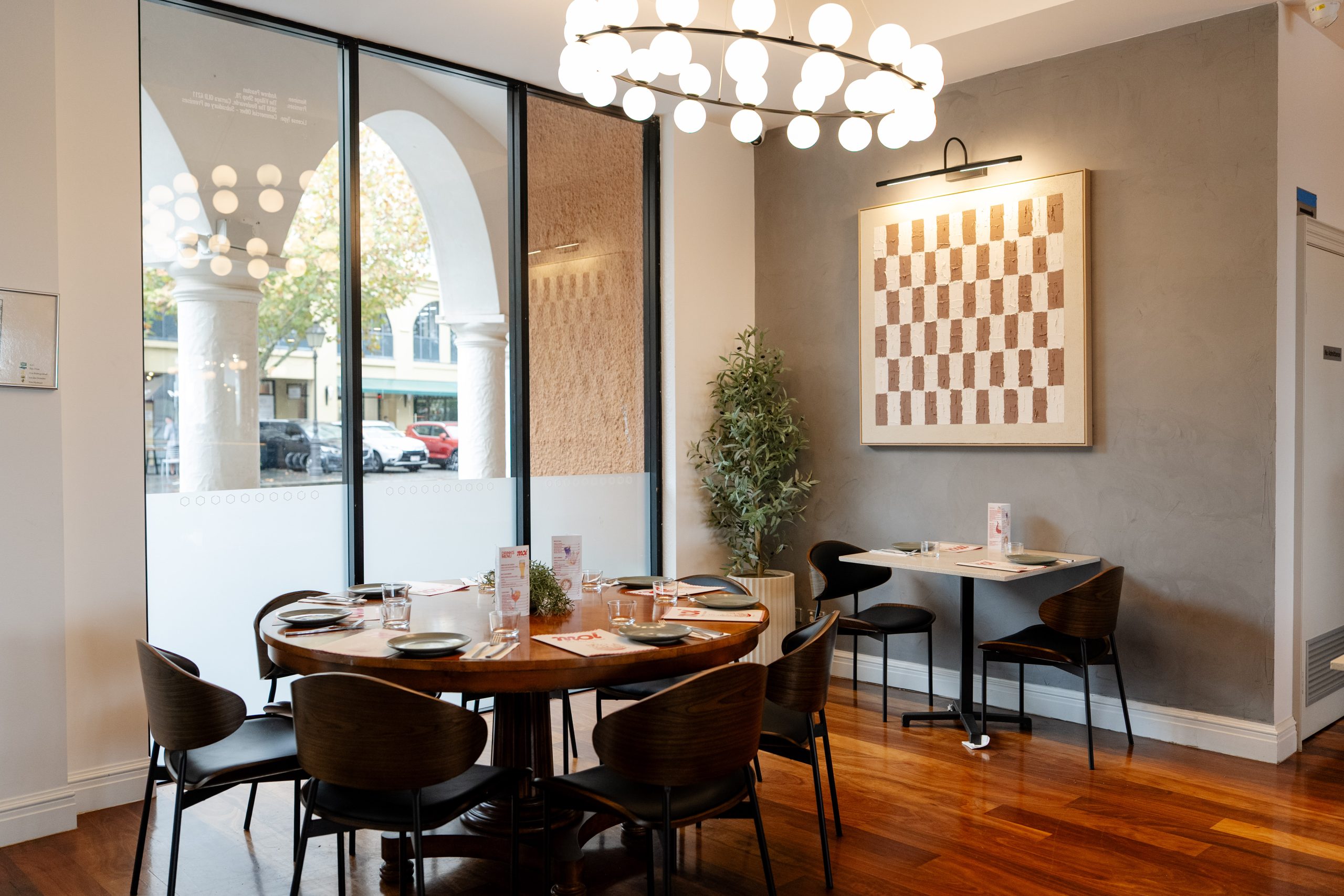
MOI is an Italian restaurant with two Gold Coast venues, Hope Island in the Broadwater Avenue precinct and Emerald Lakes at Carrara. Wood-fired pizza, house-made pasta, a genuine kitchen. The product was never the issue.
The issue was arithmetic. Here is the documented state of play in August 2024, taken from Titan Blue’s own monthly report for that month:
| Metric | August 2024 |
|---|---|
| Organic clicks | 368 for the month |
| Search impressions | 8,504 |
| Average position | 14.0 |
| Click-through rate | 4.33% |
| Pages earning any clicks | 5 |
| GA4 sessions, all channels | 1,598 |
| GA4 organic sessions | 985 |
| Google Business Profile direction requests | 104 |
| Google Business Profile calls | 137 |
| Reviews received that month | 14 |
| Emerald Lakes venue in reporting | not tracked |
Three numbers in that table matter more than the rest.
First: five pages earned clicks. Five. The menu page took 183, the homepage took 181, the contact page took 10, the about page took 4 and one suburb page took a single click. That was the entire site’s contribution. Meanwhile more than twenty suburb and landmark pages sat in the index collecting impressions and converting exactly zero of them. Coombabah, Nerang, Oxenford, Pimpama, Sorrento, Upper Coomera, Surfers Paradise: all present, all earning nothing.
Second: position 14.0. That is the middle of page two. In practical terms it does not exist. The overwhelming majority of searchers never scroll past the first ten results, and on a phone they rarely scroll past the first three.
Third: 368 clicks a month for a two-venue restaurant in one of Australia’s most competitive food markets. Gold Coast Italian is a crowded category. Every suburb has three options and each of them is fighting for the same results, plus the aggregators, the delivery platforms and the review sites sitting above all of them.
Act two: the diagnosis
Two distinct problems, needing different answers.
Problem one: two venues, one identity. MOI trades under a single brand across two suburbs eight kilometres apart. Search engines do not automatically understand that. Without deliberate structure, two locations under one brand compete with each other. The same pages try to rank for both suburbs, Google cannot decide which venue answers “Italian restaurant Emerald Lakes”, and both end up ranking worse than either would alone. In August 2024 the rank tracker did not even list an Emerald Lakes keyword. The second venue was invisible.
Problem two: pages without substance. The site had suburb pages, but they were thin. They existed, they got indexed, and they earned nothing, which is the clearest possible signal that Google was showing them to people and those people were choosing someone else. There was no depth on Italian food, no depth on the Gold Coast, nothing that would give Google a reason to treat the domain as an authority on either subject.
The obvious move, chasing “best Italian restaurant Gold Coast”, was the wrong one. That term is contested by every publisher, guide and aggregator on the coast, and winning it directly was not realistic from position 14 with a handful of pages doing any work.
So the strategy was different: build genuine location authority for each venue separately, build genuine topical depth for the brand overall, and let the competitive terms follow.
Act three: what we actually built
Separate location authority, deliberately
Each venue got its own gravity. Dedicated location content, location-specific pages, and, critically, a publishing rotation split between the two: two articles a week focused on Hope Island, two on Emerald Lakes. Every piece written for one venue reinforced that venue’s suburb, its neighbouring suburbs, its landmarks and the way people actually search for it.
This is the single highest-leverage decision in the entire programme. It is why MOI now ranks position one for moi emerald lakes, mad over italian emerald lakes, moi pizza hope island and moi italian hope island at the same time, rather than having its two venues cannibalise each other.
A publishing engine, not a blog
MOI moved to three long-form articles per week, published without exception. Two thousand words and up, each built to answer a specific question a real person types into Google or asks an AI assistant: what is the best Italian at Hope Island, what is on the lunch menu, where exactly is it, what is the dining experience like.
Consistency is the mechanism. Search authority does not arrive in a burst, it accrues. A restaurant that publishes twenty articles in one month then goes quiet reads as a campaign. One that publishes three a week for over a year reads as a publisher, and Google treats it accordingly.
The earning content library went from five pages to 211, and the query footprint grew to 8,184 distinct searches. Those thin suburb pages that earned nothing in 2024 stopped being decoration and became part of a network that actually answers something.
Answer Engine Optimisation from the first article
Every piece was built for AEO and GEO, Answer Engine Optimisation and Generative Engine Optimisation, not classic SEO alone. In practice:
- The answer comes first. The opening paragraph answers the question in the headline directly. AI engines extract the first substantive answer they find. If yours is buried under scene-setting, it is not yours that gets quoted.
- Fan-out structure. AI systems break a query into sub-questions. “Italian restaurant Hope Island” fans out into: which one, what is on the menu, where is it, can I book, what do people say, do they do takeaway. Every article was mapped against those sub-queries with a heading answering each.
- Entity-rich and specific. Named dishes, named suburbs, named landmarks, accurate trading hours, structured data. Vague content ranks vaguely.
Both Google Business Profiles working as hard as the website
Every published article was pushed to the matching venue’s Google Business Profile as a post, on publication day. Hope Island articles to the Hope Island profile, Emerald Lakes articles to the Emerald Lakes profile. Categories, attributes, hours, photos and service details were built out fully on both.
Review management was part of it too. In August 2024 the profile received 14 reviews that month and just one of them had a reply. Today the two venues hold 680 reviews between them at 4.6 and 4.7 stars, with replies as standard.
This is the part most restaurant owners underestimate, and for MOI it produced the single most dramatic result in the entire programme.
The technical layer
Instant indexing through the Google Indexing API and IndexNow on every publish, so new articles were discovered in minutes rather than days. Internal linking structured so authority flowed from the content library into the menu and location pages that actually convert. None of it is glamorous. All of it is load-bearing.
The results, in order of how much they matter
1. The Google Map Pack, the result that fills tables
For a restaurant this is the most valuable real estate on the internet, and it is the one most operators leave to chance.
The Map Pack is the block of three local businesses Google shows with a map above the organic results whenever someone searches with local intent: “Italian near me”, “restaurants Emerald Lakes”, “pizza Hope Island”. It sits above the traditional blue links. It is also what Google Maps returns, which is where most people on a phone actually start.
Here is what happened at Emerald Lakes, a venue that did not appear in the August 2024 reporting at all:
| Emerald Lakes Google Business Profile | September 2025 | July 2026 | Change |
|---|---|---|---|
| Total profile impressions | 615 | 5,231 | +750% |
| Direction requests | 40 | 529 | +1,223% |
| Website clicks from the profile | 0 | 690 | from zero |
| Calls from the profile | 0 | 157 | from zero |
And here is Hope Island, the established venue, measured against its own August 2024 baseline:
| Hope Island Google Business Profile | August 2024 | July 2026 | Change |
|---|---|---|---|
| Direction requests | 104 | 296 | +185% |
| Calls | 137 | 320 | +134% |
| Website clicks | 516 | 858 | +66% |
Read the Emerald Lakes direction requests line again. 529 people in a single month asked Google to navigate them to the door. That is not an impression or a session. Someone requesting directions to a restaurant at dinner time is a customer in transit. It is the closest thing to a booking a search report can show you.
Why the Map Pack matters more than most owners realise
- It sits above organic. You can rank number one in the blue links and still lose the customer, because three competitors appear above you in the map block.
- Mobile is where the decision happens. At Emerald Lakes, mobile Maps alone now delivers more impressions than every other surface combined. People are in a car or on a footpath deciding where to eat right now.
- The intent is immediate. A Map Pack search is rarely research. It is someone hungry, nearby, choosing.
- AI assistants lean on it. When someone asks an AI tool for a restaurant recommendation, the answer draws heavily on business profile data: categories, review volume, review sentiment, freshness. A thin profile does not get recommended.
How the ranking was built. Google weighs relevance, distance and prominence. Distance is fixed, so the work went into the other two: fully built-out profiles with correct categories, services, attributes, hours and photography, a profile post published alongside every single article to give each profile a continuous freshness signal, systematic review generation with a reply on every review, and website content reinforcing exactly what each venue should be known for in its own suburb.
That is where the two halves meet. The content programme did not only win organic rankings, it fed the local pack. The site and the profiles pull in the same direction on the same topics, and the Map Pack rewards it.
2. Position one across the brand and both suburbs
As at August 2026, from Google Search Console:
| Query | Average position | Clicks |
|---|---|---|
| mad over italian | 1.4 | 1,906 |
| mad over italian emerald lakes | 1.4 | 806 |
| moi emerald lakes | 1.6 | 932 |
| moi restaurant emerald lakes | 1.6 | 172 |
| mad over italian, moi | 1.3 | 148 |
| moi pizza hope island | 1.0 | 84 |
| moi italian hope island | 1.1 | 114 |
| moi hope island | 2.0 | 743 |
| moi italian | 2.0 | 260 |
| italian emerald lakes | 2.1 | 248 |
Compare that with the August 2024 rank tracker, which followed Hope Island only and had MOI at 4th for italian restaurant hope island, 7th for pizza hope island, 29th for best lunch menu hope island, and not found for restaurants northern gold coast and new restaurant gold coast.
Then the terms that are not brand searches at all, the ones where someone has no idea MOI exists and is simply looking for dinner:
- emerald lakes restaurants, position 4.2, 175 clicks
- italian restaurant emerald lakes, position 7.4, 177 clicks
- italian hope island, position 8.6, 130 clicks
- italian restaurant hope island marketplace, position 1
That last group is the growth engine. Brand searches capture demand that already exists. Non-brand local searches create it.
3. Clicks grew more than sevenfold
| Month | Organic clicks |
|---|---|
| August 2024 | 368 |
| August 2025 | 1,506 |
| July 2026 | 2,767 |
A 652% increase from the documented baseline. Impressions over the same period went from 8,504 to 38,539. Across the sixteen months Search Console retains, the site delivered 35,171 organic clicks.
4. Click-through rate improved while the site got bigger
Site-wide CTR moved from 4.33% in August 2024 to 6.88% across the first eight months of 2026. That combination, more impressions and a higher conversion rate on those impressions, is the one experienced SEOs look for. It means the growth came from ranking better on searches the site was already appearing in, not simply from being shown to more people.
Chasing impressions is easy and largely worthless. Converting impressions you already have into clicks is where the value sits, and that is what a position move from 14.0 to 9.7 delivers.
The honest caveats
Two things in this data deserve to be stated plainly rather than buried.
A large share of MOI’s search traffic is branded. Mad over italian, moi emerald lakes, moi hope island and their variations account for the bulk of the clicks. Some agencies would present that as a pure win. It is not the whole story, because branded search partly reflects demand the restaurant generated through the food, the location and word of mouth rather than through us.
But it is not nothing either, and here is why. Ranking position one for your own brand is not automatic. The delivery aggregators, review platforms and directory sites all compete for it, and they will happily intercept a customer who was searching for you specifically. Owning those results means the customer reaches your booking page and your menu rather than a third party’s. And the volume of branded search itself grew substantially across the period, which is the signal that discovery is turning into awareness.
The growth curve is not a straight line. Impressions on some pages have flattened in recent months. Search results shift, competitors respond, and AI Overviews absorb some informational queries entirely. What has held is the position improvement and the profile performance, the two things closest to actual customers. Anyone showing you an uninterrupted line up and to the right should be questioned.
What other hospitality operators should take from this
If you have more than one venue, structure for it deliberately. Two locations under one brand will fight each other in search results unless you give each its own content gravity. Splitting the publishing rotation by venue is why both MOI locations rank position one for their own suburb instead of splitting the difference.
Thin pages are worse than no pages. MOI had more than twenty suburb pages earning impressions and zero clicks in 2024. Pages that appear and get ignored teach Google that your site is not the answer. Depth is not optional.
Treat the Google Business Profile as a primary channel. For a restaurant it outranks your website. Complete it properly, post to it every week, get reviews relentlessly and reply to every one. Watch direction requests, not impressions, because they are the closest digital proxy for someone walking in.
Consistency beats intensity. Three articles a week for over a year outperforms any campaign burst, because search authority compounds and compounding requires time in the market.
Write for answer engines, not just search engines. Answer first, structure for sub-questions, be specific and entity-rich. The businesses getting this right now are the ones AI assistants will recommend for the next decade.
Keep your own reporting. The only reason this case study can show a real starting point is that the August 2024 report still exists. Search Console keeps sixteen months and no more. The baseline you fail to record today is the proof you cannot show in two years.
Frequently asked questions
How long did it take to see results?
Movement on local terms appeared quickly, within the first couple of months on suburb-level searches. The transformation at Emerald Lakes built through the following two to three quarters. The site-wide position improvement from 14.0 to 9.7 accumulated over roughly a year. Local search rewards patience far faster than national search does, because the competitive field in a single suburb is small.
How important is the Google Map Pack for a restaurant?
For most local hospitality businesses it is the single highest-value search surface. It appears above the organic results, it is what Google Maps shows, and its users are deciding where to go right now rather than researching. For MOI’s Emerald Lakes venue it generates 529 direction requests and 690 website clicks a month, from a standing start.
How do you rank in the Map Pack?
Google weighs relevance, distance and prominence. Distance you cannot change, so the work is in the other two: a fully completed profile with accurate categories, services and attributes, consistent posting, high review volume with genuine replies, strong photo coverage, and website content reinforcing what the venue is known for in its suburb.
We have two locations. Will they compete with each other in Google?
Yes, unless you structure the site to prevent it. That is one of the most common and most expensive mistakes multi-venue hospitality businesses make. Each venue needs its own pages, its own content stream and its own profile discipline.
Does content marketing actually work for a restaurant?
The numbers here are the case. MOI went from five pages earning clicks to 211 pages earning impressions and a query footprint of 8,184 distinct searches. Restaurants have an advantage most do not use: genuine, specific, first-hand knowledge of their food and their area that content farms cannot fake.
Is SEO still worth it now that AI answers questions directly?
It matters more, not less, but the goal has shifted. The objective is no longer only to rank, it is to become a source AI engines cite and recommend when someone asks where to eat. That requires the same foundation of depth, structure and local authority, applied with AEO discipline.
The bottom line
In August 2024, Mad Over Italian earned 368 organic clicks in a month, had five pages doing any work at all, and a second venue that did not appear in its own search reporting.
Today it holds position one for its brand and both of its suburbs, pulls more than 2,700 organic clicks a month, and its Emerald Lakes profile alone sends 529 people a month asking for directions to the door.
Same kitchen. Same food. Same two venues. What changed was a search strategy built on separated location authority, consistent publishing and disciplined local profile management.
If you would like to know what that would look like for your business, take a look at what we do, read a bit about Titan Blue, or get in touch.
Data sources: Titan Blue monthly SEO report for Mad Over Italian, August 2024; Google Search Console for moi.com.au, 14 April 2025 to 23 August 2026; Google Business Profile performance data for the Hope Island and Emerald Lakes locations. Search Console retains sixteen months of data, so figures before April 2025 are drawn from archived reporting.