Stay ahead with the latest tips, trends, and insights from the Titan Blue team , straight from the studio in Broadbeach.


TL;DR:
- SEO enhances online visibility, traffic, and credibility for small Australian businesses.
- Key components include on-page, technical, and off-page strategies focused on relevance and user experience.
- Consistent basics like accurate info, quality content, and mobile optimization outperform complex tactics.
SEO has a reputation for being complicated, expensive, and reserved for big brands with large budgets. That reputation is wrong. Search engine optimisation is one of the most practical tools available to small and medium-sized businesses across Australia, and you do not need to be a tech expert to benefit from it. This guide breaks down exactly what SEO is, how it works, and what you can do right now to improve your visibility online. Whether you run a trade business on the Gold Coast or a retail shop in Melbourne, the fundamentals apply to you.
Table of Contents
- What is search engine optimisation and why does it matter?
- The core components of effective SEO
- How search engines rank websites: key factors explained
- Practical SEO strategies for Australian small businesses
- Why most small businesses overcomplicate SEO (and what actually works)
- Take your SEO further with expert support
- Frequently asked questions
Key Takeaways
| Point | Details |
|---|---|
| SEO demystified | Even small Australian businesses can make big gains from basic SEO. |
| Three pillars of SEO | On-page, technical, and off-page SEO all work together to boost results. |
| Focus on what you control | Prioritise actions like content quality and local listings for immediate impact. |
| Consistency wins | Steady application of SEO basics beats chasing trends or shortcuts. |
What is search engine optimisation and why does it matter?
Search engine optimisation is the process of improving your website so it appears higher in search results on Google and other search engines. When someone types in “plumber near me” or “best café in Brisbane,” Google decides which websites to show first. SEO is how you influence that decision.
Many business owners assume SEO is just about stuffing keywords into a webpage. It is much broader than that. SEO basics cover everything from the words on your pages to how fast your site loads, how other websites link to you, and how easy your site is to navigate on a phone.
Search engine optimisation improves a website’s visibility on Google, leading to increased traffic and business growth. That is not just theory. Businesses that rank on the first page of Google receive the overwhelming majority of clicks. If you are not visible there, potential customers are finding your competitors instead.
Here is what SEO directly affects for your business:
- Organic traffic: More people find your website without you paying for every click
- Credibility: High rankings signal trust to potential customers
- Brand awareness: Appearing consistently in search results keeps your name front of mind
- Sales and leads: Relevant traffic converts because people are actively searching for what you offer
- Long-term results: Unlike paid ads, strong SEO keeps working over time
“The best place to hide a dead body is page two of Google.” That old joke captures a real truth: if your business is not on page one, most people will never find you.
Understanding why SEO is important is the first step. The good news is that SEO for small businesses does not require a massive budget or a dedicated IT team. Even modest, consistent effort produces real results.
The core components of effective SEO
On-page SEO, technical SEO, and off-page SEO each play a specific role in boosting search performance. Understanding what each one involves helps you prioritise where to focus your energy.
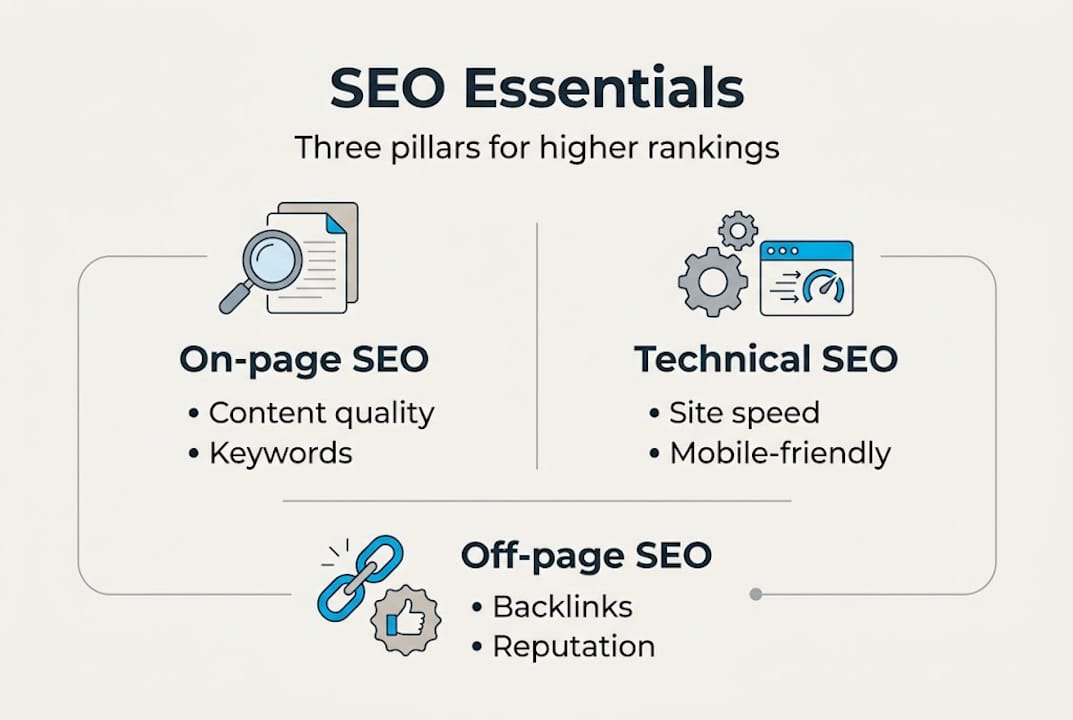
Here is a clear breakdown:
| Component | What it is | Why it matters | Sample actions |
|---|---|---|---|
| On-page SEO | Content and structure on your pages | Tells Google what your page is about | Write clear titles, use keywords naturally, add meta descriptions |
| Technical SEO | Behind-the-scenes website performance | Helps Google crawl and index your site | Improve page speed, fix broken links, ensure mobile-friendliness |
| Off-page SEO | External signals pointing to your site | Builds authority and trust with Google | Earn backlinks, get listed in directories, encourage reviews |
On-page SEO is usually where you start. This means writing quality content that answers real customer questions, using relevant keywords in your headings and page titles, and making sure each page has a clear purpose. Your SEO content writing needs to serve the reader first and the search engine second.
Technical SEO ensures Google can actually find and read your website. A slow-loading site or one that looks broken on mobile will rank poorly, no matter how good the content is. This is where a beginner’s SEO guide can help you identify quick technical fixes.

Off-page SEO is about building your reputation beyond your own website. When other credible sites link back to yours, Google treats it as a vote of confidence. Reviews on Google, mentions in local media, and listings in directories all contribute.
Here are the key important SEO strategies to focus on first:
- Optimise your page titles and meta descriptions
- Publish content that answers specific customer questions
- Ensure your website loads quickly on mobile devices
- Build citations in relevant Australian business directories
- Earn genuine backlinks from local or industry-related websites
Pro Tip: Mobile search accounts for the majority of Google searches in Australia. If your website is not fast and easy to use on a phone, you are already at a disadvantage. Test your site on mobile today.
How search engines rank websites: key factors explained
Websites are ranked based on hundreds of factors, but a handful of signals like relevance, authority, and user experience are most crucial. Understanding these signals helps you focus on what actually moves the needle.
Google’s process is simpler to understand than most people think. It crawls the web, indexes pages, and then ranks them based on how well they match what someone is searching for. You can read more about how search engines work directly from Google.
Here is what you can and cannot control:
| Within your control | Outside your control |
|---|---|
| Content quality and relevance | Competitor budgets and resources |
| Page titles and meta descriptions | Google algorithm updates |
| Site speed and mobile usability | How quickly Google re-indexes your site |
| Internal linking structure | Third-party review platforms’ policies |
| Google Business Profile accuracy | Industry-wide search trends |
Focus your energy on the left column. Here are the steps that have the most impact:
- Create relevant, useful content that directly answers what your customers are searching for
- Use clear page titles that include your main keyword and location where appropriate
- Earn quality backlinks from Australian directories, local news sites, or industry associations
- Keep your business information consistent across your website, Google Business Profile, and all directories
- Improve your site speed by compressing images and using a reliable hosting provider
- Ensure mobile usability so visitors on any device have a smooth experience
Understanding SEO in digital marketing as a whole helps you see how these ranking factors connect to your broader online strategy.
Pro Tip: Google your own business name and your main service plus location right now. What comes up? If you are not on page one, or if the information shown is inaccurate, that is your starting point.
Practical SEO strategies for Australian small businesses
Implementing targeted SEO strategies helps SMEs compete and grow online, even against larger rivals. The key is knowing which actions to take first and being consistent about it.
Local SEO is the single biggest opportunity for most Australian small businesses. When someone nearby searches for your service, you want to appear in the local map pack and in the organic results below it. Start by setting up or claiming your Google Business Profile. Fill in every field: your address, phone number, opening hours, photos, and a description that includes your location and main services.
Here are the most effective actions you can take right now:
- Claim and complete your Google Business Profile with accurate, up-to-date information
- Add location-specific keywords to your page titles, headings, and content (for example, “electrician Gold Coast”)
- List your business in Australian directories like True Local, Yellow Pages, and Yelp Australia
- Ask satisfied customers for Google reviews and respond to every review you receive
- Optimise your images by compressing file sizes and adding descriptive file names and alt text
- Write a FAQ page that answers the questions your customers ask most often
- Publish short guides or tips relevant to your industry and your local area
Content is a powerful long-term strategy. Following solid content marketing tips helps you create pages that rank for the questions your customers are already asking. A plumber who writes a guide on “how to fix a leaking tap in Brisbane” can rank for that search and attract highly relevant traffic.
For a more structured approach to growth, review proven SEO strategies for growth that are tailored to the Australian market.
Pro Tip: Spend 10 minutes each month Googling your competitors. Look at what keywords they target, what content they publish, and where they appear in local results. This simple habit reveals gaps you can fill.
Why most small businesses overcomplicate SEO (and what actually works)
Here is something we see constantly: business owners who spend months reading about the latest algorithm updates, chasing every new trend, and worrying about things that make almost no difference to their rankings. Meanwhile, they have not updated their Google Business Profile in two years and their homepage title still says “Home.”
The uncomfortable truth is that the businesses seeing the best results from SEO for small businesses are not the ones doing the most complex things. They are the ones doing the basics consistently. Accurate business information. Clear, helpful content. A website that loads quickly on mobile. Genuine reviews from real customers.
Algorithm updates come and go. Google’s core goal never changes: show users the most relevant, trustworthy result. If your website genuinely serves your customers well, you are already aligned with that goal. Stop chasing shortcuts and start building something solid. The businesses that commit to this approach for 12 months almost always outperform those who try to game the system.
Take your SEO further with expert support
Getting the basics right is achievable on your own. But as your business grows, SEO becomes more involved. Keyword research, technical audits, link building, and content strategy all take time and expertise.
At Titan Blue, we work with Australian small and medium businesses to build SEO solutions that deliver real, measurable results. Our team of SEO experts handles everything from strategy through to execution, so you can focus on running your business. Whether you are just starting out or looking to scale, our SEO services for small business are built around your goals. Get in touch with us today to find out how we can help you rank higher and attract more customers.
Frequently asked questions
How long does it take to see results from SEO?
For most Australian small businesses, noticeable improvements appear in three to six months with consistent effort. SEO is a long-term strategy and results build progressively rather than appearing overnight.
Do I need a developer to do SEO for my small business?
Many SEO basics like updating titles and content can be done without a developer, but technical changes may require expert help. Simple SEO adjustments are accessible to most business owners using modern website platforms.
Is investing in local SEO worth it for Australian businesses?
Yes, local SEO helps you appear in searches from nearby customers and brings highly qualified leads. Local SEO increases visibility in local searches, connecting you with people who are ready to buy.
What mistakes should I avoid when starting SEO?
Avoid keyword stuffing, using duplicate content, or ignoring mobile friendliness. Focus instead on customer needs and website quality, as keyword stuffing and poor content consistently harm rankings rather than help them.
Recommended

AEO Website Optimisation: 14 Technical Changes That Make AI Engines Cite Your Site
A technical guide to the 14 website changes Australian businesses need to make so AI…

How to Get Your Business Mentioned in ChatGPT: 11 Proven Tactics for 2026
Learn 11 data-backed tactics to get your Australian business mentioned in ChatGPT responses. Covers topical…

GEO Strategy for Businesses: A Practical Playbook to Get Cited by AI in 2026
Build a GEO strategy that gets your business cited by ChatGPT, Google AI Overviews, and…