


A lot of construction business owners are in the same spot right now. The work is solid, the team is reliable, referrals still come in, and the phone does ring. But lead flow feels less predictable than it used to, and the jobs you want often go to the company that shows up first online, not necessarily the one that does the best work.
That shift catches good operators off guard. A builder, plumber, civil contractor, roofer or solar installer can run tight projects, manage subcontractors well, and still lose ground because their website is thin, their service areas are unclear, or their business barely appears when someone searches for help. Online visibility has become part of reputation.
SEO for construction companies isn't about gaming search engines or stuffing suburb names into pages. It's the digital version of having a strong name in the market. People need to find you, understand what you do, trust that you're legitimate, and feel confident enough to call. If your site doesn't do that, your competitors get the enquiry.
The businesses that win online usually aren't the flashiest. They're the ones with clear service pages, real project proof, local relevance, and a site that makes it easy to take the next step. That's why the best results often start with fundamentals like a better construction company website design, not gimmicks.
Introduction From On-Site to Online
On-site, your work speaks for itself. Online, it has to speak before you've even had a conversation.
A homeowner with a leaking roof doesn't care how experienced you are if your site is slow, confusing, or buried under competitors. A facilities manager looking for a commercial contractor may never reach your estimating team if your services aren't explained clearly enough for search engines and buyers to understand. That's the core problem. Good businesses go unseen because their digital presence doesn't match the quality of their actual work.
I've seen construction companies rely on the same pattern for years. Referrals, repeat clients, signage, supplier relationships, and a bit of paid advertising when things slow down. That still matters. But it no longer covers the full buying journey.
People now research before they call. They compare. They read reviews. They scan project pages. They ask AI tools broad questions before they even search the old-fashioned way. If your company doesn't appear at those moments, you're not in the shortlist.
Practical rule: Treat your website like a live sales tool, not an online brochure.
The good news is that SEO for construction companies doesn't need to be mysterious. It works best when it's approached the same way you'd approach a build. Start with a plan. Get the structure right. Use the right materials. Fix weak points early. Keep improving what already performs.
That means knowing what people search for, building pages around services and locations you want to win, and making sure every part of your online presence supports trust. Done properly, SEO compounds. One strong page can keep generating enquiries long after it's published.
Laying the Foundation Your Keyword Blueprint
Most construction SEO campaigns go wrong before a page is written. The problem isn't content volume. It's targeting the wrong searches.
A proper keyword blueprint starts with intent. You need to know what the searcher wants, how urgent the job is, and whether that search is likely to turn into a quote request or a tyre-kicking visit. Broad terms look attractive, but specific terms usually bring better leads.

A builder targeting “home builder” is casting too wide. A builder targeting “custom home builder Gold Coast” or “knockdown rebuild builder Brisbane” is much closer to the work they want. The same applies to trades. “Plumber” is vague. “Blocked drain plumber Broadbeach” or “hot water system replacement Gold Coast” reflects clearer intent.
If you need a process for collecting and sorting these terms, a practical starting point is this guide to effective keyword research for small businesses.
Start with service intent
Search terms usually fall into a few useful buckets. For construction businesses, the strongest pages are often built around commercial intent rather than general interest.
Use a shortlist like this:
- Emergency intent: Searches such as urgent repairs, storm damage, leaks, faults, or same-day help. These terms matter for reactive trades.
- Quote intent: Searches including words like quote, cost, pricing, estimate, contractor, builder, installer, or company.
- Project intent: Searches tied to a defined job type, such as office fitout, granny flat build, retaining wall construction, warehouse concreting, or solar installation.
- Comparison intent: Searches where buyers are weighing options, such as renovation vs rebuild, tiled roof vs metal roof, or custom home builder vs volume builder.
Each bucket needs different content. Emergency terms need speed and clarity. Quote terms need trust and an obvious call to action. Comparison terms need education without drifting into waffle.
Add the qualifiers that matter
The most useful keyword isn't always the biggest one. It's the one that filters in the right lead.
Qualifiers do that work. Examples include:
- Location qualifiers: Gold Coast, Northern Rivers, Sunshine Coast, Brisbane Southside, Toowoomba
- Project type qualifiers: commercial, residential, industrial, strata, government, body corporate
- Buyer stage qualifiers: quote, cost, near me, contractor, company, builder, installer
- Specialty qualifiers: luxury, custom, heritage, insurance, emergency, energy-efficient
A search for “bathroom renovation” could mean anything. A search for “bathroom renovation builder Gold Coast quote” tells you far more about what that person is trying to do.
If a phrase doesn't line up with a real service you want to sell, don't build a page for it just because it sounds popular.
Build keyword groups, not random lists
Many campaigns often become disorganized. Businesses collect terms in a spreadsheet and then try to force all of them into one page. That creates weak content and muddled relevance.
A better approach is grouping keywords by page type.
For example:
-
Core service pages
- custom home builder Gold Coast
- home renovation builder Brisbane
- commercial fitout contractor
- roofing contractor for strata properties
-
Support pages
- how long does a bathroom renovation take
- what approvals are needed for a granny flat
- who handles commercial office fitout permits
-
Location pages
- builder in Burleigh Heads
- plumber servicing Robina
- solar installer Northern Rivers
These groups stop you cannibalising your own pages. They also make your internal linking cleaner later.
Think like the buyer, not the business owner
Construction businesses often describe services the way the industry talks. Buyers don't always search that way.
An owner may say “remedial works” while a property manager searches for “concrete balcony repairs”. A contractor may say “hydraulic services” while a client types “commercial plumbing contractor”. Your website should reflect both where it makes sense, but the primary wording should match buyer language.
A simple test helps here. If a client rang tomorrow and asked for this service, what exact words would they use on the phone? Those are usually the words worth prioritising.
Avoid the two common keyword traps
Some terms should be dropped early.
- Trap one is vanity traffic. A broad term may bring visits from students, job seekers, competitors, suppliers, and people outside your area.
- Trap two is over-localised filler. Creating near-identical suburb pages with only the place name changed usually produces weak pages and weak leads.
The blueprint should be tight. Fewer pages, better aligned to actual services, almost always beats a bloated site full of generic copy.
Dominating Your Service Area with Local SEO
Local SEO isn't just for businesses with a showroom, reception desk, or warehouse people can visit. In Australia, 73% of construction small and medium-sized enterprises operate without a dedicated physical office, according to the service area SEO analysis referencing the 2025 ABS Business Characteristics Survey. That matters because many builders and trades serve wide regions, travel to sites, and still need to rank locally.
If you operate from home, from vehicles, or from changing job sites, your local SEO strategy should be built around service areas, proof of work, and clear geographic relevance. Not a fake office footprint.
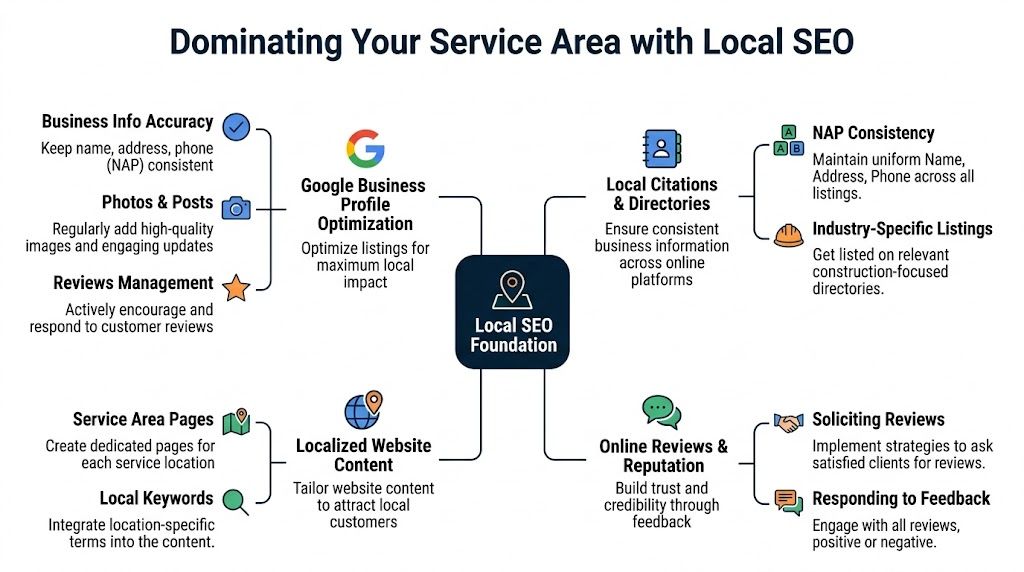
Get your Google Business Profile working properly
A half-finished profile won't do much. A well-managed one can drive calls, map visibility, and trust before someone ever lands on your website. If you want a useful overview of how location-based visibility works, this explainer on the power of Google My Business is worth reading.
Focus on the basics first:
- Choose the right primary category: Be specific. General categories are often too broad.
- Set service areas properly: List the regions you service. Don't stretch into areas you can't support well.
- Write a business description in plain English: State what you do, who you help, and where you work.
- Upload current project photos: Finished projects, in-progress works, team photos, vehicles, and site signage all help.
- Use posts sensibly: Share completed jobs, seasonal service reminders, or project updates without sounding like a press release.
A lot of construction companies claim every possible category and every surrounding suburb. That usually weakens relevance instead of improving it.
Build service area pages that prove local relevance
Service area SEO isn't about churning out suburb pages with swapped place names. Search engines are better than that now, and users can spot thin content immediately.
A strong location page needs local proof. That can include:
- Real project references: Mention the type of work completed in that area
- Practical local detail: Access issues, building styles, site conditions, weather exposure, or council-related considerations
- Specific service fit: Explain why certain services are common in that location
- Visual proof: Images from nearby jobs, if appropriate and approved
For a mobile trade on the Gold Coast, a useful page might mention common roofing issues in coastal suburbs, storm-related repairs, or the practicalities of servicing apartment-heavy areas compared with detached homes inland. That's more credible than repeating “trusted contractor in [suburb]” six times.
Your local page should read like it was written by someone who actually works there.
If you want to tighten this side of your strategy, this guide to local SEO for tradies is a solid reference point.
Citations still matter, but quality matters more
Citations are mentions of your business details across directories and listings. They help validate that your company is real, established, and consistently represented online.
For construction businesses, focus on citations that make sense:
- Core business listings: Major map, directory, and business profile platforms
- Industry associations: Relevant trade and construction directories
- Local business ecosystems: Chambers, regional business listings, and local partnerships
- Supplier or partner mentions: Especially where those pages show your business name and service details clearly
The key is consistency. Your business name, phone number, and service description shouldn't vary all over the web.
Reviews are trust signals, not decoration
Construction reviews carry more weight when they mention the actual service, suburb, and outcome. “Great company” is nice. “Completed our office fitout on time in Southport and communicated well throughout” is far more useful.
A review strategy doesn't need to be complicated:
- Ask after a clear project milestone, not at random.
- Make it easy with a direct link.
- Suggest the client mention the service provided.
- Reply to every review in a professional tone.
Negative reviews need a response too. Not defensive. Not robotic. Just measured, factual, and calm.
What doesn't work in service area SEO
Some local tactics still circulate because they were once common. They're poor bets now.
- Fake office pages: If you don't operate from a location, don't pretend you do.
- Dozens of copied suburb pages: Thin pages dilute trust and create maintenance headaches.
- Keyword-stuffed footer lists: Long chains of suburbs in the footer add little value.
- Generic stock content: Construction buyers want evidence, not filler.
For service-based construction businesses, local SEO works best when the website, profile, reviews, and local references all tell the same story. You do real work in real places, and you've got the digital proof to back it up.
Building a High-Performance Website Structure
If your site gets traffic but doesn't generate calls or quote requests, structure is usually part of the problem. Construction websites often try to say everything on the homepage and end up saying very little well.
A high-performing site should help visitors answer three questions quickly. What do you do. Where do you do it. Why should someone trust you.

The design also needs to support SEO. That's where page hierarchy, internal links, and content layout matter. A useful benchmark is this approach to SEO web page design, which focuses on building pages that work for both search visibility and user action.
Give each core service its own page
This is essential for most construction businesses.
If you offer custom homes, renovations, extensions, kitchen renovations, bathroom renovations, remedial works, roofing, and project management, those shouldn't all live on one generic services page. Each important service deserves its own page with enough depth to rank and convert.
A strong service page should include:
- A clear service headline: State exactly what the page is about
- Who the service is for: Homeowners, developers, strata, commercial clients, body corporate
- The process: Keep it practical and easy to scan
- Proof points: Projects, certifications, materials, suppliers, or team expertise
- A call to action: Quote request, inspection booking, consultation, or phone call
When every service has a distinct page, search engines can match that page to more specific searches. Visitors also land on a page that accurately reflects what they need.
Use project pages as sales assets
Many portfolio sections look nice but do very little for SEO. They show a few photos, maybe a suburb, and no real context.
A better project page includes the type of work, location, scope, constraints, and outcome. It should help a future client think, “They've handled something like my job before.”
Useful project page elements include:
- project type
- suburb or region
- brief scope
- materials or systems used
- challenge solved
- before and after context where appropriate
That doesn't mean publishing confidential details. It means giving enough substance for the page to carry trust.
A gallery without context is decoration. A project page with detail becomes proof.
Navigation should reduce friction
Visitors shouldn't need to hunt for basic information. Keep the main menu tight and predictable.
A good structure often looks like this:
- Home
- Services
- Service Areas
- Projects
- About
- Contact
Some businesses bury core pages under clever labels or oversized menus. That usually hurts usability. Construction buyers don't want to decode branding language. They want answers fast.
A page should also make it easy to move to the next logical step. From a blog post to a service page. From a service page to a project example. From a project page to a quote form.
Later in the process, conversion-focused landing page principles become useful too. This resource on best practices for landing pages that convert covers the sort of clarity and friction reduction that many construction sites need.
Speed and mobile performance aren't optional
A slow site loses attention quickly, especially on mobile. That's where a lot of local construction searches happen, often while someone is between meetings, on-site, or dealing with an urgent issue.
Common website problems include oversized images, clunky sliders, too many plugins, and forms that are painful to use on a phone. Clean that up first. Fancy effects rarely help a contractor win more work.
This short video is a useful reminder of what strong page structure needs to support.
What a construction website should feel like
The best-performing sites don't feel complicated. They feel organised.
Visitors should land on a page and immediately understand the offer, the location coverage, the quality of the work, and how to make contact. If your site feels more like a digital brochure than a working sales tool, structure is where to start fixing it.
Fuelling Growth with Content and AI Optimisation
Content is where many construction businesses either build authority or waste time. The difference usually comes down to purpose.
Publishing generic blog posts about “top renovation trends” or “why quality matters” won't move much. Buyers have seen that material a hundred times before. Search engines have too. Useful content for seo for construction companies needs to answer real questions, support service pages, and give both humans and AI systems enough clarity to trust what they're reading.

The bigger shift is this. A 2025 Australian digital marketing report notes that 68% of B2B construction leads now begin with AI-assisted searches, while only 12% of construction company websites appear in top responses on platforms like Perplexity or Gemini, according to this construction marketing trend report. That gap is where smart operators can gain ground.
If you want to understand the broader answer-engine side of the opportunity, this overview of AI search is a useful companion read.
Create content that supports buying decisions
Most construction content should sit close to the commercial decision, not miles away from it.
The strongest formats are usually:
- Service support articles: Pages that answer pre-sale questions tied directly to a service
- Project case studies: Real examples showing the problem, scope, and outcome
- Location-informed guides: Content that reflects local building conditions or common service needs
- Buyer education pages: Practical explanations of timelines, approvals, materials, or process
For example, a solar installer in Queensland might publish a page about solar integration considerations for certain roof types or local site conditions. A builder might publish content on planning a knockdown rebuild in a specific council area. A commercial contractor could create a guide on preparing for an office fitout tender.
These topics are useful because they help a buyer move forward. They also give search engines more confidence about what your business knows.
Write for the full buying committee
Construction decisions often involve more than one person. Even when the end client is an owner-builder or homeowner, other people influence the decision. Partners, property managers, procurement contacts, architects, engineers, and facility teams all care about different things.
That means one page rarely does every job.
A well-built content system might include:
- a service page for the core offer
- a project page showing a similar job
- an FAQ page covering process questions
- a location page proving regional relevance
- an article answering a technical or planning concern
This is how content starts compounding. Each page supports another page. Each page covers a different part of the decision.
AI tools tend to favour content that is clear, specific, and easy to cite. Vague pages rarely become the answer.
Structure content for answer engines, not just rankings
Optimising for Google is still important. But answer engines read pages differently from how old-school SEO was often done.
If you want your content to be useful in AI search results, write in a format that is easy to interpret. That usually means:
- Clear headings: Use direct question-style and topic-style headings
- Direct answers early: Put the key answer near the top of the section
- Scannable formatting: Lists, short paragraphs, and tightly grouped topics help
- Plain language: Avoid buzzwords and internal jargon where simpler wording works
- Entity clarity: Be explicit about service types, locations, project types, and industries served
A page titled “Our detailed Delivery Philosophy” says almost nothing. A page titled “Commercial Fitout Contractor for Gold Coast Offices” is much clearer to both users and machines.
Build citation-worthy content
This is the part many businesses miss. AI tools don't just reward what is written on your own website. They tend to trust businesses that are consistently described elsewhere as well.
For construction companies, citation-worthy content usually includes:
- Detailed project pages: Useful enough that others might reference them
- Industry commentary: Practical insights tied to regulations, standards, or local conditions
- Supplier collaboration content: Joint features, approved installer pages, or case references
- Association and community mentions: Relevant professional listings and local credibility signals
If your company is mentioned on supplier websites, association directories, local publications, or community pages in a way that aligns with your site, that strengthens trust. It also makes your brand easier for AI systems to validate.
What content usually fails
Some content formats underperform because they look like SEO output instead of business communication.
Common weak points include:
-
Thin location blogs
“Why choose a builder in Brisbane” adds little if it contains no original local insight. -
Keyword-stuffed service pages
Repeating the same phrase over and over doesn't create authority. -
Photo-only case studies
Without context, they're hard for search engines to interpret and hard for buyers to evaluate. -
Trend articles with no link to your services
If the topic doesn't lead naturally toward your actual work, it probably won't drive useful enquiries.
A practical content rhythm for construction businesses
You don't need a huge publishing machine. You need consistency and relevance.
A practical rhythm looks like this:
- improve one core service page
- publish one useful case study
- add one location-relevant page
- answer one recurring sales question in depth
- update older pages with fresh examples and clearer calls to action
That mix builds topical depth without turning your site into a content landfill.
The real opportunity with AI visibility
The rise of AI-assisted search changes what “ranking” means. A buyer may not click through ten blue links anymore. They may ask a platform for recommended contractors, compare options through a summary, or use a chatbot to narrow providers before visiting any website at all.
That changes the goal. Your content shouldn't only try to rank. It should be understandable enough to be summarised, trusted enough to be referenced, and specific enough to be chosen.
For construction businesses in Australia, that's a major opening. Plenty of firms still have decent websites but weak digital depth. If you combine strong service pages, real project proof, local relevance, and answer-friendly content, you put yourself in a much better position than businesses still relying on generic local SEO playbooks from years ago.
Measuring What Matters and Future-Proofing Your SEO
Most SEO reports are too busy to be useful. They bury the key question under charts and keyword lists. Are you getting more qualified enquiries from the work you're paying for or not?
For construction businesses, the most useful metrics are usually simple. Phone calls from your business profile. Quote form submissions. Enquiries tied to specific service pages. Contact volume from the locations you want to service. That's the data that links SEO to pipeline.
Ignore vanity metrics when they don't help decisions
Traffic on its own can be misleading. A page might attract visitors and still produce no work. A ranking report might look impressive while the phone stays quiet.
Watch these instead:
- Lead source quality: Which pages bring real enquiries
- Service-page performance: Which offers attract the strongest demand
- Location relevance: Whether the right suburbs or regions are producing leads
- Call and form activity: Whether people are taking action, not just browsing
If a page ranks but sends poor-fit leads, that page needs work. If another page gets fewer visits but better quote requests, that page is more valuable.
Good SEO reporting should help you decide what to improve next. If it doesn't, it's noise.
Future-proofing comes from clarity and maintenance
The safest SEO strategy isn't the cleverest one. It's the clearest one.
Search platforms keep changing. AI summaries are changing discovery habits. Local results change. Competitors improve. Through all of that, the businesses that hold up best usually have the same traits. Clear service pages, reliable local signals, strong project proof, useful content, and a site that's easy to use.
A practical review cycle helps:
- Check which pages generate enquiries.
- Improve weak pages before creating new ones.
- Add fresh project proof regularly.
- Update location and service information when the business changes.
- Review how your business appears across search, map listings, and AI-generated answers.
That approach keeps your SEO grounded in business outcomes, not dashboard theatre.
Frequently Asked Questions About Construction SEO
How long does SEO for construction companies take to work
It depends on your starting point. A strong website with clear service pages and decent local signals can improve faster than a messy site with duplicated content and weak structure. In practice, SEO works best when you treat it as an ongoing asset, not a short campaign.
Should I do SEO myself or hire an agency
You can handle parts of it yourself if you've got time, discipline, and someone in the business who can keep content and site updates moving. That usually works best for basics like project uploads, review requests, and keeping service information current.
An agency becomes useful when technical issues, strategy, content planning, and performance tracking start eating into the time you need to run jobs. The trade-off is simple. DIY saves budget but costs time and often slows execution. Professional support costs more but can remove bottlenecks and reduce guesswork.
Does social media help with SEO
Not in the direct, simplistic way many people assume. Social media is better treated as support. It can help distribute project content, reinforce credibility, and keep your brand visible, but your website still needs to do the heavy lifting for search.
Do I need a separate page for every suburb I service
No. Only create location pages where you can add genuine local relevance and useful detail. Thin suburb pages usually become clutter. Strong regional or service area pages with real proof are often the better option.
What's the most common SEO mistake construction businesses make
Trying to rank for everything at once. That leads to vague service pages, weak location targeting, and content that doesn't match how buyers search. A tighter strategy usually performs better.
If your construction business needs a clearer SEO strategy, a stronger website, or better visibility in both Google and AI-driven search, Titan Blue Australia can help. With deep experience across SEO, website design, content, and answer engine optimisation, the team builds practical digital strategies that help Australian businesses turn online visibility into real project leads.
Make Titan Blue a preferred source in Google
One click tells Google to surface our articles more often in Top Stories, AI Overviews and AI Mode.

How to Make Your Website AI Friendly: The 2026 Step-by-Step Guide
How to make your website AI friendly: a step-by-step 2026 guide to getting crawled, structured…

Web Design for AI Search Optimisation: The 2026 Build Guide
Web design for AI search optimisation: crawlable HTML, clear architecture, accessible UX and trustworthy content…

AEO Web Design: How to Build Websites AI Can Cite
AEO web design creates websites that AI systems can find, understand and cite through clear…