

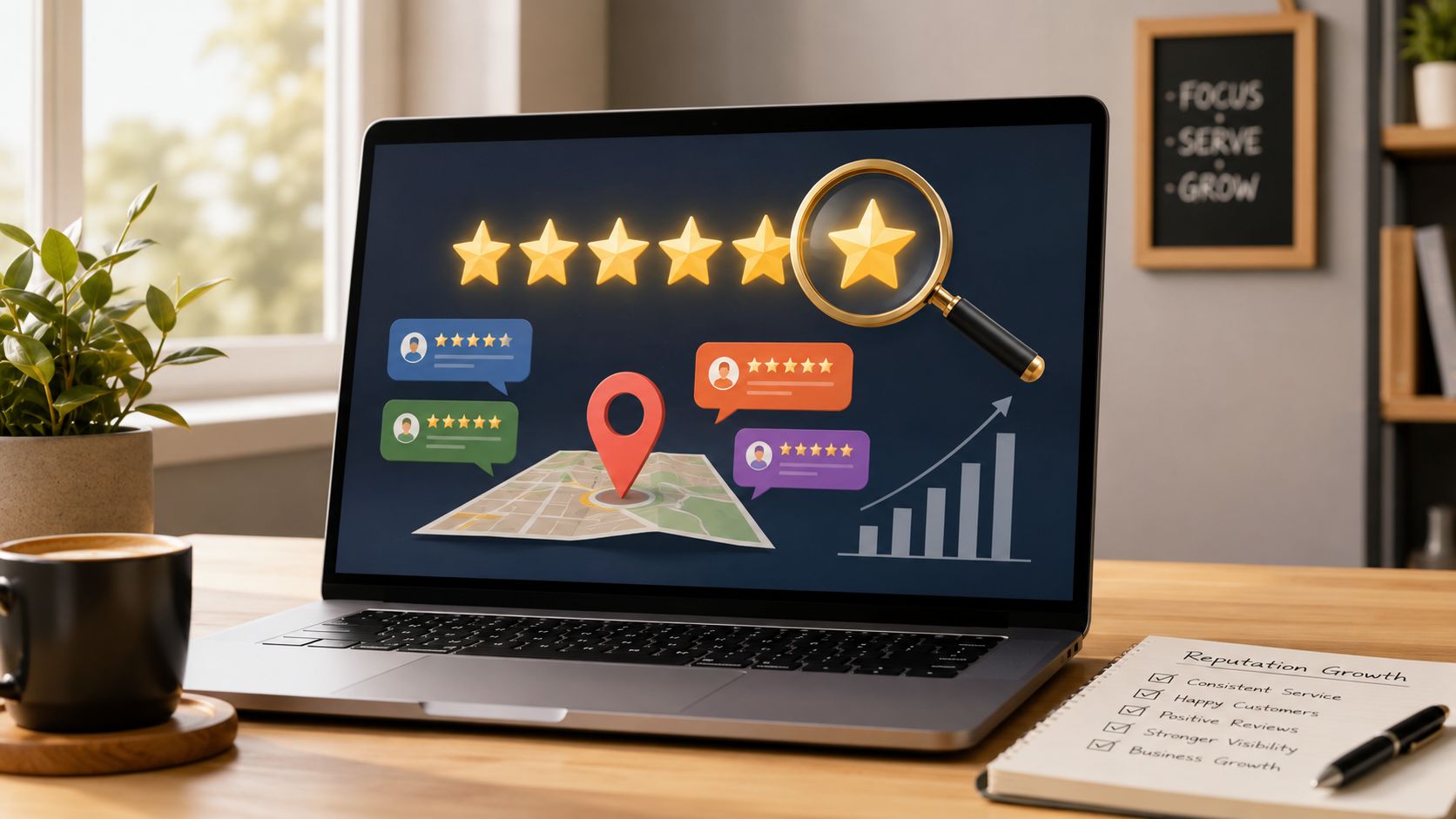
A customer searches your business name on their phone. They see your Google Business Profile, a few reviews, maybe a Facebook page, maybe a directory listing you forgot about years ago. They haven't called yet. They haven't visited your website. But they've already started deciding whether you're trustworthy.
That moment is where reputation management online now lives.
For a local business, this isn't a side task for the marketing team when they get a spare hour. It affects whether someone taps “call”, asks for a quote, books a table, or moves on to the next option. If you run a restaurant, plumbing business, motel, construction company, or trade service, your reputation is being judged in search results, on maps, inside review platforms, and increasingly inside AI-generated answers.
What Online Reputation Is and Why It Matters Now
A homeowner in Brisbane searches for an emergency plumber at 7:10 pm. They do not open a spreadsheet and compare quotes. They scan the map pack, glance at review recency, notice whether the business has replied to complaints, and make a fast trust call. That decision often happens before your website loads.
Online reputation is the total picture people form from those signals. It includes reviews, star ratings, public responses, directory accuracy, social comments, photos, branded search results, and any third-party mention that appears when someone checks whether your business looks credible.
For Australian SMBs, that picture now affects more than clicks. It shapes who calls, who asks for a quote, and who drops out before contact. It also feeds the systems deciding what to show next. Search engines use reputation signals in local visibility. AI search products increasingly pull from review language, business profiles, and third-party mentions to summarise businesses for searchers who may never visit your site.
Reputation is now an operating issue, not a cleanup task
A lot of business owners still treat reputation as a bad-review problem. In practice, it is a trust system. If your Google Business Profile is half-complete, your trading hours conflict across directories, and your last review is old, people read that as risk.
The commercial impact is straightforward. Strong reputation signals reduce hesitation. Weak ones make every lead harder to win.
In Australia, there is also a legal line to respect. The ACCC has warned businesses not to mislead consumers through manipulated or selective review practices, and online reviews can materially influence buying decisions under Australian Consumer Law, as noted in this Australian online reviews and small business analysis. Asking for reviews is fine. Gating reviews, posting fake feedback, or suppressing legitimate criticism creates risk you do not need.
Practical rule: If your review process would look questionable in an ACCC complaint, change the process.
Why the pressure is higher for local businesses
Large brands can survive a patchy profile because they already have broad recognition. A local business usually does not get that buffer. A prospect may compare only three operators. In that shortlist, reputation does real sales work.
Recent, believable reviews help. So do thoughtful responses, accurate listings, and visible signs that the business is active and well run. A neglected profile sends the opposite message, even when the actual service is good.
That is why I treat reputation as part of acquisition, not just brand image. If you want a quick primer on the commercial side, this article on why customer reviews matter for business growth is a useful companion to the wider strategy.
What has changed in the last few years
The old pattern was simpler. Rank, get the click, convert the visitor.
Now the evaluation happens across Google Business Profile, Maps, review platforms, local directories, social pages, and AI-generated summaries. Many searchers decide from those surfaces alone. For Australian SMBs, that means reputation management is no longer separate from SEO, compliance, or local lead generation. It sits inside all three.
The Core Pillars of a Strong Online Reputation
A strong online reputation isn't built from one heroic response to one bad review. It comes from a system. When that system is missing, businesses swing between neglect and panic.
Think of it as a hub-and-spoke model. Your brand sits in the middle. Around it are the functions that keep trust stable even when reviews, staffing, seasonality, or platform changes put pressure on the business.
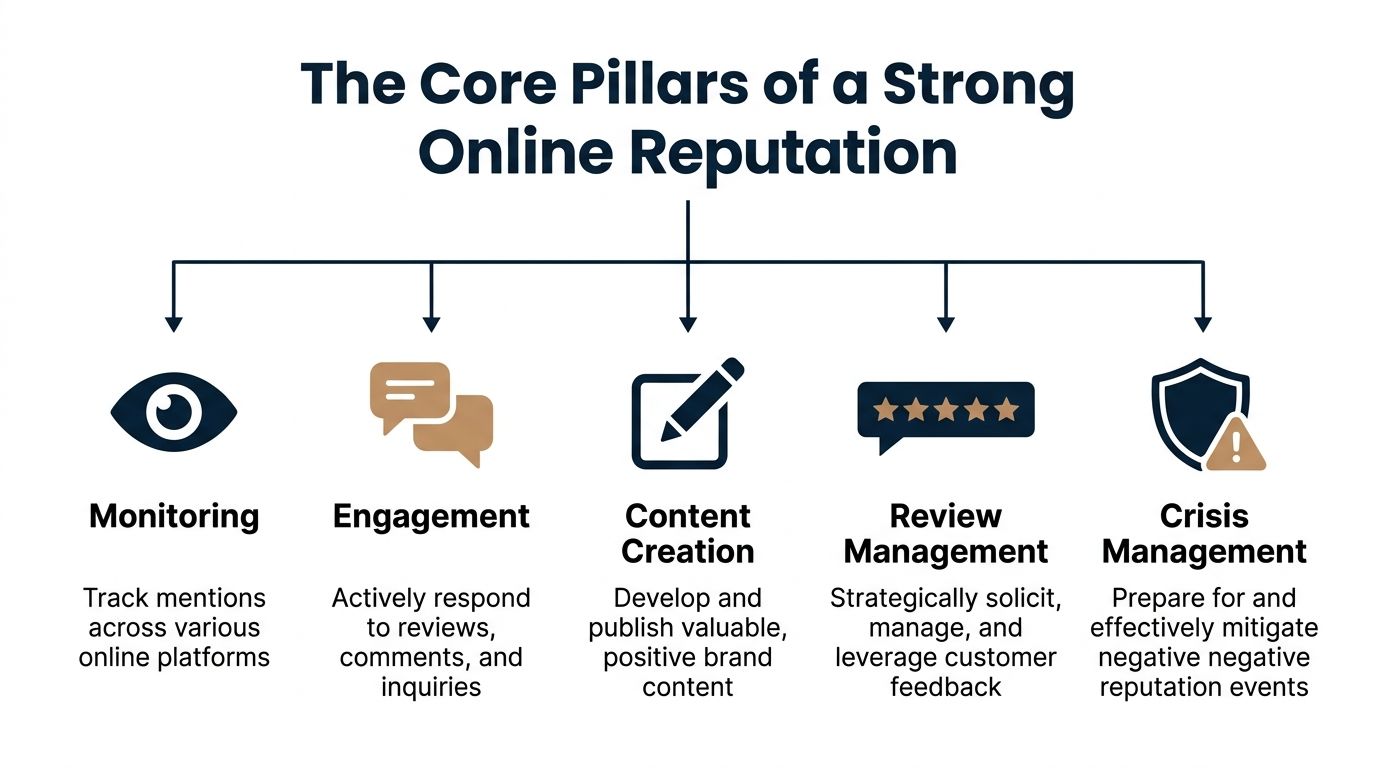
Monitoring
If you don't know what's being said, you're already late. Monitoring means checking where people encounter your business, not just waiting for an email from one platform.
For most SMEs, that includes branded Google searches, Google Business Profile, Facebook, key directories, and any industry-specific review sites your customers use.
Engagement
This is the visible behaviour side of reputation. Public replies matter because they show how the business behaves under pressure. A calm, specific response can soften a complaint. A defensive or generic one can make a mild issue look worse.
A business doesn't need witty responses. It needs consistent ones.
Most customers don't expect perfection. They expect signs that someone competent is paying attention.
Content and narrative control
You can't stop people talking about your business. You can make sure your own channels clearly explain who you are, what you do, where you operate, and what customers can expect.
That includes your website, service pages, FAQs, photos, case examples, and social profiles. When these are weak, third-party comments carry more weight because there's nothing solid to balance them.
Review management
This pillar is different from engagement. Engagement is replying. Review management is building a repeatable process for requesting, routing, responding to, and learning from feedback.
It should answer practical questions like:
- When do we ask for a review
- Which customers get asked
- Which platform matters most for our category
- Who responds if a review raises a service issue
- How do we feed recurring complaints back into operations
Crisis preparation
Most local businesses don't need a glossy crisis manual. They do need a basic playbook for the day a serious complaint, false claim, staff incident, or social post starts gaining traction.
A workable playbook usually covers:
- Who checks alerts first
- Who is allowed to reply publicly
- When legal or privacy concerns stop a public discussion
- What gets moved offline
- How fast the team must act
The point isn't to overbuild. It's to avoid improvising in a bad moment.
Mastering Review Monitoring and Response
The biggest review mistake isn't getting a negative review. It's responding emotionally, slowly, or not at all.
Busy owners often read a harsh comment, feel the review is unfair, and either fire back or ignore it for days. Both choices cost trust. Searchers don't know what happened behind the scenes. They only see whether the business looks reasonable and responsive in public.
Where to monitor without overcomplicating it
A practical stack for an Australian SME starts with Google Business Profile, key industry directories, and social media. Xero's guidance also notes the value of a response protocol, and highlights that faster responses can reduce the impact of negative sentiment because searchers often treat owner engagement as a sign of trustworthiness and operational reliability in local discovery, especially for multi-location businesses, as outlined in this guide to online reputation management for small business.
For most local operators, a simple routine works:
- Weekly check of Google Business Profile for new reviews and questions
- Monthly branded search to see what appears on page one
- Notifications turned on for major review and social platforms
- Shared inbox or assigned owner so nobody assumes someone else replied
If you've got more than one location, don't let each staff member improvise. That's how tone drifts and small problems become inconsistent public records.
How to answer positive reviews
Positive reviews deserve responses because they reinforce the customer experience and show future buyers that feedback gets noticed.
A good reply usually has three parts:
- Acknowledge the customer by name if appropriate
- Reference something specific they mentioned
- Close warmly without sounding scripted
Example structure:
- Thank them for the feedback
- Name the service or experience they referred to
- Invite them back or say you appreciate the support
Short is fine. Generic isn't.
How to answer negative reviews without making it worse
You don't need to win the argument. You need to show control.
Use this structure:
- Acknowledge the concern
- Avoid debating facts in public
- Offer an offline path to resolve it
- Keep private details out of the reply
- Stay measured even if the review feels unfair
Here's the kind of wording that works:
We're sorry to hear this was your experience. We take feedback like this seriously and would like to look into it properly. Please contact our team directly so we can review what happened and help.
That does three things. It signals professionalism, avoids admissions you may regret, and moves the conversation into a channel where the issue can be resolved.
If you need practical examples for hard situations, this guide to managing negative comments and reviews online covers the tone and process local teams can adapt.
What not to do
Avoid these common errors:
- Don't accuse the reviewer publicly of lying unless you've taken proper advice
- Don't reveal customer details to defend yourself
- Don't copy-paste the same apology under every complaint
- Don't leave old negative reviews unanswered for months
- Don't ask junior staff to “just reply nicely” without a script
A response protocol sounds formal, but for small businesses it's just a short set of approved patterns. That saves time and lowers risk.
How to Proactively Build Your 5-Star Reputation
The businesses with the strongest review profiles usually aren't luckier. They're more systematic.
Waiting for reviews to arrive naturally is like waiting for invoices to send themselves. It can happen, but it won't happen often enough, and it won't happen consistently enough to support growth. Review requests should sit inside the customer journey as a normal operational step.
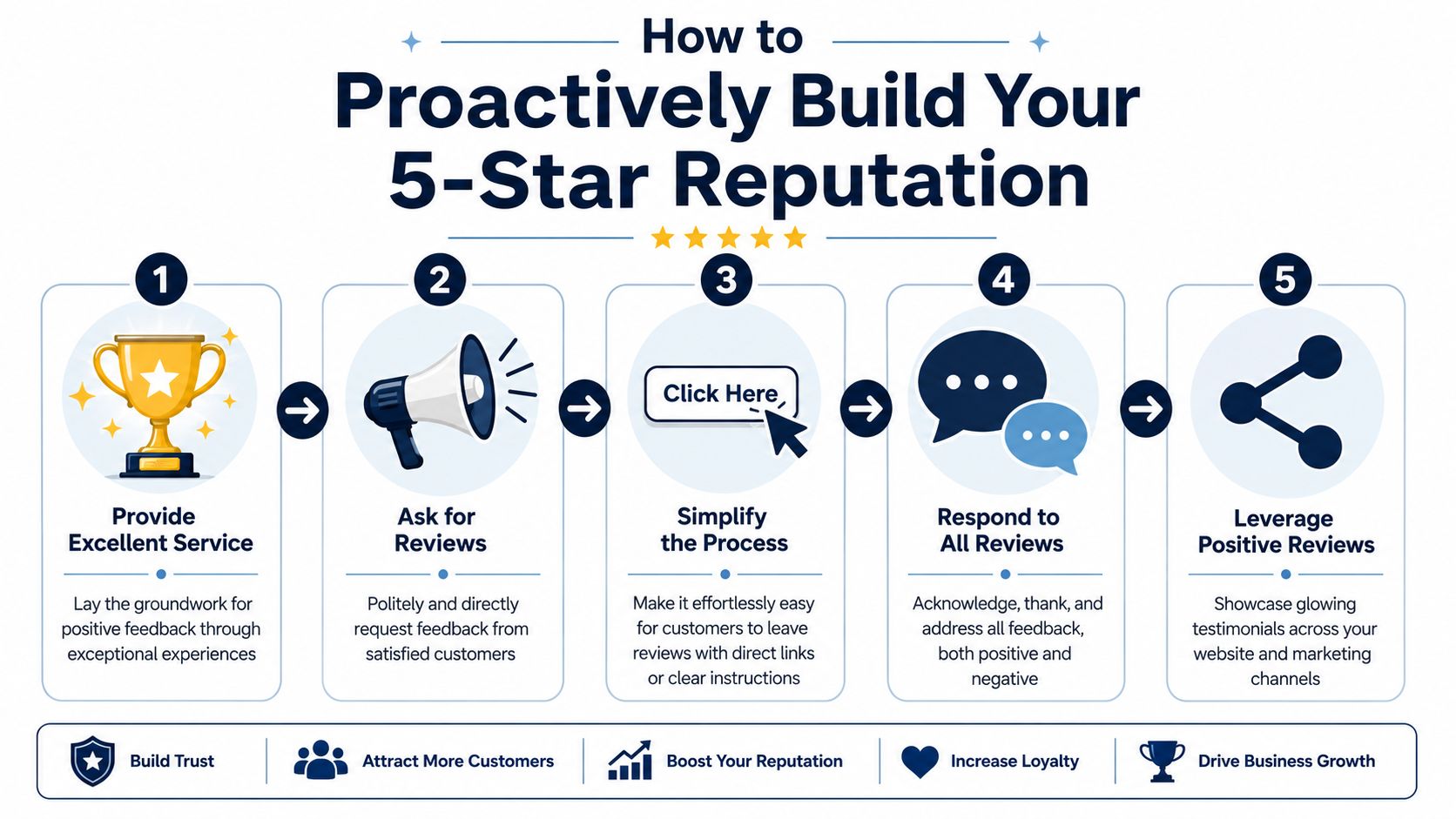
Treat review requests like part of the job closeout
ReviewTrackers recommends claiming core listings first, then actively requesting reviews through email, SMS, or POS-triggered workflows so feedback becomes a repeatable loop rather than passive chance. The same source notes that 54% of consumers trust online reviews above personal recommendations and company claims, which is why fresh reviews can affect lead quality and sales velocity. You can read that in this small business reputation management guide.
That's the key mindset shift. Asking for reviews isn't begging for praise. It's collecting proof of delivery.
For a plumber, the trigger might be job completion.
For a restaurant, it might be a follow-up after a booking.
For a motel, it could be after checkout.
For a retailer, it might be a POS or email sequence after purchase.
What works better than vague review chasing
Businesses often say, “We should get more reviews,” but there's no process behind it. That leads to random staff asking at random times.
A better setup looks like this:
- Claim your main profiles first so customers land on the right destination
- Choose one primary review platform for your category, usually where local buyers already look
- Automate the request by SMS, email, or POS workflow after a completed service
- Keep the ask simple with a direct review link
- Route internal complaints to someone who can fix the issue before it repeats
A review system should feel as routine as sending an invoice or booking confirmation.
What doesn't work
A few habits backfire fast:
- Only asking your happiest long-term customers creates an unrealistic profile and can leave fresh sentiment too thin
- Offering incentives for positive reviews creates compliance risk and trust problems
- Sending long, overexplained emails reduces action
- Asking too late means the emotional memory of good service has faded
- Letting staff decide ad hoc usually means nobody asks consistently
Keep it ethical and useful
The best review generation process does more than collect stars. It also creates operational feedback. If customers keep mentioning unclear pricing, late arrival windows, or slow handover, that's not a reputation problem first. It's an operations problem showing up in public.
That's why I prefer review workflows that connect to the business, not just the marketing stack. If negative feedback can be tagged, passed to the right person, and tracked for patterns, reputation management online starts improving the service itself.
Aligning Your Reputation for SEO and AI Search
A strong reputation no longer helps only after someone finds you. It helps determine whether you get surfaced at all.
Search engines and AI systems look for consistent trust signals. They don't think like humans, but they do assemble a picture of your business from repeated patterns across the web. If your reviews, business details, service descriptions, and third-party mentions line up, you're easier to interpret. If they conflict, your credibility weakens.
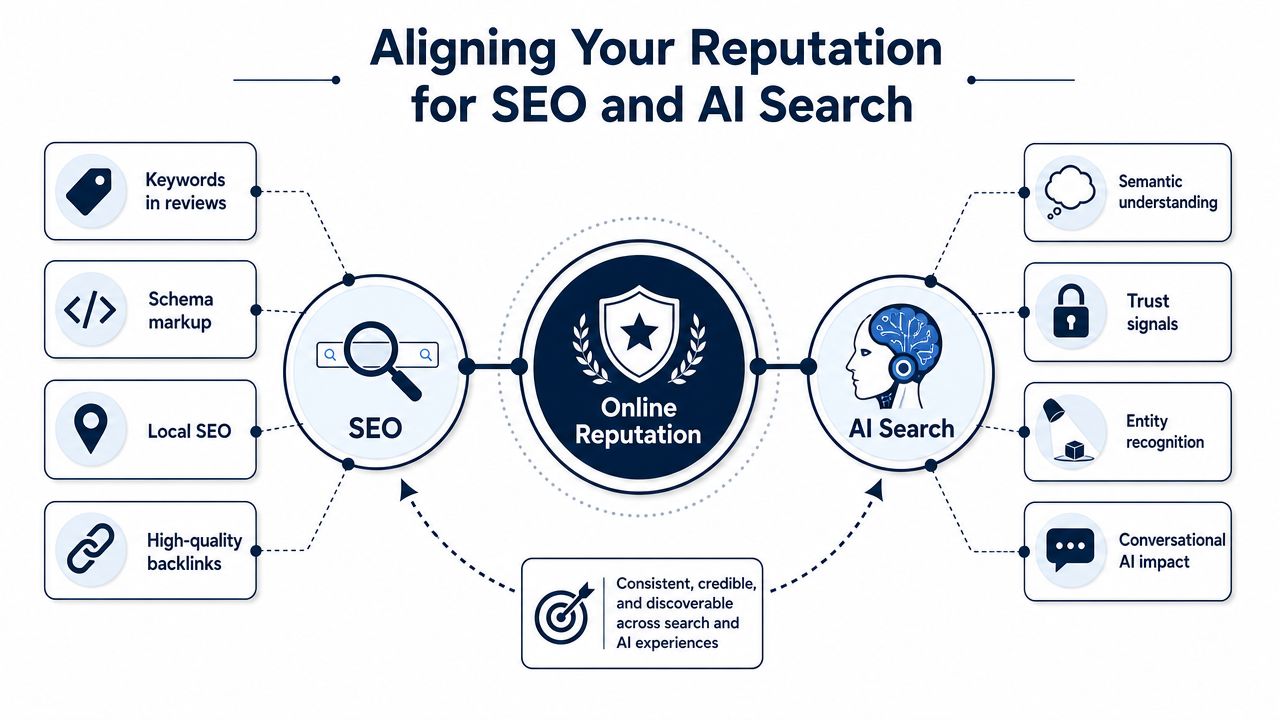
Why consistency matters more now
One of the least understood shifts in local marketing is that users may never click through to your website. AI search can summarise a business before the searcher visits any owned page.
That's why machine-readable consistency matters. As explained in this analysis of AI search and online reputation, many guides still miss the question of how a brand is discussed inside AI search, where users may not click through at all. For Australian SMEs in trades and hospitality, reputation signals from your website, Google Business Profile, and third-party reviews need to be consistent and machine-readable if you want to be surfaced as a trusted local provider.
What to tighten up first
If you want your reputation to help both SEO and AI discovery, clean up these areas:
-
Business identity consistency
Make sure your business name, address, phone number, and service areas are written consistently across your website, Google Business Profile, Facebook, and directories. -
Service language alignment
If customers describe you as “emergency plumber”, “same-day solar repairs”, or “family-friendly motel”, your website and profiles should reflect that language where accurate. -
Complete profiles
Empty categories, outdated hours, and missing descriptions create ambiguity. Machines handle ambiguity badly. -
Review relevance
Reviews that mention actual services, suburbs, and customer experiences help search systems connect your business to local intent.
The link between reviews and discoverability
When a review says “quick hot water repair in Broadbeach” or “helpful staff for late check-in”, that language becomes more than praise. It becomes context. It helps external systems understand what you do, where you do it, and why people trust you.
That doesn't mean scripting customers. It means making it easy for real experiences to be documented clearly.
If you're working on visibility in AI answer engines as well as Google, this resource on how to get cited by Chat GPT is a useful companion to traditional local SEO work.
Search used to reward relevance and authority. AI search leans hard on clarity, consistency, and trust signals spread across multiple sources.
What businesses get wrong
The common mistake is treating reviews as isolated marketing assets. They're not. They're part of your data footprint. If your website says one thing, your Google profile says another, and your reviews mention services or suburbs you never reference anywhere else, your digital identity becomes fragmented.
That fragmentation doesn't always show up as a dramatic penalty. More often, it subtly reduces confidence in your business as a recommended local option.
Reputation Management in Action for Local Businesses
The theory matters, but local owners usually want to know what this looks like in practice. Not a glossy case study with inflated numbers. Just ordinary business problems handled properly.
A restaurant dealing with slow-service reviews
A Gold Coast restaurant starts getting public comments about slow service on busy nights. The mistake would be replying with excuses about staffing or peak-hour demand.
The smarter move is to acknowledge the delay, thank the reviewer, and confirm the feedback is being reviewed. Then the owner checks whether the same complaint appears across Google, Facebook, and booking-platform comments. When it does, the issue shifts from “reputation problem” to “service bottleneck”.
The public response stays short. The internal response changes rostering, booking spacing, and front-of-house communication.
A plumber trying to stand out in a crowded suburb
A local plumber has solid service quality but weak visibility. Reviews are sparse, the Google Business Profile is thin, and the website doesn't mirror the language customers use when they need urgent help.
So the business builds a post-job SMS review request, updates service pages to match real customer intent, and asks technicians to flag jobs where the customer was clearly happy. The result isn't just a nicer profile. It's a clearer signal in search.
That's where reputation work overlaps with broader digital marketing for local business. The businesses that win locally usually don't separate trust signals from visibility signals. They treat them as the same job.
A small motel aiming for more direct bookings
A family-owned motel has decent occupancy but too much dependence on third-party booking platforms. Guests leave positive feedback there, but the motel's own channels don't reflect the same trust.
The practical fix is simple. Ask recent guests for reviews on the profile that influences direct search behaviour, respond to every new review with a human voice, and bring approved testimonials onto the website. Then make sure location details, room information, and booking policies are consistent everywhere.
For local visibility, that work pairs naturally with local SEO for small businesses. A cleaner reputation helps search performance. Better search performance brings in customers who are already pre-sold on trust.
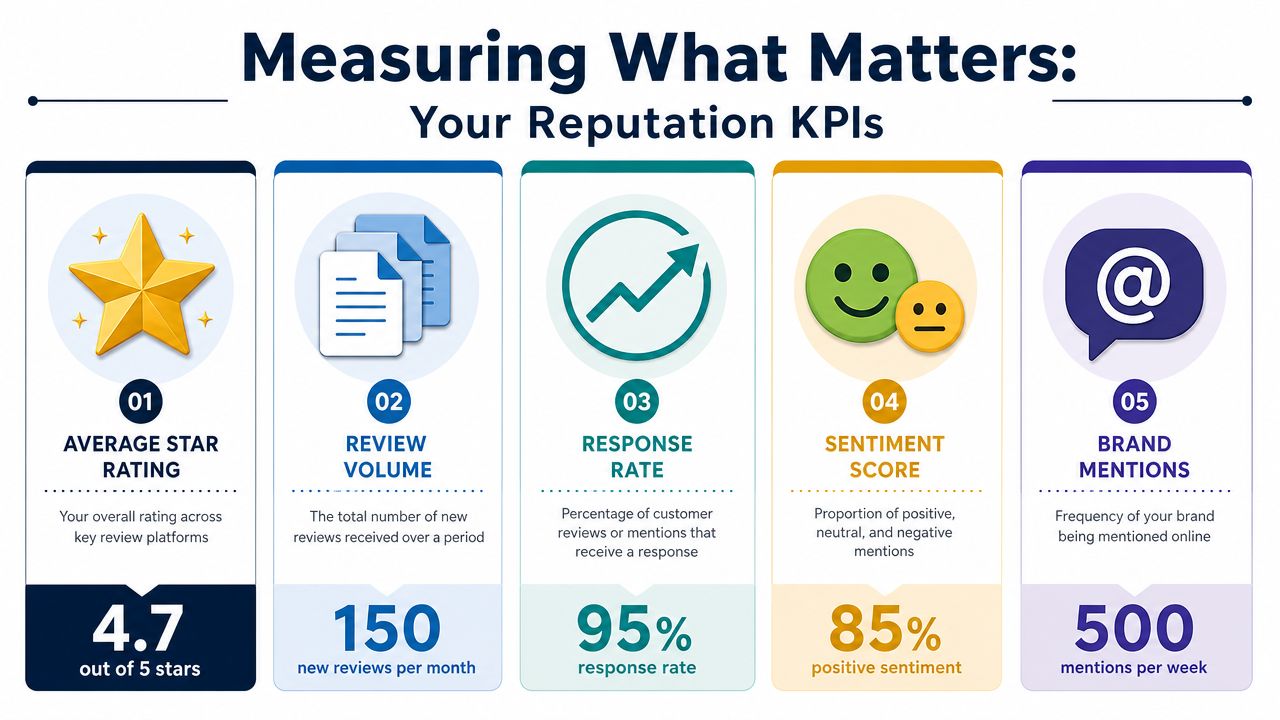
Measuring What Matters Your Reputation KPIs
If you only watch your average star rating, you'll miss the business impact.
A useful reputation dashboard should tell you whether trust is improving and whether that improvement is affecting enquiries, calls, and conversions. It doesn't need to be complicated. It needs to be tied to actions you can control.
The KPIs worth tracking
Start with a short list:
-
Review freshness
Check whether new reviews are arriving regularly or whether the profile looks stale. -
Response rate and response speed
Measure whether your team is replying consistently and within your internal standard. -
Sentiment themes
Track recurring words and issues in reviews. Pricing clarity, punctuality, cleanliness, communication, and wait time often reveal more than the score itself. -
Business actions from profile visibility
Watch calls, direction requests, booking clicks, or quote enquiries that originate from high-intent discovery points.
How to track this without enterprise software
Google Business Profile gives useful behavioural signals. Your website analytics can show traffic from profile links and review sites. A basic spreadsheet can track review dates, review themes, response dates, and issue categories.
If you want a better handle on which site metrics matter, this guide to top Google Analytics metrics helps keep reporting focused.
What good measurement changes
Once you track the right things, reputation management online stops being fuzzy. You can see whether:
- fresh reviews coincide with stronger lead flow
- response gaps appear when staff are overloaded
- negative feedback clusters around one team, service, or location
- certain complaints keep repeating because the root problem hasn't been fixed
That's the payoff. Good reputation management doesn't just improve optics. It gives you a clearer operating picture of the business.
Titan Blue Australia works with businesses that need stronger visibility, clearer trust signals, and a practical approach to search, reviews, and AI discovery. If you want help building a reputation system that's organised, compliant, and aligned with how customers now find local providers, you can explore Titan Blue Australia.
Make Titan Blue a preferred source in Google
One click tells Google to surface our articles more often in Top Stories, AI Overviews and AI Mode.

Future Proof Website Design Australia: 2026 Guide
Future proof website design Australia means modular architecture, schema and AEO built in from day…

Web Design for Google AI Overviews: The 2026 Guide
How web design earns Google AI Overview citations in 2026: answer-first structure, schema, tables and…

Web Design for ChatGPT Visibility: The 2026 Guide
What makes a website visible in ChatGPT answers: crawler access, structured data, and answer-first content.…