


You're probably in one of these situations right now. The website exists. The Facebook or Instagram page gets the occasional update. Someone set up Google Ads at some point. You've got enquiries coming in, but not consistently, and no one can tell you with confidence why one month is solid and the next is flat.
That's where most small businesses in trades, hospitality, construction, and local services get stuck. They've gone digital in pieces. A website here. A booking tool there. A few social posts. Maybe a CRM that only one person uses properly. It feels like progress, but it doesn't behave like a system.
A digital business strategy fixes that. It gives the business one clear plan for how customers find you, how they choose you, how your team handles the lead or booking, and how you measure whether the whole thing is producing profit instead of noise.
Going Digital Is Not a Strategy
A lot of owners think they've got a strategy because they've got digital assets. That's not the same thing.
A website is an asset. A Google Business Profile is an asset. Social pages, email software, online ads, booking tools, quoting forms, review platforms. They're all assets. But if they aren't connected to a business goal, they're just separate tools sitting in the ute.
That's the core difference. Going digital means you've added channels. Having a digital business strategy means those channels work together to produce a commercial outcome.
According to the Australian Bureau of Statistics, Australian businesses spent A$14.8 billion on selected digital activities in 2021–22, and 93% used the internet for business purposes, as cited in this summary of ABS digital activity data. The practical takeaway isn't that being online is special anymore. It isn't. The advantage comes from using digital better than the next operator.
What disconnected digital looks like
For a local business, it usually looks like this:
- Leads leak between channels because the website form goes to one inbox, Facebook messages go to another, and phone calls aren't tracked against campaign activity.
- Marketing decisions get made on gut feel because no one knows whether SEO, paid ads, social, or repeat customers are driving the work.
- Customer experience feels inconsistent because the ad says one thing, the website says another, and the staff handling enquiries aren't briefed on either.
Practical rule: If you can't explain how a stranger goes from search to sale in your business, you don't have a strategy yet.
A proper strategy turns your digital presence into one joined-up process. It starts with the business goal, not the tool. More bookings. Better quality quote requests. Faster lead handling. Higher-value jobs. More repeat diners. Fewer no-shows.
If you're still treating your website and social channels as separate jobs, it helps to first understand your digital presence as a whole business asset. That shift in thinking is where useful strategy starts.
What Digital Business Strategy Really Means
The easiest way to explain what digital business strategy is comes from the trades. You wouldn't build a house by buying timber, pipes, tiles, and power tools, then hoping they somehow become a finished project. You'd start with a plan. The plan tells everyone what's being built, what order things happen in, and how each part supports the final result.
Digital business strategy works the same way.
Your website, CRM, booking system, social channels, ad account, review profile, email platform, and reporting tools are the materials. The strategy is the blueprint that decides how they fit together and what job each one is meant to do.
It answers the questions that matter
A useful strategy answers practical questions like:
- Who are we trying to win? Not “everyone in Queensland”, but specific customer types.
- What action do we want them to take? Call, book, request a quote, visit, enquire.
- What path should they follow? Search result to service page to form. Instagram to menu page to booking tool. Google Business Profile to phone call.
- What tools support that path? Website pages, local SEO, booking software, CRM, paid ads, email automation.
- How will we know it's working? Better lead quality, more completed bookings, faster response, stronger conversion from visit to enquiry.
That last point matters more than most businesses realise. A strategy isn't a glossy PDF that gets made once and forgotten. It's an operating logic. It tells you what to prioritise, what to ignore, and what to improve next.
What it looks like in practice
Take a restaurant. The strategy might be built around filling quieter nights, improving direct bookings, and reducing dependence on third-party platforms. That changes the digital setup. Menu pages need to be easy to find. Booking friction needs to be low. Google Business Profile information needs to be complete. Social content needs to support demand at the right times, not just look active.
For a plumber, the strategy might focus on urgent local search visibility, fast call handling, suburb-specific service pages, and a quoting workflow that doesn't leave leads sitting overnight.
Strategy is the part that decides what the business is trying to make happen online. Marketing is only useful when it follows that decision.
If you want the short version, here it is. Digital business strategy is the plan that links business goals, customer behaviour, digital channels, and internal operations into one measurable system. That's why it sits above marketing, design, and software choices. It tells each of them what their job is.
Why Your Australian Business Needs a Strategy Now
This isn't just about keeping up with trends. In Australia, digital capability has become part of how businesses compete.
The Australian Government's Digital Economy Strategy set a goal for Australia to become a top 10 digital economy and digital government by 2030, and estimated the digital economy could contribute up to A$315 billion a year to GDP by 2030 if delivered effectively, as noted in this overview of the Digital Economy Strategy. That matters because it moved digital out of the “nice to have” bucket and into the core growth conversation.
For a small business owner, that doesn't mean you need to become a tech company. It means customers already expect digital convenience, digital clarity, and digital trust.
The pressure is local, not just national
A café on the Gold Coast doesn't compete with “the internet”. It competes with the other venues a customer can compare in a few minutes. A solar installer doesn't compete with every installer in Australia. They compete with the businesses that show up clearly in the areas they service and answer buyer questions better.
That's why a strategy matters now. Without one, businesses tend to overspend on activity and underspend on fundamentals.
Common examples include:
- Running ads before fixing the website and paying to send traffic into a weak conversion path.
- Posting constantly on social media while local search visibility stays poor.
- Buying software too early without changing the workflow around it.
- Chasing reach when the actual issue is slow lead response or poor service-page clarity.
What a strategy protects you from
Good strategy gives small businesses something bigger operators already have. Direction.
It helps you decide where digital improves the business. In a trade business, that may be lead routing, suburb targeting, and mobile-first service pages. In hospitality, it may be direct bookings, event visibility, and repeat customer communication.
Most wasted digital spend comes from solving the wrong problem. Businesses buy exposure when the real fix is conversion, clarity, or follow-up.
The businesses that do well in this environment usually aren't doing everything. They're doing the right sequence of things. They know which channels deserve investment, which customer journeys need work, and which digital tasks are just busywork dressed up as strategy.
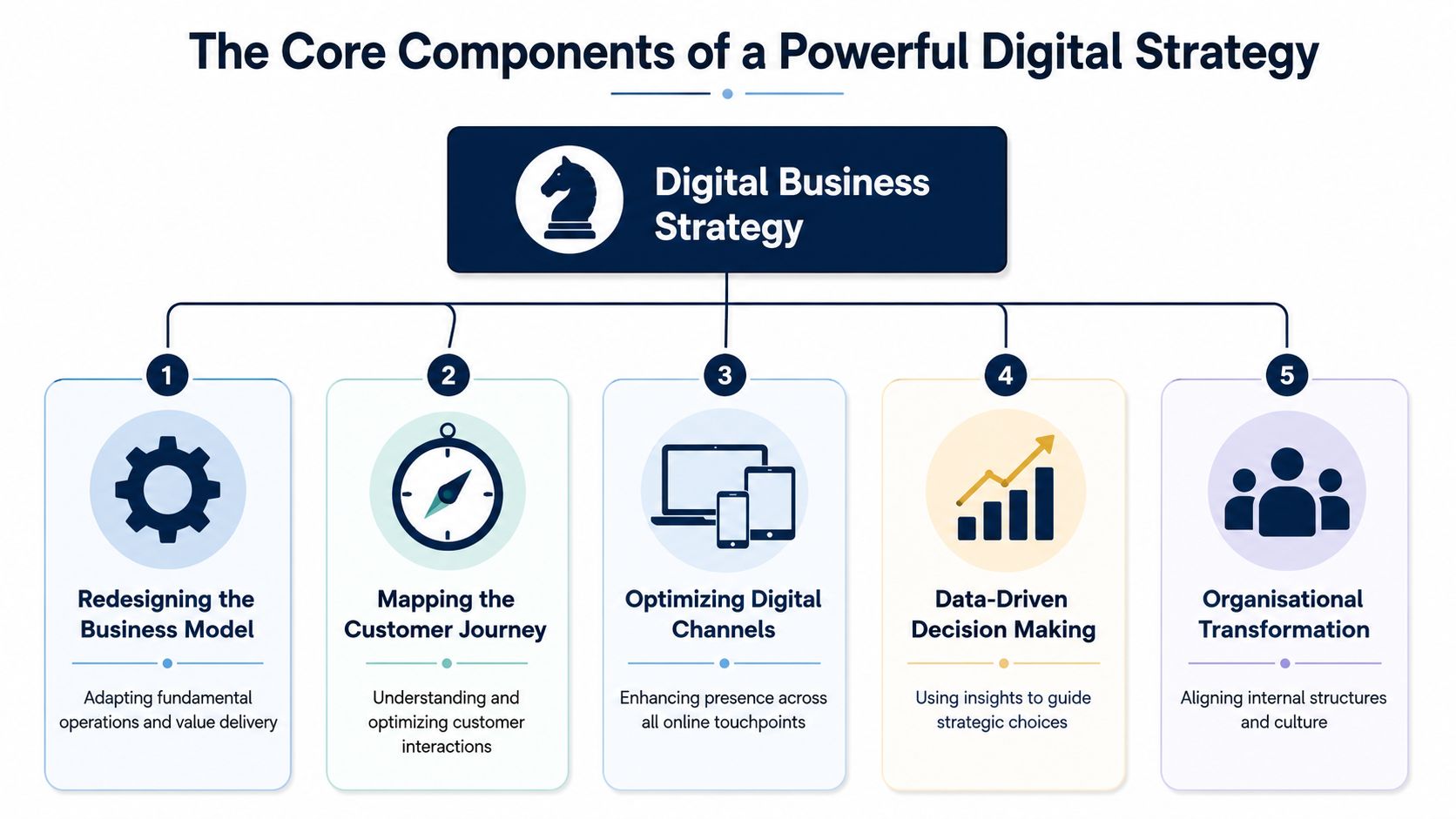
The Core Components of a Powerful Strategy
A strong strategy isn't one idea. It's a set of connected decisions. If even one part is weak, the rest works harder than it should.
In Australia in 2023–24, 51% of businesses used at least one form of social media and 44% used cloud computing, as summarised in this guide to digital business transformation strategy. Those tools only become valuable when the business integrates them properly and uses the data they generate to make decisions.
Business model and customer journey
Start here, because many SMEs often skip this step and create difficulties.
- Business model design means deciding how digital changes the way you deliver value. A restaurant might push direct online bookings and event enquiries instead of relying too heavily on walk-ins. A trade business might use online triage forms to separate urgent jobs from quote-based work.
- Customer journey mapping means working out each step from discovery to decision. For a builder, that could be Google search, project gallery, service page, enquiry form, consultation call. For a venue, it could be Instagram reel, menu page, booking page, confirmation email.
If the journey is clunky, no amount of marketing polish fixes it.
Channels, data, and technology
Businesses often buy too much or buy the wrong thing.
- Digital channel selection means picking the channels that match buyer behaviour. Search matters for intent. Social matters for proof and recall. Email matters for repeat business. Not every channel deserves equal energy.
- Data and measurement means tracking what leads to real outcomes. Not vanity metrics. Real ones. Calls, bookings, quote requests, repeat visits, lead quality.
- Technology stack means choosing tools that support the workflow. Website CMS, CRM, booking software, ad platforms, analytics, review management. Each tool should reduce friction, not add admin.
A local business doesn't need a flashy stack. It needs a sensible one.
Governance and internal alignment
This is the least glamorous part, but it's often the difference between a strategy that works and one that dies in a folder.
- Governance means assigning responsibility. Who updates service pages? Who follows up leads? Who checks reports? Who owns the booking funnel?
- Internal alignment means the front desk, sales team, manager, and marketing support aren't pulling in different directions.
A strategy fails when the website says “book now” but the team treats online leads like a side job.
If you're building these pieces together, a combined approach to web design and SEO marketing often makes more sense than treating site performance and visibility as separate projects.
Digital Strategy Versus Digital Marketing Explained
This is one of the most common mix-ups in small business. Owners ask for a digital strategy, but what they really mean is “we need better marketing”. Sometimes that's true. Often it isn't.
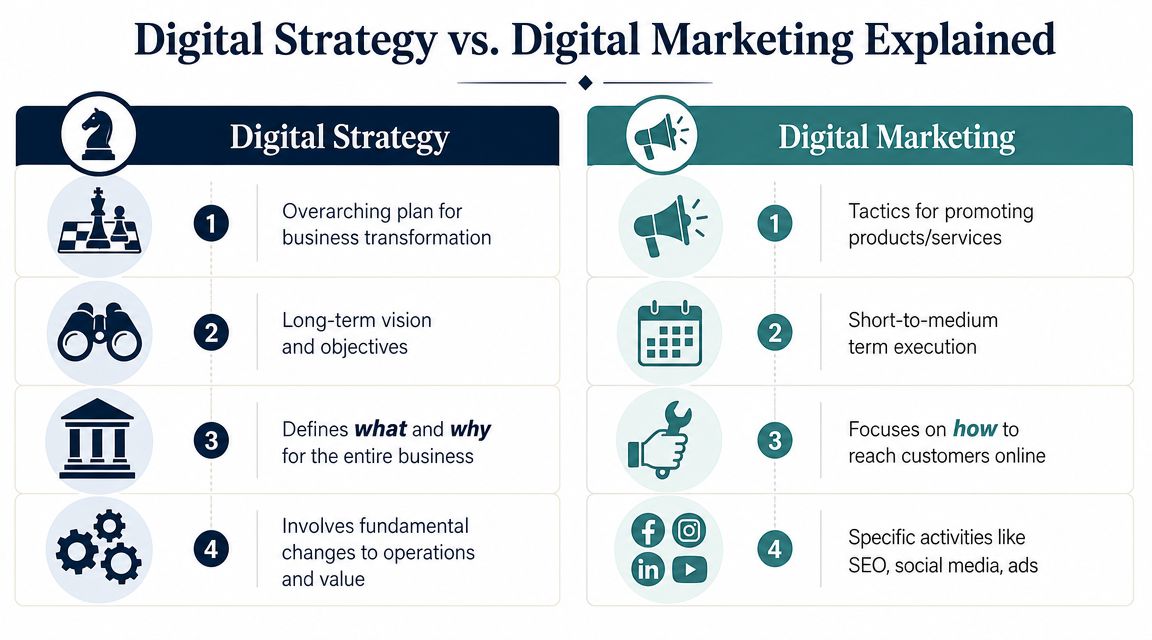
BCG describes a digital strategy roadmap as the plan that defines the transformation, accountabilities, and metrics needed to align business goals with outcomes. That's the important distinction highlighted in BCG's digital strategy roadmap explanation. Strategy sets direction. Marketing executes within it.
The simple way to separate them
Think of strategy as the season plan. Marketing is the playbook for each match.
Digital business strategy decides:
- which customers matter most
- which services or offers to push
- which customer journeys need redesign
- what role technology should play
- what success looks like commercially
Digital marketing handles:
- SEO work
- Google Ads
- Meta campaigns
- content creation
- email campaigns
- social posting
- landing pages
Marketing is important. It's just not the whole game.
When businesses confuse the two
A hospitality venue says, “We need more Instagram.” Maybe. But maybe the issue is that the booking page is poor, event pages are thin, and branded search traffic isn't converting.
A trade business says, “We need Google Ads.” Maybe. But maybe the actual problem is that enquiry handling is slow, the service area pages are vague, and trust signals are weak.
That's why digital marketing without strategy often feels busy but unstable. You can get activity. You can even get leads. But you can't build predictable growth if the offer, journey, channel mix, and backend process aren't aligned.
Marketing creates motion. Strategy makes sure the motion is heading somewhere useful.
If your current efforts feel tactical, this is usually the gap. A proper digital marketing strategy for Australian businesses should follow business decisions, not replace them.
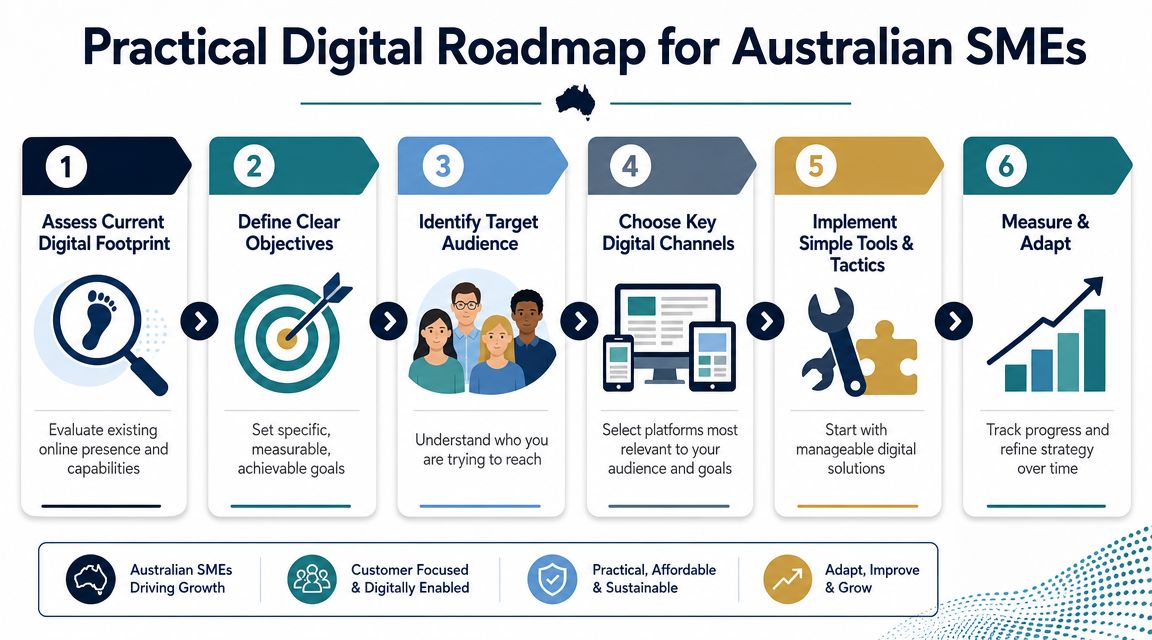
A Practical Roadmap for Australian SMEs
A lot of small businesses don't need a massive transformation plan. They need a clear starting point and a sequence they can follow.
The practical reality is that many are still at the foundation stage. In 2023–24, only 35% of Australian businesses had at least one external website profile and 20% used paid internet advertising, according to Queensland Government guidance on building a digital strategy. That tells you something important. Plenty of businesses still need the basics done properly before they layer on complexity.
Start with audit and goals
The first stage is audit. Work out what you've got.
Look at your website, Google Business Profile, reviews, enquiry forms, ad accounts, SEO visibility, booking tools, CRM, and reporting. Then ask the hard questions. Is the mobile experience usable? Are service pages clear? Do forms get answered quickly? Can you tell where good leads come from?
The second stage is goals. Not vague ones. Practical ones.
For a trade business, goals might include better quality quote requests, faster lead handling, and stronger visibility in service suburbs. For hospitality, they might include more direct bookings, more event enquiries, and better repeat customer communication.
A useful goal changes behaviour. “Get more traffic” doesn't help much. “Increase qualified booking and enquiry opportunities from core pages” gives you something to build around.
Here's a useful explainer if you want a simple framework for digital strategy for small business.
To see the broader thinking in action, this video gives a practical overview:
Then choose action and measurement
Once the goals are clear, move to action. This is where discipline matters.
Pick the few initiatives most likely to improve the business. That may include rewriting service pages, improving local SEO, fixing mobile speed, connecting forms to a CRM, improving booking flows, or tightening ad targeting. It usually does not mean launching every channel at once.
Then set measurement rules that match commercial outcomes.
- For trades, watch quote requests, phone enquiries, lead quality, response time, and booked jobs from digital channels.
- For hospitality, track online bookings, function enquiries, phone calls from search, and repeat traffic from email or direct visits.
- For both, check where drop-offs happen. If people visit but don't convert, the problem isn't visibility alone.
A roadmap should be simple enough that the owner can understand it and strong enough that the team can follow it.
Future-Proofing Your Strategy for AI Search
Search is changing. Customers still use Google, maps, reviews, websites, and social channels, but they're also starting to ask AI tools direct questions. That shift matters for local businesses because the winner may not be the business with the biggest brand. It may be the one with the clearest answers.

The ABS reported that 13% of Australian businesses used AI in 2023–24, and the practical implication drawn from the ABS business use of information technology release is that while adoption is growing, most businesses don't need to digitise everything. They need to become more legible to both people and AI-driven search.
What legible means in practice
For a local business, legibility means your website and digital footprint make it easy for a machine and a customer to understand:
- what you do
- where you do it
- who you help
- why someone should trust you
- how to take the next step
That means broad, thin pages won't do the job. “We offer quality plumbing services” is weak. A detailed page on emergency plumbing in a specific service area, with clear problems solved, FAQs, trust signals, and next actions, is much stronger.
How to prepare without overcomplicating it
You don't need a full AI program to improve this. Start with content and structure.
- Build clear service pages that answer real buyer questions in plain English.
- Add local trust signals such as service areas, testimonials, credentials, and project examples.
- Use consistent business information across your website and major platforms.
- Write FAQ content around common pre-sale questions customers ask your team every week.
- Make your content machine-readable with clean page structure, clear headings, and unambiguous wording.
The future of local visibility belongs to businesses that are easiest to understand, not businesses that use the most buzzwords.
If you want to go deeper on this shift, generative engine optimisation is the discipline focused on helping businesses become stronger answers inside AI-driven discovery environments.
Turn Your Digital Presence Into a Growth Engine
The best way to think about digital business strategy is this. It turns random digital activity into a working business system.
Without strategy, a website is often just an online brochure. Social media becomes a maintenance task. Ads become a spend line. Reporting becomes guesswork. The business stays busy, but the digital side never becomes dependable.
With strategy, each part has a job. Search brings the right visitors. Pages answer the right questions. Forms and booking tools reduce friction. Staff know how to handle leads. Reporting shows what deserves more investment and what needs fixing.
That's what local businesses need now. Not more noise. Not more disconnected tools. A plan that helps them get found, get chosen, and convert demand into revenue.
For trades, that can mean fewer wasted leads and stronger suburb-level visibility. For hospitality, it can mean better direct bookings, clearer event pathways, and a stronger repeat customer loop. For both, it means digital stops feeling like overhead and starts behaving like infrastructure.
If your business has already “gone digital” but it still feels patchy, that's the signal. The next step isn't necessarily more marketing. It's better alignment between your goals, your channels, your content, and your operations.
If you want a practical plan rather than more disconnected tactics, Titan Blue Australia helps businesses across Australia build and execute digital strategy across websites, SEO, Answer Engine Optimisation, content, social media, and ROI tracking. The work starts with the business goal, then builds the digital system around it.
Make Titan Blue a preferred source in Google
One click tells Google to surface our articles more often in Top Stories, AI Overviews and AI Mode.

Future Proof Website Design Australia: 2026 Guide
Future proof website design Australia means modular architecture, schema and AEO built in from day…

Web Design for Google AI Overviews: The 2026 Guide
How web design earns Google AI Overview citations in 2026: answer-first structure, schema, tables and…

Web Design for ChatGPT Visibility: The 2026 Guide
What makes a website visible in ChatGPT answers: crawler access, structured data, and answer-first content.…