


Last updated:
TL;DR:
- A strong digital presence includes website, Google profile, social media, reviews, and online content.
- Consistency and strategic investment in digital channels are key to long-term business growth.
- Most SMEs need expert support to optimize their digital footprint and maximize results.
In Australia, 80% of consumers start their shopping journey online, which means your business is being judged online before you even pick up the phone. For many small and medium-sized business owners, the term “digital presence” sounds vague or overly technical. It is neither. Your digital presence is the sum of every way your business appears, behaves, and communicates online. Get it right, and it becomes one of your most powerful growth tools. Get it wrong, and competitors with stronger online footprints will consistently win the customers you should be attracting.
Table of Contents
- Understanding digital presence: More than just a website
- Why digital presence matters for business growth in Australia
- Building blocks: Core elements of a winning digital presence
- Strategic investment: Digital presence as a long-term business asset
- Why most SMEs undervalue their digital presence (and what actually drives results)
- Get expert help to build your Australian digital presence
- Frequently asked questions
Key Takeaways
| Point | Details |
|---|---|
| Multi-channel is essential | A strong digital presence means more than just a website; it integrates listings, social media, and ongoing content. |
| Trust drives business growth | Australians see digital visibility as a trust signal, which directly influences buying decisions and revenue. |
| Strategic investment pays off | Treating digital presence as a long-term investment—budgeting 5-10% of revenue—delivers sustained results. |
| Consistency is key | Maintaining a cohesive message and style across all channels builds credibility and authority. |
Understanding digital presence: More than just a website
Having established that online journeys dominate, let’s clarify what “digital presence” really means for your business.
Most business owners assume a website is enough. It is not. A website is one component of a much larger ecosystem. Think of your digital presence as every touchpoint a potential customer encounters when they search for, discover, or research your business online. That includes your website, yes, but also your social media profiles, your Google Business Profile listing, online reviews, directory listings, content you publish, and any paid advertising you run.
Key components of digital presence include your website, social media profiles, online business listings such as Google Business Profile, professional networking platforms, digital marketing channels, and multimedia content like videos and images. Each of these elements plays a distinct role, and together they shape how your brand is perceived.
Here is a quick breakdown of the core elements:
- Website: Your owned digital asset, where you control the message, design, and user experience.
- Google Business Profile: Your listing on Google Maps and local search results, critical for foot traffic and local discovery.
- Social media profiles: Platforms like Facebook, Instagram, and LinkedIn where you engage with your audience.
- Online directories and listings: Sites like Yellow Pages, True Local, and industry-specific directories.
- Content and multimedia: Blog posts, videos, podcasts, and images that demonstrate your expertise.
- Digital advertising: Paid campaigns on Google Ads, Meta Ads, and other platforms that drive targeted traffic.
- Online reviews: Customer feedback on Google, Facebook, and review sites that builds or erodes trust.
The difference between a basic and a cohesive digital presence is significant. Here is a simple comparison:
| Element | Basic digital presence | Cohesive digital presence |
|---|---|---|
| Website | Static, rarely updated | Optimised, mobile-friendly, updated regularly |
| Social media | Sporadic posts, inconsistent branding | Consistent posting schedule, aligned brand voice |
| Google Business Profile | Unclaimed or incomplete | Fully completed, with photos and reviews |
| Online reviews | Unmonitored | Actively managed and responded to |
| Content | None or minimal | Regular, relevant, and SEO-driven |
| Advertising | No paid strategy | Targeted campaigns with clear goals |
These pieces do not operate in isolation. A customer might discover you through a Google search, visit your website, check your reviews, follow you on Instagram, and then finally make contact. If any one of those touchpoints is weak or inconsistent, you risk losing them. Explore digital marketing tips to understand how these elements connect in practice.
Why digital presence matters for business growth in Australia
With the components clear, the next question is: why does a robust digital presence matter for your business success?
The answer is straightforward. Your customers are online, and they are making decisions based on what they find. 80% of Australian consumers begin their shopping journey online. If your business does not show up clearly and credibly, you are invisible to the majority of your potential market.
Trust is the first driver of growth. When a consumer searches for a service and finds a business with a professional website, active social media, positive reviews, and a complete Google listing, they immediately perceive that business as more credible. A weak or absent digital presence signals risk. Consumers move on quickly.
The second driver is reach. Unlike traditional marketing, your digital presence works around the clock. A well-optimised website can attract enquiries at 2am. A strong Google Business Profile can direct foot traffic on a Saturday afternoon without any additional spend.
The third driver is measurability. Unlike a flyer or a newspaper ad, every element of your digital presence can be tracked, tested, and improved. You can see exactly which channels bring in leads, what content resonates, and where customers drop off.
Australian social media engagement rates vary by industry, with Food and Beverage achieving 1.8%, Retail at 1.2%, and Technology at 0.9%. The cost per lead on Facebook sits between AUD $25 and $45, depending on your sector and targeting. These figures matter because they help you prioritise where to invest your time and budget.
| Industry | Social media engagement rate | Facebook cost per lead (AUD) |
|---|---|---|
| Food and Beverage | 1.8% | $25 to $35 |
| Retail | 1.2% | $30 to $40 |
| Technology | 0.9% | $35 to $45 |
Here are the top three reasons a strong digital presence drives revenue for Australian SMEs:
- Visibility: Customers can find you when they are actively searching for your product or service.
- Credibility: A professional, consistent online presence builds trust before any conversation takes place.
- Conversion: A well-structured website and clear calls to action turn visitors into paying customers.
“Your digital presence is not just about being seen. It is about being trusted, remembered, and chosen over your competitors.”
Pro Tip: Focus your initial investment on the platforms where your target customers are most active. For most Australian SMEs, this means Google Business Profile and Facebook before branching into LinkedIn or TikTok. Understanding digital marketing in Australia will help you make smarter channel decisions from the start.
Building blocks: Core elements of a winning digital presence
Now, let’s break down how to get these elements working together effectively.

Knowing what digital presence means is one thing. Knowing how to audit and improve yours is another. Many business owners have pieces in place but have never checked whether those pieces are working together. Here is a practical framework to get started.
Step 1: Audit your current digital assets
Go through each of the following and rate them honestly:
- Website: Is it mobile-friendly? Does it load in under three seconds? Is the contact information easy to find? Is it updated with current services and pricing?
- Google Business Profile: Is it claimed and verified? Does it have accurate hours, address, phone number, and photos?
- Social media profiles: Are they active? Is the branding consistent across platforms? Do they link back to your website?
- Online listings: Are your business details consistent across all directories? Inconsistent NAP (name, address, phone number) data confuses both customers and search engines.
- Reviews: Are you actively requesting reviews from satisfied customers? Are you responding to all reviews, positive and negative?
- Content: Do you have any blog posts, videos, or guides that demonstrate your expertise and attract organic search traffic?
Step 2: Identify your gaps
Once you have completed the audit, you will likely find several gaps. Common issues include:
- Outdated website content that no longer reflects your services
- An unclaimed or incomplete Google Business Profile
- Social media profiles that have not been posted to in months
- No review management strategy
- Inconsistent contact details across different online directories
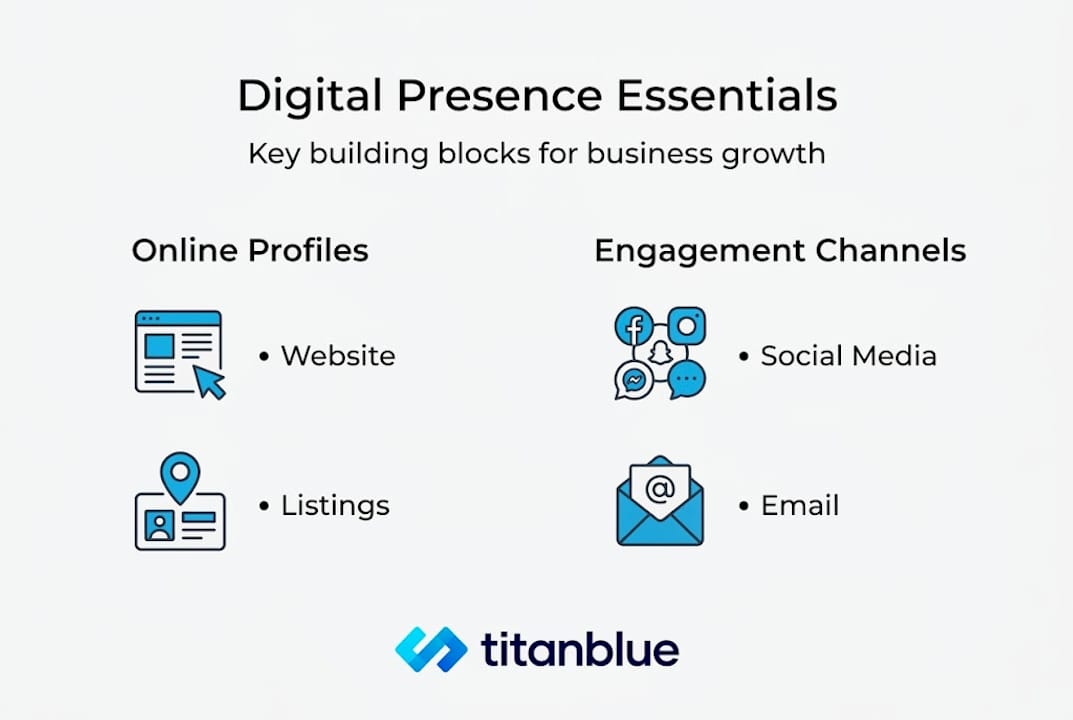
Key components such as your website, social media profiles, and business listings must all align to create a trustworthy and coherent brand image online.
Step 3: Prioritise and act
You do not need to fix everything at once. Prioritise the changes that will have the greatest impact on visibility and trust first. Claiming and completing your Google Business Profile, for example, costs nothing and can immediately improve your local search rankings.
Here are some quick wins to get started:
- Claim and complete your Google Business Profile today
- Update your website’s contact page and ensure it is mobile-responsive
- Post consistently to your most active social media platform, even if it is just three times per week
- Ask your five most recent satisfied customers to leave a Google review
- Check your business details on three major directories and correct any inconsistencies
Pro Tip: Consistency is the single most underrated factor in building digital trust. Use the same business name, logo, phone number, and address format across every platform. Inconsistency creates confusion and undermines credibility. Start with digital marketing basics to build a solid foundation before scaling.
Strategic investment: Digital presence as a long-term business asset
Having built the basics, it is vital to shift from quick fixes to a longer-term mindset.
Many business owners treat their digital presence as a task to complete rather than an asset to grow. This is where the biggest opportunity is missed. A strong digital presence compounds over time. The SEO work you do today continues to generate traffic months and years from now. The reviews you collect build a body of social proof that makes every future sale easier.
“Experts emphasise treating digital presence as a strategic ecosystem and ongoing investment, not a one-off tactic. Allocating 5 to 10% of annual revenue to digital marketing is the benchmark for businesses serious about sustained growth.” Establish Digital Presence
The key strategic distinction is between SEO and digital advertising. Both have a role, but they serve different purposes:
- SEO (search engine optimisation): A long-term investment that builds organic visibility over time. Results take three to six months to materialise but continue to grow with sustained effort. Lower cost per lead over time.
- Digital advertising (Google Ads, Meta Ads): Delivers immediate visibility and traffic. Results are fast but stop the moment you stop spending. Higher short-term cost but useful for launches, promotions, and fast lead generation.
The smartest approach is to run both in parallel. Use digital advertising strategies to generate immediate leads while your SEO builds momentum in the background. Over time, your organic traffic grows and your reliance on paid ads decreases.
Here are the strategic steps to treat your digital presence as a long-term asset:
- Set a realistic annual digital marketing budget, targeting 5 to 10% of revenue
- Invest in SEO from day one, even if results take time to appear
- Create a content calendar and commit to publishing regularly
- Track your key metrics monthly: website traffic, enquiry volume, conversion rate, cost per lead
- Review and adjust your strategy every quarter based on what the data tells you
Pro Tip: Do not wait until business is slow to invest in your digital presence. The businesses that maintain consistent investment during strong periods are the ones that weather downturns most effectively. Explore the web and digital marketing guide for a broader view of how these strategies connect, and review SEO investment advice to understand the long-term return on organic search.
Cohesion across all marketing channels is also critical. Your website, social media, email marketing, and advertising should all carry the same brand voice, visual identity, and core message. Fragmented marketing confuses customers and dilutes the impact of every individual channel.
Why most SMEs undervalue their digital presence (and what actually drives results)
With the strategic importance clear, let’s dig into the most common missteps and what actually works.
Here is the uncomfortable truth: most SMEs are investing time and money into digital marketing without a clear strategy, and they are getting inconsistent results because of it. Sporadic social media posts and a website that was built three years ago and never touched again are not a digital presence. They are digital noise.
The businesses that see real, measurable growth from their online activity share one common trait: consistency. Not perfection. Not the biggest budget. Consistency. They show up regularly, they maintain their listings, they respond to reviews, and they track what is working.
The compound benefit of this approach is significant. Each piece of content you publish, each review you collect, and each backlink your website earns adds to a growing body of digital authority. This is what separates businesses that generate leads on autopilot from those that struggle month to month.
For time-poor SME owners, the practical advice is this: focus on three things done consistently rather than ten things done poorly. Choose your highest-impact channels, maintain them well, and measure results over a 90-day period minimum. Explore Australian marketing strategies to find the right focus areas for your specific industry and goals.
Get expert help to build your Australian digital presence
Ready to take your digital presence from insight to action? Here is where to get professional support.
Understanding your digital presence is the first step. Building and maintaining it effectively is where most business owners need support. That is exactly what we do at Titan Blue.
Whether you need a winning web presence built from the ground up, an SEO web page design that actually ranks, or a social media management guide to keep your audience engaged, we have the expertise to deliver results. We work with Australian SMEs across the Gold Coast and beyond, providing practical, strategic digital solutions that generate real leads and measurable growth. Get in touch with our team today to discuss where your digital presence stands and what it could look like with the right strategy behind it.
Frequently asked questions
What is a digital presence for a small business?
A digital presence is the combination of your website, social media, business listings, and online content that shapes how your business appears and interacts online. Key components include your website, social media profiles, Google Business Profile, professional networking, digital marketing channels, and multimedia content.
How much should an Australian SME budget for digital marketing and presence?
Experts recommend investing 5 to 10% of annual revenue in digital marketing to build and sustain a strong presence that drives consistent growth over time.
Which online channels matter most for Australian businesses?
The most impactful channels are your business website, Google Business Profile, and social media platforms relevant to your target customers. Key components such as these form the foundation of any effective digital presence strategy.
Is social media engagement in Australia worth the investment?
Social media can be a valuable lead source when approached strategically. Engagement rates vary by industry, from 1.8% in Food and Beverage to 0.9% in Technology, with Facebook cost per lead ranging from AUD $25 to $45 depending on your targeting and sector.
Recommended
- What is digital advertising? A guide for Australian SMBs
- Grow with web and digital marketing: A practical guide for Australian businesses
- Digital Marketing Consulting for Australian Businesses
- Digital advertising strategies for Australian SMEs in 2026
Make Titan Blue a preferred source in Google
One click tells Google to surface our articles more often in Top Stories, AI Overviews and AI Mode.

ChatGPT GPT-6 Search Upgrade: What It Means for Australia
OpenAI rolled out GPT-6 to ChatGPT on 7 October 2026 with faster search. Here is…

Best Dental Website Design Agencies in Australia: 7 Compared
Best dental website design agencies in Australia 2026: seven compared on dental proof, booking, AHPRA…

Childcare Centre Website Design Australia: The 2026 Guide
Childcare centre website design Australia: show hours, ages and enrolment as text so parents and…