

Two years after Eat at ROBs launched their website, they ranked 11th for their single best competitive keyword. Today they hold position one for “how to make burger patties”, “grill burgers”, “meat patty” and “smash burger Rozelle”, outranking national recipe publishers and every burger shop in the Inner West. This is exactly how it happened, with the numbers from both ends.
If you run a hospitality business and you are wondering whether content marketing actually moves the needle, this case study is the honest version. Not a highlight reel, the baseline, the strategy, the mechanism, and the parts that did not work the way the textbooks say they should.
The short answer
Between June 2024 and August 2026, Titan Blue took Eat at ROBs from a website that ranked for its own name and almost nothing else to a site that:
- Doubled organic search clicks, from roughly 1,038 a month to 2,039 a month
- Cut average search position from 15.6 to 7.3 across the entire site, page two to page one
- Lifted click-through rate from 5.81% to 7.01% while impressions actually tightened
- Grew the ranking keyword footprint from 24 tracked keywords to 8,203 unique queries
- Took position one for eleven non-brand keywords, including national recipe terms contested by major food publishers
- More than doubled Google Map Pack direction requests, from 1,107 a month to 2,581, people actively navigating to the front door
- Grew reviews from 11 to 713 at a 4.6-star average
- Grew branded search demand by up to 72% on key variations, the clearest proof that search visibility converted into real-world customers
And the first meaningful rankings landed within four weeks, because the SEO programme launched alongside a Google Ads push rather than after it.
Below is how each of those happened.
Act one: what “less than impressive” actually looked like
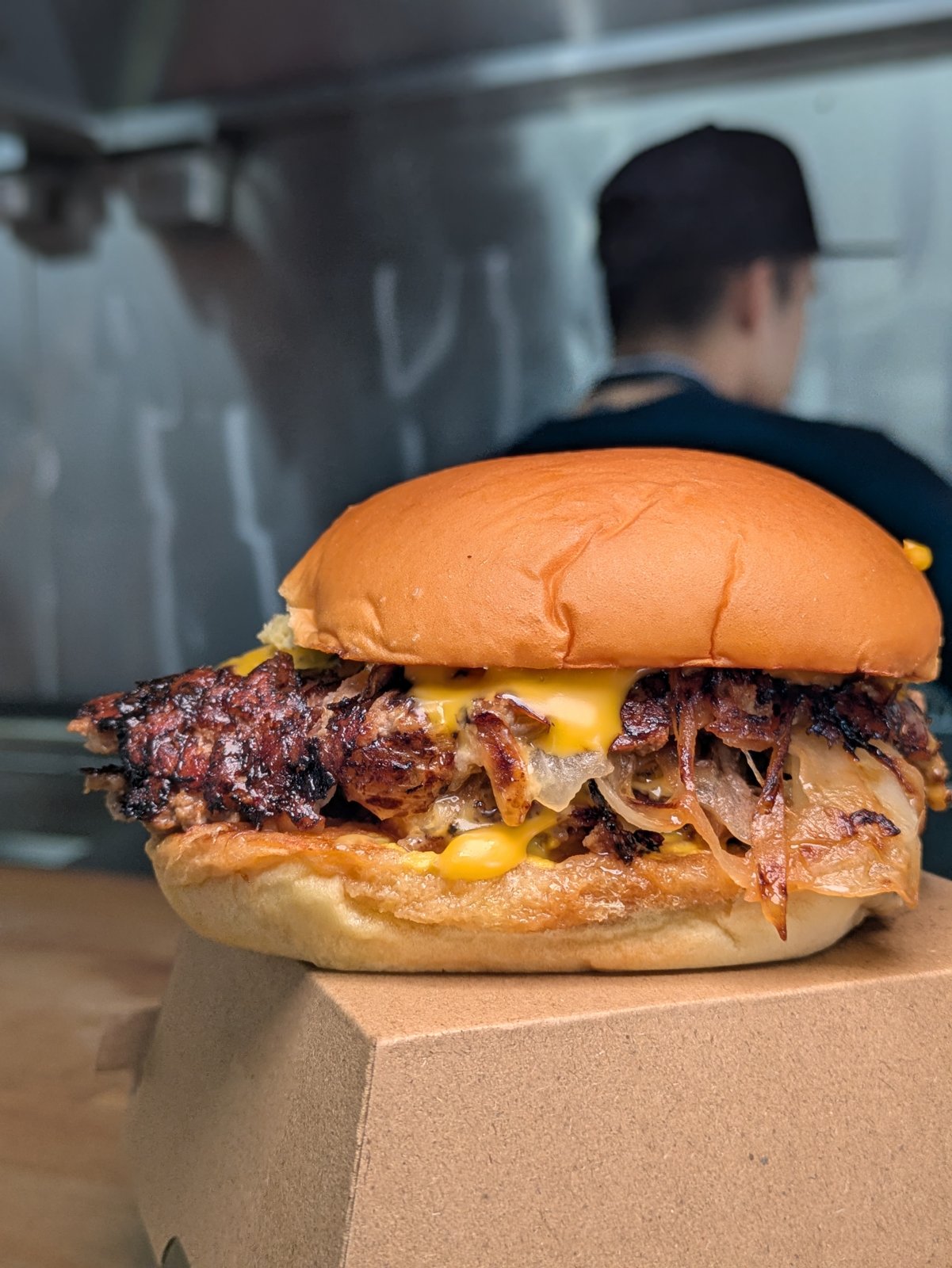
Eat at ROBs is a smash burger shop at 621 Darling Street, Rozelle, in Sydney’s Inner West. Great product, loyal locals, genuine reputation. The website had been live for two years.
Here is the state of play in June 2024, taken from Titan Blue’s own monthly report for that month:
| Metric | June 2024 |
|---|---|
| Organic clicks | ~1,038 for the month |
| Pages in Search Console | 29 |
| Pages earning zero clicks | 17 of 29 |
| Homepage average position | 11.15 |
| GA4 sessions, all channels | 4,094 |
| GA4 organic sessions | 1,871 |
| Google Business Profile impressions | 7,389 |
| Reviews | 11 (4.73 average) |
| Backlinks / referring domains | 31 / 21 |
| Keywords tracked | 24 |
Two numbers matter most in that table.
First: 17 of 29 pages earned nothing. The site was not competing. It was a digital business card that Google served to people who already knew the brand name. The homepage and the menu page produced 87% of all organic clicks between them. Everything else was decoration.
Second: the best competitive ranking was 11th. The rank tracker in June 2024 followed 24 keywords. “Burgers Inner West” sat at 11th, top of page two, the position that gets seen by almost nobody. Beyond that: “burger shop Sydney” 28th. “Hamburger delivery” 30th. “Best chicken burger Sydney” 71st.
For a business with a genuinely excellent product in a food-obsessed city, that is the definition of leaving money on the table. And it is worth being blunt about the period before this: the figures prior to mid-2024 were weaker still. We do not have surviving reporting from those years, Google Search Console only retains sixteen months of data, so this case study starts from the earliest documented baseline we can stand behind rather than from a number we would have to estimate.
Act two: the diagnosis
The instinct in this situation is to chase the obvious commercial keyword. “Best burgers Sydney.” Huge volume, enormous intent, and completely unwinnable for a single-location shop competing against Broadsheet, Time Out, Concrete Playground and every aggregator with a decade of domain authority.
We diagnosed the problem differently. Eat at ROBs did not have a rankings problem. It had a topical authority problem. Google had no reason to consider the domain an authority on burgers, because the domain had never said anything about burgers. It had a menu.
Search engines, and increasingly AI answer engines, do not rank pages in isolation. They build a model of what a domain knows about. A site with thirty pages, seventeen of which are empty of engagement, does not read as an authority on anything. A site that has published two hundred substantive answers about burger cooking, burger sourcing, burger comparison and burger culture reads very differently.
So the strategy was not “rank for best burgers Sydney.” The strategy was: become the domain Google trusts on the subject of burgers, then let the commercial keywords follow.
Act three: what we actually built
A publishing engine, not a blog
Eat at ROBs moved to three long-form articles per week, published consistently, every week, without exception. Not 400-word filler. Two thousand words and up, each one structured to answer a real question a real person types into Google or asks an AI assistant.
Consistency was the point. Search authority is not bought in a burst; it accrues. A site that publishes forty articles in one month and then goes quiet reads as a campaign. A site that publishes three a week for two years reads as a publisher.
Answer Engine Optimisation from day one
Every article was built for AEO and GEO, Answer Engine Optimisation and Generative Engine Optimisation, not just classic SEO. In practice that means:
- The answer comes first. The opening paragraph directly answers the question in the title. No throat-clearing preamble. AI engines extract the first substantive answer they find; if yours is buried under three paragraphs of scene-setting, it is not yours that gets quoted.
- Fan-out structure. AI systems decompose a query into sub-questions. “How to make burger patties” fans out into: what meat ratio, how much to handle it, what size, how to season, how to cook, common mistakes. Every article was mapped against those sub-queries with a heading answering each one directly.
- Entity-rich, structured content. Clear H2/H3 hierarchy, FAQ blocks, schema markup, specific named things rather than vague description.
This is the part most agencies still treat as optional. It is the reason a burger shop can outrank a national food magazine.
Google Business Profile as an amplifier
Every published article was pushed to the Google Business Profile as a post, on publication day, automatically. GBP posts are a chronically underused signal for local businesses, they feed the local pack, they give returning searchers something current to see, and they create a second surface for the same content to work on.

Google Ads running in parallel from day one
The organic programme did not start alone. A Google Ads push launched alongside it, deliberately, for two reasons. First, it bought visibility immediately on the high-intent local terms while the SEO work was still building, a business does not get to wait nine months for phones to ring. Second, the search term data from the ad account showed exactly what real customers were typing, which fed straight back into the content plan. Paid search told us what to write about; the content then earned those positions permanently.
That combination is why the first meaningful ranking movement showed up within four weeks rather than after two quarters.
The technical layer
Instant indexing via the Google Indexing API and IndexNow on every publish, so articles were discovered within minutes rather than days. Clean internal linking so authority flowed from the content library into the commercial pages. Genuine site speed and mobile performance work. None of this is glamorous and all of it is load-bearing.
The results, in order of how much they matter
1. Position one for keywords a burger shop has no business winning
This is the headline. As at August 2026, from Google Search Console, non-brand keywords where Eat at ROBs holds an average position of 1.x:
| Keyword | Average position |
|---|---|
| how to cook burgers on the stove | 1.0 |
| how to cook a burger on the stove | 1.0 |
| grill burgers | 1.0 |
| meat patty | 1.0 |
| how to make burger patties | 1.1 |
| how to make a burger patty | 1.1 |
| burger patty | 1.1 |
| smash burger Rozelle | 1.2 |
| Rozelle smash burger | 1.2 |
| beef patty recipe | 1.5 |
| how to make hamburger patties | 1.8 |
Look at that list again. Most of those are national, non-local recipe keywords. A single-site burger shop in Rozelle is outranking recipe publishers, food media brands and international sites on their own subject matter. In June 2024 the same business could not crack the top ten for “burgers Inner West”.
Add the top-three positions: Rozelle burgers (2.3), burger Rozelle (2.5), Rozelle burger (2.3), burger Balmain (3.0), homemade burger recipe (2.3), smash burger recipe (3.2), turkey burger recipe (2.8), hamburger patty recipe (2.9), best burger recipe (3.4), how to make homemade burgers (3.5).
They own every meaningful variation of their own suburb, and they rank top-five in Balmain, a suburb they do not even trade in.
2. Clicks doubled
| Period | Organic clicks |
|---|---|
| June 2024 | ~1,038 |
| June 2025 | 1,803 |
| June 2026 | 2,039 |
A 96% increase over two years, with the growth curve still intact. Across the sixteen months Search Console retains, the site delivered 28,319 organic clicks.
3. Average position halved
Site-wide weighted average position moved from 15.6 to 7.3. The homepage alone went from 13.1 to 6.5, and its clicks rose from 7,998 to 9,131, while its impressions fell from 136,000 to 105,000.
That combination is the one experienced SEOs get excited about. Fewer impressions and more clicks means Google stopped showing the site to poorly matched searchers and started showing it to the right ones. Click-through rate rose from 5.81% to 7.01%, a 21% improvement. Visibility got better by getting more precise.
4. The content library became the engine
In June 2024, the blog contributed effectively zero clicks. Today 143 content pages earn impressions, delivering 377 clicks and 105,160 impressions in a six-month window. The unique query footprint went from 5,774 to 8,203, a 42% increase in the number of distinct things people search and find this business for.
Individual performers include Best Burgers Inner West Without the Hype, What To Do If Burgers Come Out Undercooked, How To Make Burger Patties Juicy, and Sydney’s Best Burger Ranking 2026.
5. The Google Map Pack, the result that feeds the till
For a hospitality business, this is arguably the most valuable real estate on the internet, and it is the one most operators ignore.
The Map Pack is the block of three local businesses Google shows with a map above the organic results whenever someone searches with local intent, “burgers near me”, “burgers Rozelle”, “best smash burger Inner West”. It sits above the traditional organic listings. It is also what Google Maps itself returns, which is where most people on a phone actually start.
Here is what that surface now delivers for Eat at ROBs, from Google Business Profile performance data:
| Metric (June 2026) | Result |
|---|---|
| Total profile impressions | 12,602 |
| Impressions from Google Maps | 8,139 (65%) |
| Impressions from Google Search | 4,463 |
| Direction requests | 2,581 |
| Website clicks from the profile | 1,104 |
| Total reviews | 713 at 4.6 stars |
Compare that to the June 2024 baseline: 7,389 impressions, 1,107 direction requests, 829 website clicks and 11 reviews.
| Google Business Profile | June 2024 | June 2026 | Change |
|---|---|---|---|
| Profile impressions | 7,389 | 12,602 | +71% |
| Direction requests | 1,107 | 2,581 | +133% |
| Website clicks | 829 | 1,104 | +33% |
| Reviews | 11 | 713 | +6,382% |
Read the direction requests line again. 2,581 people in a single month asked Google to navigate them to the front door. That is not an impression, a session or a soft metric. Someone requesting directions to a burger shop is a customer in transit. It is the closest thing to a sale that a digital report can show you, and it more than doubled.
Why the Map Pack matters more than most owners realise
- It sits above organic. You can be number one in the blue links and still lose the click, because three competitors appear above you in the map block.
- Mobile is where the decision happens. 65% of Eat at ROBs’ visibility now comes from Maps, and mobile Maps alone accounts for more impressions than every other surface combined. People are standing on a street deciding where to eat.
- The intent is immediate. A Map Pack search is rarely research. It is someone hungry, nearby, choosing now.
- AI assistants lean on it. Local recommendations generated by AI tools draw heavily on business profile data, categories, review volume and review sentiment. A thin profile does not get recommended.
How the ranking was built. Map Pack position is driven by relevance, distance and prominence. Distance is fixed, so the work went into the other two: a completely built-out profile with correct categories, services, attributes, hours and photos; a Google Business Profile post published with every single blog article, giving the profile a continuous freshness signal; systematic review generation and a reply on every review, which lifted the count from 11 to 713; and the website content itself, which reinforces the topical relevance Google uses to decide which local business best answers “smash burger Rozelle”.
That last point is where the two halves of the strategy meet. The content programme did not just win organic rankings, it fed the local pack. The profile and the site pull in the same direction, on the same topics, and the Map Pack rewards it.
6. Brand demand grew, the number that proves it is real
Every metric above measures search. This one measures the business.
| Branded query | Before | After | Change |
|---|---|---|---|
| eat at robs | 4,774 | 5,126 | +7% |
| robs burgers | 904 | 1,076 | +19% |
| eat at robs rozelle | 314 | 383 | +22% |
| robs burgers rozelle | 152 | 262 | +72% |
People do not search a brand by name unless they have encountered it. Rising branded search volume is the signal that discovery is converting into awareness, and awareness into intent. New non-brand discovery queries appearing in the data, “Rozelle smash burger”, “burger shop Rozelle”, “best burgers in Sydney 2026”, “American style diner Sydney”, are the top of that same funnel, feeding it.
The honest caveat
Those national recipe keywords at position one do not, on their own, generate many clicks. AI Overviews now answer “how to make burger patties” directly on the results page, and a large share of that traffic never reaches any website. If we presented those rankings as a traffic win, we would be overselling.
Their real value is different, and more durable: they are what taught Google that this domain is an authority on burgers. That authority is precisely what lifted the commercial, high-intent, locally converting terms, “burgers Rozelle”, “smash burger Rozelle”, “burger Balmain”, into the top three. The recipe content is the foundation. The local commercial rankings are the building.
There is a second benefit that is becoming more important every month: when someone asks ChatGPT, Gemini or Perplexity for burger advice or a Sydney burger recommendation, the sites those systems have learned to trust on the topic are the ones that get named. Ranking one for “how to cook a burger on the stove” is not just a Google position. It is a seat at the table in AI-generated answers.

What other hospitality operators should take from this
Stop chasing the keyword you want and build the authority that earns it. “Best burgers Sydney” was never winnable directly. It became reachable as a by-product of two years of genuinely useful content on the broader subject.
Consistency beats intensity. Three articles a week for two years outperforms any campaign burst, because search authority compounds and compounding requires time in the market.
Write for answer engines, not just search engines. Answer first, structure for sub-questions, be specific and entity-rich. The businesses that get this right now will be the ones AI assistants recommend for the next decade.
Treat the Map Pack as a primary channel, not an afterthought. For a local business it outranks your website. Complete the profile, post to it every week, and get reviews relentlessly, 713 reviews is not luck, it is a process. Direction requests are the metric to watch, because they are the closest digital proxy for someone walking in.
Run paid and organic together at launch. Ads bought Eat at ROBs visibility in week one while the organic work started compounding. Neither alone would have produced results at four weeks and at two years.
Track branded search as your real KPI. Rankings and clicks are inputs. Rising branded demand means people are encountering you, remembering you, and coming back for you. That is business growth, showing up in a search report.
Do not wait for perfect data. We could not reconstruct Eat at ROBs’ pre-2024 performance because Google does not keep it. If you are not archiving your own monthly reporting, start now, the baseline you fail to record today is the proof you cannot show in two years.
Frequently asked questions
How long did it take to see results?
Faster than most people expect. Key rankings moved within four weeks of the combined Google Ads and SEO push going live. Running paid search alongside the organic programme meant Eat at ROBs occupied the results page from day one, ads at the top, the Map Pack in the middle, organic listings climbing underneath, while the SEO work compounded behind it. Early wins landed on the local Rozelle and Inner West terms, which are the ones that actually put people through the door. The broader national rankings and the position-one recipe terms built on top of that foundation over the following months. The lesson is that paid and organic are not alternatives; run together they buy visibility immediately and earn it permanently.
Does content marketing work for a single-location restaurant?
Yes, and the numbers here are the case. A single Rozelle burger shop now outranks national publishers on their own keywords. Local businesses have an advantage most do not use: genuine, specific, first-hand expertise that content farms cannot fake.
Is SEO still worth it now that AI answers questions directly?
It matters more, not less, but the goal has shifted. The objective is no longer only to rank, it is to become a source that AI engines cite and recommend. That requires the same foundation of depth, structure and topical authority, applied with AEO discipline.
How important is the Google Map Pack for a restaurant?
For most local hospitality businesses it is the single highest-value search surface. It appears above the organic results, it is what Google Maps shows, and its users are deciding where to go right now rather than researching. For Eat at ROBs, 65% of all Google Business Profile visibility comes from Maps, and the profile generated 2,581 direction requests in a single month.
How do you rank in the Map Pack?
Google weighs relevance, distance and prominence. Distance you cannot change, so the work is in the other two: a fully completed profile with accurate categories and attributes, consistent posting, high review volume with genuine replies, strong photo coverage, and website content that reinforces what the business is known for. Eat at ROBs moved from 11 reviews to 713 and posts to the profile with every article published.
Why publish recipe content for a restaurant that sells burgers rather than recipes?
Because it builds the topical authority that makes the commercial pages rank. The recipe articles are not the destination; they are how the domain earned the right to compete for “burgers Rozelle”.
The bottom line
In June 2024, Eat at ROBs had a website that worked for people who already knew about them. In August 2026 they hold position one for keywords contested by national publishers, own the search results for their suburb, and are searched for by name 72% more often on their fastest-growing branded term.
Same burgers. Same shop. Same great product. What changed was a search strategy built on topical authority and answer engine optimisation, executed consistently for two years.
If you would like to know what that would look like for your business, get in touch with Titan Blue.
Data sources: Titan Blue monthly digital marketing report for Eat at ROBs (June 2024); Google Search Console for eatatrobs.com.au, 14 April 2025 to 23 August 2026; Google Business Profile performance data, June 2026. Search Console retains sixteen months of data, so pre-April 2025 figures are drawn from archived reporting.