


Last updated:
An AEO friendly website architecture is one built so AI engines such as ChatGPT, Google AI Overviews, Perplexity, Gemini and Claude can reach, parse and lift your content without guesswork. In practice that means a flat URL structure with no page buried more than two or three clicks from the homepage, semantic HTML with one clear topic per page, structured data (Organization, BreadcrumbList, Article and FAQPage schema) wired consistently site-wide, server-rendered content that never hides behind JavaScript, and internal links that tell both humans and machines how your pages relate. It is not a single plugin or a schema tag bolted on at the end. It is how the whole site is organised, from the sitemap down to the heading tags.
Most businesses hear “AEO” and think it starts and ends with schema markup. It does not. Schema is one layer of architecture, and as we will show below, the research on how much it actually moves AI citations is more contested than most agencies admit. The structural decisions underneath it, URL depth, content grouping, internal linking, and whether your pages can be rendered without a browser, matter just as much, and in some cases more.
What does “website architecture” actually mean for AEO?
Website architecture is the way pages, categories and links are organised across a site: the sitemap, the URL hierarchy, the internal linking pattern, and the technical layer that renders it all. Traditional SEO architecture optimises this for crawl budget and topical authority signals passed through PageRank. AEO architecture optimises for the same foundations, but with one extra requirement: every important passage has to be extractable as a standalone answer by a machine that is not going to click through three pages to find context.
That changes some decisions. A traditional site might spread a topic across five thin pages to target five keyword variants. An AEO friendly site consolidates that same topic into one deep, well-structured page with clear H2/H3 sub-answers, because AI engines are choosing between candidate passages, not candidate domains. Depth beats fragmentation.
What is the ideal site structure for AI crawlers to work with?
Three structural rules cover most of it:
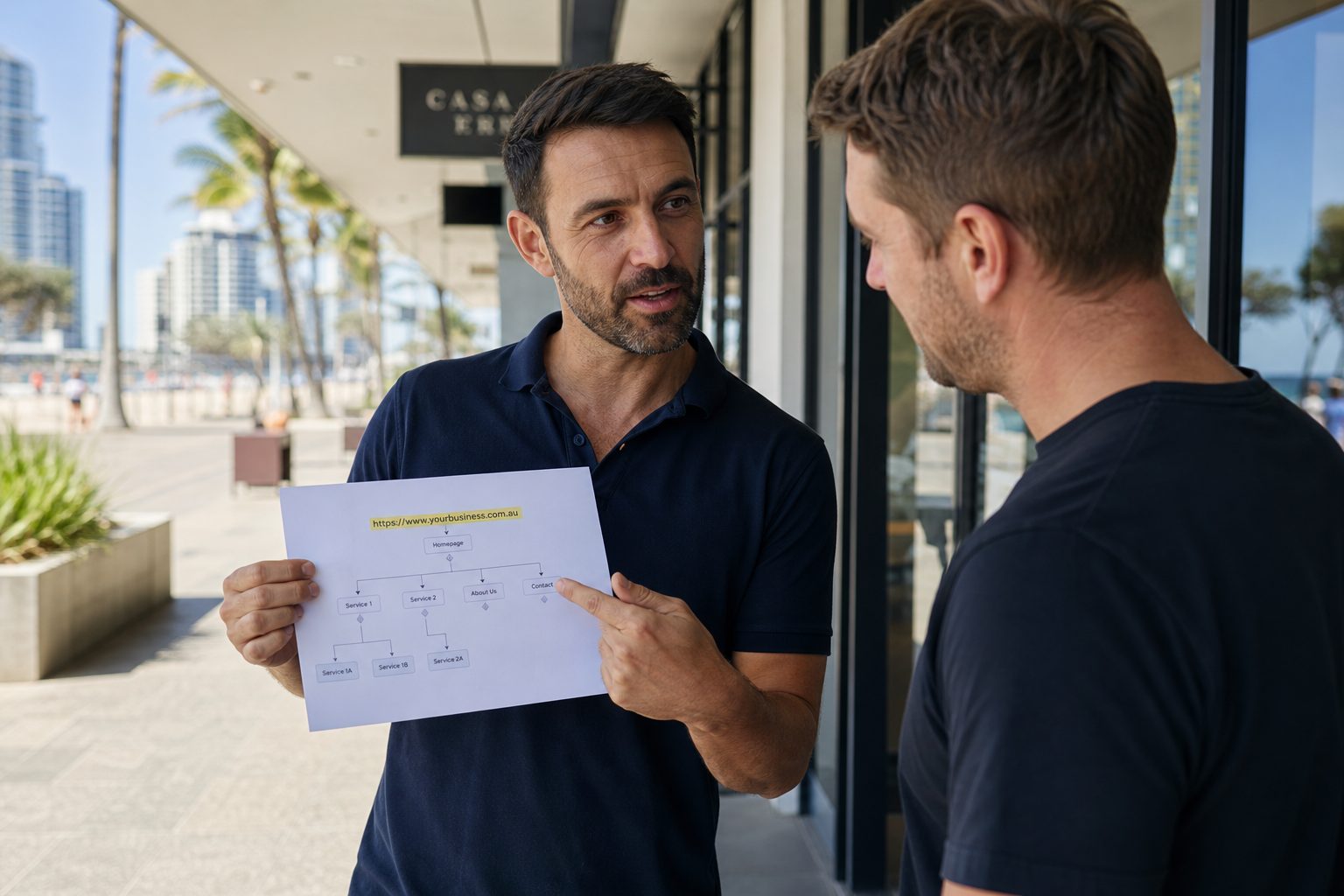
- Flat depth. Every important page should sit within two to three clicks of the homepage. Pages buried six levels deep in nested categories get crawled less often, by search engines and AI crawlers alike, because crawl budget is finite and deep pages are simply visited less frequently.
- Pillar and cluster grouping. One comprehensive pillar page for a broad topic, linked out to and back from a cluster of specific supporting pages. This gives AI systems a clear signal of topical hierarchy and lets a single cluster page carry full context without relying on the reader having seen the pillar first. It also means one strong page carries the weight of a competitive head term while supporting pages absorb the long-tail, rather than every page competing against every other page on the same site.
- Consistent breadcrumb trails. BreadcrumbList schema markup, matched by a visible breadcrumb in the page itself, tells both users and machines exactly where a page sits in the site’s hierarchy. It is one of the cheapest architecture wins available and one of the most commonly skipped, particularly on older WordPress builds where the breadcrumb was added to the theme years ago and never carried through to newer page templates.
Suburb-level or service-level pages (a Broadbeach real estate agency’s suburb guides, a Southport clinic’s service pages, a Robina retailer’s category pages) benefit the same way: group related pages under one hub, link them to each other, and keep the click depth shallow from both the homepage and the sitemap.
Does schema markup actually matter for AEO architecture, or is that overstated?
This is the part most agencies gloss over, and the honest answer is that the evidence is mixed. A large-scale citation study by The Stacc, analysing 4,243 cited URLs against roughly 50,000 non-cited control pages, found schema markup increases citation likelihood by 2.3x in Google AI Overviews, with HowTo schema delivering the strongest lift at 2.8x. The same study found pages over 2,500 words receive 1.6x more citations than pages under 800 words, and that named-source citations (quoting a specific person or organisation inline) increase citation odds by 2.1x.
Against that, a matched study reported by CMSWire covers an Ahrefs study from May 2026 that tracked 1,885 pages which added JSON-LD between August 2025 and March 2026, matched against 4,000 control pages with similar citation levels that never added schema. It found no meaningful citation uplift on AI Mode or ChatGPT, and a small statistically significant decline on Google AI Overviews. The same reporting cites a separate Ahrefs analysis of 75,000 brands finding that branded web mentions correlate with AI visibility far more strongly (0.664) than backlinks do (0.218). A separate industry report from RankSenseAI puts it plainly: results vary so widely by engine that a single sitewide schema rollout produced a 1,500% increase in Google AI Overview citations while simultaneously decreasing citations on ChatGPT, Gemini and Copilot, with no measurable effect on Perplexity at all.
Our read: schema is not a magic switch, but it is not nothing either. It appears to help specifically with Google’s AI surfaces some of the time, it costs little to implement correctly once your architecture already supports it, and Google’s own structured data documentation still describes it as “a standardized format for providing information about a page and classifying the page content.” Treat it as one input among several, not the whole strategy. Skipping it because “the research is mixed” throws away a cheap, low-risk signal. Relying on it alone while ignoring URL depth, content consolidation and earned mentions is the more common mistake.
Not sure whether your site’s architecture is holding you back?
We check click depth, schema coverage, breadcrumb consistency and internal linking as part of every AEO build. It takes 15 minutes and it’s free.

How should internal linking be structured for AI extraction?
Internal links are how you tell an AI crawler which pages belong together and which page is the authoritative source on a topic. Three practical rules:
- Link down from the pillar to every cluster page, and back up from every cluster page to the pillar, using descriptive anchor text rather than “click here” or “read more”.
- Cross-link sibling pages that cover adjacent sub-topics, so an engine that lands on one page can trace the rest of the topic cluster without needing a sitemap crawl.
- Keep orphan pages to zero. A page with no internal links pointing to it is invisible to both crawlers and readers, no matter how well it’s written.
This is exactly the model behind Titan Blue’s own AEO web design pillar: one comprehensive hub page, linked down to every supporting guide (including our earlier piece on structured data and web design best practices), with each supporting guide linking back up. It is a small structural decision that compounds every time we publish another page in the cluster.
How does content consolidation actually work in practice?
Say a Gold Coast physiotherapy clinic has five separate pages: “sports injury physio Broadbeach”, “sports injury physio Surfers Paradise”, “sports injury physio Southport”, and two more for nearby suburbs. Each page repeats roughly the same 400 words with the suburb name swapped. That structure made sense for older local SEO tactics that rewarded keyword-matched URLs. It works against AEO for two reasons: an AI engine sees five thin, near-duplicate pages competing for the same underlying question, and none of the five has enough depth to be a strong extraction candidate on its own.
The AEO friendly version consolidates this into one comprehensive “sports injury physiotherapy Gold Coast” page that genuinely answers the sub-questions (what conditions are treated, what the first appointment involves, what recovery timelines typically look like, when to see a GP first) and then handles suburb coverage through a short, clearly structured “areas we serve” section with its own heading, rather than five duplicate pages. One deep page beats five thin ones almost every time, because it gives the engine one strong candidate passage per sub-question instead of five weak ones split across separate URLs.
The same logic applies to ecommerce category structures. A WooCommerce or Shopify store with fifteen near-identical category pages for slightly different product variants should usually consolidate down to a smaller number of well-populated categories, each with a genuinely useful buying guide section, rather than optimising each thin variant page in isolation.
What technical foundations does AEO architecture depend on?
Structure alone is not enough if the technical layer underneath it blocks access. Three foundations matter most:
| Foundation | Why it matters for AEO | Common failure |
|---|---|---|
| Server-side rendering | AI crawlers generally do not execute client-side JavaScript reliably; content rendered only in the browser after a script runs is often invisible to them. | React or Vue single-page apps with no server-rendered fallback |
| Crawl access | An AI engine cannot cite what it cannot fetch. | robots.txt blocking GPTBot, Google-Extended, ClaudeBot or PerplexityBot, often left over from a generic “block all bots” rule |
| Core Web Vitals and load speed | Slow, unstable pages get crawled less frequently and drop out of the freshness signals AI engines weight. | Unoptimised images, render-blocking scripts, no caching layer |
WordPress with Elementor, WooCommerce for ecommerce, or a well-configured Shopify theme all handle server-side rendering by default, which is one reason we build on WordPress for most Gold Coast clients rather than a client-rendered framework unless there is a specific reason to.
Two more foundations sit underneath these three. First, a single canonical URL per page: duplicate content reachable through multiple URL patterns (with and without trailing slashes, with tracking parameters, through both a category and a tag archive) forces a crawler to guess which version is authoritative, and it often guesses wrong. Second, mobile-first rendering: Google has indexed the mobile version of a page as the primary version for years, and AI crawlers built on the same underlying infrastructure inherit that bias, so a page that renders differently, or drops content, on mobile is effectively serving a different (usually thinner) version to the systems deciding whether to cite it.
How do you audit your own site’s AEO architecture?
Rather than describe this in the abstract, we ran the audit on our own published AEO guides. We checked all 12 live articles in our AEO Web Design series for two structural signals that matter for architecture specifically: BreadcrumbList schema (site hierarchy) and FAQPage schema (extractable Q&A blocks). All 12 carried both, verified live from the rendered page today, not from a database record. That is the baseline we hold ourselves to before we recommend it to a client.
To run the same check on your own site:
- Pull up any page’s source and search for
"@type":"BreadcrumbList"and"@type":"FAQPage"in the JSON-LD block, not just in your CMS settings, because a setting can be enabled without actually rendering on the live page. - Count clicks from your homepage to your five most important service or product pages. More than three clicks is a structural problem worth fixing before anything else.
- Check for orphan pages using your analytics or a crawler tool: any page with zero internal links pointing to it needs at least one contextual link added.
- Fetch your
robots.txtand confirm it explicitly allows GPTBot, Google-Extended, ClaudeBot and PerplexityBot rather than relying on a default allow-all that a plugin update could silently override. - Load a key page with JavaScript disabled (or view the page source directly) and confirm the core content is still there. If it is blank, an AI crawler is probably seeing the same blank page.
What does this look like in practice for a Gold Coast business?
A Broadbeach clinic, a Southport tradesperson, and a Robina ecommerce store all face the same underlying architecture problem even though their content is completely different: too many thin pages, inconsistent schema, and a navigation structure built around what looks tidy in a menu rather than what an AI engine needs to understand the site. Fixing it usually looks the same across all three: consolidate overlapping pages into one deep, well-linked resource per topic, wire schema consistently rather than on a handful of flagship pages, and flatten the click depth so nothing important sits more than a couple of links from the homepage. None of that requires a full rebuild. It is a restructuring exercise layered onto the site that already exists.
Order of operations matters here more than most businesses expect. Fixing schema on a site that still has orphaned pages and a five-click-deep navigation treats the symptom, not the cause: an AI crawler that cannot reach a page in the first place will never see the schema on it. The sequence we generally recommend is: fix crawl access and click depth first, consolidate duplicate or near-duplicate content second, wire schema and breadcrumbs third, and only then start layering in content depth improvements like FAQ sections and named-source citations. Doing it in reverse order means redoing work once the structural layer changes underneath it.
How do you know if the architecture changes are actually working?
Three signals are worth tracking, none of which require expensive tooling. First, server log files: pulling raw access logs and filtering for known AI crawler user agents (GPTBot, Google-Extended, ClaudeBot, PerplexityBot, Amazonbot, Bytespider) shows whether crawl frequency to your key pages increases after a restructure. A flattened, well-linked page should see more frequent crawler visits within a few weeks. Second, Google Search Console’s URL Inspection tool confirms whether Google can actually render a page the way you intend, including whether structured data is detected and error-free; the Enhancements reports there will flag broken FAQPage or BreadcrumbList markup directly. Third, and hardest to measure precisely, direct referral traffic and brand-name searches originating from AI chat interfaces; most analytics platforms now have some version of an “AI referrer” or “generative AI” traffic source, though the tracking is inconsistent across engines and should be read as a directional signal rather than an exact count.
What we would caution against is treating any one of these as proof on its own. A crawler hitting a page more often does not guarantee a citation. A clean Search Console report does not guarantee AI Overviews eligibility. Architecture work is a precondition for citation, not a guarantee of it, which is exactly why the schema research above is so mixed: schema is one input into a system with many other independent variables layered on top, including topical authority, brand mentions, and the query itself.
Frequently Asked Questions
What is AEO friendly website architecture?
It is a site structure, URL hierarchy, internal linking pattern and technical rendering setup designed so AI engines like ChatGPT, Google AI Overviews, Perplexity, Gemini and Claude can crawl, parse and extract content as standalone answers, rather than requiring a human to click through multiple pages for context.
Is website architecture more important than schema markup for AEO?
Neither works well alone. Research is genuinely mixed on how much schema alone moves AI citations, with some studies showing a 2.3x lift on Google AI Overviews and others finding no measurable uplift at all across engines. Structural fundamentals, flat click depth, content consolidation, internal linking and crawl access, apply consistently across every engine and every study, which makes them the safer foundation to get right first.
How many clicks should a page be from the homepage?
Two to three clicks for anything you consider an important page. Pages buried deeper get crawled less often by both search engines and AI crawlers, and are less likely to be surfaced as a citation candidate.
Should I use one long page or several shorter pages for a topic?
Generally one deep page. AI engines choose between candidate passages, not candidate domains, so a single comprehensive page with clear H2/H3 sub-answers usually outperforms several thin pages competing for the same underlying question. The exception is when the sub-topics genuinely serve different audiences with different intents, for example a product page versus a returns policy page, where splitting them keeps each page focused and each still needs its own clean architecture rather than being merged for the sake of a word count.
Does a WordPress or Shopify site have an AEO architecture advantage over a custom-built site?
Mainly through server-side rendering. Both platforms render content on the server by default, so AI crawlers can read it without executing JavaScript. A custom single-page application built in React or Vue needs an explicit server-rendered fallback to get the same result.
What is the single fastest architecture fix for a small business site?
Adding BreadcrumbList schema matched to a visible breadcrumb trail, and fixing any pages buried more than three clicks deep. Both are usually a few hours of work and apply to every page on the site at once.
Can I check my own site’s AEO architecture without hiring an agency?
Yes. View your page source and search for BreadcrumbList and FAQPage schema in the JSON-LD block, count clicks from your homepage to key pages, check for orphan pages with no internal links, and confirm your robots.txt allows GPTBot, Google-Extended, ClaudeBot and PerplexityBot.
Ready to Fix Your Site’s Architecture?
Titan Blue has helped Gold Coast businesses grow their digital presence since 2001.
If your site’s structure, schema or internal linking is working against you in AI search, we can map out exactly what to fix and in what order.

Good website architecture was never only a search engine concern. It is what makes a site usable, fast and easy to maintain, whether the visitor is a person browsing on their phone in a Broadbeach cafe or an AI engine deciding whether your page is worth citing. Getting the structure right once tends to pay off across every channel at the same time.

At Titan Blue, every new build starts with the architecture decisions covered above before a single page of copy is written, because a beautifully designed page sitting six clicks deep with no schema and a blocked robots.txt is invisible to the systems that are increasingly deciding what gets recommended. Our AEO services and business website design work both start from the same structural checklist, whether the site is a five-page brochure business or a full ecommerce catalogue.
Make Titan Blue a preferred source in Google
One click tells Google to surface our articles more often in Top Stories, AI Overviews and AI Mode.

Best Medical Practice Website Design Agencies in Australia: 7 Compared
Best medical practice website design agencies in Australia, compared: seven picks, what each page shows,…

Shopify Website Design Australia: The 2026 Guide
Shopify website design Australia: product pages, collections, delivery info and product data that win sales,…

Cleaning Company Website Design Australia: The 2026 Guide
Cleaning company website design Australia: the pages, quote forms and schema that win jobs, plus…