

TL;DR:
- Australian SMEs are increasingly successful in e-commerce, expanding market reach and driving sales growth. Key success factors include mobile optimisation, fast load times, streamlined checkout, and effective marketing integrations. Overcoming barriers like cost, cybersecurity concerns, and skills gaps with government support and strategic planning is essential for building competitive online stores.
Many Australian small and medium-sized business owners still believe e-commerce is a game reserved for large retailers with deep pockets. That assumption is costing them sales. The reality is that nimble SMEs are now driving a significant share of online growth across Australia, often outpacing slower-moving corporate competitors. This guide covers everything you need to know: how e-commerce expands your reach, which features actually move the needle, what barriers you will face, and the practical strategies that separate thriving SME online stores from those that stall. Whether you are just starting out or looking to scale, the opportunity is real and it is right now.
Table of Contents
- Expanding market reach and driving sales growth
- Core mechanics: features that enable success
- Barriers and readiness: overcoming SME challenges
- Optimising for advantage: practical strategies to stand out
- Our perspective: what most SME leaders miss about e-commerce advantage
- Ready to build your SME’s e-commerce advantage?
- Frequently asked questions
Key Takeaways
| Point | Details |
|---|---|
| Market reach boost | E-commerce websites let Australian SMEs reach new audiences and tap into national demand with ease. |
| Success fundamentals | Optimise for mobile, speed, checkout, and SEO to secure more sales and reduce customer drop-off. |
| Barrier busting | SMEs face cost, skills, and security hurdles, but government grants and digital programmes ease the path. |
| Personalisation edge | Using AI, loyalty programs, and local service keeps customers engaged against bigger rivals. |
Expanding market reach and driving sales growth
Your physical shopfront limits you to foot traffic and local awareness. An e-commerce website removes that ceiling entirely. E-commerce websites enable Australian SMEs to expand market reach beyond geographic limits, compete with larger retailers, and drive measurable sales growth. That is not a minor upgrade. That is a structural shift in how your business operates.
Your online store works around the clock. A customer in Perth can buy from a Gold Coast business at 11pm on a Sunday. No staff required. No overtime costs. This kind of passive revenue generation is one of the most underrated advantages of digital commerce for smaller operators.
The numbers back this up. Australian e-commerce reached $82.6B in 2025, yet only 39% of SMEs generate meaningful online revenue. That gap is not a warning sign. It is an opening. The businesses that act now will capture market share before the window narrows.
Here is why SMEs should prioritise digital commerce right now:
- Customers increasingly expect to browse and buy online before visiting in person
- Online stores reduce reliance on a single location or seasonal foot traffic
- Digital channels let you test new products with minimal upfront cost
- You can boost your online sales with targeted campaigns that physical stores simply cannot replicate
- Competing with larger players becomes possible when your site is fast, credible, and easy to use
“The businesses winning online are not always the biggest. They are the most consistent and the most customer-focused.”
Understanding ecommerce web design essentials is the first practical step toward turning this opportunity into revenue. The market is growing. The question is whether your business is positioned to benefit.
Core mechanics: features that enable success
Knowing that e-commerce works is one thing. Understanding what makes it work is another. The key mechanics include mobile optimisation, fast load times, strong SEO, integrated marketing tools, and AI-driven personalisation. Get these right and your store becomes a sales engine. Get them wrong and you are leaving money on the table.
More than 60% of online purchases now happen on mobile devices. If your site is not built for mobile first, you are losing more than half your potential customers before they even see your products. Speed matters just as much. 53% of users abandon a site that takes longer than three seconds to load. Every second of delay costs you conversions.

Here is a quick comparison of high-performing versus underperforming e-commerce sites:
| Feature | High-performing site | Underperforming site |
|---|---|---|
| Mobile experience | Fully responsive | Desktop-only or broken |
| Page load speed | Under 2 seconds | 4 seconds or more |
| Checkout process | 3 steps or fewer | Long, confusing forms |
| SEO structure | Optimised product pages | No metadata or structure |
| Marketing integration | Email, ads, social connected | Isolated, no automation |
The top five features to prioritise for your SME e-commerce site:
- Mobile responsiveness — design for the small screen first, then scale up
- Fast load speed — compress images, use caching, and choose reliable hosting
- Streamlined checkout — fewer steps, guest checkout option, multiple payment methods
- SEO for e-commerce sites — optimised product titles, descriptions, and structured data
- Marketing integrations — connect your store to email platforms, Google Ads, and Meta
Pro Tip: AI-powered tools can personalise product recommendations in real time based on browsing behaviour. Even basic implementations can increase average order value noticeably. Explore the features of high-performing e-commerce sites to see how these elements work together.
Barriers and readiness: overcoming SME challenges
Most SME owners know they should be selling online. So what stops them? The honest answer is a mix of cost, confidence, and complexity. SMEs struggle with cybersecurity, cost, skills gaps, and working capital, and 67% have lost revenue directly due to capital constraints. These are real barriers, not excuses.
Security is a growing concern. Security is the top priority for 58% of small and medium-sized businesses, up 14% year on year. Customers will not enter their payment details on a site they do not trust. An SSL certificate, clear privacy policy, and reputable payment gateway are non-negotiable starting points.
Here is a summary of the most common barriers SMEs face:
| Barrier | Impact level | Practical solution |
|---|---|---|
| Cybersecurity concerns | High | SSL, trusted payment gateway, regular audits |
| Upfront build costs | High | Staged builds, grants, SaaS platforms |
| Skills and knowledge gap | Medium | Digital upskilling programmes, agency support |
| Time constraints | Medium | Outsource setup, use automation tools |
| Working capital | High | Government grants, phased investment |
The good news is that support is available. Federal and state government programmes offer grants and free advisory services specifically for SMEs adopting digital tools. Organisations like the Australian Small Business Advisory Services (ASBAS) provide free digital coaching. These resources are underused.
Quick wins to improve your readiness right now:
- Register your business with Google Business Profile for free visibility
- Use a trusted platform like Shopify or WooCommerce to reduce build complexity
- Apply for available digital grants through your state government portal
- Invest in basic staff training on platform management and digital security
- Pair your store with solid SEO growth strategies from day one
“Waiting for the perfect moment to go online is the most expensive decision an SME can make.”
Small, deliberate steps consistently applied will outperform a single large investment made without a clear plan.
Optimising for advantage: practical strategies to stand out
Once your store is live, the real work begins. Getting traffic is one challenge. Converting that traffic and keeping customers coming back is another. Personalisation, omnichannel integration, loyalty programmes, and free shipping are the strategies that drive competitive advantage for SMEs today.
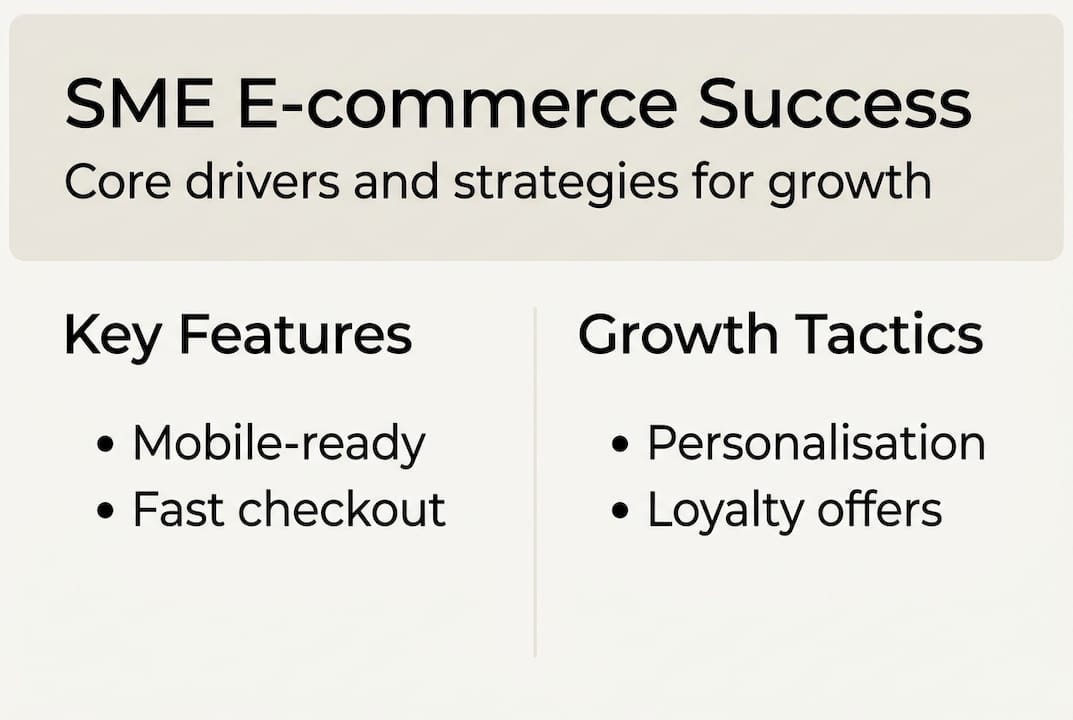
Personalisation does not require a massive budget. Even simple tools that recommend related products or send follow-up emails based on purchase history can significantly increase repeat sales. AI-powered recommendation engines are now accessible to businesses of any size through standard e-commerce platforms.
Omnichannel means connecting your online and offline experience. A customer who sees your product in-store should be able to order it online for delivery. A customer who buys online should be able to return in-store. This integration builds trust and removes friction. Businesses that operate in silos lose customers at every gap.
Key metrics every SME should track:
- Conversion rate — the percentage of visitors who complete a purchase (industry average is 1 to 3%)
- Average order value (AOV) — how much each customer spends per transaction
- Cart abandonment rate — how many customers leave before completing checkout
- Customer lifetime value (CLV) — total revenue generated per customer over time
- Return on ad spend (ROAS) — revenue generated for every dollar spent on advertising
Loyalty matters more than most SME owners realise. 62% of Australians will switch retailers for better deals or service. That means your existing customers are always at risk. A simple loyalty programme, personalised follow-up email, or exclusive member discount can be the difference between a one-time buyer and a repeat customer.
Pro Tip: Offer free shipping above a minimum order threshold. It consistently increases AOV and reduces cart abandonment. Combine this with parcel locker delivery options to give customers more flexibility.
Pair these tactics with strong SEO for small businesses and proven SEO ranking strategies to drive organic traffic that does not depend on paid advertising.
Our perspective: what most SME leaders miss about e-commerce advantage
Here is the uncomfortable truth. Most SMEs that struggle online are not failing because of budget. They are failing because of focus. They invest in expensive platforms or flashy design while neglecting the basics: fast load times, clear product descriptions, and a checkout process that does not frustrate customers.
Agility is the real advantage SMEs have over large retailers. You can test a new product page this week, review the data next week, and make changes immediately. A corporate team would take months to do the same. That speed is genuinely powerful if you use it.
The most successful Australian SMEs we work with share one trait. They treat their website as a living business asset, not a set-and-forget project. They review their metrics regularly, update their content, and respond to customer behaviour. If you want a practical starting point, the complete ecommerce build guide covers the full process from planning to launch. Small, targeted improvements consistently applied will always outperform a single expensive overhaul.
Ready to build your SME’s e-commerce advantage?
The strategies in this guide are proven and practical. But knowing what to do and having the capacity to execute it are two different things. That is where expert support makes a real difference.
At Titan Blue, we build e-commerce websites that are fast, conversion-focused, and built to grow with your business. Explore the e-commerce website design benefits that come with a professionally built store, learn what goes into designing high-performing websites, and protect your investment with reliable website care that keeps your store running at its best. Get in touch with our team today and let’s build something that actually drives results.
Frequently asked questions
What is the biggest advantage of having an e-commerce website for an Australian SME?
E-commerce websites enable you to reach more customers 24/7, growing your sales well beyond your local area in a cost-effective way.
Which e-commerce features are most important to implement first?
Prioritise mobile responsiveness, fast load speed, secure payment, and a simple checkout flow. These key mechanics have the greatest direct impact on your conversion rate.
How can a small business compete against large online marketplaces?
Focus on personalisation, local service, loyalty programmes, and niche products. Personalisation and loyalty help SMEs counter price competition from large platforms effectively.
What are the common pitfalls when building an SME e-commerce site?
Neglecting SEO, slow site speed, and a poor checkout experience are the most frequent mistakes. SEO and fast user experience are vital for driving organic traffic and keeping customers on your site.
Are there government grants or support to help SMEs go online?
Yes. Many federal and state programmes provide digital upskilling, grants, and free advisory specifically for e-commerce adoption. Government-funded programmes can help SMEs bridge skills and capital gaps effectively.
Recommended
- Australian E Commerce SEO Services a Guide to Driving Growth
- What is ecommerce website design and why it matters in 2026
- How to Increase Online Sales in Australia
- How to build an ecommerce site in Australia: a complete guide
Make Titan Blue a preferred source in Google
One click tells Google to surface our articles more often in Top Stories, AI Overviews and AI Mode.

AEO Website Design Checklist 2026: The Complete Build Guide
A practical AEO website design checklist for 2026 covering crawlability, schema markup, content structure, Core…

How to Make Your Website AI Friendly: The 2026 Step-by-Step Guide
How to make your website AI friendly: a step-by-step 2026 guide to getting crawled, structured…

Web Design for AI Search Optimisation: The 2026 Build Guide
Web design for AI search optimisation: crawlable HTML, clear architecture, accessible UX and trustworthy content…