


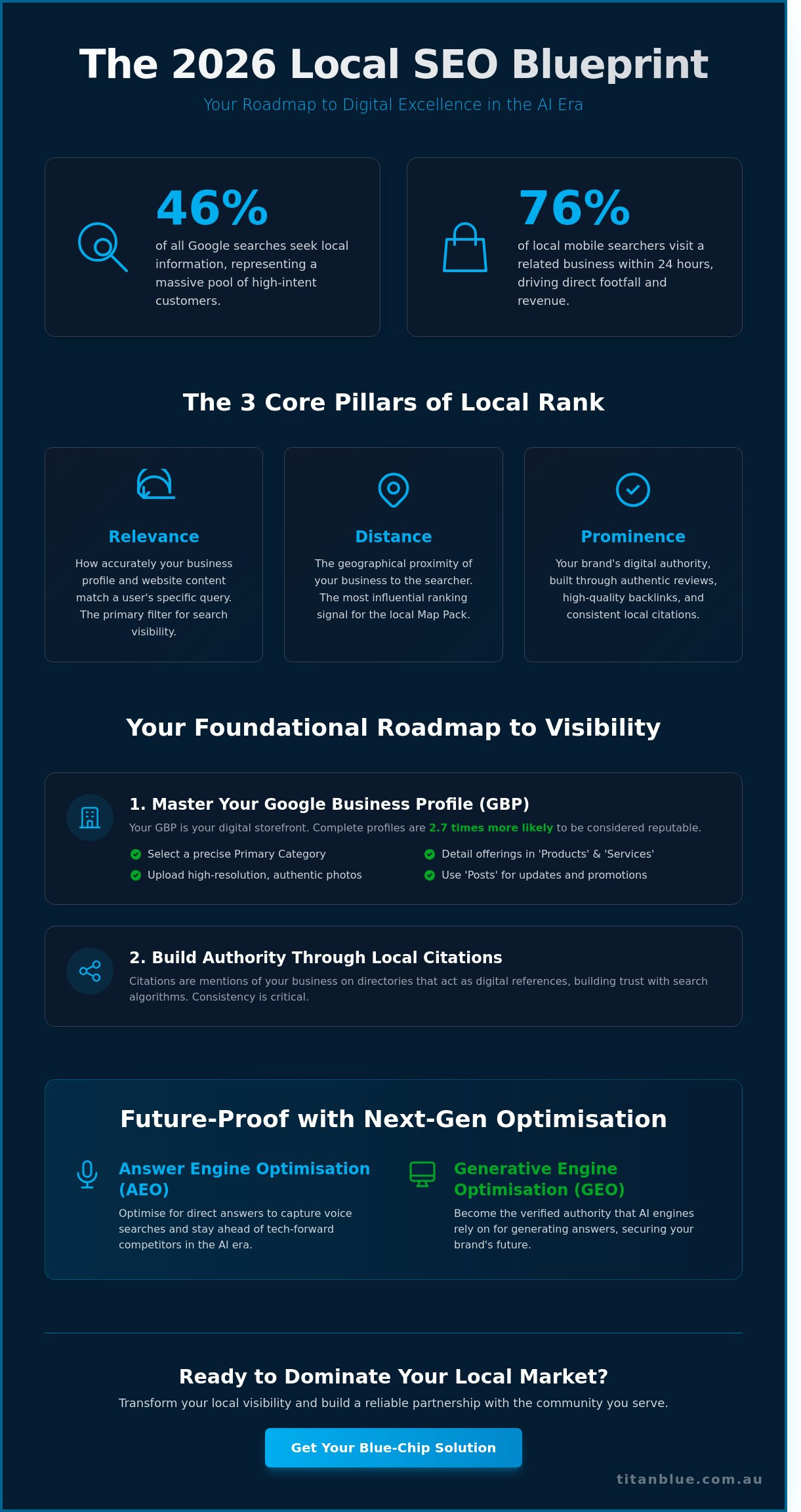
By 2026, the traditional search result will be secondary to the AI-driven answer, meaning your business must be more than just listed; it must be verified as the local authority. Research shows that 46% of all Google searches now seek local information, yet many Sydney businesses remain invisible to these high-intent customers. You’ve likely felt the frustration of watching competitors dominate the Map Pack while you’re left decoding complex terms like Schema and Citations. It’s exhausting to manage a business while worrying if tools like ChatGPT are making your current local seo strategy obsolete.
We’ve created this guide to provide a stable roadmap for Digital Excellence in the Australian market. You’ll learn how to transform your visibility and capture customers using a bespoke blend of modern SEO and Generative Engine Optimisation (GEO). We’ll break down the exact steps to increase your local enquiries and provide blue-chip solutions that future-proof your brand against the next wave of AI search shifts. This is about more than just rankings; it’s about building a reliable partnership between your brand and the community you serve.
Key Takeaways
- Master the essentials of Google Business Profile and NAP consistency to establish a rock-solid digital storefront for your Australian brand.
- Learn how to integrate Answer Engine Optimisation (AEO) to capture voice searches and stay ahead of tech-forward competitors in the AI era.
- Implement a strategic local seo framework that moves beyond the Map Pack to secure visibility across the evolving 2026 digital landscape.
- Discover how to leverage proactive review acquisition strategies to build the trust and authority needed to convert high-intent local customers.
- Adopt a performance-driven approach by creating bespoke localised content that resonates with the specific needs of your target community.
Defining Local SEO in the 2026 Digital Landscape
Local SEO is the strategic process of optimising your online presence to attract more business from relevant local searches. It’s the engine that powers your visibility when a potential client in your suburb looks for exactly what you offer. While many associate the term strictly with the Google Map Pack, the 2026 landscape is far more nuanced. When exploring What is Local SEO?, it’s clear that the practice has moved far beyond basic directory listings; it now encompasses a holistic digital footprint designed to satisfy both human intent and sophisticated AI algorithms. At Titan Blue, we view these high-end optimisations as blue-chip solutions that should be accessible to every Australian enterprise.
Google’s shift from traditional “blue links” to providing “intelligent answers” means your data must be structured for immediate consumption. Research from 2024 confirms that 46% of all Google searches are seeking local information. This massive volume of local intent drives the three core pillars search engines use to determine your rank:
- Relevance: How accurately your business profile and website content match the user’s specific query.
- Distance: The geographical proximity of your business to the searcher or the specific location mentioned in the search.
- Prominence: The digital authority of your brand, built through authentic reviews, high-quality backlinks, and consistent local citations.
The Evolution of Local Search: Beyond Google Maps
User behaviour has matured significantly. People no longer just search for “businesses”; they ask complex questions about local services. This shift has accelerated the rise of zero-click searches, where users find your phone number, address, or service list directly on the search results page without ever visiting your website. Your business information must be accurate and accessible at a glance to capture these leads. Local SEO acts as the foundation of your digital strategy, ensuring your brand remains the definitive answer to a local problem. It’s about being present where the conversation happens.
Why Australian Businesses Require a Bespoke Local Strategy
The Australian market presents unique competitive challenges, from the high density of Sydney and Melbourne to the specific needs of regional hubs. You can’t rely on generic global tactics to win in a local auction. Local SEO operates on a different algorithm than traditional organic SEO; it prioritises local signals over global authority. This distinction is vital because local visibility drives high-quality leads that convert at a much higher rate. Data suggests that 76% of people who search for something nearby on their smartphone visit a related business within 24 hours. A bespoke strategy ensures you capture this high-intent traffic, turning digital searches into physical footfall and measurable revenue growth for your brand.
The Foundational Pillars of Local Search Visibility
Success in the Australian market requires a rock-solid structural base. You can’t build a high-performing digital presence on a shaky foundation of inconsistent data. To dominate your niche, you must align your brand with the three core signals search engines use to verify your legitimacy: relevance, distance, and prominence. These pillars ensure that when a potential client in Sydney or Melbourne searches for your services, your business appears as the most reliable solution.
Mastering Your Google Business Profile
Your Google Business Profile (GBP) acts as your digital storefront. It’s often the first interaction a potential client has with your brand. Start your optimisation by selecting a primary category that exactly matches your core revenue driver. According to 2024 industry data, businesses with complete profiles are 2.7 times more likely to be considered reputable by consumers. You should utilise high-resolution visual storytelling by uploading authentic photos of your team and completed projects to build immediate rapport.
Engage users directly by using the “Products” and “Services” tabs to list your bespoke offerings. Regular “Posts” can highlight recent wins or seasonal promotions, keeping your profile active and relevant. Proximity is the geographical distance between the user and your business, serving as the most influential ranking signal for the local Map Pack.
Building Authority Through Local Citations
Local citations are mentions of your business across the web on high-authority Australian directories like True Local, Yellow Pages, and Hotfrog. These listings act as digital references that build foundational trust with search algorithms. Consistency is your non-negotiable requirement here. Your Name, Address, and Phone Number (NAP) must be identical across every platform. Even a small discrepancy, like “Street” versus “St”, can dilute your authority and confuse search bots.
You should conduct a technical audit to find and merge “ghost” listings. These are old or automated entries that contain outdated information. Fixing these ensures your strategic local seo efforts aren’t undermined by conflicting data. For the 40% of Australian small businesses operating as Service-Area Businesses (SABs), the strategy shifts slightly. If you don’t have a physical office, you can define your service radius within GBP while keeping your home address private. This allows you to rank effectively in specific suburbs without needing a traditional shopfront. This tailored approach ensures your brand remains visible where your customers actually live and work.
Next-Gen Local SEO: Integrating AEO and GEO
Relying solely on the “Map Pack” is a strategy from 2020. In the 2026 market, local seo demands a sophisticated shift toward how machines interpret your business data. Tech-forward competitors have moved beyond simple keyword stuffing. They now focus on how AI models perceive their brand’s relevance and reliability. If your business isn’t visible to the algorithms powering modern search, you’re effectively invisible to your customers.
Staying ahead requires a dual approach. You must optimise for both the human user and the AI “crawler” that synthesises information. This involves a transition from static listings to a dynamic, AI-ready presence. By implementing advanced technical structures, you ensure your business remains the primary choice when a digital assistant or generative engine makes a recommendation.
Capturing the Voice of the Local Customer with AEO
Answer Engine Optimisation (AEO) is about winning the “zero position” in search results. When an Australian homeowner asks their smart speaker, “Who is the most reliable electrician in Geelong?”, they don’t want a list of links. They want a single, authoritative answer. To capture these queries, your content must pivot from generic keywords to natural language solutions. We focus on creating structured FAQ sections and concise service descriptions that provide immediate value.
Securing featured snippets builds instant authority. It positions your brand as the definitive expert in your local area. This strategy reduces friction for the customer, providing the direct answer they need at the exact moment of intent. It’s a supportive way to guide your local audience toward your services without them having to dig through pages of results.
GEO: Ensuring Your Brand is the AI’s Top Recommendation
Generative engines like ChatGPT and Gemini don’t just search the web; they synthesize it. They form recommendations by pulling data from local reviews, social signals, and mentions on reputable Australian news sites. This process, known as generative engine optimisation, is the new frontier for local brands. You need a high volume of positive “brand citations” across the generative web to ensure these AI platforms trust your business enough to recommend it.
To dominate your local seo rankings in 2026, your data must be structured for AI-readiness. This includes:
- Advanced Schema Markup: Using JSON-LD to clearly define your service areas, opening hours, and price points.
- Consensus Building: Encouraging detailed, keyword-rich reviews that mention specific local landmarks or suburbs.
- Strategic Citations: Ensuring your brand name is mentioned in local digital publications and community forums.
This technical rigor ensures your brand isn’t just found; it’s endorsed by the AI tools your customers use every day. We act as your trusted navigator through this digital complexity, ensuring your business remains a blue-chip solution for your local community.
Building Trust and Authority through Social Proof
Digital trust is the primary currency of the Australian marketplace. According to the BrightLocal 2024 Consumer Review Survey, 98% of consumers read online reviews for local businesses before making a purchase decision. This social proof acts as a psychological shortcut, reducing the perceived risk for a potential customer. In the context of local seo, high-volume, high-quality feedback signals to search engines that your brand is a reliable solution for the user’s query.
Building long-term brand equity requires a proactive review acquisition strategy rather than a passive approach. You need to implement a system that captures customer sentiment at the peak of their satisfaction. This doesn’t just improve your star rating; it builds a defensive moat around your reputation. Managing your reputation also involves active participation. Data from Uberall indicates that businesses responding to at least 32% of their reviews see an 80% higher conversion rate compared to those that remain silent. Whether a review is glowing or critical, your response demonstrates professional accountability and engagement, both of which are weighted heavily by modern ranking algorithms.
The Strategic Management of Customer Reviews
Review Velocity and Review Diversity are critical signals for the 2026 local algorithm. Velocity refers to the steady stream of new feedback, while diversity involves gathering reviews across multiple platforms like Google, ProductReview.com.au, and industry-specific directories. To encourage authentic feedback, integrate review requests into your post-purchase workflow or SMS follow-ups. Ensure you stay within ACCC guidelines by avoiding incentivised or fake reviews, which can lead to heavy penalties. Once captured, these reviews become powerful marketing assets that you can repurpose for your social media feeds and website testimonials to reinforce your market position.
Schema Markup: The Secret Language of Local SEO
LocalBusiness Schema is a specific type of structured data that helps search engines categorise your services with surgical precision. It translates your website content into a format that algorithms can instantly digest, covering your ABN, physical address, and specific service categories. For businesses operating across multiple suburbs or states, implementing separate structured data for each location ensures search engines don’t conflate your service areas. Schema acts as a direct data bridge between your website and generative engines to ensure AI-driven search results present your business details with absolute precision.
Navigating Your Journey to Local Digital Excellence
Local SEO isn’t a trophy you win once and keep forever. It’s a continuous cycle of refinement and adaptation. Many Australian business owners fall into the trap of a “set and forget” mentality, only to find their visibility plummeting after a few months of inactivity. In the 2026 digital environment, search algorithms prioritise businesses that demonstrate active engagement with their community. You must monitor your performance metrics consistently to stay ahead of the curve.
True success isn’t measured by vanity metrics like keyword rankings alone. While appearing at the top of search results is a vital first step, it’s the tangible business growth that matters. You should track specific conversion points, such as click-to-call actions, booking enquiries, and physical foot traffic. Data from late 2025 suggests that businesses focusing on conversion-optimised local profiles see a 34% higher ROI than those chasing rankings alone. This shift in focus ensures your digital presence serves your bottom line rather than just your ego.
Developing a Performance-Driven Local Content Strategy
Your content needs to speak the language of your specific neighbourhood. Hyper-local blogging allows you to address the unique pain points of your regional audience, such as specific weather impacts on Sydney home maintenance or local council regulations in Western Sydney. By using local case studies and data, you demonstrate a level of expertise that generic content can’t match. If you’re ready to scale your reach, it’s vital to choose a partner who understands these nuances. Consult our seo company selection guide to ensure you’re making a secure investment for your brand’s future.
Why a Managed SEO Strategy is a Blue-Chip Investment
The complexity of modern search requires a sophisticated, full-service approach. Technical management, algorithm monitoring, and reputation management are heavy burdens for any business owner to carry alone. Titan Blue’s “Trusted Navigator” model functions as a seamless extension of your team, providing the stability you need in an unpredictable market. We treat your local seo strategy as a blue-chip asset, focusing on long-term resilience and steady growth. Moving from digital curiosity to measurable local dominance requires a professional hand. By partnering with experts, you secure the peace of mind that comes with knowing your brand is being guided toward excellence by an experienced, local team.
Secure Your Local Digital Future
The 2026 digital landscape demands a shift from traditional search tactics to a sophisticated strategy that integrates AEO and GEO. Dominating your local seo requires more than just a basic map listing; it’s about becoming the trusted authority that generative engines recommend first. By prioritising social proof and technical optimisation, you create a resilient foundation that turns local searches into loyal customers. You don’t have to navigate these technical complexities alone.
Titan Blue has delivered over 20 years of strategic digital excellence, helping Australian businesses achieve sustainable growth through bespoke solutions. As specialists in AEO and GEO future-proofing, our experienced Australian team ensures your brand remains visible as search technology evolves. We act as your trusted navigator, providing the high-level expertise needed to simplify the digital experience and ensure your brand scales with confidence. We value measurable results over empty promises, positioning our team as a seamless extension of your own business. It’s time to move beyond curiosity and start building your legacy of digital excellence. We’re ready to help you lead the market.
Empower your brand with a bespoke Local SEO strategy; contact Titan Blue today.
Frequently Asked Questions
What is the difference between SEO and Local SEO?
Local SEO focuses on optimising your presence for location-based searches, while traditional SEO aims for broader national visibility. While both use content and keywords, local strategies prioritise the Google Map Pack and local directory results. In 2026, 46% of all Google searches have local intent. This targeted approach ensures your Melbourne or Sydney storefront appears exactly when nearby customers search for your specific services.
How long does it take to see results from a Local SEO strategy?
You can expect to see measurable movement in your local rankings within 3 to 6 months of starting a consistent local seo strategy. Initial wins often appear in the first 90 days as Google indexes your updated business profile and local citations. Achieving a top-three position in a competitive Australian suburb usually takes closer to 180 days. This timeline depends on your existing domain authority and the density of competitors.
Do I need a physical office to rank for Local SEO in Australia?
You don’t need a physical storefront to rank, provided you operate as a Service Area Business and meet customers at their locations. Google allows businesses like plumbers or mobile detailers to hide their residential address while still appearing in local searches. You must serve a specific geographic area within Australia to qualify for a profile. Data from 2025 shows that service businesses can achieve 85% of the visibility that brick-and-mortar stores enjoy.
How much does professional Local SEO management cost in 2026?
Professional management typically ranges between A$750 and A$2,500 per month for most Australian small businesses. According to the 2025 BrightLocal industry survey, 68% of agencies have moved toward performance-based or fixed-tier pricing models to ensure transparency. High-competition niches in major hubs like Sydney CBD may command higher fees due to intensive content requirements. Investing in a bespoke strategy ensures your budget focuses on the specific channels that drive revenue.
Can I do Local SEO myself or do I need an agency?
You can manage basic tasks like profile updates yourself, but scaling your growth usually requires the technical expertise of a strategic partner. DIY efforts often stall at the 40% growth mark because they lack the sophisticated tools needed for deep competitor analysis. An agency acts as a steady hand, managing complex tasks like schema markup and local link acquisition. This partnership allows you to focus on running your business while experts secure your long-term digital excellence.
How do online reviews actually impact my local search rankings?
Online reviews are a primary ranking factor, contributing to approximately 17% of how Google determines local visibility. High ratings and frequent, keyword-rich feedback signal to search algorithms that your business is reliable and active. A 2025 study found that businesses with a 4.5-star rating or higher receive 35% more clicks from the local map pack. Consistently responding to reviews builds trust with both the algorithm and your future Australian customers.
What is a Google Business Profile and why is it free?
Google Business Profile is a free tool that allows you to manage how your local business appears on Google Maps and Search. Google provides this at no cost because accurate local data keeps their users engaged and provides a better search experience. While the listing itself is free, the strategic optimisation of that profile is what separates market leaders from the rest. It serves as your digital storefront, providing essential details to your local community.
How does AI and ChatGPT affect my local business visibility?
AI affects your visibility by powering Search Generative Experience, which provides direct answers to user queries using your business data. In 2026, 60% of local discovery happens through AI-driven summaries rather than traditional link lists. Ensuring your website uses structured data allows AI models to accurately recommend your services to local users. This technological shift makes high-quality, authoritative content more critical than ever for maintaining your brand’s presence in the Australian market.
Make Titan Blue a preferred source in Google
One click tells Google to surface our articles more often in Top Stories, AI Overviews and AI Mode.

Solar Installer Website Design Australia: The 2026 Guide
How solar installer websites in Australia should show CEC accreditation, real install proof and AI-ready…
Hotel & Hospitality Website Design Australia: 2026 Guide
Hotel and hospitality website design in Australia explained: booking flow, schema, AEO and what actually…
Restaurant Website Design Australia: The 2026 Guide
What a restaurant website in Australia needs: HTML menus, bookings, GBP sync, schema, and AI-ready…