


Last updated:
TL;DR:
- Effective SEO and content marketing must be integrated as a single growth strategy to boost organic rankings and traffic. Quality content that addresses relevance, authority, and user value naturally attracts backlinks and engages visitors, leading to sustained organic growth. Australian SMBs that combine targeted content creation with strategic optimization will outperform competitors relying on isolated tactics.
Most business owners assume SEO and content marketing are two separate jobs. You either tweak your website’s technical settings or you write blog posts. The reality is very different. When SEO powered by content is done properly, research confirms it delivers a measurably high effect on organic rankings and traffic. This guide is written specifically for Australian small and medium-sized businesses who want to stop guessing and start using content marketing and SEO together as a single, purposeful growth strategy.
Table of Contents
- Why content marketing matters for SEO
- Key components: How content drives SEO performance
- Content types that move the SEO needle
- Integrating content marketing and SEO: A step-by-step game plan
- Our take: Why Australian SMBs need an integrated content and SEO approach for 2026
- Next steps: Elevate your SEO with expert support
- Frequently asked questions
Key Takeaways
| Point | Details |
|---|---|
| Quality content drives SEO | Valuable, relevant content is essential for higher search rankings and web traffic. |
| Integration delivers results | Aligning content marketing with SEO creates a compounding effect on business visibility. |
| Keyword strategy is crucial | Targeted keyword research ensures content matches what your audience is looking for. |
| Backlinks amplify authority | Well-crafted content attracts links that significantly boost search credibility. |
Why content marketing matters for SEO
SEO without content is like a shop with no stock. You can have the best signage in town, but if there is nothing inside worth buying, nobody stays. Content is what gives search engines something to evaluate, and it is what gives your potential customers a reason to trust you.
Search engines rank pages based on three core criteria: relevance, authority, and user value. Well-crafted content satisfies all three at once. A detailed service page answers a specific search query (relevance), earns links from other credible websites (authority), and keeps visitors engaged longer (user value). Remove the content, and you remove the engine that drives visibility.
“When SEO and content marketing work together, the results are not incremental. They compound over time, creating sustainable organic growth that paid advertising simply cannot replicate.”
The meta-analysis evidence is clear: SEO powered by quality content produces a high effect size for improved organic rankings and traffic. This is not theory. It is measured, repeated, and confirmed across industries and markets.
Here is how content marketing directly impacts SEO performance:
- Keyword visibility: Every well-written article or page gives you another opportunity to rank for the terms your customers are actively searching for.
- Backlink acquisition: Genuinely useful content earns links from other websites, which signals credibility to search engines.
- Dwell time and engagement: Quality content keeps visitors on your site longer, which sends positive engagement signals.
- Indexed pages: Each new piece of content adds another indexed page, expanding your overall footprint in search results.
- Topical authority: Publishing consistently on relevant subjects tells search engines you are a knowledgeable source in your field.
Investing in SEO marketing for small business means investing in content first. There is no shortcut around it. And developing the right content marketing strategies from the outset is what separates businesses that grow organically from those that stay invisible online.
Key components: How content drives SEO performance
With the foundation established, it is essential to look at what really makes content effective for SEO. Not all content is equal. Publishing something just to fill space will not move your rankings. What matters is the quality, structure, and strategic intent behind every piece you create.

Research confirms that content quality, keywords, and backlinks are the three biggest levers for SEO success. These are not optional extras. They are the core of any effective content strategy.
Here is what each element means in practice:
- Content quality: Depth, originality, and genuine usefulness matter far more than word count or publishing frequency. A single well-researched article that answers a real customer question will outperform ten shallow posts every time.
- Targeted keyword usage: This means incorporating the search terms your audience actually uses, naturally and contextually, rather than forcing them awkwardly into sentences.
- Link building: Content that provides genuine value earns references from other websites. These backlinks act as votes of confidence in the eyes of search engines.
- Content structure: Proper use of headings, subheadings, bullet points, and internal links makes content easier for both search engines and human readers to navigate.
| Component | Why it matters | Practical example |
|---|---|---|
| Content quality | Establishes relevance and authority | In-depth guide answering a specific question |
| Keyword usage | Connects content to search queries | Natural inclusion of location-based terms |
| Backlinks | Signals credibility to search engines | Being referenced by an industry publication |
| Structure and formatting | Improves crawlability and readability | Clear H2/H3 headings, short paragraphs |
Good website content writing combines all four components. Skip one and your results suffer. A thorough keyword research guide will show you how to identify the exact phrases worth targeting before you write a single word. Pair that with content marketing best practices and you have a repeatable system that compounds over time.
Pro Tip: Before writing any piece of content, identify the single primary keyword you want it to rank for. Build the entire article around answering the search intent behind that keyword, not just including the phrase.
Content types that move the SEO needle
Once you understand the key ingredients, it is time to consider which content formats deliver the biggest SEO impact. Not every format suits every business, but understanding the options helps you prioritise your effort and budget wisely.
High-quality content tailored to search intent drives rankings across all sectors, regardless of industry or business size. The key word here is “tailored.” Generic content written for no one in particular ranks for nothing in particular.
Here are the content types Australian SMBs should focus on:
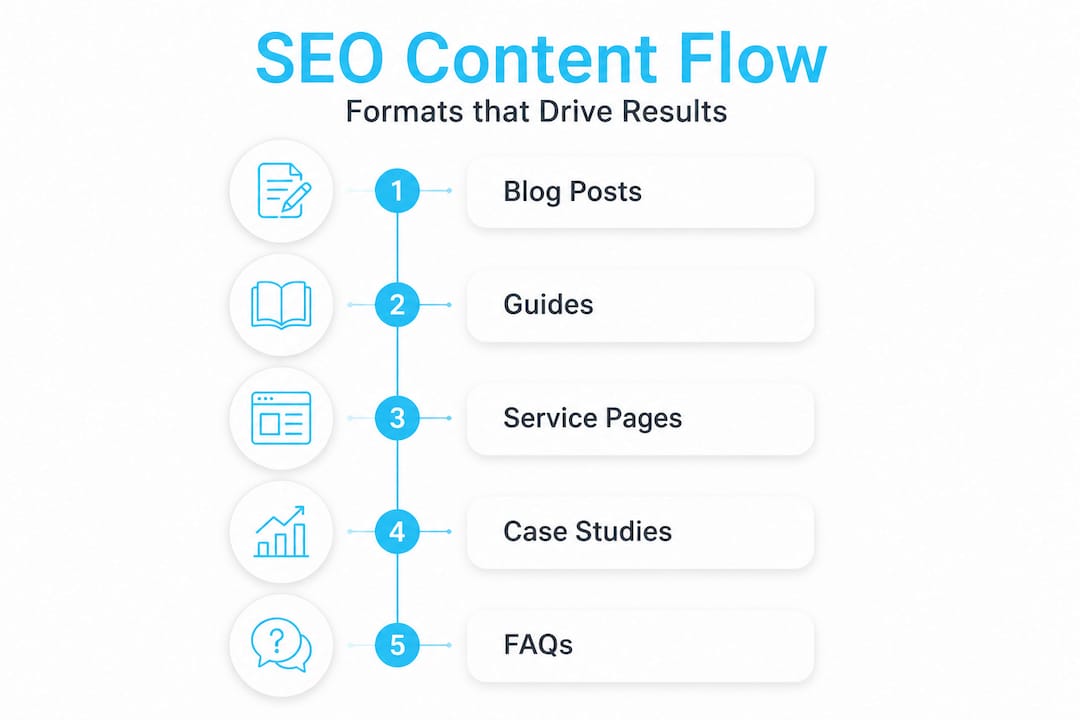
- Blog posts: Regular, informative articles build topical authority over time. A landscaping company in Brisbane that publishes detailed seasonal gardening guides will steadily accumulate rankings for dozens of relevant search terms.
- Service pages: These are your most commercially important pages. Each service you offer deserves its own dedicated page, written to address the exact questions customers ask when searching for that service.
- Guides and resources: Educational long-form content captures top-of-funnel traffic, people who are researching before they are ready to buy. These pieces build trust early.
- Case studies and testimonials: These formats support conversion. When a potential customer reads about a real result you achieved for a real business, trust increases significantly.
| Content type | Primary SEO benefit | Best for |
|---|---|---|
| Blog posts | Building topical authority | Ongoing organic visibility |
| Service pages | Ranking for commercial search terms | Direct lead generation |
| Guides and resources | Top-funnel keyword coverage | Brand awareness and trust |
| Case studies | Conversion support and trust signals | Decision-stage customers |
Effective SEO traffic growth strategies almost always involve a mix of these formats working together. Your service pages capture buyers. Your blog posts capture researchers. Your guides build authority. The combination is what creates consistent, growing organic traffic. Pairing all of this with strong web design and SEO integration ensures your content performs at its technical best once published.
Integrating content marketing and SEO: A step-by-step game plan
Knowing what content works, the next step is mapping out how to unite your marketing and SEO strategies for real-world results. Strategy without execution is just intention. This game plan gives you a concrete process to follow.
Content and SEO alignment is the key to sustainable growth in organic visibility. Here is how to make that alignment happen in your business:
-
Research keywords and customer pain points first. Before creating any content, understand what your audience is searching for and what problems they need solved. Use keyword tools, look at competitor content, and talk to your existing customers. Real insight drives real results.
-
Build a content calendar around SEO opportunities. Map out your content topics by keyword priority and publishing schedule. Consistency matters. A business that publishes two well-researched articles per month will outperform a competitor that publishes sporadically and without strategic intent.
-
Optimise each piece for on-page SEO. This means writing descriptive title tags, using your target keyword in the first paragraph, structuring content with clear headings, adding internal links to related pages, and writing compelling meta descriptions. Every published piece should be technically optimised from the start.
-
Promote your content through relevant channels. Great content that nobody sees earns no backlinks. Share your articles through email newsletters, social media, and industry groups. Reach out to relevant websites that might find your content worth referencing. Active promotion accelerates the link-building process significantly.
-
Measure performance and adjust. Track rankings, organic traffic, engagement rates, and conversion metrics. If a piece is not performing after three months, revisit it. Update the information, improve the depth, refine the keyword targeting. Content is not a publish-and-forget exercise.
SEO marketing for small businesses works best when this process becomes a routine part of your marketing operations. Combining this with consistent content marketing best practices gives your business a genuine competitive edge in organic search.
Pro Tip: Set a quarterly content review date in your calendar. Use it to update your three best-performing articles with fresh data, new examples, and improved structure. Updated content often sees a significant ranking boost within four to six weeks.
Our take: Why Australian SMBs need an integrated content and SEO approach for 2026
Here is something we see regularly working with Australian businesses. A business owner spends money on SEO, gets some technical fixes done, and then wonders why traffic is not growing six months later. Separately, another business publishes blog content regularly, but nobody reads it because it never ranks. Both businesses are doing something right. Neither is doing it together.
The uncomfortable truth is that SEO without content is a foundation with no building on top of it. And content without SEO is a building nobody can find. The businesses winning in organic search right now are the ones treating these two functions as a single, unified strategy.
In 2026, search engines are more sophisticated than ever. They are not just matching keywords. They are assessing expertise, evaluating trustworthiness, and measuring how genuinely useful a piece of content is to the person reading it. Thin content, keyword-stuffed articles, and generic service pages simply do not perform the way they once did.
Australian SMBs face a specific challenge here. The local market is competitive in many sectors, and many businesses are still relying on outdated tactics. That creates a real opportunity for businesses willing to invest in quality. Publishing well-researched, genuinely helpful content that addresses your specific local audience’s needs will put you ahead of competitors who are still chasing shortcuts.
We have also seen businesses fail because they focus too narrowly on one tactic at a time. They run a link-building campaign without improving their content. Or they rewrite their service pages without doing keyword research first. Tactic-by-tactic thinking does not produce integrated results.
The best content marketing advice we can give is this: build a system, not a series of campaigns. Define your audience clearly. Map their search journey from awareness to purchase. Create content that supports every stage of that journey. Optimise every piece technically. Promote it consistently. Measure and improve. Repeat. That is how sustained organic growth happens.
Next steps: Elevate your SEO with expert support
If this article has clarified how content marketing and SEO work together, the next question is how to make it happen for your specific business. Knowing the strategy is one thing. Executing it consistently, while also running a business, is another challenge entirely.
At Titan Blue, we work with Australian SMBs to build and execute content and SEO services strategies that are tailored to your market, your audience, and your growth targets. Whether you need a complete content strategy built from scratch or targeted SEO help for small business to improve what you already have, we have solutions designed to fit your budget and goals. Our team of web design experts ensures every piece of content you publish is supported by a technically sound, well-structured website built to rank. Get in touch today and let’s map out a plan that gets your business found.
Frequently asked questions
How long does it take to see SEO results from content marketing?
Most businesses see meaningful improvements in search rankings and organic traffic within 3 to 6 months, provided content is published consistently and optimised correctly. SEO powered by content builds momentum over time, meaning results typically improve the longer the strategy is maintained.
What is the best type of content for SEO?
Well-researched articles, detailed guides, and service pages that directly address users’ search intent produce the strongest SEO results. Research confirms that content tailored to search intent drives rankings across all sectors, making relevance to the searcher’s actual need the most important factor.
How does keyword research support content marketing for SEO?
Keyword research ensures you are creating content around the exact phrases your potential customers are searching for, which directly increases your organic visibility. Research shows that content quality, keywords, and backlinks are the primary drivers of SEO success, and keyword research informs two of those three factors.
Do backlinks matter if I focus on content?
Yes, and the good news is that quality content naturally attracts backlinks. When other websites reference your articles or guides, it signals authority to search engines and boosts your rankings. Content quality and backlinks work together, and one reinforces the other when your content is genuinely useful.
Recommended
- Effective SEO Marketing for Small Business Success – Titan Blue Australia
- Dominate Real Estate SEO in 2026
- A Guide to Content Marketing Service That Drives Growth
- Website Content Writing: website content writing that boosts SEO and conversions
Make Titan Blue a preferred source in Google
One click tells Google to surface our articles more often in Top Stories, AI Overviews and AI Mode.

Best Dental Website Design Agencies in Australia: 7 Compared
Best dental website design agencies in Australia 2026: seven compared on dental proof, booking, AHPRA…

Childcare Centre Website Design Australia: The 2026 Guide
Childcare centre website design Australia: show hours, ages and enrolment as text so parents and…

Electrician Website Design Australia: The 2026 Guide
Electrician website design Australia: what to build, what we found on eight Gold Coast electrician…