

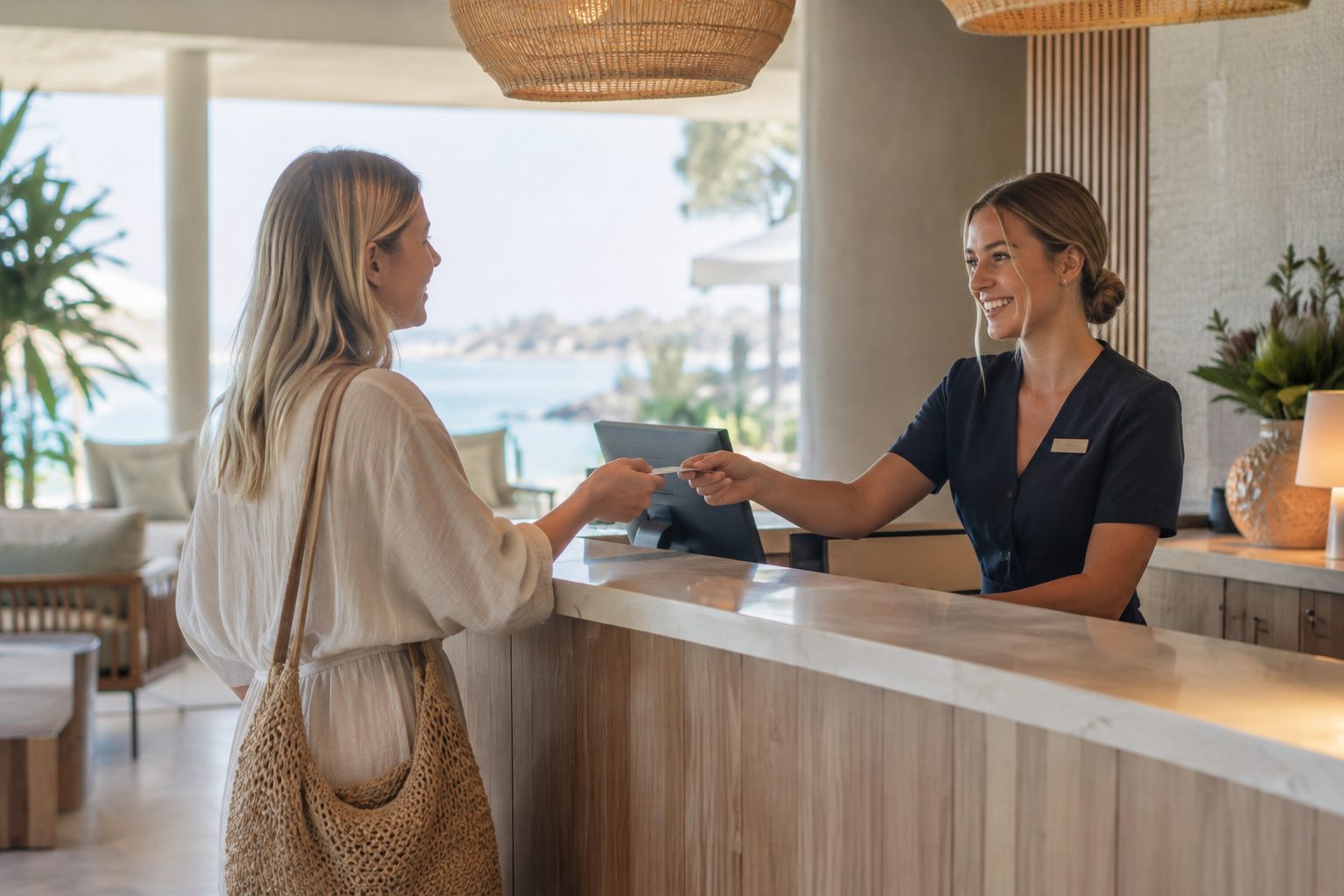
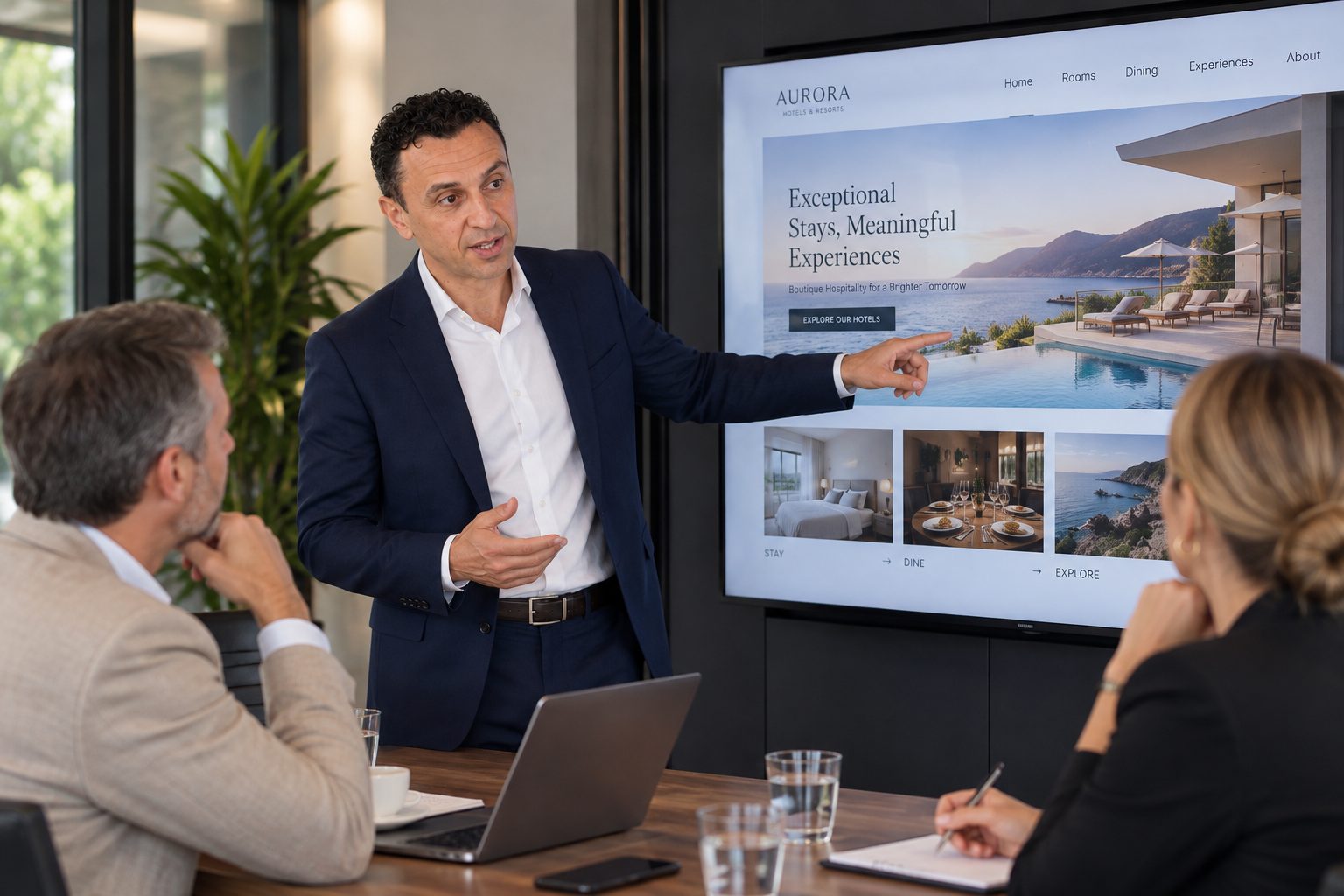
Hotel and hospitality website design in Australia means building a site around one job: turning a browsing guest into a direct booking, without losing them to a third-party booking platform along the way. That means a booking widget visible without scrolling, room and rate pages that stand alone as complete answers, real photography over stock imagery, and structured data that tells Google and AI engines exactly what kind of property you are, where it is, and what it costs to stay. Everything else on the site, from the homepage hero to the contact page, supports that one conversion path.
Most hospitality operators in Australia, from a Broadbeach boutique hotel to a Southport serviced apartment block or a Burleigh Heads bed and breakfast, are competing with Booking.com and Expedia on their own website. That is a harder fight than it looks, because OTAs (online travel agents) have booking engines, review volume and ad budgets that a single property cannot match feature for feature. The website’s advantage is different: it can answer questions an OTA listing never will, in language specific to the property, and it can be built so AI engines cite it directly when someone asks a question like “family friendly hotel near Broadbeach with parking”.

Australia’s hospitality sector is also unusually seasonal and regionally specific. A Gold Coast property competing for Schoolies, Commonwealth Games legacy tourism or Christmas school holiday traffic has a different content and booking calendar to a Robina corporate stay hotel targeting weekday business travellers, or a Coolangatta beachfront apartment building targeting long weekend family bookings. A hospitality website design brief in Australia should account for that seasonality directly, not treat every enquiry as generic.
What does hotel and hospitality website design actually involve?
It involves five connected pieces working as one system: a booking engine or integration with a property management system (PMS) such as SiteMinder, RMS or Cloudbeds, a room or accommodation type structure that gives each room its own page, a gallery and virtual tour that load fast on mobile, local and destination content that captures nearby search intent, and technical foundations (speed, Core Web Vitals, schema markup) that make the site both usable and machine readable. A hospitality site is judged commercially by one number: the ratio of direct bookings to OTA bookings, because every OTA booking pays a commission the direct booking does not.
This is different from a standard business website build. A cafe or a tradie website needs a contact form and a clear service list. A hotel or accommodation website needs a live booking flow connected to real inventory and pricing, which raises the technical bar and the stakes of getting it wrong. A broken date picker or a booking widget that opens in a disconnected new tab costs a confirmed booking, not just a bounce.
What should a hotel website include?
At minimum, a hospitality website in Australia should include the following, each built as its own crawlable page rather than a single long homepage:
- A booking widget above the fold on the homepage and every room page, with date pickers visible without scrolling and real-time availability rather than a “check availability” link that leaves the site
- Individual room or accommodation type pages, each with its own description, photography, amenities and a direct booking CTA, rather than one page listing every room type
- A local area and destination page naming nearby landmarks, beaches, transport links and attractions, since this is what captures “near me” and location-specific search intent
- Real photography of the actual property, not stock imagery. Guests can tell, and so can review sites
- Transparent pricing and policies, including cancellation terms, check in and check out times, and any resort or service fees, stated plainly rather than surfaced only at checkout
- An accessible booking flow, built to WCAG guidelines so guests using assistive technology can complete a booking without assistance, which is both good practice and, for many Australian businesses, a legal expectation under the Disability Discrimination Act
- A mobile-first booking flow, since most hospitality searches and a large share of hospitality bookings now happen on a phone
- Reviews and guest content embedded from the property’s own review history, not just a link out to a third-party review site
A hub-and-spoke structure works well here: a single “Rooms” or “Accommodation” hub page links out to a standalone page for each room type or property, and each of those pages is genuinely complete on its own, with its own photography, amenity list and booking path. This also happens to be the structure that best supports answer engine optimisation, because it gives an AI engine one clean, specific page to cite for “which room has a balcony” rather than forcing it to guess from a single long page. It is the same hub-and-spoke logic used in general web design for any business with multiple distinct offerings, applied to rooms and property types instead of services.
Local content deserves its own dedicated page rather than a paragraph buried on the homepage. A genuinely useful local area page names real landmarks (Kurrawa Park, the Oasis Shopping Centre, Q1, HOTA), gives walking distances rather than vague claims like “close to everything”, and covers practical questions a guest actually has: where to park, whether public transport runs late, which beach is patrolled, and what is within walking distance for a family without a car. That level of specificity is also what an AI engine needs to answer a location-based question about the property with confidence.
How does booking integration actually work?
The booking widget on a hotel or hospitality website is almost never built from scratch. It is typically a channel manager or booking engine (SiteMinder, RMS, Cloudbeds, ResRequest or similar) embedded into the site via an API or iframe, connected back to the property’s PMS so that availability and rates stay in sync across the website, OTAs and the front desk in real time. The website design work is making sure that integration feels like a native part of the site rather than a disconnected system, and that it does not demand an account signup or force the guest into a new browser tab before they can see a price.
For multi-property groups, whether that is a small chain of Gold Coast serviced apartments or a national accommodation brand, this gets more complex again: a central booking engine has to serve multiple properties, each with its own page, its own local content and its own schema, while sharing one underlying reservation system. Getting that structure right at the build stage saves a costly re-platform later.
What platforms do Australian hospitality businesses build on?
WordPress remains the most common platform for independent hotels, bed and breakfasts, motels and small accommodation groups in Australia, usually paired with a booking engine plugin or an embedded third-party widget rather than a native WordPress booking system, since WordPress itself is not built to manage live room inventory. Elementor and similar page builders are commonly used on top of WordPress to handle the visual layout of room pages and galleries. Larger hotel groups and resorts more often use a dedicated hospitality CMS or a custom build that ties directly into an enterprise PMS. Whichever platform is used, the same requirement holds: the booking engine has to be the fastest, most reliable part of the site, because it is the only part directly connected to revenue, and that speed is measured against Google’s Core Web Vitals thresholds, which increasingly matter as much on a booking widget as they do on the homepage.
Serviced apartment operators and short-stay accommodation providers, common along the Gold Coast’s Surfers Paradise and Broadbeach high-rise strips, face an added layer: many also list on short-term rental platforms alongside a direct booking site, and the website needs to make the direct-booking price and terms visibly competitive with those listings rather than simply linking out to them. Clear, comparable pricing on the property’s own site is what earns the direct booking instead of the platform fee.
💡 Not sure if your booking flow is costing you guests?
We review hospitality websites for booking friction, mobile speed and AI search readiness. It takes 15 minutes and it’s free.
How long does a hotel or hospitality website project take?
A straightforward rebuild for a single independent property, with booking engine integration, room pages, a local content section and photography already available, typically runs several weeks from content collection to launch. The variable that most often extends the timeline is not design, it is data: getting accurate, current room descriptions, rates and photography from the operations team, and confirming the booking engine’s API access and testing the live connection before launch. Multi-property builds, or any build requiring custom PMS integration, take longer because each property’s content and inventory has to be mapped and tested individually.
How do you know if a hospitality website is actually working?
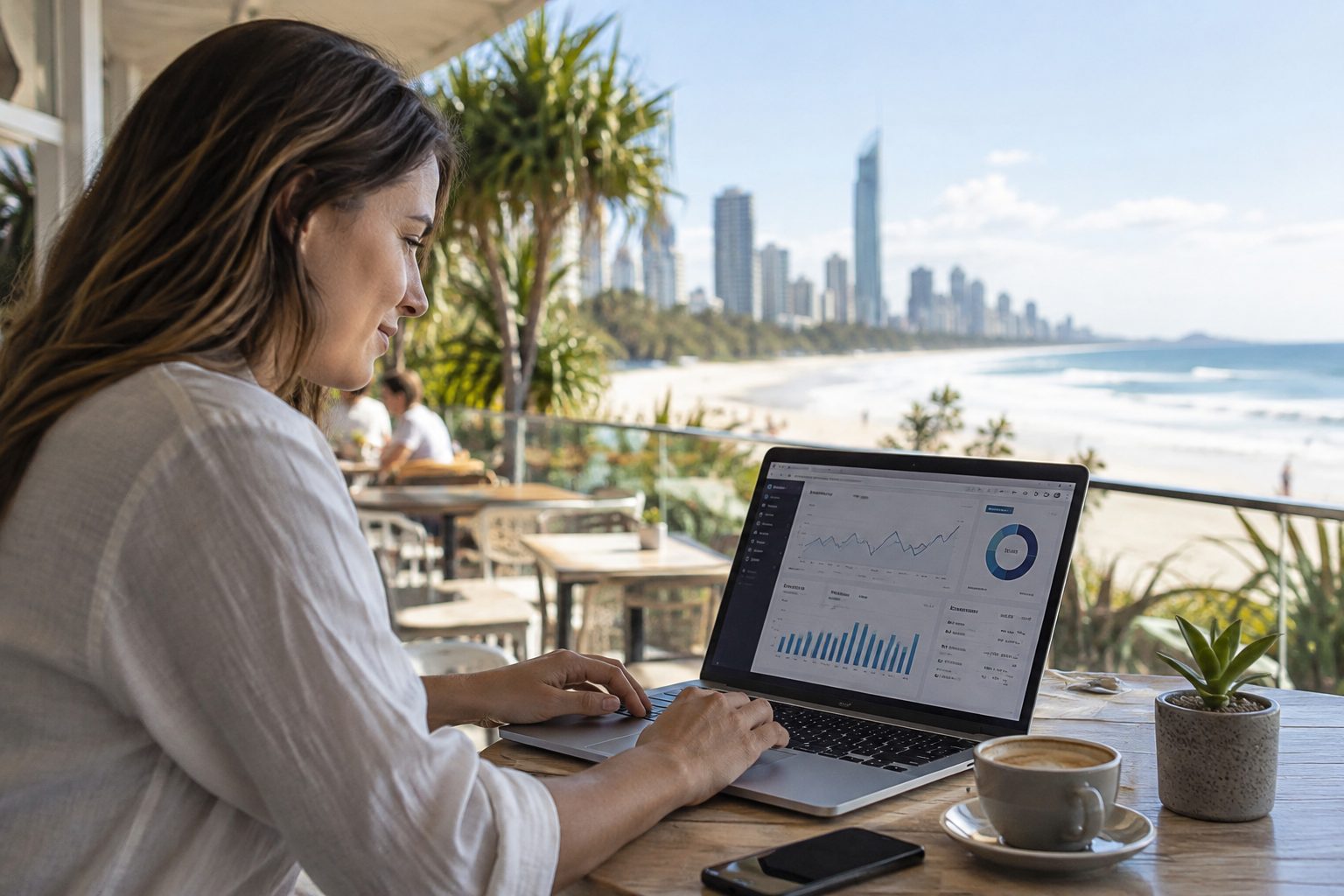
The clearest measure is the direct booking ratio: what share of confirmed reservations came through the website versus through an OTA. A website that is working should show that ratio moving in the property’s favour over time, alongside falling OTA commission spend as a proportion of total revenue. Secondary signals worth tracking include mobile conversion rate on the booking widget specifically (not just the site overall), average time to complete a booking, and whether the site appears when a prospective guest searches a specific, local, intent-rich phrase such as “pet friendly accommodation Burleigh Heads” rather than only a generic brand search.
Search Console and analytics data will show whether the site is being found for those local and destination queries. What they will not show directly is whether an AI engine such as Google’s AI Overviews, ChatGPT or Perplexity is citing the property when someone asks a similar question conversationally. That is a separate, and increasingly important, measure of visibility, and one most hospitality operators have no way of checking without deliberately running the question themselves and reading what comes back.
It is worth being precise about what that kind of check actually is. Running a query through a live search index and reading which pages appear is a look at ranked results for one query on one day, not a test of whether an AI assistant is recommending a property, and the two should not be confused when reporting results internally or to a board.
What makes a hotel website AI-ready, and why does it matter now?
This is where most hospitality websites in Australia currently fall short, and it is the single biggest opportunity in the category. AI engines answer travel questions by pulling from pages that state facts plainly and mark them up in a machine-readable way: schema.org’s Hotel and LodgingBusiness types exist specifically so a hotel page can declare its name, address, star rating, amenities, check in and check out times and price range in a structured format that a crawler, and increasingly an AI engine, can read without having to interpret prose. Google’s own developer documentation sets out the Hotel and HotelRoom structured data fields for exactly this purpose, and Google’s own structured data introduction confirms this markup is read by both Search and its AI features, not just traditional listings.
To see how many Australian hospitality websites are actually doing this, we ran a direct browser-based check against six hotel and resort pages: their homepage or property page, fetched live with a standard browser user agent, and read for schema.org structured data in the page source. Three of the six returned a page we could read in full. Of those three, only one carried any JSON-LD structured data at all, and it was a generic LocalBusiness block rather than the purpose-built Hotel type, which tells a crawler far more about room types, amenities and price range. The other three did not return a readable page for us: two redirected to a 404 and one reset the connection. We treat those three as inconclusive rather than as evidence of anything, because a failed or blocked fetch is not proof a site lacks schema.
The practical takeaway: even among established hospitality brands with significant marketing budgets, hotel-specific schema is inconsistently implemented. For an independent property or a smaller Australian hospitality group, that is an opening rather than a disadvantage, because it means a well-built, correctly marked-up site does not need to out-market a larger competitor to be found and cited, it needs to be more legible to the systems doing the finding.
In practice, being AI-ready as a hospitality website means: Hotel or LodgingBusiness schema with accurate amenity, address and rating data; a distinct, complete page per room type rather than one long page; an FAQ section that answers real guest questions directly (check in flexibility, parking, pet policy, cancellation terms) in plain language; and local content that names actual nearby landmarks and suburbs rather than vague regional claims. AI engines cite specific, well-structured answers. They do not cite a homepage that only says “luxury accommodation in a stunning location” without naming where that location is or what the room actually includes.
A quick way to check where a property currently stands is to run its homepage and one room page through a structured data test and read the result plainly: does it return a Hotel entry with amenities and address, a generic LocalBusiness block, or nothing at all. Titan Blue’s own AI Ready Check runs that same kind of assessment against a live site and reports back what an AI engine would actually be able to read from it today.
What are the most common hospitality website mistakes?
- Booking widgets that open in a new, disconnected tab, which breaks the sense of a single continuous experience and increases abandonment
- Stock photography instead of the property’s own images, which undermines trust the moment a guest compares it to review site photos
- One long accommodation page instead of individual room pages, which weakens both search visibility and AI citability, because there is no single, complete page to point to for a specific room type
- No structured data at all, or only generic
LocalBusinessschema, leaving the property invisible to the structured queries AI engines increasingly rely on - Pricing or fees hidden until checkout, which damages trust and is increasingly penalised by both guests and review platforms
- Slow image-heavy pages on mobile, where most hospitality browsing now happens, particularly for last minute and same-week bookings
Fixing these does not require a full rebuild in most cases. A booking widget can usually be re-embedded inline rather than in a new tab, schema can be added to existing pages without touching the design, and a single accommodation page can be split into individual room pages while keeping the same URL structure for the hub page. The work that takes longest is usually gathering accurate, current photography and copy from the operations team, not the technical build itself.
Frequently Asked Questions
Do hotel websites need a booking engine, or can a simple contact form work?
A contact form alone will lose most bookings to a competitor or an OTA that offers instant confirmation. A live booking engine connected to real inventory and pricing is now the baseline expectation, even for small independent properties.
What is the difference between a hotel website and a general business website?
A hotel website has to manage live inventory, pricing and availability through a connected booking system, and typically needs individual pages per room or accommodation type. A general business website usually only needs a clear service list and a contact or enquiry form.
Does my hotel need a page for every room type?
Yes, if search visibility and AI citability matter to the business. A single page listing every room type gives search engines and AI systems no clean, specific page to point to when someone asks about a particular room. Separate pages solve that.
What is LodgingBusiness or Hotel schema, and do I need it?
They are schema.org structured data types that let a hotel page declare facts (name, address, star rating, amenities, price range, check in and check out times) in a format search engines and AI systems can read directly. Our own check of Gold Coast and Queensland hospitality sites found it inconsistently implemented, so adding it correctly is a genuine point of difference.
Should hospitality content focus on selling the room or answering questions?
Both, but in that order reversed from how most sites are written. Answer the practical questions first (location, parking, pet policy, cancellation terms, what is included) in plain language, then let the photography and description do the selling. AI engines and time-poor guests both respond better to a direct answer than to marketing language.
How does AEO apply to a hotel website specifically?
Answer engine optimisation for hospitality means structuring the site so an AI engine can lift a specific, accurate answer from it, a room’s amenities, a property’s pet policy, its distance from a landmark, rather than having to interpret a long marketing page. That requires clean schema, one topic per page, and plain factual language alongside the persuasive copy.
What platform should a small Australian hotel or B&B build on?
WordPress with a properly integrated booking engine plugin or embedded widget is the most common and cost-effective choice for independent properties. The platform matters less than making sure the booking flow, schema markup and mobile speed are all built correctly on top of it.
Can an existing hotel website be fixed, or does it need a full rebuild?
In most cases it can be fixed in place. Re-embedding a booking widget inline, adding Hotel schema, splitting one long accommodation page into individual room pages and rewriting a local area page can all be done without a ground-up rebuild, as long as the underlying platform and booking engine integration are sound.
Ready to Turn Visibility into Direct Bookings?
Titan Blue has helped Gold Coast businesses grow their digital presence since 2001.
If your hotel or hospitality website is losing bookings to OTAs, or missing from AI search results altogether, we can fix both. Let’s talk about your property’s website.
Make Titan Blue a preferred source in Google
One click tells Google to surface our articles more often in Top Stories, AI Overviews and AI Mode.
Hotel & Hospitality Website Design Australia: 2026 Guide
Hotel and hospitality website design in Australia explained: booking flow, schema, AEO and what actually…
Restaurant Website Design Australia: The 2026 Guide
What a restaurant website in Australia needs: HTML menus, bookings, GBP sync, schema, and AI-ready…
AI Optimised Web Design Gold Coast: What It Means
AI optimised web design Gold Coast means sites AI systems can read, understand and cite.…