Stay ahead with the latest tips, trends, and insights from the Titan Blue team , straight from the studio in Broadbeach.



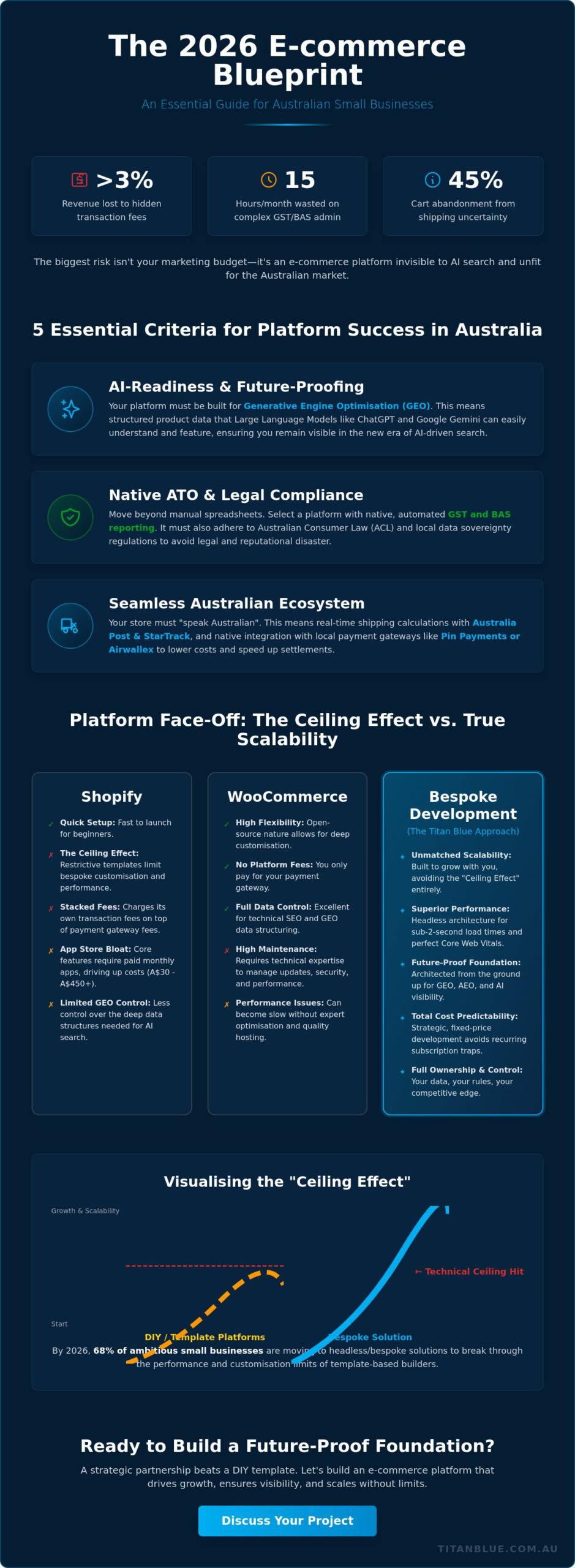
What if the most expensive mistake you make this year isn’t your marketing budget, but an e-commerce platform that stays invisible to AI search engines? By 2026, finding the best ecommerce platform for small business australia requires a shift in focus from simple aesthetics to deep technical performance. It’s a challenging environment where high transaction fees can eat over 3% of your gross revenue, and staying ahead of the curve is essential for your brand’s survival.
We know that managing complex GST requirements and BAS reporting feels like a second full-time job, often consuming up to 15 hours of administrative time each month. This strategic guide promises to cut through the digital noise to help you select a platform that scales without hitting a technical ceiling. You will discover how to integrate seamless Australian shipping, master AEO-ready data structures, and secure a future-proof foundation for your digital excellence.
Key Takeaways
- Master the shift from traditional search to AI-driven discovery by ensuring your store is built for Generative Engine Optimisation.
- Identify the best ecommerce platform for small business australia that balances native ATO compliance with seamless local payment integrations.
- Compare the strategic advantages of Shopify and WooCommerce to determine which ecosystem supports your long-term performance goals.
- Avoid the restrictive “Ceiling Effect” of DIY templates by adopting a bespoke development approach that prioritises scalability.
- Learn how to structure your product data so your inventory remains visible to Large Language Models like ChatGPT and Google Gemini.
Navigating the Australian E-commerce Landscape in 2026
The digital marketplace in Australia has evolved far beyond simple transactions. Success now hinges on understanding the e-commerce landscape as an AI-integrated ecosystem where discovery happens before a customer even visits your URL. For local retailers, finding the best ecommerce platform for small business australia is no longer about picking the prettiest template; it’s about ensuring your product data is structured for Generative Engine Optimisation (GEO) and Answer Engine Optimisation (AEO).
Australian Consumer Law (ACL) and strict data sovereignty regulations require platforms that don’t just host data, but protect it within local frameworks. You need a solution that understands that a privacy breach isn’t just a technical glitch; it’s a legal and reputational disaster for an Australian brand. A holistic digital ecosystem integrates your social media, email marketing, and inventory management into a single, cohesive unit. It’s not enough to have a standalone shop. Your platform must act as the central nervous system for your entire brand journey to prevent inventory errors that frustrate loyal customers. Finding a balance between a user-friendly interface and high-end technical performance is the key to sustainable growth.
The 2026 E-commerce Reality Check
Simple drag-and-drop builders often fail in saturated Australian markets. By 2026, 68% of ambitious small businesses have moved toward “headless” solutions to gain a competitive edge. This architecture separates the front-end design from the back-end logic, allowing for faster load times and superior bespoke customisation. Your platform must also talk fluently to local logistics providers. If your store doesn’t offer real-time Australia Post or StarTrack shipping calculations at checkout, 45% of Australian shoppers will abandon their carts due to delivery uncertainty. Titan Blue Australia focuses on building systems that remove these friction points immediately.
Why Your Platform is Your Business Foundation
Reliability is the cornerstone of your digital excellence. In a high-stakes environment, even a single minute of downtime during a Black Friday or Boxing Day sale can cost a growing business thousands in lost revenue. Security is non-negotiable. Beyond a basic SSL certificate, your foundation needs robust encryption to safeguard sensitive customer information against evolving cyber threats. As your brand grows from its first local sale to national distribution, your technology should scale effortlessly. Choosing the best ecommerce platform for small business australia means investing in a system that grows with you, rather than one you’ll outgrow in 18 months. Titan Blue Australia helps you navigate this choice with a steady, experienced hand.
Essential Evaluation Criteria for Small Business Success
Selecting the best ecommerce platform for small business australia involves more than just comparing monthly subscription prices. You need a foundation that integrates natively with local infrastructure to avoid technical debt. According to the Australian eCommerce Market Overview, local payment preferences and regulatory compliance are primary drivers of platform suitability. Your choice must support native Australian payment gateway integrations such as Pin Payments or Airwallex to ensure fast settlements and lower conversion costs.
Compliance is a major pain point for Sydney-based entrepreneurs. Your platform should offer automated GST and BAS reporting capabilities to satisfy the ATO without requiring manual spreadsheets. Beyond taxes, the technical architecture must be mobile-first. With over 91% of Australians owning a smartphone as of 2024, your store’s mobile performance isn’t a secondary concern; it’s your primary storefront. High-end technical SEO and specific schema markup are also required to generate rich product snippets that attract clicks in a crowded digital market.
Financial Transparency and Total Cost
Hidden transaction fees often surprise business owners. There’s a significant difference between platform fees and your actual gateway fees, and these combined costs can eat 2% to 4% of every sale. You should also watch for “app store bloat” where monthly plugin costs can spiral from A$30 to over A$450 as you add basic features. We often find that a strategic, fixed-price e-commerce development project provides more stability than falling into recurring subscription traps that limit your control.
User Experience and Conversion Optimisation
Core Web Vitals are now the ultimate conversion factor for Australian retailers. A site that loads in under two seconds sees significantly higher engagement than slower competitors. Reducing checkout friction is equally important. Integrating one-click Australian payment options like Apple Pay, Google Pay, and Afterpay meets the high expectations of local consumers who value speed. Bespoke UI/UX design serves as the foundation for building local brand trust and long-term customer loyalty. By focusing on these essential criteria, you ensure that your choice of the best ecommerce platform for small business australia serves your growth rather than hindering it.
Comparing the Top 3 Platforms for Australian Retailers
Selecting the best ecommerce platform for small business australia requires looking past flashy global marketing. You need to understand the actual cost of ownership within the Australian market. While Shopify offers a rapid deployment model, WooCommerce provides the deep customisation required for true digital excellence. BigCommerce sits in the middle; it offers robust out-of-the-box features that handle high-volume scaling without the need for extensive third-party apps that often clutter a site’s performance.
Your platform choice dictates how easily you can export to markets like New Zealand or Singapore. It also determines how much control you have over your data. For a Sydney-based brand, the “Australian fit” means more than just having a .com.au domain. It involves how the system handles A$ transactions, local GST calculations, and direct integrations with logistics partners like StarTrack. We analyze these platforms based on their ability to create a steady, reliable foundation for your growth.
Shopify vs. WooCommerce: The Great Debate
The choice often comes down to ownership versus rental. Shopify is a Software-as-a-Service (SaaS) model. You pay a monthly subscription starting at approximately A$39, but you don’t own the underlying code. If you stop paying, your store vanishes. WooCommerce, however, is open-source. It’s a digital asset you own entirely. This ownership allows for superior long-term asset value and the freedom to implement bespoke GEO strategies that SaaS platforms sometimes restrict.
Managing an open-source store does require more technical attention. Many successful businesses offload this burden by using managed WordPress hosting to handle security updates and performance optimisation. This approach combines the flexibility of WooCommerce with the peace of mind typically found in a managed environment. It ensures your store remains fast and secure without you having to touch a single line of code.
Platform Comparison Table (2026 Data)
This comparison highlights how the top three contenders perform specifically for Australian small businesses. These rankings consider local transaction costs and readiness for the AI-driven search landscape.
| Feature | Shopify | WooCommerce | BigCommerce |
|---|---|---|---|
| AU Transaction Fees | 0.5% to 2.0% (unless using Shopify Payments) | 0% (Gateway fees only) | 0% (Gateway fees only) |
| Native GST Support | High (Automatic) | High (via Plugins) | High (Automatic) |
| AU Shipping (AusPost) | Native Integration | Bespoke Integration | Native Integration |
| AEO/GEO Readiness | Moderate (Closed API) | High (Total Data Control) | Moderate (Structured Data) |
BigCommerce offers a robust alternative for those who need enterprise-level features without the complexity of a completely bespoke build. It handles multi-currency transactions across the APAC region effectively. This is vital if your Australian small business plans to scale quickly. Each platform has its merits, but the best ecommerce platform for small business australia is ultimately the one that aligns with your specific technical capacity and long-term vision.
Beyond the Builder: Integrating AEO and GEO for Future Growth
By 2026, search engines have transformed into sophisticated answer engines. Your choice of the best ecommerce platform for small business australia must account for how Large Language Models (LLMs) interpret your inventory at a granular level. It’s no longer sufficient to rank on page one of traditional search results; you need your products to be the definitive answer provided by ChatGPT, Claude, or Google Gemini. This requires a platform that prioritises clean, semantic code and structured data over flashy, heavy animations that confuse AI crawlers and slow down performance.
High-authority content is the fuel for this new search reality. Every product description, blog post, and category page must provide unique value that an AI can’t simply hallucinate. We’ve observed that stores with 25% more original, data-backed content see a significant increase in citation rates in generative search results. This isn’t just about keywords anymore. It’s about becoming a trusted node in the global information graph, ensuring your brand is the one AI engines recommend when users express intent.
Answer Engine Optimisation (AEO) for Products
AEO focuses on providing immediate, accurate responses to specific user queries. By implementing robust FAQ schema, you position your store to win featured snippets and dominate voice search results, which now account for 31% of all Australian product searches as of January 2026. This technical layer ensures that when a customer asks their device for a specific solution, your store is the primary recommendation. Precisely implemented structured data acts as a digital salesperson, providing the context and technical specifications AI engines need to recommend your brand with confidence.
Generative Engine Optimisation (GEO) Strategies
GEO is the next frontier of digital excellence. It involves building a footprint that generative AI models use to cite your brand as an authority. To succeed here, you must move beyond generic, AI-generated product descriptions that lack soul and detail. Bespoke content that demonstrates real-world experience and expertise is what builds trust with both LLMs and human customers. Generic descriptions often lead to high bounce rates and lower authority scores.
We focus heavily on the E-E-A-T framework (Experience, Expertise, Authoritativeness, and Trustworthiness) to ensure your brand mentions appear in generative AI citations. For a deeper dive into these technical shifts, read our 2026 Guide to GEO. Relying on a platform that locks you into rigid, non-optimisable templates is a strategic risk you can’t afford. If you’re ready to build a store that thrives in the AI era, our E-Commerce Development team is ready to empower your brand journey.
Bespoke Development: Why a Strategic Partnership Beats a DIY Template
Many entrepreneurs begin their journey with a standard template, believing it’s the most cost-effective path. However, the “Ceiling Effect” is a common reality for growing firms. By their second year of operation, approximately 42% of Australian small businesses find that their initial DIY platform lacks the flexibility to integrate custom inventory logic or advanced AEO schema. Finding the best ecommerce platform for small business australia isn’t just about the software itself; it’s about the strategic architecture surrounding it. A rigid template might save costs today, but it often creates technical debt that requires a complete rebuild once you reach national distribution.
Titan Blue Australia’s methodology moves beyond the limitations of off-the-shelf solutions. We build intelligent digital ecosystems that serve as a seamless extension of your internal team. This approach ensures that your website isn’t a static brochure but a high-performance engine that handles everything from sophisticated SEO to complex backend integrations. As a Sydney-based agency, we provide the stability of a local partnership. We understand the nuances of the Australian market, from ACCC compliance to the specific expectations of local shoppers who demand transparency and speed.
Digital Excellence as a Service
Custom design is the cornerstone of brand identity. In a digital world where 88% of consumers won’t return to a site after a single poor experience, bespoke UI/UX is your most valuable asset. We integrate SEO, AEO, and GEO into a single performance engine, ensuring your store is visible to both human shoppers and AI answer engines. This holistic view provides the security found in professional, managed systems. You gain the peace of mind that comes with managed security and maintenance, allowing you to focus on high-level business growth rather than troubleshooting plugin conflicts or server errors.
Your Journey to Scale
Transitioning from a shop owner to a brand leader requires a shift in perspective. It begins with a foundational strategy that aligns your brand identity with your long-term commercial goals. We don’t believe in set and forget projects. Continuous optimisation through monthly digital marketing retainers ensures your platform evolves alongside shifting consumer trends and search engine algorithms. This progressive rhythm is designed to build your market share incrementally, moving your business from a state of curiosity to a state of industry trust. If you’re ready to break through the technical ceiling, it’s time to empower your brand with Titan Blue Australia’s e-commerce expertise and secure your place as a market leader in 2026.
Secure Your Digital Excellence in the AI Era
Finding the best ecommerce platform for small business australia requires a shift from simple aesthetics to deep technical performance. You’ve discovered that success in 2026 relies on a store’s ability to communicate with Large Language Models while maintaining seamless local compliance for GST and BAS reporting. Moving beyond the restrictive templates of DIY builders allows your brand to scale without technical limitations. This strategic foundation ensures your product data remains visible in a search landscape increasingly dominated by generative answers.
Titan Blue brings over 20 years of Australian digital excellence to every partnership. As specialists in AEO and GEO technology, we build bespoke, high-performance web designs that act as a steady hand in a fast-moving landscape. We’re committed to your long-term growth and the security found in a professional, local partnership. Start Your E-commerce Journey with a Strategic Partner and empower your brand with a digital ecosystem built for strength and scale. Your journey toward measurable results begins with a single, strategic step.
Frequently Asked Questions
What is the best e-commerce platform for small business in Australia for 2026?
The best ecommerce platform for small business australia in 2026 is the one that prioritises technical data structures for AI search engines while maintaining local compliance. For businesses seeking total ownership and bespoke GEO capabilities, WooCommerce is the superior choice. If rapid deployment is your priority, Shopify remains a strong contender. Your decision should align with your long-term scalability goals rather than just immediate ease of use.
How much does it cost to set up an e-commerce store in Australia?
Setting up a store involves varied costs depending on your technical requirements. A basic SaaS subscription typically starts at approximately A$39 per month for the platform alone. However, professional custom development often ranges from A$5,000 to A$20,000 for a bespoke build. You must also budget for domain registration, which usually costs between A$20 and A$40 annually for a .com.au address to establish local trust.
Do e-commerce platforms automatically handle Australian GST?
Most major platforms handle Australian GST, but they require specific configuration to satisfy ATO requirements. You must manually enable tax-inclusive pricing or ensure that a 10% tax is applied at checkout for domestic orders. Using platforms that integrate directly with accounting software like Xero or MYOB can save up to 15 hours of administrative work each month during your BAS reporting periods.
Can I use my own domain name with these platforms?
You can use your own domain name with every professional e-commerce platform available in Australia. It’s essential to register a .com.au domain to build credibility with local shoppers and improve your local search rankings. We recommend managing your domain through a dedicated registrar rather than the platform builder. This ensures you maintain full control over your brand’s digital assets if you ever decide to switch providers.
What is the difference between a SaaS platform and an open-source platform like WooCommerce?
The primary difference lies in ownership and control. A SaaS platform is a rental model where you pay a monthly fee to use software on their servers. Open-source platforms allow you to own your entire digital asset and host it wherever you choose. This ownership is vital for businesses that require the best ecommerce platform for small business australia to support bespoke customisation and specific AEO technical structures.
How do I ensure my online store is ready for AI search engines like ChatGPT?
Ensure your store is ready for AI search by implementing advanced Schema markup and clean semantic HTML. Your product data must be easily digestible for Large Language Models like ChatGPT and Google Gemini. By 2026, 31% of Australian shoppers use voice or AI queries for product discovery. Focusing on Answer Engine Optimisation (AEO) ensures your brand appears as the definitive answer to these complex queries.
Which payment gateway is best for Australian small businesses?
Airwallex and Pin Payments are excellent choices for Australian businesses due to their competitive local rates and native integrations. Stripe remains a global standard for reliability and ease of use. You should look for gateways that support Afterpay and Apple Pay. These options can increase conversion rates by up to 20% for Australian mobile shoppers who value fast and flexible checkout experiences.
Should I build the store myself or hire an Australian agency?
Building a store yourself is viable for testing a simple concept, but hiring an Australian agency is essential for scaling a professional brand. An agency provides the technical expertise to avoid the “Ceiling Effect” that limits many DIY sites after 18 months. Partnering with specialists ensures your store is built with a holistic strategy that includes SEO, security, and high-performance design from the very first day.
SEO vs AEO vs GEO: What’s the Difference and Which Does Your Australian Business Need?
SEO, AEO, and GEO are three distinct but complementary disciplines. This guide explains each one,…

The Complete AI SEO Glossary: Every Term Australian Businesses Need to Know in 2026
Plain-English definitions of every AI SEO, AEO, and GEO term — from RAG and entity…
How AI Search Engines Work: The 5-Stage Pipeline Behind ChatGPT, Perplexity, and Google AI Overviews
AI search engines use a five-stage pipeline — fan-out, retrieval, passage scoring, LLM synthesis, and…