


Last updated:
Australian retailers face a pivotal challenge in 2026: 73% of shoppers now prefer AI-personalised experiences, fundamentally reshaping how online stores must design their digital storefronts. Your website isn’t just a catalogue anymore. It’s your most powerful sales tool, competitive differentiator, and customer relationship builder. This guide reveals how strategic website design drives measurable sales growth and customer engagement for Australian retail businesses navigating today’s digital marketplace.
Table of Contents
- Introduction To The Role Of Website Design In Retail
- Core Website Design Principles Driving Retail Success
- Leveraging AI And Personalisation In Retail Website Design
- Common Misconceptions And Clarifications About Website Redesign
- Choosing The Right E-Commerce Platform For Australian Retailers
- Practical Steps To Optimise Website Design For Enhanced Retail Performance
- Take Your Retail Website Design To The Next Level With Titan Blue
- Frequently Asked Questions
Key takeaways
| Point | Details |
|---|---|
| Mobile-first design impact | Reduces bounce rates by 60% and captures regional growth in mobile commerce across Australia. |
| AI personalisation power | Increases conversions by up to 30% when implemented with transparency and ethical practices. |
| Platform selection matters | WooCommerce offers customisation for complex stores whilst Shopify provides speed for quick launches. |
| Redesign timing is strategic | Best practice every 3-5 years aligns with SEO updates, technology shifts, and evolving customer expectations. |
| Integration multiplies results | Combining website design with digital marketing and SEO maximises traffic, engagement, and revenue growth. |
Introduction to the role of website design in retail
Your website serves as the first interaction point for most Australian shoppers, functioning as both storefront and sales channel. In 2026, this digital presence determines whether customers engage, purchase, or bounce to competitors. The stakes have never been higher.
Digital transformation has reshaped Australian retail beyond recognition. Unified commerce integration is rated important by 88% of retailers, connecting inventory, customer data, and sales channels into cohesive systems. This shift demands websites that seamlessly bridge online and offline experiences whilst maintaining speed, personalisation, and mobile accessibility.
Consumer expectations have evolved dramatically:
- Shoppers demand sub-three-second load times and instant mobile responsiveness
- Personalised product recommendations and dynamic content are expected, not optional
- Seamless omnichannel experiences allow browsing on mobile and purchasing in-store
- Trust signals like security badges, reviews, and transparent policies influence buying decisions
Competitive pressures intensify as digital-first retailers capture market share from traditional stores. Your role of web design in Australian retail extends beyond aesthetics to encompass conversion optimisation, search visibility, and customer retention. Retailers who view their website as a static brochure rather than a dynamic sales platform risk irrelevance in today’s market.
Understanding these retail industry trends for 2026 positions you to make informed design decisions that drive tangible business outcomes.
Core website design principles driving retail success
Mobile-first design isn’t optional for Australian retailers anymore. Mobile-first approaches reduce bounce rates by 60% whilst capturing the faster mobile commerce growth happening in regional areas compared to metropolitan centres. Your site must load perfectly on smartphones before you even consider desktop layouts.

Website speed directly impacts both search rankings and sales conversions. Google Core Web Vitals set clear targets: Interaction to Next Paint (INP) under 200 milliseconds and Largest Contentful Paint (LCP) under 2.5 seconds. Missing these benchmarks costs you visibility in search results and patience from shoppers who abandon slow sites.
Clean, minimalist interfaces build immediate trust with Australian consumers. Cluttered designs signal unprofessionalism and trigger security concerns. White space guides attention to products and calls-to-action, whilst intuitive navigation reduces friction in the buying journey.
Key design elements that drive conversions:
- High-quality product imagery with zoom functionality and multiple angles
- Prominent, contrasting call-to-action buttons using action-oriented language
- Simplified checkout processes with guest options and progress indicators
- Trust signals positioned strategically near purchase decisions
Performance optimisation integrates technical and aesthetic considerations. Compressed images maintain visual appeal without sacrificing load speed. Lazy loading displays content as users scroll, improving perceived performance. Content delivery networks distribute resources geographically to serve Australian users faster.
Pro tip: Test your site’s mobile performance using Google PageSpeed Insights and real devices from both Sydney and regional areas. Network speeds vary significantly across Australia, and your design must accommodate both fibre connections and slower regional internet.
Investing in responsive web design solutions ensures your retail site adapts fluidly across devices, maintaining functionality and visual appeal whether shoppers browse on phones, tablets, or desktops. This flexibility captures sales opportunities regardless of how customers access your store.
Leveraging AI and personalisation in retail website design
AI-driven personalisation transforms generic browsing into tailored shopping experiences that drive loyalty and sales. Dynamic content adapts in real-time based on user behaviour, browsing history, location, and previous purchases. A Sydney shopper sees different featured products than a Brisbane customer, reflecting regional preferences and seasonal variations.
The impact is substantial. AI personalisation boosts conversions by up to 30% when implemented thoughtfully. Product recommendations become eerily accurate, email campaigns reference actual browsing behaviour, and pricing strategies adjust to competitive pressure and demand signals.
Ethical transparency maintains customer trust in AI applications. Australian consumers appreciate personalisation but demand clarity about data usage. Trust in AI depends on transparency and ethical implementation, requiring clear privacy policies, opt-in mechanisms, and explanations of how algorithms work.
“Personalisation must enhance the customer experience without feeling invasive. The best implementations feel helpful rather than creepy, anticipating needs whilst respecting boundaries.” — Leading Australian retail strategist
Personalisation extends across the entire customer journey, not just your website. Email marketing references browsing behaviour. Retargeting ads showcase abandoned cart items. SMS notifications alert customers when wishlisted products go on sale. This omnichannel approach reinforces your brand presence and nurtures purchase intent across touchpoints.
Implementation requires selecting the right tools. Many e-commerce platforms offer built-in personalisation engines, whilst third-party solutions provide advanced capabilities like predictive analytics and automated segmentation. Start simple with product recommendations and abandoned cart recovery, then expand to dynamic homepage content and personalised search results.
Exploring the power of personalisation for websites reveals practical strategies for balancing automation with human touch, ensuring your retail site feels responsive and intelligent without crossing into uncomfortable territory.
Common misconceptions and clarifications about website redesign
Many retailers mistakenly view redesign as purely aesthetic, a fresh coat of paint to modernise appearance. This misconception costs businesses measurable opportunities. Strategic redesign improves SEO performance, site speed, lead generation capabilities, and conversion rates far beyond visual updates.
Redesign addresses technical debt that accumulates over years. Outdated code slows performance. Legacy plugins create security vulnerabilities. Mobile responsiveness bolted onto desktop-first designs creates clunky experiences. Proper redesign rebuilds foundations whilst preserving what works.
Best practice timing for website redesign:
- Every 3-5 years aligns with major technology shifts and platform updates
- When Google algorithm changes significantly impact search visibility
- Following business model changes like adding e-commerce or subscription services
- After competitor analysis reveals your site underperforms industry standards
Redesign combined with digital marketing multiplies growth impact. A beautiful new site without traffic generates zero sales. Conversely, driving traffic to a slow, confusing site wastes advertising spend. The synergy between optimised design and targeted marketing campaigns delivers the strongest return on investment.
Delaying redesign harms business outcomes progressively. Search rankings decline as Google prioritises faster, mobile-friendly competitors. Bounce rates increase as user expectations outpace your site’s capabilities. Security risks grow as software becomes outdated. Revenue opportunities slip away to retailers who invest in their digital presence.
Pro tip: Don’t wait for complete obsolescence before redesigning. Plan strategically by monitoring performance metrics quarterly and budgeting for redesign when you spot declining engagement, increasing bounce rates, or falling search visibility.
Understanding the true investment in website redesign benefits helps you frame it as revenue-generating rather than cost, shifting perspective from expense to strategic growth initiative.
Choosing the right e-commerce platform for Australian retailers
Platform selection fundamentally shapes your website’s capabilities, costs, and scalability. WooCommerce and Shopify dominate Australian retail, each offering distinct advantages for different business models and priorities.
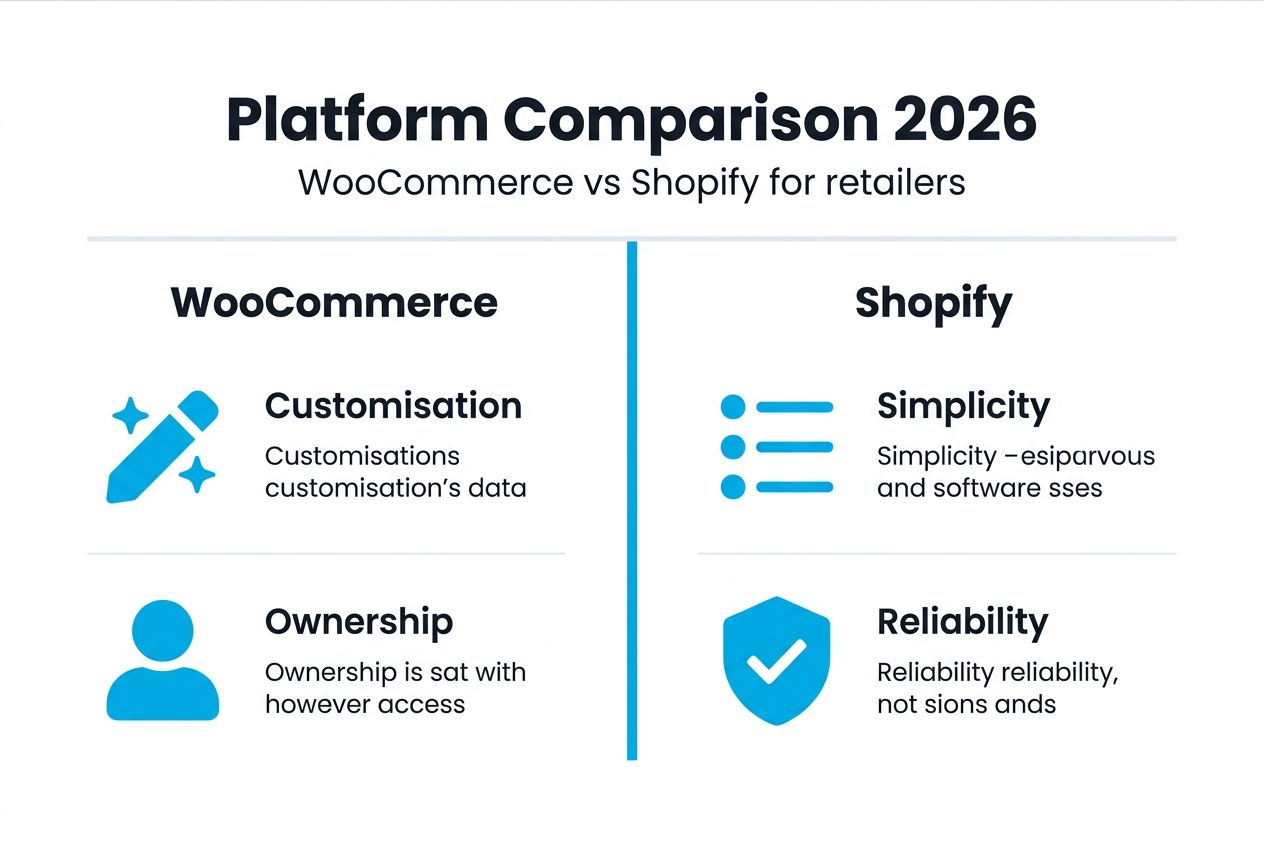
WooCommerce delivers deep customisation and complete ownership. Built on WordPress, it provides unlimited design flexibility and access to thousands of plugins. You control hosting, data, and functionality completely. This freedom suits retailers with complex catalogues, unique business logic, or specific integration requirements.
Shopify prioritises simplicity, reliability, and speed to market. Hosted infrastructure means no server management. Built-in features cover most retail needs without plugins. Automatic updates and security patches reduce technical overhead. This convenience appeals to retailers wanting to focus on products rather than technology.
| Feature | WooCommerce | Shopify |
|---|---|---|
| Setup complexity | Moderate to high, requires hosting | Simple, fully hosted solution |
| Customisation | Unlimited via code and plugins | Good but constrained by platform |
| Monthly costs | Hosting + plugins (variable) | Fixed subscription tiers |
| Transaction fees | Payment gateway only | Platform fee unless using Shopify Payments |
| Ownership | Complete control of data and code | Dependent on Shopify infrastructure |
| Scalability | Scales with hosting investment | Automatically scales with traffic |
Platform choice impacts total cost of ownership significantly. WooCommerce appears cheaper initially but requires ongoing hosting, security, and maintenance investment. Shopify’s subscription model provides predictable costs but transaction fees add up, particularly for high-volume stores.
No universal best platform exists. Your decision depends on:
- Technical expertise available in-house or budget for ongoing development support
- Complexity of your product catalogue and unique business requirements
- Expected transaction volume and sensitivity to percentage-based fees
- Desire for complete control versus preference for managed convenience
Australian retailers should also consider local payment gateway integration, AUD currency handling, and compliance with Australian consumer law. Both platforms support these requirements, but implementation ease varies.
Exploring comprehensive ecommerce web design guides clarifies how platform capabilities translate into practical advantages for your specific retail context, helping you choose confidently.
Practical steps to optimise website design for enhanced retail performance
Monitor performance metrics consistently to identify redesign needs before crisis hits. Track bounce rates, average session duration, conversion rates, and page load speeds monthly. Sudden drops signal problems requiring immediate attention. Gradual declines indicate evolving customer expectations outpacing your current design.
- Audit your current site against Google Core Web Vitals benchmarks focusing on INP under 200ms and LCP under 2.5 seconds for optimal engagement.
- Implement mobile-first design standards starting with your highest-traffic pages and checkout flow.
- Ensure accessibility compliance including alt text for images, keyboard navigation, and screen reader compatibility.
- Integrate AI personalisation tools beginning with product recommendations and abandoned cart recovery.
- Align redesign timing with SEO improvements and paid advertising campaign launches for maximum impact.
- Test extensively on diverse devices representing both metropolitan fibre connections and regional mobile networks.
- Establish conversion tracking for every step of your sales funnel to measure redesign effectiveness.
Implementation requires balancing ambition with practicality. You don’t need perfection immediately. Prioritise high-impact changes like mobile optimisation and checkout simplification before tackling nice-to-have features.
Pro tip: Create a staging environment to test changes before launching to live traffic. This safety net allows experimentation without risking current sales whilst gathering real user feedback through limited beta testing.
Integrating your website improvements with broader digital marketing strategy for retail success ensures design changes support and amplify your SEO, content marketing, and paid advertising efforts rather than working in isolation.
Regional considerations matter for Australian retailers. Test site performance from Perth, Darwin, and Hobart, not just Sydney and Melbourne. Network infrastructure varies dramatically across the continent, and your design must accommodate this reality to capture nationwide opportunities.
Take your retail website design to the next level with Titan Blue
Transforming your retail website from functional to exceptional requires expertise spanning design, development, and digital marketing. Titan Blue’s website design and development services combine user-centric design principles with robust technical implementation, creating retail sites that engage visitors and convert browsers into buyers.

Our tailored approach addresses your specific challenges. Whether you’re launching your first e-commerce store, redesigning an underperforming site, or scaling to meet growing demand, we build solutions that align with your business goals and budget realities. From platform selection through ongoing optimisation, we partner with Australian retailers to maximise their digital presence.
Specialised e-commerce SEO services ensure your beautifully designed site actually gets found by customers searching for your products. Combined with strategic digital advertising that boosts retail sales, we deliver integrated solutions that drive measurable traffic, engagement, and revenue growth for retailers across Australia.
Frequently asked questions
What is the ideal frequency for redesigning a retail website?
Best practice is redesigning every 3-5 years to remain current with technology shifts and evolving user expectations. This timing aligns with major platform updates, SEO algorithm changes, and accessibility standards. Regular redesign supports sustained search visibility and marketing effectiveness whilst preventing the technical debt that accumulates in ageing sites. Monitor performance metrics between redesigns to identify whether circumstances demand earlier updates.
Learn more about benefits of website redesign for Australian retail businesses.
How does mobile-first design impact Australian retail websites?
Mobile-first design reduces bounce rates by up to 60% by prioritising the smartphone experience where most browsing happens. Regional Australian shoppers demonstrate faster mobile commerce growth compared to metropolitan areas, making mobile optimisation essential for capturing nationwide opportunities. Sites designed mobile-first also perform better in Google’s mobile-first indexing, directly improving search visibility and organic traffic.
Explore responsive web design solutions that adapt seamlessly across devices.
Which e-commerce platform suits small to medium Australian retailers best?
WooCommerce offers high customisation and complete ownership, making it ideal for retailers with complex catalogues or unique business requirements willing to manage hosting and technical maintenance. Shopify provides easier setup, managed hosting, and faster speed to market, suiting retailers who prioritise simplicity and want to focus on products rather than technology. Your choice depends on technical capabilities, budget structure (variable versus fixed costs), transaction volume sensitivity to fees, and desire for control versus convenience. Both platforms support Australian payment gateways and consumer law compliance.
Review our comprehensive ecommerce platform guide for detailed comparisons.
How does integrating AI personalisation affect online retail sales?
AI personalisation boosts conversions by up to 30% by tailoring product recommendations, content, and offers to individual shopper behaviours and preferences. This relevance increases engagement, average order values, and customer loyalty. However, transparency in how you collect and use data builds essential trust with Australian consumers. Implement personalisation ethically with clear privacy policies, opt-in mechanisms, and explanations of algorithmic decision-making to maximise benefits whilst maintaining customer confidence.
Discover AI personalisation strategies for exceptional website experiences.
Recommended
- Website Design in 2024: Future-Proof Your Business
- Role of Web Design – Driving Gold Coast E-Commerce
- 6 Features for a High-Performing eCommerce Website Design
- 7 Web Design Best Practices for Gold Coast Retailers
Make Titan Blue a preferred source in Google
One click tells Google to surface our articles more often in Top Stories, AI Overviews and AI Mode.

Google September 2026 Spam Update Done: Australian Impact
Google finished its September 2026 spam update on 8 October. What the global rollout means…

ChatGPT GPT-6 Search Upgrade: What It Means for Australia
OpenAI rolled out GPT-6 to ChatGPT on 7 October 2026 with faster search. Here is…

Best Dental Website Design Agencies in Australia: 7 Compared
Best dental website design agencies in Australia 2026: seven compared on dental proof, booking, AHPRA…