


Many business owners think a website redesign is just about making their site look prettier, but that’s only the tip of the iceberg. In reality, redesign is a strategic investment that drives SEO performance, user experience, and conversion rates. For Australian SMBs navigating a competitive digital landscape in 2026, understanding the full scope of redesign benefits is essential. This guide reveals why redesign matters and how it positions your business for measurable growth.
Table of Contents
- Understanding The Importance Of Website Redesign
- How Website Redesign Impacts Seo And Organic Traffic
- Boosting User Experience And Conversion Rates Through Redesign
- Common Misconceptions About Website Redesign
- Framework For Deciding When And How To Redesign
- Leveraging Digital Marketing After Your Website Redesign
- Take Your Website Redesign To The Next Level With Titan Blue Australia
- Frequently Asked Questions
Key Takeaways
| Point | Details |
|---|---|
| Website redesign drives organic traffic and lead generation | Strategic redesign improves SEO rankings and user engagement, increasing qualified leads. |
| Mobile optimization reduces bounce rates by 60% | Mobile-first design keeps visitors engaged and converts mobile traffic effectively. |
| Redesign every 3-5 years maximizes ROI | Regular updates align with technology shifts and market trends without wasting resources. |
| UX improvements significantly boost conversions | Clear navigation and compelling CTAs guide visitors toward desired business actions. |
| Integrating digital marketing post-redesign multiplies growth | Combining SEO and paid campaigns after launch accelerates lead generation and ROI. |
Understanding the Importance of Website Redesign
Your website is the digital storefront for your business. As technology and customer expectations evolve rapidly, what worked three years ago may now hinder your competitiveness. Most SMBs benefit from redesigning their websites every 3-5 years to stay competitive and updated with digital trends. This cycle ensures your site leverages current SEO standards, security protocols, and user experience best practices.
The Australian digital market demands mobile-first, fast, and secure websites. With over 85% of Australians browsing on smartphones, failing to meet mobile standards means losing the majority of potential customers. Modern search engines prioritize technical elements like page speed, mobile responsiveness, and structured data when determining rankings. If your current site falls short on these factors, you’re invisible to the customers actively searching for your services.
Redesign isn’t just about aesthetics. It addresses foundational issues that impact how search engines crawl your site, how users interact with your content, and ultimately how many leads convert into paying customers. Key reasons to prioritize redesign include:
- Aligning with evolving SEO algorithms that reward technical excellence
- Reducing bounce rates through improved navigation and faster load times
- Building trust with modern design that signals professionalism and security
- Integrating advanced features like AI-powered chat or personalized user journeys
Investing in expert website redesign services ensures these elements work together cohesively. The result is a platform that attracts visitors, engages them effectively, and converts interest into measurable business outcomes. For more foundational insights, explore website design insights for Australian SMBs and learn how top SEO services for SMBs in Australia integrate with redesign strategy.
How Website Redesign Impacts SEO and Organic Traffic
Search engine optimization is the backbone of organic visibility. When you redesign strategically, you unlock improvements across multiple SEO factors that directly increase traffic. Mobile optimization stands out as the most critical element. Ignoring mobile optimization in redesign leads to 60% higher bounce rates, limiting growth in Australia’s mobile-first market. Google’s mobile-first indexing means your mobile site version determines your rankings. If it’s slow, clunky, or difficult to navigate, your business won’t appear in search results.
Site speed is another game changer. Pages that load in under two seconds rank higher and retain more visitors. Redesign offers the opportunity to optimize images, implement caching, and streamline code. Faster sites improve both SEO performance and user satisfaction, creating a virtuous cycle of better rankings and increased engagement.

Site architecture influences how search engines crawl and index your content. A well-structured redesign creates clear hierarchies, logical URL structures, and internal linking that guides both users and bots. This makes it easier for search engines to understand your content and rank relevant pages for target keywords. The table below summarizes the SEO elements improved by strategic redesign:
| SEO Element | Redesign Impact | Business Benefit |
|---|---|---|
| Mobile Responsiveness | Ensures seamless experience on all devices | Reduces bounce rates by 60%, increases mobile conversions |
| Page Load Speed | Optimizes code, images, and hosting infrastructure | Improves rankings and keeps users engaged longer |
| Site Architecture | Streamlines navigation and internal linking | Enhances crawlability, boosts indexing of key pages |
| On-Page SEO | Updates meta tags, headers, and schema markup | Increases click-through rates from search results |
Content strategy integration is the final piece. Redesign provides a fresh canvas to implement keyword research, create pillar content, and build topic clusters that establish authority. When combined with effective SEO strategies for Australian SMBs, your redesigned site becomes a lead-generation engine.
Pro Tip: Implement schema markup during redesign to help search engines understand your content better and increase chances of appearing in rich snippets.
For tailored solutions, consider small business SEO packages that align technical improvements with ongoing optimization. Understanding mobile optimization bounce rate statistics reinforces why mobile-first redesign is non-negotiable in 2026.
Boosting User Experience and Conversion Rates through Redesign
Traffic means nothing if visitors leave without taking action. User experience improvements from redesign directly impact conversion rates by making it easier for customers to find information, trust your brand, and complete desired actions. Usability enhancements like intuitive navigation, readable typography, and logical page flows keep visitors engaged longer, creating more opportunities for conversion.
Clear call-to-actions guide users toward business goals. Whether you want visitors to request a quote, book a consultation, or purchase a product, strategically placed CTAs with compelling copy make the path obvious. Redesign allows you to test button placement, wording, and visual prominence to maximize response rates.
Trust signals are essential for Australian SMBs competing online. Updated design communicates professionalism and credibility. SSL certificates, trust badges, customer testimonials, and modern aesthetics reassure visitors that your business is legitimate and reliable. Mobile-optimized websites reduce bounce rates by 60%, significantly impacting user retention and conversions by meeting user expectations for seamless mobile experiences.
Key UX improvements that boost conversions include:
- Simplified navigation that reduces clicks to key information
- Prominent contact forms and phone numbers for immediate engagement
- Fast load times that prevent frustration and abandonment
- Accessible design that accommodates users with disabilities
- Personalized content that speaks directly to visitor needs
Pro Tip: Use heatmaps and user session recordings post-redesign to identify friction points and continuously refine the user journey for better conversions.
Understanding website design cost insights helps you budget appropriately for UX features that deliver measurable ROI. Investing in these elements pays dividends through higher conversion rates and customer lifetime value.
Common Misconceptions About Website Redesign
Misconceptions about redesign prevent many Australian SMBs from making strategic investments. Clarifying these myths helps you approach redesign with realistic expectations and sound strategy. Here are the most common misunderstandings:
-
Redesign is just a visual facelift: While aesthetics matter, strategic redesign addresses SEO, site speed, mobile optimization, security, and user experience. Visual updates are one component of a comprehensive business strategy.
-
Redesigns should happen frequently: Constant redesign wastes resources and confuses users. The optimal cycle is every three to five years, allowing you to incorporate meaningful technology advances without disrupting established traffic patterns.
-
Mobile optimization is optional: In 2026, mobile traffic dominates. Skipping mobile optimization guarantees high bounce rates, poor rankings, and lost revenue. It’s a mandatory foundation, not an optional enhancement.
-
Redesign automatically improves SEO: Redesign creates the opportunity for SEO improvements, but you must implement best practices deliberately. Without proper planning, redesign can actually harm rankings if technical elements are neglected.
-
Existing content should be completely replaced: Your current content may already rank well. Strategic redesign preserves and enhances valuable content while adding fresh material to fill gaps and target new keywords.
-
Redesign results are immediate: SEO improvements and user behavior changes take time to materialize. Expect to see measurable results within three to six months as search engines re-crawl your site and users adapt to the new experience.
For deeper insights into separating fact from fiction, review myths about website redesign to build a realistic roadmap for your project.
Framework for Deciding When and How to Redesign
Making informed redesign decisions requires a structured approach. This framework helps Australian SMBs assess timing, scope, and strategy to maximize ROI:
-
Assess current performance: Analyze website analytics, SEO rankings, bounce rates, and conversion metrics. Identify specific weaknesses like slow page speed, poor mobile experience, or outdated design that impact business goals.
-
Define clear business objectives: Determine what you want redesign to achieve. Common goals include increasing organic traffic by 40%, reducing bounce rates by 30%, or improving lead generation by 50%. Specific targets guide decision-making throughout the project.
-
Conduct competitor benchmarking: Review competitor websites to identify design trends, features, and user experiences that set industry standards. Note gaps where your site falls short and opportunities to differentiate your offering.
-
Plan integration with marketing strategy: Redesign should align with your broader digital marketing initiatives. Consider how SEO, content marketing, paid advertising, and social media will leverage the new platform to drive growth.
-
Implement with technical excellence: Work with experienced developers who understand SEO best practices, mobile optimization, security protocols, and performance optimization. Cutting corners during implementation undermines long-term success.
-
Test and iterate post-launch: Use A/B testing, user feedback, and analytics to refine the user experience. Continuous improvement ensures your redesigned site evolves with changing customer needs and market conditions.
The comparison table below contrasts reactive versus strategic redesign approaches:
| Approach | Timing | Focus | Outcome |
|---|---|---|---|
| Reactive | Only when site breaks or looks outdated | Quick visual fixes | Short-term patch, misses strategic opportunities |
| Strategic | Every 3-5 years aligned with business goals | SEO, UX, conversions, and technology integration | Long-term competitive advantage and measurable ROI |
Pro Tip: Document your decision-making process and create a redesign brief that outlines objectives, target audience insights, and success metrics to keep the project focused and accountable.
For actionable planning guidance, explore website redesign planning tips that walk through each phase of the process in detail.
Leveraging Digital Marketing After Your Website Redesign
Redesign sets the stage, but integrating digital marketing amplifies results. Combining SEO with paid advertising accelerates lead generation and ensures your new site reaches target audiences quickly. Organic traffic builds gradually as search engines index improvements, while paid campaigns deliver immediate visibility and traffic.
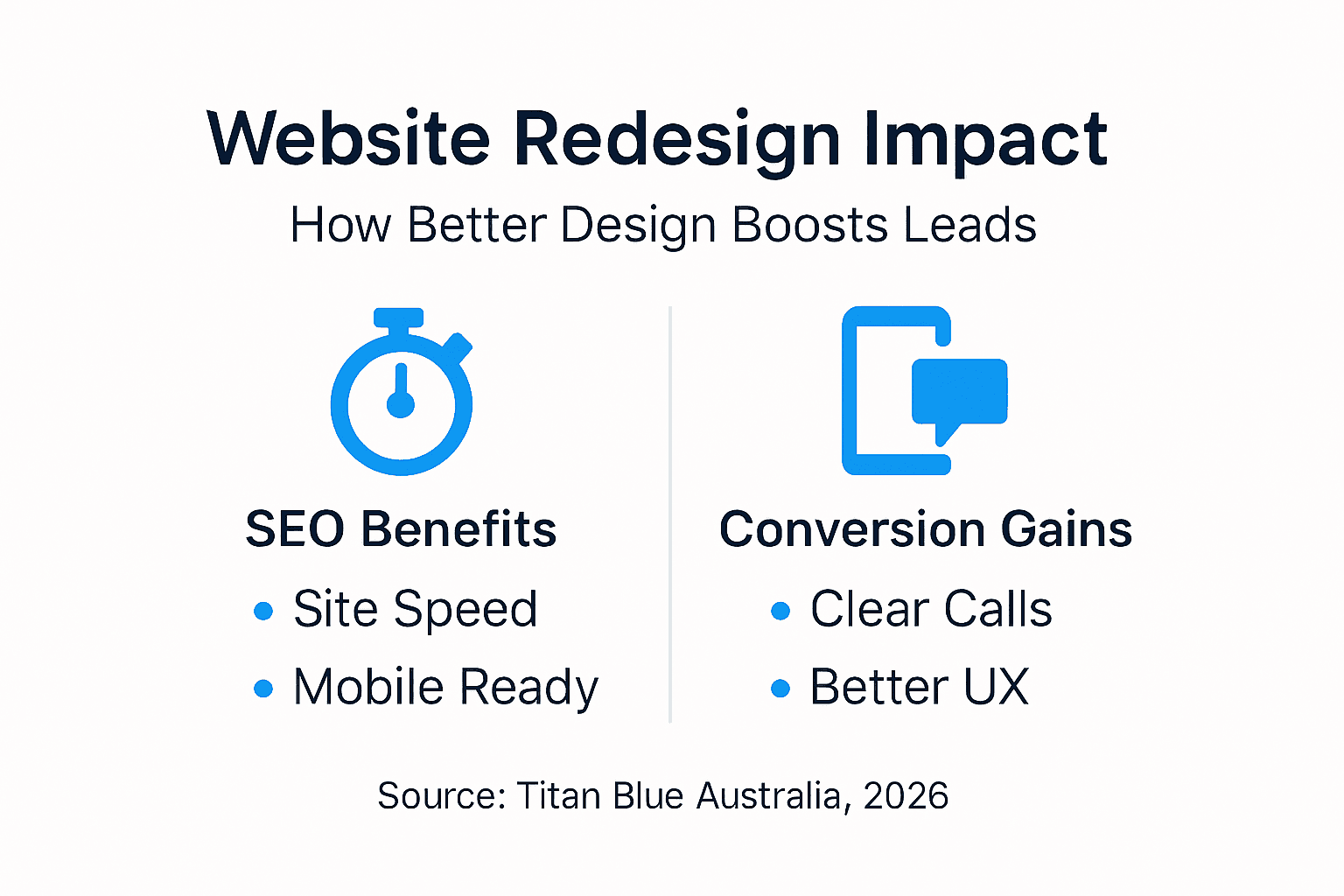
Data-driven campaign optimization is essential post-redesign. Use analytics to track user behavior, identify high-performing pages, and refine messaging. A/B test landing pages, ad copy, and CTAs to continuously improve conversion rates. Post-redesign marketing integration can increase leads by up to 75% when executed strategically.
Key marketing activities to implement immediately after launch include:
- SEO monitoring: Track keyword rankings, organic traffic, and indexing status to ensure redesign improvements translate into visibility gains.
- Paid search campaigns: Launch Google Ads targeting high-intent keywords to capture demand while organic rankings improve.
- Social media promotion: Share new content and features across social channels to drive traffic and build awareness.
- Email marketing: Announce the redesign to your existing database, highlighting new features and encouraging engagement.
- Conversion rate optimization: Continuously test and refine user flows based on real visitor behavior data.
Ongoing analysis ensures website changes meet business goals. Set up dashboards that track traffic sources, conversion funnels, and revenue attribution. Regular review meetings keep your team aligned on performance and identify opportunities for further optimization.
For comprehensive support, explore digital marketing strategies for SMBs and SEO marketing guide for small businesses to build an integrated growth strategy that maximizes your redesign investment.
Take Your Website Redesign to the Next Level with Titan Blue Australia
Ready to transform your website into a lead-generation engine? Partnering with experienced professionals ensures your redesign delivers measurable business results. Titan Blue specializes in custom website redesign tailored for Gold Coast businesses and SMBs across Australia. We integrate cutting-edge design with proven SEO strategies to boost visibility, engagement, and conversions.

Our team handles every aspect of the redesign process, from strategy development through post-launch optimization. We build mobile-first, fast-loading sites that rank well and convert visitors into customers. By combining expert Gold Coast web design services with digital marketing for small businesses, we deliver integrated solutions that drive sustainable growth in 2026 and beyond.
Pro Tip: Partner with teams that offer both design and marketing expertise to ensure your redesigned site achieves its full potential through coordinated strategy execution.
Discover how SEO marketing for small business amplifies your redesign investment and positions your business for long-term success.
Frequently Asked Questions
What is the ideal frequency for website redesign for Australian SMBs?
Redesigning every three to five years balances staying current with technology and market trends without wasting resources on unnecessary changes. This cycle allows you to incorporate meaningful SEO improvements, security updates, and user experience enhancements that deliver measurable ROI.
How does website redesign improve my search engine rankings?
Redesign improves rankings by optimizing mobile responsiveness, increasing page speed, restructuring site architecture for better crawlability, and implementing current SEO best practices. These technical improvements signal quality to search engines, resulting in higher visibility for target keywords.
Is mobile optimization really necessary in 2026?
Absolutely. With over 85% of Australians browsing on mobile devices, failing to optimize means losing the majority of potential customers. Mobile-first indexing by Google means your mobile site version determines your search rankings, making optimization mandatory for visibility.
Can I redesign my website without interrupting existing traffic?
Yes, with proper planning. Implement 301 redirects to preserve SEO value from existing URLs, maintain high-performing content, and use staging environments for testing before launch. Experienced developers ensure smooth transitions that protect your traffic and rankings.
How do I measure ROI after completing a website redesign?
Track key metrics including organic traffic growth, keyword ranking improvements, bounce rate reductions, conversion rate increases, and lead generation volume. Set baseline measurements before redesign and compare performance at 90-day intervals to quantify business impact and ROI.
What role does content play in a successful website redesign?
Content is central to redesign success. Strategic content updates target relevant keywords, address customer pain points, and establish authority in your industry. Preserve high-performing existing content while adding fresh material to fill gaps and support improved site architecture.
Recommended
- Your Ultimate Website Redesign Checklist for 2025 – Titan Blue Australia
- Accelerate Website Growth with Expert Website Redesign Services
- Website Design in 2024: Future-Proof Your Business
- Why Invest In Website Design: Transforming Gold Coast Business
Make Titan Blue a preferred source in Google
One click tells Google to surface our articles more often in Top Stories, AI Overviews and AI Mode.

How to Make Your Website AI Friendly: The 2026 Step-by-Step Guide
How to make your website AI friendly: a step-by-step 2026 guide to getting crawled, structured…

Web Design for AI Search Optimisation: The 2026 Build Guide
Web design for AI search optimisation: crawlable HTML, clear architecture, accessible UX and trustworthy content…

AEO Web Design: How to Build Websites AI Can Cite
AEO web design creates websites that AI systems can find, understand and cite through clear…