


Last updated:
Many Australian business owners believe website design is simply choosing colours and fonts. The reality is far more complex: a poorly designed site can lose 42% of potential bookings simply due to loading speed. Website design encompasses user experience, technical infrastructure, mobile optimisation, and ongoing performance management. This guide demystifies what website design truly involves, reveals realistic Australian costs in 2026, and shows how design choices directly impact your bottom line.
Table of Contents
- Understanding Website Design: More Than Just Looks
- How Much Does Website Design Cost In Australia In 2026?
- The Critical Role Of Website Speed And Mobile Optimisation
- Choosing The Right Website Design Approach For Your Business
- Explore Professional Website Design Services Tailored For Australian SMBS
- Frequently Asked Questions
Key takeaways
| Point | Details |
|---|---|
| Website design scope | Encompasses visual design, user experience, technical development, hosting, and SEO integration beyond aesthetics. |
| Australian costs 2026 | Range from $500 for simple sites to $20,000+ for complex solutions with custom features. |
| Speed matters critically | Sites loading under 2 seconds increase bookings significantly while slow sites drive away mobile visitors. |
| Mobile optimisation essential | With 82% mobile traffic, responsive design is non-negotiable for customer retention. |
| Approach impacts longevity | DIY tools seem cheap initially but custom development offers superior scalability and security. |
Understanding website design: more than just looks
Website design extends far beyond selecting attractive layouts and colour schemes. For Australian SMBs, understanding this broader scope prevents costly mistakes and helps you invest wisely. A comprehensive website design and development approach integrates multiple disciplines working together to create a functional, profitable online presence.
Professional website design combines several interconnected elements. Visual design creates the aesthetic appeal and brand identity. User experience (UX) ensures visitors find information easily and complete desired actions. Technical development builds the underlying infrastructure that makes everything work. SEO integration helps potential customers discover your business. Content creation communicates your value proposition effectively.

Website design costs in Australia reflect this complexity because multiple factors contribute to the final investment. Each component requires specific expertise and time commitment.
Core website design components include:
- Domain registration establishing your web address
- Reliable hosting infrastructure ensuring site availability
- Template selection or custom design defining visual structure
- Professional copywriting articulating your business message
- Image optimisation and multimedia integration
- Search engine optimisation for visibility
- Security certificates protecting customer data
- Mobile responsive design for all devices
- Contact forms and interactive elements
- Analytics integration for performance tracking
Business owners often focus solely on how a site looks, neglecting technical foundations that determine whether it performs reliably under traffic, ranks in search results, or converts visitors into customers. A visually stunning website that loads slowly or breaks on mobile devices wastes your investment. Conversely, fast loading speeds, intuitive navigation, and clear calls to action generate tangible business results regardless of elaborate design flourishes.
The distinction between template based sites and custom development significantly impacts both initial costs and long term capabilities. Templates offer quick deployment at lower cost but limit customisation and scalability. Custom solutions require larger upfront investment but provide tailored functionality matching your specific business processes and growth plans.
How much does website design cost in Australia in 2026?
Australian businesses face varied website design pricing depending on complexity, features, and provider expertise. Understanding these ranges helps you budget appropriately and avoid unrealistic expectations. The cheapest option rarely delivers the best value when considering long term performance and scalability needs.
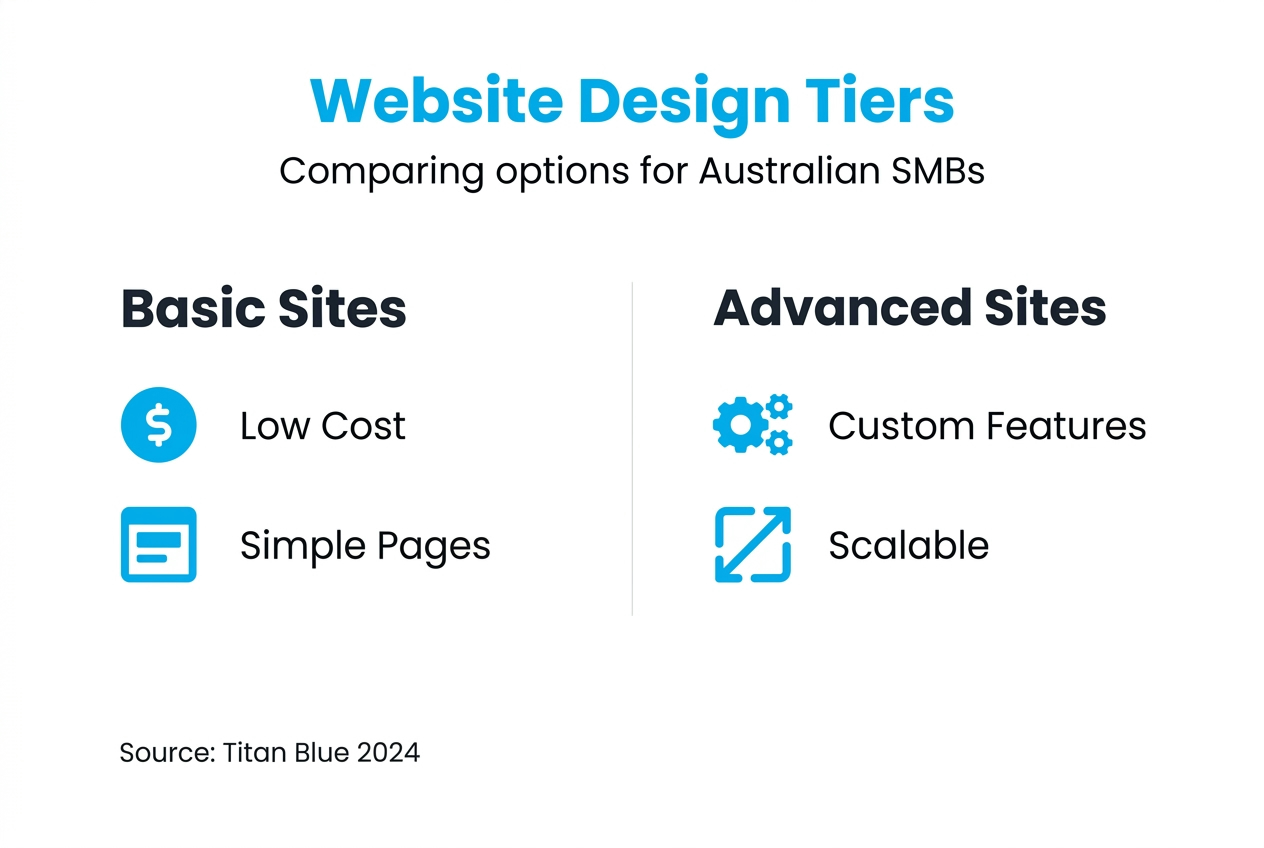
Website design costs vary significantly across three main tiers. Simple websites with basic information pages typically range from $500 to $5,000. These suit startups or businesses needing straightforward online presence without complex functionality. Moderate complexity sites incorporating custom features, content management systems, and basic SEO optimisation cost between $5,000 and $20,000. Highly complex websites with e-commerce, customer portals, extensive custom development, and advanced integrations exceed $20,000 and can reach $50,000 or more.
These figures represent complete projects including design, development, and initial setup. However, several additional costs require consideration when evaluating website design investment.
Ongoing website costs include:
- Annual domain renewal: $15 to $50 depending on extension
- Hosting fees: $100 to $500+ annually based on performance requirements
- SSL security certificates: Often included with hosting or $50 to $200 yearly
- Content updates and additions: $50 to $150 per hour for professional services
- Technical maintenance and security updates: $50 to $200 monthly
- SEO optimisation and monitoring: $500 to $2,000+ monthly depending on competitiveness
The table below compares typical Australian website costs by complexity level:
| Complexity Level | Initial Cost | Features Included | Suitable For |
|---|---|---|---|
| Simple | $500 – $5,000 | 5-10 pages, template design, basic contact form | Startups, local service businesses |
| Moderate | $5,000 – $20,000 | Custom design, CMS, SEO setup, 20+ pages, forms | Growing SMBs, professional services |
| Complex | $20,000+ | E-commerce, custom functionality, integrations, member areas | Established businesses, online retailers |
Investing appropriately in website design prevents expensive rebuilds within 2 to 3 years. Cheap solutions often require complete replacement as businesses grow, ultimately costing more than choosing suitable infrastructure initially. Hidden costs emerge when DIY platforms charge transaction fees, limit functionality, or require expensive workarounds for standard business needs.
Pro Tip: When comparing quotes, create a detailed features checklist ensuring all proposals include identical scope. A lower price often means fewer included services, not better value. Ask specifically about hosting, SSL, training, content upload, initial SEO setup, and post-launch support to understand true total investment.
The critical role of website speed and mobile optimisation
Website performance directly impacts your business revenue and customer satisfaction. Australian SMBs cannot afford to overlook loading speed and mobile responsiveness when these factors determine whether visitors become customers or abandon your site for competitors. Technical optimisation delivers measurable returns on investment.
Sites achieving load times under 2 seconds see 42% higher bookings compared to slower competitors. This statistic reflects real customer behaviour: people expect instant access to information and quickly lose patience with sluggish websites. Every second of delay exponentially increases bounce rates as frustrated visitors click away.
Mobile device dominance reshapes design priorities for Australian businesses. Mobile traffic represents 82% of visits yet mobile users experience 68% bounce rates on slow loading sites. This disconnect between mobile visitor volume and poor mobile experience represents massive lost opportunity. Your website must deliver flawless mobile performance to capture this substantial audience.
Core Web Vitals measure user experience through specific metrics. Largest Contentful Paint (LCP) tracks how quickly main content loads, ideally under 2.5 seconds. First Input Delay (FID) measures interactivity responsiveness. Cumulative Layout Shift (CLS) quantifies visual stability preventing frustrating element movements. Google uses these metrics for search rankings, making website speed optimisation essential for visibility and conversions.
Key speed optimisation techniques include:
- Image compression reducing file sizes without visible quality loss
- Lazy loading deferring offscreen content until needed
- Browser caching storing frequently accessed files locally
- Content delivery networks distributing files from geographically closer servers
- Minifying CSS and JavaScript removing unnecessary code
- Static site generators creating pre-rendered pages eliminating server processing delays
- Edge hosting serving content from locations nearest visitors
Mobile friendly design requires responsive layouts automatically adjusting to different screen sizes. Touch friendly buttons sized appropriately for finger taps prevent frustration. Simplified navigation accommodates smaller screens without overwhelming users. Readable font sizes eliminate pinching and zooming. Fast loading mobile pages retain impatient users.
Businesses investing in mobile optimisation see improved engagement metrics including longer session durations, lower bounce rates, and higher conversion rates. Mobile users behave differently than desktop visitors, often seeking quick information while on the go. Your site must deliver instant answers and frictionless interactions matching these usage patterns.
“Website speed is not a luxury feature but a fundamental requirement for competitive Australian businesses. Customers simply will not tolerate slow sites when faster alternatives exist one click away.”
Pro Tip: Test your website speed monthly using Google PageSpeed Insights and real device testing. Performance degrades over time as content accumulates and plugins multiply. Regular monitoring identifies issues before they significantly impact customer experience and search rankings.
Choosing the right website design approach for your business
Australian SMBs face three primary website development approaches, each offering distinct advantages and limitations. Understanding these options helps you select the strategy aligning with your budget, timeline, technical capabilities, and growth ambitions. Short term savings often create long term constraints requiring expensive migrations.
DIY website builders like Wix, Squarespace, and Weebly attract businesses with low initial costs and quick setup. These platforms provide drag and drop interfaces requiring no coding knowledge. However, DIY builders present limitations including restricted customisation, vendor lock-in, scalability constraints, and potential SEO disadvantages. You pay monthly fees indefinitely while owning no actual website assets.
Template based websites using WordPress themes or similar frameworks offer middle ground solutions. Professional developers customise pre-built templates to your branding and content. This approach balances affordability with greater flexibility than pure DIY tools. Quality varies dramatically between templates, with some offering excellent foundations while others include bloated code hampering performance.
Custom website development creates tailored solutions matching your exact requirements. Developers build functionality specifically for your business processes rather than forcing workflows into template constraints. Custom development provides superior scalability, security, and automation unmatched by DIY alternatives. Initial costs run higher but total ownership cost often proves lower over 5 to 10 year timeframes.
The following table compares these approaches across critical business factors:
| Approach | Initial Cost | Scalability | Security | SEO Potential | Best For |
|---|---|---|---|---|---|
| DIY Builders | $0 – $500 | Limited | Platform dependent | Moderate | Very small businesses, testing concepts |
| Template Based | $2,000 – $8,000 | Good | Dependent on updates | Good | SMBs with standard requirements |
| Custom Development | $10,000+ | Excellent | Fully controlled | Excellent | Growth focused businesses, unique needs |
DIY platforms charge ongoing monthly fees while offering minimal customer support. Technical issues often require extensive troubleshooting without expert assistance. Data migration away from these platforms proves challenging, creating effective vendor lock-in. Transaction fees on e-commerce sales further erode profit margins.
Security considerations favour custom solutions where developers implement specific protections matching your risk profile. DIY platforms share infrastructure across thousands of sites, making them attractive targets for automated attacks. Template based sites require diligent plugin updates preventing vulnerabilities.
Key factors when choosing your approach:
- Current budget versus long term total cost of ownership
- Required customisation for unique business processes
- In-house technical capabilities for ongoing management
- Growth trajectory and future functionality needs
- Integration requirements with existing business systems
- Industry security and compliance obligations
Businesses frequently outgrow initial website choices within 2 to 3 years, necessitating expensive rebuilds or migrations. Selecting appropriate infrastructure from the start prevents this disruption and wasted investment. Consider where your business will be in 5 years when making design approach decisions today.
Reviewing website design costs comprehensively including ongoing management, security, updates, and potential migration expenses reveals true investment requirements. The cheapest initial option often becomes the most expensive over time when considering all factors. Your website represents a critical business asset deserving appropriate investment matching its importance to revenue generation.
Analysing website design prices from multiple providers helps identify reasonable market rates and red flags. Suspiciously low quotes typically mean inexperienced developers, offshore outsourcing with communication challenges, or incomplete scope omitting essential features. Conversely, premium pricing should reflect demonstrable expertise, comprehensive services, and superior support.
Explore professional website design services tailored for Australian SMBs
Navigating website design complexities becomes significantly easier with expert guidance. Australian businesses benefit from local providers understanding regional market dynamics, customer expectations, and competitive landscapes. Professional services transform technical challenges into strategic advantages.
Titan Blue specialises in helping Gold Coast and Australian SMBs establish powerful online presence through custom website design that delivers measurable business results. Our comprehensive approach addresses every aspect covered in this guide, from performance optimisation to mobile responsiveness to ongoing support. We understand that your website must generate leads and sales, not simply look attractive.
Our services span the complete digital ecosystem including website development, speed optimisation, SEO integration, and ongoing website care ensuring your site remains secure, fast, and effective. This holistic approach prevents the common pitfall of beautiful websites that fail to perform commercially. We focus relentlessly on metrics that matter: traffic, engagement, and conversions.
Exploring our website design and development services reveals how professional expertise accelerates your online growth while avoiding expensive mistakes. Whether you’re launching a new site or improving an existing presence, we provide strategic guidance matching technical solutions to your specific business objectives.
Frequently asked questions
What is website design?
Website design encompasses visual aesthetics, user experience, technical infrastructure, and content strategy working together to create effective online presence. It includes layout planning, colour schemes, typography, navigation structure, mobile responsiveness, loading speed optimisation, and SEO integration. Professional design balances business goals with user needs to drive conversions and engagement.
How can I ensure my website is mobile friendly?
Implement responsive design frameworks automatically adjusting layouts for different screen sizes. Test your site across actual mobile devices regularly, not just browser simulators. Optimise images and minimise scripts reducing mobile load times. Use Google’s Mobile Friendly Test identifying specific issues. Monitor mobile performance metrics including bounce rates and session duration, then refine based on mobile optimisation best practices.
What factors influence website design cost?
Design complexity determines pricing alongside custom feature requirements, hosting infrastructure quality, domain selection, SEO integration depth, professional content creation, and ongoing maintenance needs. Custom functionality costs significantly more than template implementations. Higher initial investment often delivers long term savings through better performance, fewer technical issues, and reduced need for expensive rebuilds. Review comprehensive website design costs before budgeting.
Why is website speed important for my business?
Faster websites keep visitors engaged, improve search engine rankings, and increase sales conversions directly. Slow sites frustrate users who abandon before content loads, especially on mobile devices where patience is minimal. Speed impacts every business metric from bounce rates to average order values. Sites loading under 2 seconds see dramatically higher customer retention and revenue. Prioritise speed optimisation as fundamental business requirement.
Recommended
- Custom website design benefits for Australian SMBs 2026
- Website design workflow for Gold Coast SMEs: 2026 guide
- A Guide to Ecommerce Web Design in Australia – Titan Blue Australia
- Website design cost australia: A Clear Guide to Pricing
Make Titan Blue a preferred source in Google
One click tells Google to surface our articles more often in Top Stories, AI Overviews and AI Mode.

Google Search Controls Update: What Australian Sites Need
Google updated its Search controls page on 21 Oct 2026, now listing the generative AI…

Bing Topics Portfolio: What It Means for Australian Sites
Microsoft Bing launched Topics Portfolio in AI Performance. What it shows, whether it reaches Australia,…

Best Medical Practice Website Design Agencies in Australia: 7 Compared
Best medical practice website design agencies in Australia, compared: seven picks, what each page shows,…